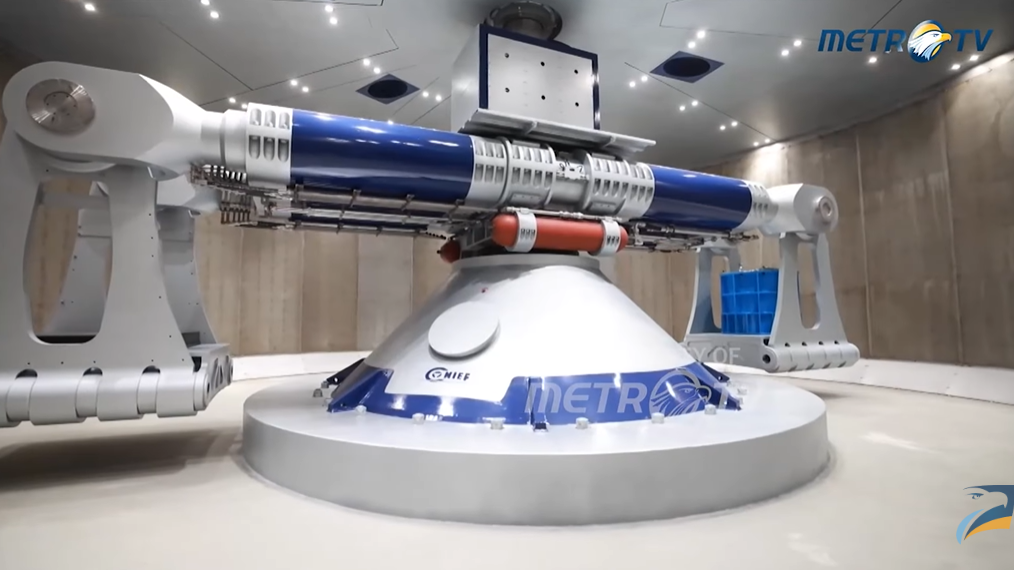

China has built a machine that treats gravity like a dial, not a constant, turning the pull we feel on our bodies into a variable that can be cranked up hundreds or even thousands of times. In doing so, its engineers have created a kind of time accelerator for the physical world, shrinking experiments that once took generations into tests that can be run in a working week. The country’s new hypergravity complex is not just a scientific curiosity, it is a strategic tool that could reshape how we design spacecraft, dams, tunnels, and even coastal cities.
Inside China’s hypergravity monster
At the heart of this story is a sprawling research station built around a family of colossal centrifuges, machines that spin so fast they generate artificial gravity far beyond anything on Earth. The flagship system is described as a record breaking hypergravity machine that can subject test objects to forces up to 1,900 times stronger than normal, using centrifugal motion to mimic extreme environments that would otherwise be unreachable in a lab. In practical terms, that means a structure that would experience a century of stress under normal conditions can be pushed through the same ordeal in a matter of days, because every second under such intense loading counts as years of wear in the real world, a compression of space and time that turns long term engineering questions into short experiments.
The facility is led by Chen Yunmin, a member of the Chinese Academy of Sciences, and it has been described as the world’s most advanced hypergravity research station, built with an investment measured in hundreds of millions of yuan. Its main centrifuge, often referred to in official material as part of the CHIEF complex, is housed in a vacuum chamber to reduce air resistance and energy loss, allowing the rotor to spin massive payloads at speeds that would tear ordinary equipment apart. According to detailed technical descriptions, China’s record system can handle tonne scale models while ramping up the effective gravitational force using centrifugal motion, a combination of scale and intensity that sets it apart from earlier research rigs.
From 1,900 g to 300 g: a new gravity ladder
What makes this complex so striking is not just its peak power, but the way it stacks multiple machines to cover a wide range of gravity levels and test scenarios. At the top end, reports describe a hypergravity machine capable of generating up to 1,900 times Earth’s gravity, a figure that has been highlighted as a global record and a benchmark for extreme testing. That same reporting notes that the facility is located in China and explicitly compares the artificial pull to what we feel on Earth, underlining how far beyond everyday experience these experiments now reach.
Alongside that extreme machine, engineers have also brought online a so called monster centrifuge that operates at a still staggering but more routinely usable level of 300 times Earth’s gravity. Technical coverage of This Monster Centrifuge Just Hit 300 g describes it as a workhorse for physics and engineering experiments, powerful enough to crush test samples with forces that would pulverize most materials, yet controllable enough to run repeated cycles. Another detailed explainer on What hypergravity means notes that hypergravity simply refers to forces stronger than the gravity we experience on Earth, and stresses that these 300 g conditions let scientists observe processes that would normally unfold over geological timescales within human timescales, a key part of the time compression story.
CHIEF: a space time compressor in steel and concrete
The core of the complex is known as CHIEF, a large integrated experimental platform that combines hypergravity with other extreme environmental testing. Official descriptions explain that Under such extreme conditions, CHIEF acts like a space time compressor, because a 1 meter model spinning at 100 g can simulate the behavior of a 100 meter structure over a much longer period. The logic is straightforward: if you increase the force on a system by a factor of 100, you can accelerate the damage, deformation, or settling that would normally take decades, then read out the results in days or weeks. That is why engineers talk about compressing centuries of testing into days, not as a metaphor but as a literal description of how stress and time scale in these experiments.
Technical briefings on the CHIEF platform emphasize that it is not just a single centrifuge, but a large scale, integrated experimental platform that also supports extreme environmental testing such as temperature swings, vibration, and fluid flow. One official summary notes that The facility is a large platform for research into infrastructure safety, disaster disposal, and new material creation, which means the same machine that can mimic mountain erosion can also be used to test how a new alloy deforms under crushing loads. In that sense, CHIEF is less a single experiment and more a national laboratory for gravity itself, a place where the pull that shapes planets and buildings can be dialed up and studied like any other variable.
How hypergravity rewrites engineering timelines
Hypergravity is not a new concept, but the scale and precision now available in China’s complex change what it can do for engineering. In simple terms, when a structure or material is subjected to forces hundreds of times stronger than normal, the processes that would slowly accumulate damage over years are forced to play out much faster. Detailed explainers on Hypergravity underline that this acceleration lets scientists observe phenomena like soil consolidation, creep in concrete, or fatigue in metals within human timescales, instead of waiting for nature to do the work. That is the essence of the time compression claim: by turning up gravity, you speed up the clock on physical change.
One of the clearest explanations of this benefit comes from a technical overview that states One of the major benefits of the project lies in the compression of scientific time, because through CHIEF, natural processes such as mountain erosion or seismic movements can be reproduced in a laboratory. Instead of waiting for a hillside to slowly slump over decades, researchers can build a scale model, spin it at hundreds of g, and watch the same failure unfold in hours, capturing data that would otherwise be impossible to collect. For infrastructure planners, that means being able to test how a dam, tunnel, or offshore platform might respond to rare but catastrophic events long before they are built, and to do so with a level of control that field observations can never match.
From spacecraft to dams: what gets tested at 1,900 g
The most obvious beneficiaries of this hypergravity ladder are aerospace projects, where every launch and landing involves violent changes in acceleration. Analysts who have examined the CHIEF complex note that it was explicitly designed to support spacecraft testing, with one technical overview explaining that For instance, testing a spacecraft in artificial hypergravity conditions can allow scientists to prepare the vehicle for the extreme forces it will encounter during launch and re entry. Instead of relying solely on computer simulations, engineers can mount scale models or critical components on the centrifuge, spin them up to hundreds of g, and directly measure how they deform, vibrate, or fail, then feed that data back into design tweaks.
But the applications go far beyond rockets. The same overview notes that the facility is intended to support research into infrastructure safety, including dams, tunnels, and offshore platforms, by letting engineers simulate years of stress in a short period. Another detailed description of the complex explains that the facility will be comprised of three primary hypergravity centrifuges, allowing researchers to replicate conditions for a wide range of geological processes, according to a report cited by Nov. That means the same machine that helps qualify a new spacecraft heat shield can also be used to test how a coastal levee might respond to repeated storm surges, or how a subway tunnel might settle in soft soil over decades, all within the controlled chaos of a spinning arm.
China’s race to build the world’s mightiest centrifuge
China’s hypergravity push is not happening in isolation, it is part of a broader race to build the world’s largest and most capable centrifuges. Video coverage of the project shows how China debuts world’s largest centrifuge, simulating gravity hundreds of times greater than Earth, with sweeping shots of the massive rotor and the reinforced concrete housing that contains it. Another clip, titled China Debuts World’s Mightiest Centrifuge, Unleashing Ultra intense Gravity, underscores how much of this project is also about signaling technological prowess, showing off a machine that can generate forces few other countries can match.
Technical summaries of the CHIEF complex reinforce that narrative, describing how Key Points include that China launched CHIEF, the world’s largest centrifuge facility, featuring the CHIEF1300 centrifuge capable of generating ultra high gravity for large scale models. Those same key points highlight that the facility has already completed successful pilot tests on infrastructure safety, suggesting that it is not just a showpiece but an operational tool feeding into real world projects. In that sense, the race to build the mightiest centrifuge is less about raw numbers and more about who can turn those numbers into safer bridges, more reliable spacecraft, and more resilient cities.
Revisiting gravity from Newton to hypergravity
There is also a philosophical thread running through this project, one that reaches back to the story of an apple falling from a tree and the birth of classical physics. Popular explainers about the CHIEF complex often invoke the image of an apple and Sir Isaac Newton defining the laws of gravity, then ask how much truth there is in the simplified legend. The point is not to retell the myth, but to show how far the study of gravity has come, from watching fruit drop in an orchard to building machines that can dial gravity up to hundreds or thousands of g on command.
In that sense, China’s hypergravity monster is a kind of tribute to Newtonian mechanics, a giant rotating laboratory that relies on the same equations of motion that were first written down centuries ago. The difference is scale and intent: where Newton used thought experiments and simple observations to infer universal laws, modern engineers are using steel, concrete, and high speed rotors to stress test those laws in regimes that nature rarely provides. By turning gravity into a controllable parameter, facilities like CHIEF let researchers probe the limits of materials, structures, and even geological processes in a way that would have been unimaginable in Newton’s time, yet still rests on the foundations he laid.
Strategic stakes: why hypergravity matters now
For China, the strategic value of this hypergravity complex is as important as its scientific novelty. The facility gives the country a powerful tool for de risking major infrastructure projects at a time when climate change, rapid urbanization, and geopolitical competition are all raising the stakes for engineering failure. Official descriptions emphasize that the platform supports research into disaster disposal and new material creation, which means it can be used to test how levees hold up under repeated storm surges, how nuclear waste containers age under stress, or how novel alloys behave under crushing loads, all before those systems are deployed in the field. In a world where a single dam failure or tunnel collapse can have national level consequences, the ability to compress decades of testing into days is a strategic asset.
The same logic applies to aerospace and defense. With the CHIEF complex, engineers can subject spacecraft components, re entry vehicles, or even scale models of hypersonic systems to accelerations far beyond what they will see in service, building in a margin of safety that is hard to achieve with simulations alone. A detailed overview of the project notes that Similarly, you could use a centrifuge like this to observe how dams might function over years of stress in just a few days, and it adds that we do not yet have a clear picture of all the experiments that will be run at a facility that manages 1,200 g t and beyond. That uncertainty is part of the point: by building a machine that can bend gravity and time to its will, China has created a platform whose full impact will only become clear as researchers find new ways to use it.
More from MorningOverview