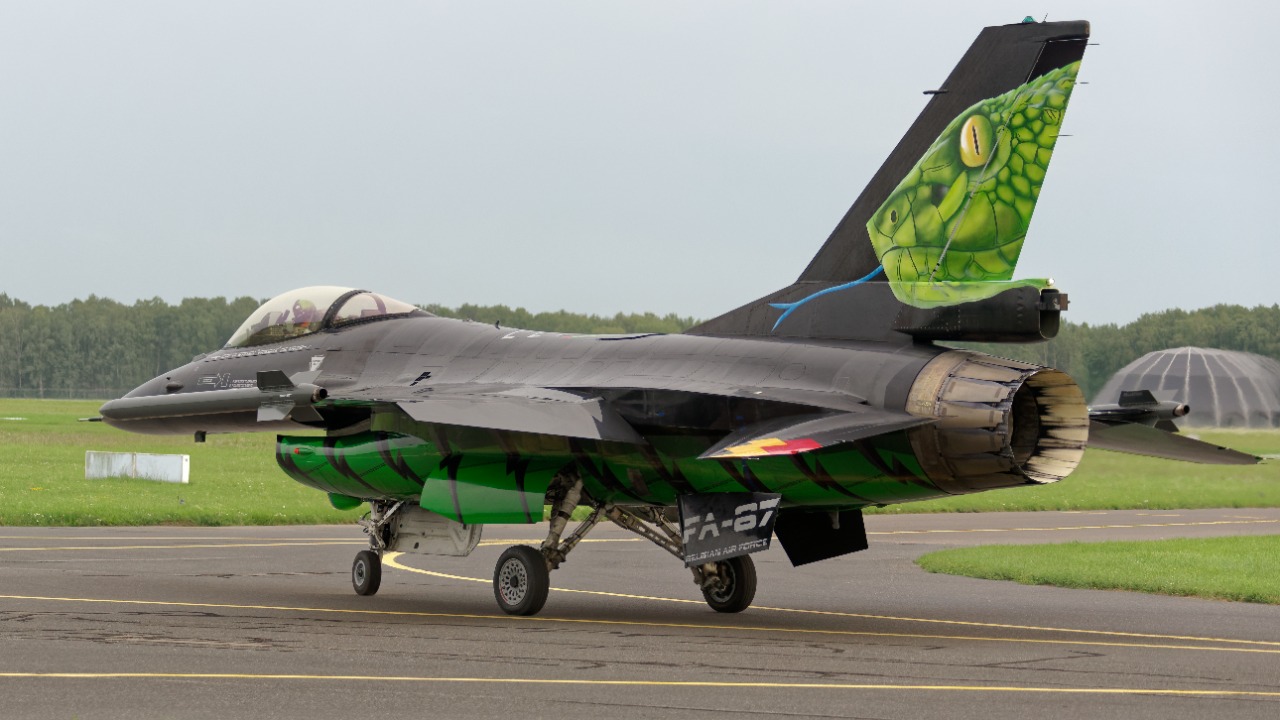

The world’s only self-flying F-16 has quietly crossed a threshold that once belonged to science fiction, shifting from a lab curiosity into a frontline testbed for autonomous combat. The X-62A VISTA is no longer just proving that an algorithm can keep a fighter in the air, it is now shaping how future wars might be fought, how human pilots will train, and how air forces will think about risk.
As the United States and its rivals race to harden their skies with smarter jets and denser defenses, this single modified F-16 has become a kind of Rosetta Stone for machine decision making in the air. What happens inside its cockpit, where software now shares or even takes over the stick, is starting to ripple outward into combat-coded F-16s, commercial adversary fleets, and even foreign experiments in fully autonomous dogfights.
VISTA: the world’s only self-flying F-16
The X-62A VISTA sits at the center of this shift because it is, as the Air Force itself now describes it, the world’s only self-flying F-16. Built on an older F-16D airframe, VISTA is packed with advanced software and control systems that let artificial intelligence agents fly the jet in real time, from takeoff through complex maneuvers, without a human touching the stick. In practical terms, it is a flying laboratory where algorithms can be stress tested at fighter-jet speeds instead of inside a simulator.
That unique status matters because it gives The Air Force a controlled way to push autonomy to the edge of what is safe, then pull lessons back into the broader fleet. The program, often shortened to VISTA, has evolved from a research platform into a pathfinder for autonomous air combat, with Dec test campaigns focused on how AI handles high-G turns, sensor fusion, and rapid threat reactions. By treating the X-62A VISTA as a reusable “software body” for different AI pilots, the service can iterate far faster than if it had to certify a new aircraft for every experiment, which is why officials now frame it as a cornerstone of the journey toward autonomous air combat.
From testbed to template for combat F-16s
The most striking sign that VISTA has leveled up is that its software is no longer confined to a single experimental jet. The Air Force has begun installing artificial intelligence into fully combat coded F-16s, effectively turning frontline fighters into flying testbeds that can carry live weapons while an AI pilot helps manage the mission. This shift means autonomy is moving out of the lab and into the same squadrons that would be tasked with defending airspace or striking targets in a crisis.
In a briefing highlighted in Apr, officials described how the last of these new test aircraft are being prepared so that AI agents proven in VISTA can be ported into operational F-16s with minimal rework. The idea is to let algorithms handle tasks like route optimization, sensor management, and even basic dogfighting while a human in the cockpit or on the ground supervises. By treating the combat-coded jets as an extension of the X-62A’s work, the service is effectively using VISTA as a template for a new generation of AI pilots in F-16s.
Scaling up: more AI pilots across the F-16 fleet
The move to embed autonomy in combat-coded jets did not come out of nowhere. Earlier efforts signaled that The Air Force was willing to put AI into legacy fighters at meaningful scale, not just as a one-off experiment. In Apr, leaders announced plans to equip a small group of F-16 Fighting Falcons with artificial intelligence, expanding the number of aircraft that could host these digital copilots from a handful to a broader test cadre.
That decision to add AI pilots to six more F-16s marked a turning point in how the Air Force thought about risk and reward. Instead of keeping autonomy locked inside a single demonstrator, the service chose to spread it across a mini-fleet, giving engineers more data on how algorithms behave in different airframes, climates, and mission profiles. The expansion also signaled to pilots that AI was not a passing fad but a capability that would increasingly share their cockpit, a message underscored in the Apr update on adding AI pilots to more F-16s.
Dogfights where the AI pulls the Gs
For many aviators, the real test of an autonomous fighter is not whether it can cruise or land, but whether it can survive a dogfight. That threshold has already been crossed. In a widely watched engagement, an AI-controlled F-16 took part in a dogfight with a manned fighter, pitting software against a human pilot in the kind of close-in, high-G duel that has long been considered the ultimate test of skill. The engagement showed that algorithms could not only keep up but could execute aggressive maneuvers that would push a human to physical limits.
The roots of that contest trace back to work by the Defense Advanced Research Projects Agency, better known as DARPA, which has spent years training AI agents in simulated air combat before moving them into real aircraft. When the autonomous F-16 finally mixed it up with a human-flown jet, it validated DARPA’s bet that machine learning could handle the split-second decisions of a turning fight. The encounter, described as an “AI Top Gun” moment, underscored how quickly autonomy is moving from theory to practice in dogfights with manned fighters.
Turkey’s autonomous formation flight raises the stakes
While the X-62A VISTA anchors the American push, other countries are racing to prove their own autonomous air combat chops. Turkey recently staged what it billed as the world’s first autonomous jet dogfight in the form of an AI-powered formation flight, a test that required multiple aircraft to fly in close proximity under software control. Formation flying at fighter speeds is unforgiving, with tiny errors in timing or positioning risking midair collisions, which is why this demonstration resonated far beyond Turkey’s borders.
The Turkish team emphasized that An AI system had to coordinate thrust, bank angles, and spacing across the formation, all while reacting to turbulence and minor deviations in real time. That kind of exact coordination and timing is difficult even for seasoned human pilots, so handing it to algorithms marked a bold step. For U.S. planners watching from afar, the test was a reminder that VISTA’s advances are part of a wider contest in which other nations are already experimenting with AI-powered formation flight.
Invisible wingmen: how private F-16s are training with AI
Autonomy is not just creeping into government fleets. In the commercial adversary air world, the world’s only privately owned F-16 has been paired with an invisible AI wingman that exists only in code. Top Aces, the sole commercial operator of an F-16, has integrated this virtual partner into its live-virtual-constructive training framework so that human pilots can fight alongside or against AI-controlled “ghost” aircraft that share the same airspace digitally.
For militaries that hire Top Aces to provide realistic training, this invisible wingman means a single real F-16 can simulate an entire formation of AI-driven jets, each reacting dynamically to the scenario. The system lets instructors dial up the difficulty by adjusting how aggressive or unpredictable the AI becomes, giving students a taste of what future air battles with autonomous opponents might feel like. By embedding the AI into a commercial F-16 that already dominates the skies in adversary contracts, Top Aces is turning its jet into a bridge between today’s training and tomorrow’s AI wingman concepts.
Private-sector dogfights with an AI ally
The same privately owned F-16 has become a showcase for how industry can push AI in directions that complement government programs like VISTA. In Mar, Top Aces highlighted how its jet “dominates skies” with an invisible AI ally in what it calls ultimate dogfights, using the virtual partner to stress human pilots in ways that would be too risky or expensive with additional live aircraft. The AI can be scripted to fly like a peer adversary, a missile truck, or a sacrificial decoy, all while the real F-16 maneuvers through the same scenario.
From a training perspective, this approach lets air forces rehearse complex engagements without fielding a full squadron. The realm of military aviation is shifting toward blended environments where live jets, virtual constructs, and constructive (computer-generated) forces all interact, and Top Aces is positioning its F-16 at the center of that shift. By giving customers access to an AI ally that can be reprogrammed between sorties, the company is helping them prepare for real-world scenarios in which autonomous aircraft will be part of the threat and part of the solution, a trend captured in the Mar analysis of how Top Aces uses its invisible AI ally.
Human versus machine: the ultimate dogfight test
Beyond structured experiments and training contracts, the image that has captured public imagination is simple: a fighter plane piloted by artificial intelligence going head-to-head with a human pilot. That scenario has already played out, with an AI-powered F-16 fighting against a person in a manned jet. Unlike promotional simulations, this contest involved real hardware, real G-forces, and real consequences if the software misjudged a maneuver or lost situational awareness.
Observers noted that the AI did not tire, did not black out, and could sustain high-G turns that would quickly wear down a human opponent. At the same time, the human pilot brought intuition, creativity, and a feel for the aircraft that is hard to encode. The engagement, captured in a detailed breakdown of an AI-powered F-16 taking on a human pilot, underscored that the near-term future is likely to be one of teaming rather than replacement, with humans and machines each playing to their strengths inside the same battlespace.
Upgrading the brain and senses of the AI fighter
For the X-62A VISTA and its AI cousins, software is only part of the story. The Air Force is also investing in new hardware so these jets can sense and survive in more realistic combat environments. Plans are underway to add Radar upgrades and other enhancements to the experimental Air Force AI fighter, giving it better awareness of targets, threats, and terrain. Improved sensors mean the AI agents flying the jet can be trained and evaluated against more complex scenarios that resemble real-world missions instead of sanitized test ranges.
The Air Force has been explicit that these upgrades are meant to help the X-62A conduct complicated tests of artificial intelligence technology, not just basic autopilot functions. By pairing a more capable radar with advanced processors and data links, the service can expose AI pilots to dense electronic clutter, multiple bogeys, and contested airspace, then watch how they prioritize and react. Those insights will feed back into both the experimental fleet and the combat-coded F-16s now hosting AI, a feedback loop described in detail in plans for upgrading the Air Force AI fighter.
More from MorningOverview