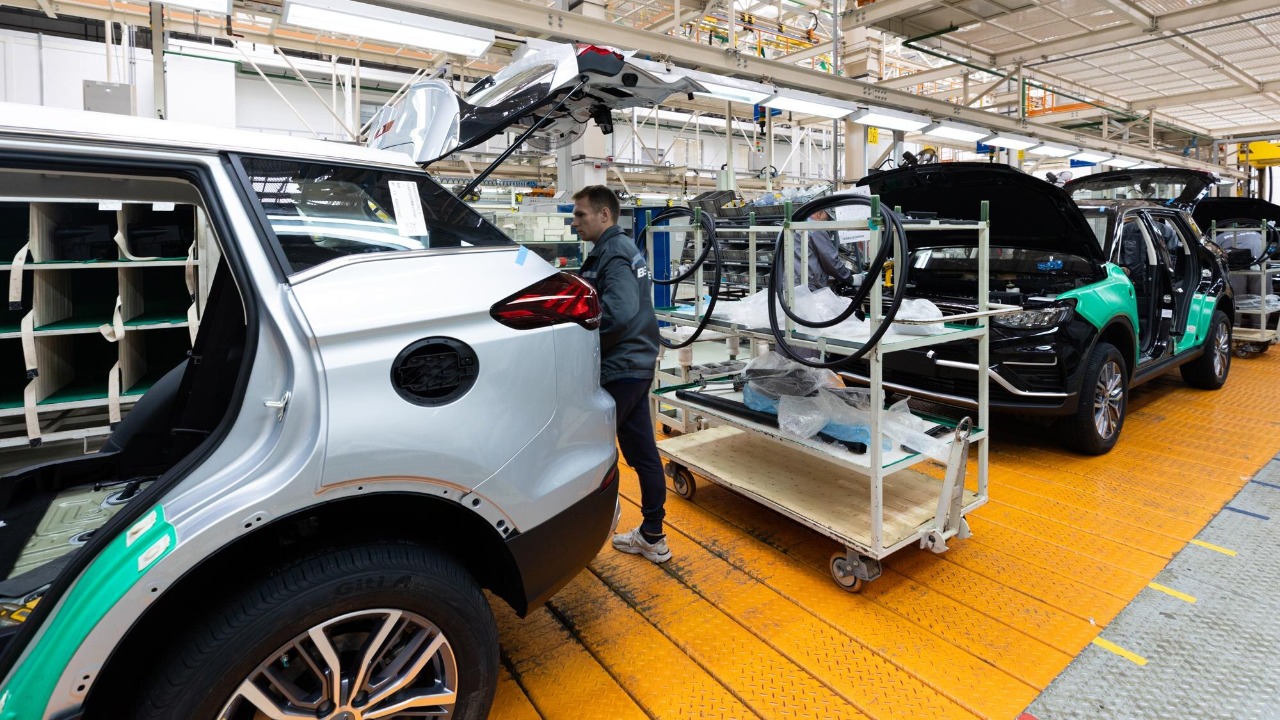

The Internal Revenue Service has now put hard edges around one of President Donald Trump’s most talked‑about consumer promises: a tax perk for buying certain new cars built in the United States. The confirmation turns a campaign slogan into a concrete deduction that could reshape what many Americans choose to drive over the next few years. It also quietly rewires the balance between traditional auto incentives and the clean‑vehicle credits that have dominated the policy debate since the first wave of electric cars hit the mass market.
At its core, the new benefit lets qualifying buyers write off interest on loans for eligible vehicles, but only if those cars are newly purchased and assembled in the United States. That sounds simple, yet it sits on top of a dense stack of rules from the One, Big, Beautiful Bill Act, existing clean‑vehicle credits, and fresh IRS guidance that together determine who really wins and who is left on the sidelines.
How Trump’s “No Tax on Car Loan Interest” became real policy
The starting point for the new perk is a provision branded “No Tax on Car Loan Interest,” a centerpiece of the One, Big, Beautiful Bill Act that President Trump championed as a break for working drivers. The IRS describes this as a new deduction, formally labeled “No Tax on Car Loan Interest,” that is “Effective for 2025 through 2028” and tied to vehicles that meet strict criteria, including final assembly in the United States. In practice, that means the federal government is temporarily reopening a door it closed decades ago, letting individuals once again deduct interest on certain personal car loans, but only if they buy the right kind of new, U.S.‑built vehicle.
Earlier guidance on the One, Big, Beautiful Bill Act framed the measure as part of a broader push to cut costs for “working Americans and seniors,” but the car provision has quickly become one of its most visible consumer hooks. By explicitly linking the deduction to new vehicles and to domestic assembly, the law turns a tax break into an industrial policy tool, rewarding buyers who choose models that keep production lines and jobs inside U.S. borders. That design choice is why the IRS confirmation matters so much to automakers and dealers, not just to taxpayers filling out returns.
The Dec guidance that locked in the rules
The broad promise of “No Tax on Car Loan Interest” only became actionable once regulators spelled out how it would work, and that clarity arrived in a detailed bulletin from tax authorities. In a release identified as IR‑2025‑129, The Department of the Treasury and the Internal Revenue Service used a Dec announcement from WASHINGTON to lay out how individuals can claim the new deduction for interest on car loans. That guidance explains which loans qualify, how to document interest payments, and how the deduction interacts with other parts of the tax code, turning a political slogan into a line item that tax preparers can actually use.
Alongside that bulletin, the IRS published an Overview of the new deduction that emphasizes it is “Effective 2025 through 2028” and available to both itemizing and non‑itemizing taxpayers. That detail is crucial: by opening the benefit to people who take the standard deduction, the policy reaches far beyond the relatively small slice of households that still itemize. The overview also reinforces that the deduction is limited to interest on loans used to purchase qualifying new vehicles, which keeps the focus squarely on fresh sales rather than refinancing or used‑car deals.
Which “new made‑in‑USA” cars actually qualify
Once the IRS confirmed the contours of the deduction, attention shifted to which vehicles would actually unlock the savings. According to a detailed explanation of the policy, the tax deduction applies to new cars assembled in the US that are purchased from 2025 through the end of 2028, with The IRS stressing that final assembly in the United States is a non‑negotiable requirement for eligibility. That confirmation, laid out in coverage of new made‑in‑USA cars, means a 2026 Ford F‑150 built in Michigan could qualify while an otherwise identical truck assembled in Mexico would not.
The same reporting notes that the deduction is limited to “new cars,” which rules out used vehicles and likely excludes demonstrator models that have already been titled. That pushes buyers toward factory‑fresh inventory and gives automakers a direct incentive to keep more production lines on U.S. soil. Analysts cited in that coverage, including voices from the Bipartisan Policy Center, have framed the rule as a targeted nudge that could shift marginal investment decisions on where to build popular models, especially in segments like compact SUVs and crossovers where production is already split between U.S. and foreign plants.
How much buyers can save under OBBBA
For households trying to decide whether to accelerate a purchase, the key question is how much money is really at stake. A breakdown of the One, Big, Beautiful Bill Act, often shortened to OBBBA, walks through how the deduction translates into dollars off a tax bill, explaining that the law can shave hundreds or even thousands of dollars from the cost of financing a qualifying car. One analysis of how much you can save on new car purchases under OBBBA notes that the structure effectively caps the benefit for very expensive vehicles and then phases it down “for every $1,000 above the cutoff,” a design that keeps the focus on mass‑market buyers rather than luxury shoppers, as detailed in a state‑by‑state breakdown.
In practical terms, that means a family financing a $35,000 sedan at a typical interest rate could see a meaningful deduction, while someone stretching for a $90,000 performance SUV would watch the benefit taper off. Consumer‑facing explainers have seized on that contrast, with one widely shared video bluntly titled “New Bill Act is Going to Save You THOUSANDS on Your Next …” telling viewers that “here’s a way you can save some money on your next car, the one big beautiful bill or OBBBA, was it’s easier to just say,” underscoring how the policy is being marketed as a middle‑class windfall in clips like this OBBBA explainer. The political message is clear: the administration wants buyers to feel the savings directly when they sign a loan contract, not just when they file taxes months later.
Interaction with the New Clean Vehicle Credit and EV incentives
The new deduction does not exist in a vacuum, and its rollout collides with a complex web of electric‑vehicle incentives that were already in flux. The IRS guidance on credits for new clean vehicles explains that, for cars purchased in 2023 or after, buyers must navigate “More In Credits & Deductions” and that if a vehicle is placed in service after Sept. 30, 2025, they must have acquired it under specific rules tied to The New Clean Vehicle framework, as laid out in the agency’s clean vehicle credit guidance. That timing overlaps directly with the start of the car‑loan interest deduction, creating a narrow window in which some buyers might stack benefits while others see older credits fade away.
Tax professionals are already warning that the landscape for electric‑vehicle incentives is shifting under OBBBA. A detailed advisory on the OBBBA’s impact on clean energy credits notes that “Electric vehicle credits” have been pared back, stating that “Electric vehicle credits, Clean vehicle incentives have been phased out most quickly under OBBBA” and that “The New Clean Vehicle” credit is no longer available for vehicles acquired after Sept. 30, 2025, as explained in an analysis of OBBBA individual clean‑energy credits. That means a buyer choosing between a U.S.‑built gasoline SUV and an imported electric hatchback could find the tax code nudging them toward the former, a reversal of the incentives that dominated the early 2020s.
Where EV‑specific credits still fit in
Even as OBBBA reshapes the field, electric‑vehicle buyers are not left entirely without support. Consumer tax guides still point to “Various Electric Vehicle Credits” that remain on the books, outlining how different programs apply to new and used EVs, plug‑in hybrids, and fuel‑cell vehicles. One widely used filing resource notes that these Various Electric Vehicle Credits are being evaluated and adjusted for 2025 and beyond, with some benefits shrinking while others are repurposed to favor domestic manufacturing and battery supply chains.
At the same time, policy analysts are watching how the new deduction interacts with manufacturing‑side incentives like the section 30D and 45X credits. A detailed explainer on those provisions points out that “Just as traditional automotive manufacturers were accelerating work to build out electric vehicle (EV) supply chains,” the policy environment shifted around the consumer credits, while still preserving the clean vehicle credit (30D) and the advanced manufacturing credit (45X) for companies that invest in U.S. plants, as described in an analysis of the 30D and 45X tax credits. That combination means an automaker that builds an electric crossover in an American factory could benefit twice: once from production‑side credits and again from consumers who can deduct their loan interest because the vehicle is assembled in the United States.
IRS messaging and the politics behind the perk
The way the IRS has communicated the new deduction underscores how politically sensitive it is. On its public news page, the agency has highlighted multiple pieces of guidance, including a notice that “Treasury, IRS announce forthcoming guidance on a new method for recovering federal excise tax paid on dyed fuel,” identified as IR‑2025‑122, Dec., which sits alongside the car‑loan interest materials in the Treasury, IRS news releases for the current month. Grouping the car deduction with other technical tax updates signals that, at least on paper, the agency is treating it as a routine implementation task rather than a political trophy.
Outside government, however, the politics are front and center. One widely viewed commentary video bluntly titled “Trump Gives Tax Breaks to Car Buyers — But Who Really Wins?” argues that “trump’s big beautiful bill gives tax breaks to car buyers. but who really wins the auto. industry just got a political…” boost, framing the deduction as a strategic gift to domestic manufacturers and dealers rather than a neutral consumer policy, as argued in this critical breakdown. That critique dovetails with concerns from some clean‑energy advocates who see the shift from direct EV credits to broader car‑loan deductions as a step away from aggressive decarbonization goals and toward a more traditional, production‑focused industrial strategy.
What this means for shoppers between 2025 and 2028
For individual buyers, the practical takeaway is that the calendar now matters as much as the showroom sticker. The deduction for “No Tax on Car Loan Interest” is explicitly “Effective for 2025 through 2028,” and it applies only to interest paid on loans used to purchase qualifying new vehicles during that window, as spelled out in the IRS’s Effective period language. That creates a four‑year rush in which buyers who were already planning to replace an aging car may decide to move sooner, especially if they can pair the deduction with favorable dealer incentives or low‑rate financing.
At the same time, the phase‑out of some clean‑vehicle credits after Sept. 30, 2025, means that shoppers considering an electric car face a more complicated trade‑off. They must weigh any remaining EV‑specific credits, the new loan‑interest deduction for U.S.‑built models, and the possibility that state‑level incentives could change in response to federal policy. For many households, the most tax‑efficient choice will be a new, moderately priced vehicle assembled in the United States and financed with a conventional loan, a combination that maximizes the new deduction while staying within the OBBBA thresholds that limit benefits for high‑end purchases.
The bigger shift in U.S. auto and tax policy
Stepping back, the IRS confirmation of Trump’s car‑loan deduction marks a broader pivot in how Washington uses the tax code to shape the auto market. For much of the past decade, federal policy leaned heavily on targeted credits for electric and other clean vehicles, with the goal of accelerating a transition away from internal‑combustion engines. Under OBBBA, that approach is giving way to a more technology‑neutral, location‑specific incentive that rewards any qualifying new car, truck, or SUV as long as it is assembled in the United States and financed with a loan whose interest can be documented and deducted under the “No Tax on Car Loan Interest” rules.
Whether that shift ultimately reduces emissions or simply boosts domestic production will depend on how automakers respond between now and 2028. Companies that align their lineups with the new rules, building more popular models in U.S. plants and offering competitive financing, stand to benefit from a wave of tax‑motivated demand. Others that keep key vehicles offshore or rely heavily on leasing, which does not generate deductible loan interest for individual buyers, may find themselves at a disadvantage. For now, what is clear is that the IRS has translated a campaign promise into a concrete, time‑limited perk, and that anyone shopping for a new car in the next few years will need to think as carefully about assembly lines and tax forms as they do about horsepower and trim packages.
More from MorningOverview