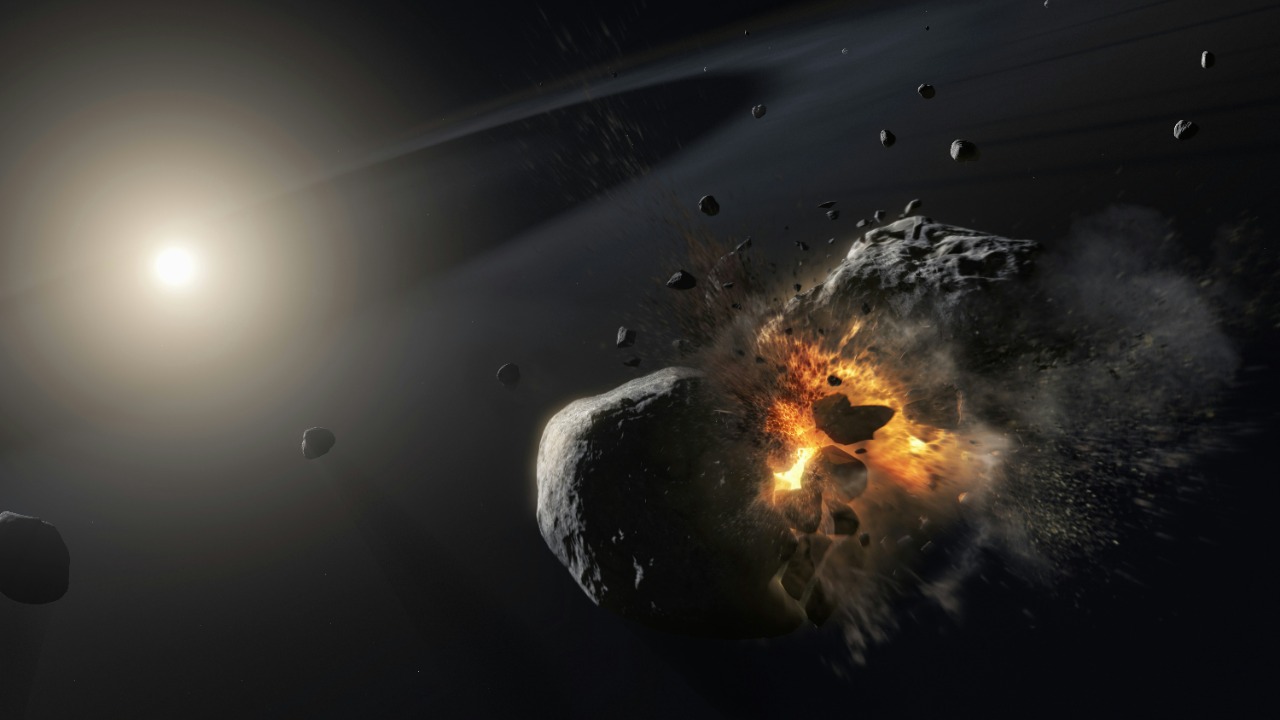

Far from our own solar system, astronomers have finally watched what planetary scientists have long predicted but never directly seen: two massive asteroids slamming into each other around another star. The violent crash, captured by NASA’s Hubble Space Telescope, turns a distant planetary system into a natural laboratory for how worlds are built and destroyed. For the first time, the slow, statistical story of planet formation has a single, cinematic frame.
The collision unfolded in the dusty outskirts of a nearby star system, where icy and rocky bodies constantly jostle for space. Instead of inferring such impacts from leftover debris, scientists have now seen the immediate aftermath, a spreading cloud of dust that betrays the moment two large objects met at high speed and shattered. It is a glimpse of the chaos that once shaped Earth and its neighbors, and a reminder that even mature planetary systems can still be dangerous places.
Hubble’s historic view of a smashup in real time
For decades, astronomers have modeled how asteroids and protoplanets collide as they assemble full-sized worlds, but those calculations relied on indirect clues like dust belts and gaps in debris rings. The new observations change that, giving researchers a direct look at two massive asteroid-like bodies colliding around a nearby star and leaving behind a bright, expanding plume. NASA’s Hubble Space Telescope, designed primarily for faint galaxies and distant nebulae, has now added “cosmic crash cam” to its résumé by resolving the dusty wreckage of this impact in unprecedented detail.
In a short video produced to explain the discovery, the collision is described as two massive asteroids smashing together and generating a cloud of fine material that Hubble can pick out against the surrounding ring. The piece is directed by Bethany Downer and Nico Bartmann, with editing by Nico Bartmann and web and technical support by Enciso Systems, underscoring how carefully the team translated a complex dataset into a visual story of two massive asteroid fragments spreading through space. That communication effort mirrors the scientific leap: a theoretical process has become something you can literally watch unfold, frame by frame.
A nearby star system under violent construction
The drama is playing out around Fomalhaut, a bright star relatively close to Earth that has long been a favorite target for planet hunters. Fomalhaut is encircled by a broad debris ring, a halo of icy and rocky leftovers that signals an active planetary construction zone. Astronomers have tracked clumps and gaps in that ring for years, suspecting that unseen planets and colliding asteroids were sculpting its structure, but until now they lacked a clear, time-resolved example of a major impact.
Fresh Hubble images show that the debris ring is not a static band but a dynamic environment where dust clouds appear and evolve, including distinct features labeled cs1 and cs2 that trace out recent disruptions. One composite view highlights the main debris ring and the dust clouds cs1 and cs2 around Fomalhaut, giving scientists a map of where the most energetic collisions are happening. That map, in turn, helps them estimate how often large bodies crash together and how quickly the system is grinding its building blocks down into dust.
Why this counts as a genuine first
Astronomers have seen hints of collisions before, such as sudden brightening in dusty disks or unexplained clumps that later disperse, but those signals were ambiguous. The new Hubble data stand out because they capture both the morphology and evolution of the dust cloud in a way that points unambiguously to a high-speed impact between large solid objects. Instead of a slow, uniform glow, the images reveal a localized, expanding feature that moves and fades over time, behavior that matches simulations of asteroid-scale smashups rather than gentle dust stirring.
NASA has framed the result as a historical milestone, emphasizing that Hubble has, for the first time, directly imaged catastrophic collisions in a planetary system beyond our own. In a celebratory post, the agency notes that NASA and the Hubble Space Telescope have now moved from inferring such events to actually seeing them, a shift that gives theorists a concrete benchmark. That benchmark matters because it lets researchers test long-standing models of how often big impacts occur, how much dust they produce, and how quickly that dust spreads or clumps into new structures.
Reading the debris: what the dust cloud reveals
The dust cloud itself is more than a visual spectacle, it is a diagnostic tool. By measuring its brightness, color, and how fast it expands, scientists can estimate the size and composition of the colliding bodies. A brighter, more reflective cloud suggests a high content of ices or fine silicate grains, while a darker plume would point to carbon-rich rubble. The rate at which the cloud disperses through the debris ring also hints at the local density of material and the gravitational influence of any nearby planets that might be stirring the region.
Reporting on the event notes that NASA’s Hubble has captured asteroids colliding with each other around a nearby star, revealing a phase of violent planet formation rather than a quiet, settled system. The same coverage explains that NASA Hubble has even spotted a second dust cloud in a different location, suggesting that such collisions are not isolated flukes but part of an ongoing cascade. Together, these plumes sketch out a system where large bodies are still being shattered and reassembled, a process that can either feed the growth of planets or strip them of material over time.
How often do worlds get smashed apart?
One of the most striking implications of the Fomalhaut observations is statistical rather than visual. Planet formation models predict that the biggest smashups, involving objects hundreds of kilometers across, should be relatively rare across the hundreds of millions of years it takes to build a full planetary system. Yet catching even one such event in the act suggests that the tail end of planet building might be more violent, or at least more visible, than some simulations assumed. The presence of multiple dust clouds in the same system strengthens the case that we are seeing a sustained era of destructive collisions rather than a single unlucky impact.
Analyses of the system describe these as massive cosmic collisions around a nearby star, with the largest impacts thought to be uncommon across the long timescales of planetary assembly. One detailed discussion notes that the biggest smashups are thought to be uncommon across the hundreds of millions of years it takes to build a full planetary system, yet astronomers have now witnessed such events around Fomalhaut as seen in reflected light, a point underscored in a report on massive cosmic collisions. That tension between rarity and direct detection will push theorists to revisit how they model the late stages of planet formation and the frequency of catastrophic impacts.
What Fomalhaut teaches us about our own solar system
For all its drama, the Fomalhaut collision is not an alien curiosity so much as a mirror held up to our own past. Planetary scientists believe that the early solar system was shaped by similar high-energy encounters, from the suspected giant impact that formed Earth’s Moon to the collisions that likely stripped Mercury of much of its original mantle. By watching another system in the throes of such violence, researchers gain a comparative case that can validate or challenge those narratives. If the timing, scale, and frequency of impacts around Fomalhaut match what models predict for our own history, confidence in those models grows.
The Fomalhaut system appears to be a particularly rich analog because it is close enough for Hubble to resolve fine structures and because its debris ring is bright and well defined. In one description, the NASA/ESA Hubble imagery is introduced with the phrase “Nasa’s Hubble Sees Asteroids Colliding at Nearby Star For The First Time,” highlighting that Fomalhaut is both a nearby star and a stage for ongoing asteroid collisions. The same account notes that Fomalhaut sits at just 25 light years away, close enough that its dust clouds can be tracked over time. That proximity turns it into a benchmark system for testing ideas about how belts of asteroids and comets evolve around stars like our Sun.
From telescope images to public imagination
Part of what makes this discovery resonate beyond the scientific community is how visual and intuitive it is. Instead of abstract graphs or spectra, the public can see a ring of material around a star and a distinct cloud blossoming within it, the telltale sign of a recent crash. NASA and its partners have leaned into that storytelling power, releasing animations and annotated images that walk viewers through the sequence of events. The narrative is simple but profound: two large bodies collided, shattered, and left behind a trail of dust that we can now follow as it spreads and fades.
Social media posts about the event have amplified that sense of immediacy, framing the observation as Hubble making history by catching asteroids in the act of colliding. One widely shared update describes how NASA’s Hubble Space Telescope has directly imaged the aftermath of two massive asteroid bodies smashing together, using hashtags that evoke both the destruction of worlds and the broader context of missions like James Webb. That blend of rigorous observation and accessible storytelling helps bridge the gap between technical astrophysics and the broader public imagination, turning a distant dust cloud into a shared human experience of discovery.
The crowded sky problem: satellites versus starlight
As spectacular as the Fomalhaut collision images are, they also highlight a growing challenge for space-based astronomy closer to home. Capturing faint dust clouds around distant stars requires long exposures and pristine views, yet Earth orbit is becoming increasingly cluttered with artificial satellites. Each bright trail that crosses a telescope’s field of view can contaminate data, forcing astronomers to discard or painstakingly correct affected images. The more satellites there are, the harder it becomes to find clean windows for observing subtle features like expanding dust plumes.
Researchers have begun to quantify that risk, warning that planned satellite megaconstellations could dramatically increase the number of streaks in astronomical images. In one analysis, Scientists found that if 560,000 satellites are launched as planned, there could be an average of two satellite trails in every Hubble exposure. That figure is not just an inconvenience, it is a direct threat to the kind of delicate measurements needed to track dust clouds around stars like Fomalhaut. The same telescope that has just delivered a landmark view of colliding asteroids could find its future observations increasingly compromised by the glow of human-made hardware.
What comes next for Hubble and its successors
The Fomalhaut collision is unlikely to be the last such event that astronomers catch in real time. With Hubble continuing to monitor the system and other observatories joining the effort, researchers expect to see dust clouds evolve, disperse, and perhaps even interact with unseen planets. Future observations could reveal whether the debris from a single impact can seed new clumps that later coalesce into smaller bodies, or whether it is quickly ground down and blown out of the system. Either outcome would refine our understanding of how planetary systems age and whether they remain dynamically active long after their main planets have formed.
Coverage of the discovery notes that, for the first time ever, a NASA telescope has spotted asteroids violently colliding, with the impact generating a dust cloud that can be tracked over time. One report emphasizes that this is a scientific first, describing how astronomers have witnessed two objects violently colliding in space and linking that observation to broader questions about planetary system evolution, a point captured in a summary of asteroids violently colliding. As Hubble ages and newer instruments like the James Webb Space Telescope and future large space telescopes come online, the toolkit for catching and dissecting such events will only grow more powerful, promising a richer, more detailed picture of how often the universe smashes its building blocks together to make, and unmake, worlds.
More from MorningOverview