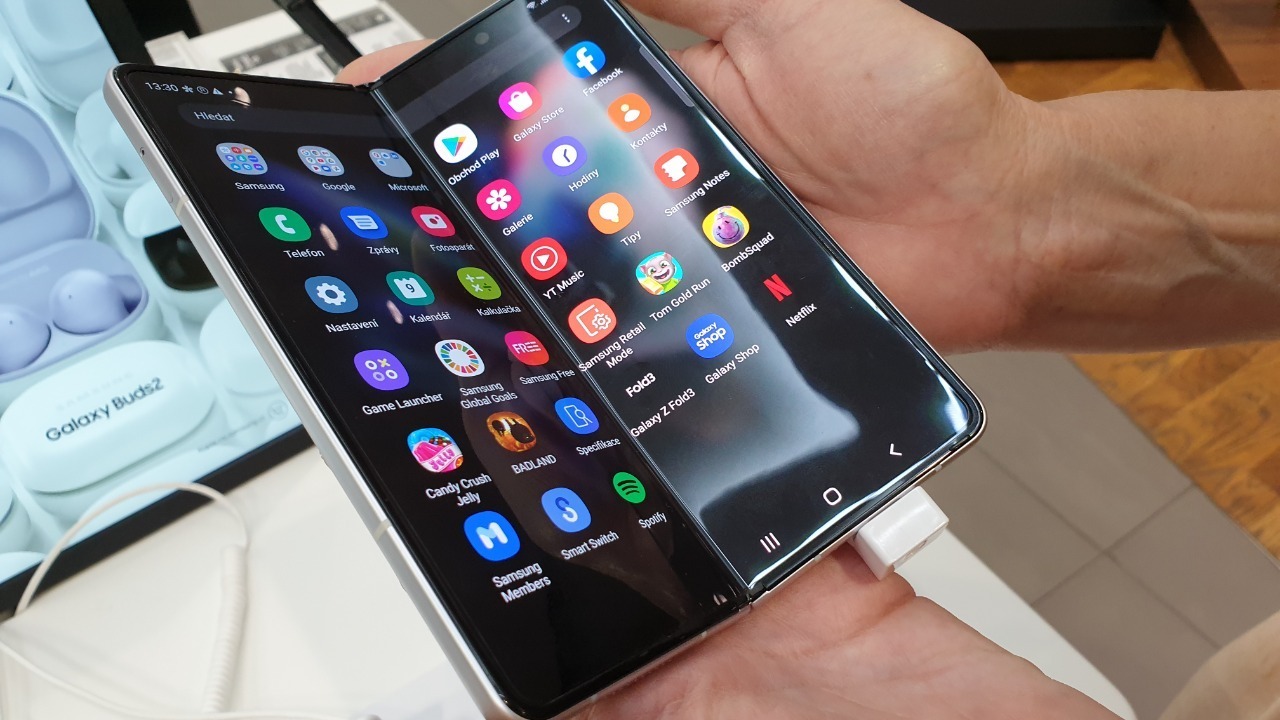

Samsung’s Galaxy Z TriFold is shaping up as one of the boldest experiments in mobile hardware, and also one of the most financially painful. Multiple reports indicate that even at a sticker price of $2,400, the device is not covering what it costs Samsung to build and bring it to market. The company appears to be accepting red ink on each unit in exchange for a shot at defining the next era of foldable computing.
If that sounds familiar, it is because consumer tech has seen this playbook before, from early flat‑screen TVs to first‑generation VR headsets. What makes the Galaxy Z TriFold different is the scale of the bet and the uncertainty around how quickly the market, and Samsung’s own supply chain, can catch up to such an ambitious design.
Samsung’s most ambitious foldable is a financial sinkhole
The core claim is stark: Samsung may be losing money on every Galaxy Z TriFold it sells. Reporting that cites Korean outlet The Bell describes the phone as Samsung’s most audacious foldable yet, and says the company is effectively subsidizing each device to get it into the hands of early adopters. In other words, the headline price is not high enough to offset the bill of materials, manufacturing complexity, and the cost of building a new category around a triple‑folding screen.
That same reporting frames the Galaxy Z TriFold as a halo product that is meant to showcase what Samsung’s display and hinge engineering can do, even if the balance sheet suffers in the short term. The Bell is described as a Korean source, and its account, relayed in English, underlines that Samsung is prioritizing long‑term ecosystem positioning over immediate profit on this one device. The suggestion that Samsung’s most audacious foldable yet is being sold at a loss sets the stakes for how radical the company’s strategy has become.
A $2,400 flagship that still runs in the red
The most jarring detail is the price tag. The Galaxy Z TriFold reportedly costs $2,400 at retail, a figure that would normally signal a healthy margin in the smartphone world. Yet multiple analyses say that even at $2,400, Samsung is not breaking even. One breakdown explicitly frames the device as a case study in how a $2,400 phone can still lose money for its maker, pointing to the gap between what consumers pay and what it takes to build such a complex piece of hardware.
Another report repeats that the Galaxy Z TriFold costs $2,400, but adds that Samsung might still be losing money on each sale, reinforcing the idea that the company is absorbing a loss to keep the sticker price from climbing even higher. The language around how Samsung’s Galaxy Z TriFold is apparently being sold at a loss underscores that this is not a marginal shortfall, but a structural problem with the economics of triple‑folding phones at current component and manufacturing costs.
Inside the bill of materials problem
To understand why a $2,400 device can still be unprofitable, it helps to look at the bill of materials, or BOM. Analyses that dig into the Galaxy Z TriFold’s cost structure describe a high price for the flexible OLED panels, the multi‑segment hinge, and the reinforced chassis needed to keep three folding sections aligned to within fractions of a millimeter. One report explicitly notes that there is a high price to pay for tolerances measured in a fraction of a millimeter, and that this precision is expensive at every step of the supply chain.
Those same breakdowns say the BOM and manufacturing overhead together push the total cost per unit close to, or even above, the retail price. The phrase “Why a $2,400 Phone Still Loses Money for Samsung” is used to frame how the combination of exotic materials, low‑yield production, and complex assembly erodes any margin. The detailed explanation of Why a $2,400 Phone Still Loses Money for Samsung makes clear that this is not simply about marketing or distribution, but about the raw cost of building each unit.
Triple folds, triple the manufacturing headaches
The Galaxy Z TriFold is not just another foldable, it is a device that folds in two places, creating three distinct screen segments. That design multiplies the engineering challenges that already exist in single‑hinge foldables. Each hinge must be precisely aligned, the flexible display must survive repeated bending across multiple radii, and the entire assembly has to remain thin and light enough to be pocketable. Reports that describe the TriFold as Samsung’s most audacious foldable yet highlight how these requirements drive up both component costs and failure rates during production.
Manufacturing overhead rises sharply when yields are low, and early triple‑folding designs are almost guaranteed to suffer from defects that would be rare in more mature product lines. The need to test each hinge segment, calibrate the folding angles, and ensure that the display does not crease or delaminate adds time and labor to every unit that leaves the factory. Analyses that focus on how the Galaxy Z TriFold sold at a loss despite its size and supply chain reach point to these manufacturing headaches as a key reason why Samsung’s Galaxy Z TriFold sold at a loss despite its size and supply chain reach.
Why Samsung is willing to bleed cash on a halo device
Given the financial hit, the obvious question is why Samsung is willing to proceed. The reporting that leans on The Bell’s account suggests the company sees the Galaxy Z TriFold as a strategic investment in future categories, not a profit center in its own right. By pushing a triple‑folding design into the market, Samsung can test consumer appetite for tablet‑sized screens that still fit in a pocket, gather data on durability, and pressure app developers to optimize for more complex multi‑window layouts. The loss per unit becomes a kind of R&D expense, spread across a small but influential group of early adopters.
There is also a branding dimension. Being first to market with a working triple‑folding phone reinforces Samsung’s image as a leader in display technology and foldable hardware, even if rivals catch up later with cheaper designs. Reports that describe Samsung’s most audacious foldable yet emphasize that the company is trying to pull hardware and software ecosystems forward, betting that the long‑term payoff from owning this narrative will outweigh the short‑term red ink. In that sense, the TriFold is as much a statement of intent as it is a product.
Knock‑on effects for the Galaxy S26 and mainstream pricing
The financial strain from the Galaxy Z TriFold is not happening in isolation. One report says that Samsung does not yet know what the Galaxy S26 will cost, in part because fluctuating component prices and the losses on the TriFold complicate its broader pricing strategy. The same account notes that Samsung is losing money on the Galaxy Z TriFold, and that uncertainty about how quickly costs will fall makes it harder to set a stable roadmap for more mainstream flagships.
That report, attributed to writer Ben Schoon, describes how Samsung is wrestling with the question of how much a future sequel might cost, and how that uncertainty feeds into decisions about the Galaxy S26. The suggestion that Ben Schoon is highlighting both the TriFold’s losses and the unknown Galaxy S26 price underlines how a single halo device can ripple through an entire product portfolio. If Samsung keeps eating losses on the TriFold, it may need to be more aggressive on margins elsewhere, or accept lower profitability across its smartphone line.
How the TriFold compares with other ultra‑premium devices
At $2,400, the Galaxy Z TriFold sits above almost every other mainstream smartphone, including Samsung’s own Galaxy S Ultra series and most competing foldables. Yet the reports that dissect its economics argue that the TriFold undercuts what a truly cost‑reflective price would be. In other words, if Samsung priced the device purely to cover its BOM and overhead with a normal margin, it would likely need to charge even more than $2,400, a figure that would push it into an even narrower niche.
That is why some analyses describe the TriFold as undercutting the masses despite its $2,400 price, because it is effectively discounted relative to what it costs to make. The phrase “Galaxy Z TriFold Undercuts Masses Despite $2,400 Price” is used to capture this paradox, and it is tied directly to the idea that the phone still loses money for Samsung. The framing of Galaxy Z TriFold Undercuts Masses Despite $2,400 Price reinforces that the company is intentionally keeping the price lower than a strict cost‑plus calculation would dictate, in order to seed the market.
The role of software and ecosystem in justifying the cost
Hardware is only part of the story. Reports that cite The Bell’s analysis also mention that software ecosystems need to catch up to the Galaxy Z TriFold’s form factor. A triple‑folding device invites new use cases, such as running three apps side by side, using one panel as a keyboard and another as a canvas, or folding the device into different shapes for media consumption and productivity. If Android, major apps like Chrome, Gmail, and Microsoft Office, and Samsung’s own One UI do not fully exploit these possibilities, the value proposition of the TriFold becomes harder to justify, especially at $2,400.
That is why some of the commentary around Samsung’s most audacious foldable yet stresses the need for software ecosystems to catch up. The hardware may be ahead of its time, but without matching advances in app design and multitasking frameworks, consumers are effectively paying for potential rather than realized benefits. This gap between what the device can theoretically do and what the software currently enables adds another layer of risk to Samsung’s decision to sell the TriFold at a loss, because it may take several product cycles before the ecosystem fully aligns with the hardware vision.
What the TriFold experiment signals about Samsung’s future
Stepping back, the Galaxy Z TriFold looks less like a one‑off curiosity and more like a signal of where Samsung wants to take mobile computing. By accepting losses on a $2,400 device, the company is telegraphing that it sees foldables, and especially multi‑fold designs, as central to its long‑term strategy. The willingness to absorb a negative margin suggests confidence that costs will fall as yields improve, suppliers scale up, and design refinements simplify manufacturing over time.
At the same time, the uncertainty around the Galaxy S26’s pricing and the need for software ecosystems to catch up show that the path from experimental halo product to mainstream category is anything but guaranteed. Samsung is effectively betting that the lessons learned from the TriFold, from hinge durability to user interface patterns, will feed into more affordable devices down the line. The presence of the Galaxy Z TriFold in product listings, including generic product search pages and more detailed product listings, hints at how Samsung is already normalizing the idea of a triple‑folding phone, even as the economics remain upside down.
More from MorningOverview