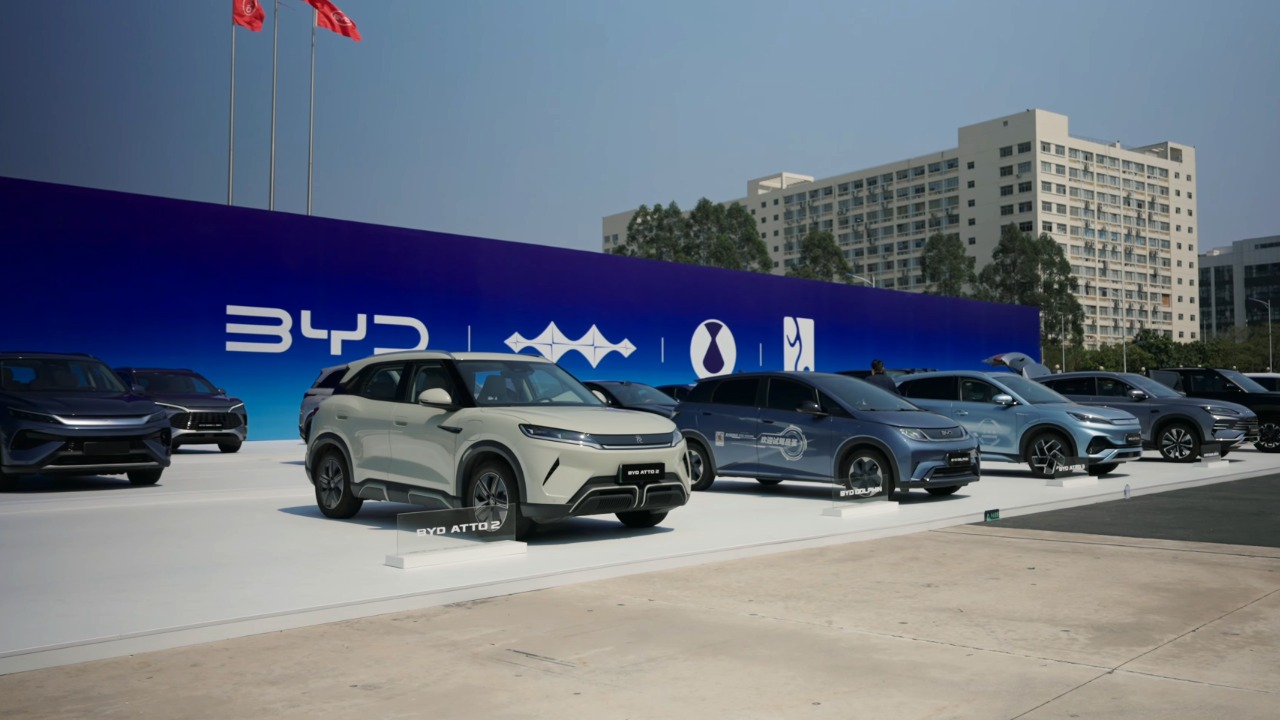

Chinese electric vehicle makers have shifted from domestic disruptors to global exporters, and the latest trade data shows that shift turning into a tidal wave. Exports of Chinese EVs are surging into key markets, with Mexico emerging as a standout gateway to the Americas and Europe absorbing a growing share of higher value models. The result is a reshaping of the global auto industry that is colliding with trade politics, industrial policy and consumer demand all at once.
Behind the headlines about tariffs and trade disputes is a simple reality: Chinese manufacturers are building more EVs than their home market can absorb, and they are finding eager buyers abroad. From Latin America to Europe and across Asia, the combination of aggressive pricing, improving quality and heavy state support is turning Chinese EV exports into one of the defining economic stories of the energy transition.
China’s EV export surge by the numbers
The clearest sign of the shift is the pace of growth. According to detailed trade tallies, China’s exports of electric vehicles jumped by 87% year on year in November, a rate that would be remarkable for a niche technology, let alone a sector that is already shipping vehicles worldwide. In unit terms, exports reached 199,836 vehicles for the month, underscoring how quickly Chinese brands have scaled their overseas operations. I see that combination of rapid percentage growth and large absolute volumes as the core reason policymakers in importing countries are suddenly on edge.
Several analyses converge on the same headline figure of an 87% surge, reinforcing that this is not a statistical blip but a structural shift in trade flows. One breakdown notes that China exported 199,836 electric vehicles worldwide in November, while another, compiled as Takeaways by Bloomberg AI, reaches the same total and growth rate. For an industry that measures success in tens of thousands of units per model line, nearly 200,000 exported EVs in a single month is a powerful signal that Chinese factories are now building for the world, not just for domestic showrooms.
Mexico’s astonishing role as breakout market
Within that global surge, Mexico has emerged as the most dramatic story. Trade data shows that China’s EV exports to Mexico in November rose by 2,367% year on year to 19,344 vehicles, a leap that would be hard to imagine in any other major auto market. Another assessment describes Deliveries of Chinese EVs to Mexico as having “skyrocketed” by more than 2,000% in November, while a separate breakdown of the same trend notes that Shipments to Mexico exploded by 2,300% year on year to about 19,300 vehicles. When multiple data cuts all point to four digit percentage growth and roughly the same volume, it is clear that Mexico has become a central outlet for China’s EV overcapacity.
The broader vehicle trade picture reinforces that point. Over the first nine months of the year, New vehicle exports from China reached 4.95 million units, up 14.8% from a year earlier, and Mexico was identified as the country’s biggest export destination. That aligns with the November EV spike and helps explain why automakers and officials in Mexico are now central to debates about how Chinese brands might use North American production and trade rules to reach the United States and Canada. I see Mexico not just as a fast growing customer market, but as a strategic bridgehead in the global EV trade.
Europe’s growing dependence on Chinese-built EVs
While Latin America is delivering the most eye catching growth rates, Europe is quietly becoming one of the most important destinations for Chinese built electric cars. Port statistics and trade breakdowns show that a significant share of the nearly 199,836 exported EVs in November were headed for European Union markets, where local manufacturers are still ramping up affordable battery models. Countries such as Belgium have become key landing points, with their deep water ports handling large volumes of vehicles that are then distributed across the continent.
In the United Kingdom and other European markets, Chinese brands are increasingly visible in showrooms and on city streets, often undercutting established rivals on price while offering long range batteries and generous equipment. Analysts who track the November export surge argue that Europe’s appetite for lower cost EVs is one reason China’s overall shipments could keep growing even if some individual markets tighten tariffs. From my perspective, that leaves European policymakers in a bind: they want to protect domestic industry, but they also need affordable EVs to hit climate targets, and Chinese exporters are exploiting that tension.
Asia and Latin America as volume engines
Beyond Mexico and Europe, the regional pattern of China’s EV exports shows Asia and Latin America acting as the main volume engines. One detailed breakdown notes that Asia was the biggest import region for Chinese EVs in November, reflecting both proximity and the presence of fast growing middle class markets. Countries such as Indonesia and Thailand are investing heavily in EV charging and battery supply chains, which makes them natural targets for Chinese exporters looking to lock in early market share.
Latin America, meanwhile, is emerging as a complementary growth pole, with China’s November export surge explicitly described as being led by Asia and Latin America together. Mexico’s four digit growth is the headline, but other regional markets are also ramping up imports as governments roll out incentives and fuel economy rules. I read this as evidence that Chinese EV makers are not relying on any single country; instead, they are building a diversified export footprint that spans multiple continents and income levels.
Why Chinese EVs are so competitive abroad
The raw numbers only tell part of the story. To understand why Chinese EV exports are expanding so quickly, it is necessary to look at the underlying cost structure and industrial strategy. Analysts point to a combination of large scale domestic production, control over battery supply chains and sustained state support as key reasons why China can push aggressively into overseas markets while still offering attractive prices. When factories are already running at high volumes for the domestic market, exporting incremental units becomes a way to keep assembly lines full and amortize fixed costs.
There is also a product angle. Reports on the November surge highlight that many of the exported vehicles are modern crossovers and compact cars with competitive range and technology, not just stripped down budget models. A detailed piece by Michael Gauthier notes that Chinese EV exports nearly doubled in November and were up 87% last month, underscoring how quickly manufacturers have moved from serving domestic buyers to tailoring vehicles for foreign tastes. From my vantage point, that combination of scale, cost and increasingly sophisticated design is what makes Chinese EVs such a formidable presence in global markets.
How Mexico became a strategic gateway
Mexico’s role in this story goes beyond headline growth rates. As Chinese EV shipments to the country jump by 2,300% to about 19,300 vehicles in a single month, Chinese automakers are also exploring local assembly and deeper integration into North American supply chains. The fact that China’s overall new vehicle exports are growing by 14.8% with Mexico as the top destination suggests that EVs are riding on a broader wave of automotive trade between the two countries.
For policymakers in Washington and Ottawa, that raises sensitive questions about how Chinese brands might use plants or partnerships in Mexico to access North American markets under existing trade agreements. For Mexico itself, the surge in imports and potential investment is both an opportunity and a challenge: it could cement the country’s status as a regional auto hub, but it also risks political backlash if Chinese EVs are seen as undercutting local or allied manufacturers. I see Mexico’s position as uniquely pivotal, sitting at the intersection of Chinese industrial strategy and North American trade politics.
Consumer demand and perception on the ground
Behind the trade statistics are real buyers making choices in dealerships and online. In emerging markets, many consumers are drawn to Chinese EVs because they offer long range and modern features at prices that undercut Western and Japanese rivals. A discussion thread on Prize Grapefruiter’s post about Chinese EV exports captures this sentiment, with one commenter from Türkiye noting that Chinese models are “always out of stock,” a small but telling sign of how demand is outpacing supply in some countries. While anecdotal, such feedback aligns with the macro data showing rapid growth in exports to price sensitive markets.
In wealthier regions, perceptions are more mixed. Some European buyers remain wary of unfamiliar brands, but others are swayed by generous equipment levels and competitive warranties. As more Chinese EVs arrive in Mexico and European ports, word of mouth and online reviews will play a larger role in shaping demand. From what I can see, the combination of strong value propositions and improving quality is gradually eroding the stigma that once attached to Chinese cars, especially among younger, tech focused buyers.
Policy backlash and the limits of protection
The speed of China’s EV export growth is already triggering political responses, particularly in Western capitals. Officials worry that a flood of subsidized imports could undermine domestic automakers just as they are investing heavily in their own electric lineups. Analyses of the 87% November export surge argue that traditional tools like tariffs and anti dumping investigations may slow, but not stop, the trend, especially when Chinese manufacturers can reroute shipments through third countries or invest in local assembly.
Mexico’s central role complicates any attempt to build a neat wall around Chinese EVs. With Mexico now absorbing four digit percentage growth in Chinese EV shipments and acting as China’s largest overall vehicle export destination, trade negotiators face a moving target. Even if some markets tighten rules, others, including parts of Asia and Latin America, are likely to keep welcoming affordable EVs to meet climate and mobility goals. I do not see an easy policy fix that can reconcile the desire to protect local industry with the global push for cheaper, cleaner transport.
What the export boom means for the global auto industry
For incumbent automakers in Europe, North America and Japan, the message from China’s export numbers is stark. An industry that once assumed Chinese brands would remain mostly domestic is now confronting a competitor that can ship nearly 199,836 EVs in a single month, with growth of 87% year on year. That scale gives Chinese manufacturers enormous leverage in negotiations with suppliers and logistics providers, and it allows them to experiment with new models and technologies at a pace that slower growing rivals may struggle to match.
At the same time, the export boom is accelerating the global transition to electric mobility by making EVs more accessible in markets that might otherwise have waited years for affordable options. From Mexico and Latin America to Belgium, the United Kingdom and fast growing Asian markets, Chinese EVs are filling gaps left by slower moving incumbents. I expect that dynamic to keep reshaping the competitive landscape, forcing established brands to cut costs, speed up product cycles and, in some cases, partner with the very Chinese companies that are now their fiercest rivals.
The road ahead for China, Mexico and Europe
Looking forward, the interplay between Chinese industrial policy, Mexican trade strategy and European regulation will determine how sustainable this export boom really is. If Mexico continues to deepen its role as China’s top vehicle export destination while also attracting EV assembly plants, it could become the linchpin of a new North American EV supply chain with Chinese characteristics. Europe, for its part, will have to decide how far it is willing to go in restricting imports from China without jeopardizing its own climate goals and consumer access to affordable EVs.
For China, the stakes are equally high. Maintaining an 87% export growth rate is unlikely over the long term, but even a partial deceleration would still leave Chinese brands as dominant players in many foreign markets. The November figures, from the 2,367% surge to 19,344 EVs in Mexico to the 14.8% rise in overall new vehicle exports, show how quickly that dominance is being built. I expect the next phase of this story to be defined less by raw growth rates and more by how governments and companies adapt to a world in which Chinese EVs are a permanent, powerful presence on roads from Mexico City to Brussels.
More from MorningOverview