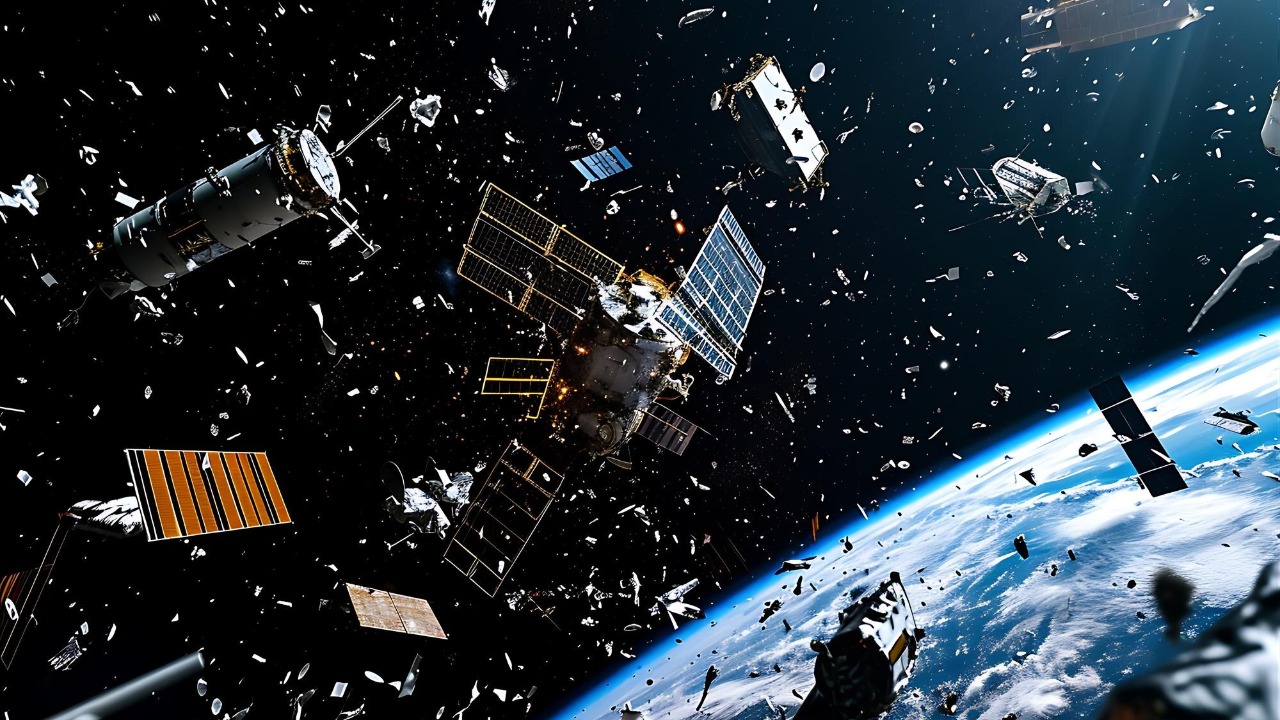

Orbital debris stopped being an abstract risk in 2025 and briefly became a live emergency, forcing operators to scramble spacecraft out of harm’s way and exposing how fragile the rules of the road in low Earth orbit really are. The scare underscored that the world’s patchwork of guidelines, voluntary pledges, and prototype cleanup missions still falls short of a coherent system that can keep pace with a booming space economy. I see a widening gap between the speed of commercial launches and the slow grind of regulation and remediation, and the events of this year made that gap impossible to ignore.
The year orbital debris stopped feeling hypothetical
The turning point came when a piece of space junk slammed into a Chinese spacecraft, a collision that crystallized years of warnings about the growing amount of material circling Earth. Analysts described how space debris struck a Chinese spacecraft and framed the damage as a Wake up Call for International Collaboration, not just a one-off mishap. I read that incident less as bad luck and more as the predictable outcome of packing thousands of satellites and fragments into the same crowded lanes without a binding traffic code.
That collision was not the only alarm. Later in the year, operators faced what was described as an orbital emergency when a conjunction warning forced rapid maneuvers to protect active satellites from a potential chain reaction of impacts. Reporting on how space debris led to an orbital emergency in 2025 made clear that the risk is no longer confined to aging hardware but now threatens new projects like Google’s proposed data center in orbit, which would have to operate in an already crowded environment. Taken together, these episodes showed that the orbital commons is edging closer to a tipping point where one bad day could reshape access to space for years.
A Starlink malfunction that became a viral warning sign
Even when debris is not the direct cause, it lurks in the background of high-profile failures. On December 17, 2025, a Starlink satellite operated by SpaceX malfunctioned dramatically after suffering a sudden and severe anomaly, losing control and tumbling through orbit in a way that was captured and shared widely. The clip, which showed how a Starlink satellite just lost control, turned a technical failure into a public spectacle and a stark reminder that every dead or tumbling spacecraft effectively becomes part of the debris field. I see that video as a rare moment when the normally invisible dynamics of orbital risk were made visceral for people far from any launchpad.
Follow-up analysis emphasized that the malfunctioning Starlink vehicle was not just a company problem but a systemic one, because a single tumbling satellite can threaten others in its path and complicate collision avoidance. A separate post highlighting that on December 17, 2025, a Starlink satellite malfunctioned underscored how quickly a failure can add to the population of non-manoeuvrable space debris. When I connect that incident to the Chinese spacecraft strike, the pattern is clear: we are steadily seeding orbit with objects that cannot reliably dodge each other, yet the mechanisms to remove or neutralize them remain largely aspirational.
The numbers show mitigation is improving, but debris is still winning
Behind the headline-grabbing incidents, the data on the space environment tell a more sobering story. The ESA Space Environment Report 2025 notes that fragmentations are still a problem and that Mitigation compliance remains incomplete, even as Both rocket bodies and payloads are re-entering in greater numbers year on year. In other words, operators are getting better at deorbiting some hardware, but the overall population of fragments and derelicts continues to grow. That tension is captured in the way Mitigation and Both rocket bodies and payloads are discussed side by side, as if progress and backsliding are happening simultaneously.
The same report stresses that Debris objects increase outpaces natural re-entries, and that Despite the improvement in mitigation efforts, a lack of compliance and remedial action is leaving a large stock of non-manoeuvrable space debris in key orbits. That conclusion, laid out in the section on how Debris and Despite the trends are evolving, undercuts any complacency that current guidelines are enough. When I weigh those figures against the 2025 emergencies, it is hard to avoid the sense that we are running up a balance of risk faster than we are paying it down.
How regulators are trying to catch up
Policymakers have not been idle, but their tools still look modest compared with the scale of the problem. In the United States, the Federal Communications Commission has been tightening its expectations for satellite operators, building on what it calls the Orbital Debris Second Report and Order to require more detailed end-of-life plans and data sharing. The Federal Register entry on Space Innovation and Mitigation of Orbital Debris in the New Space Age explains that space innovation and mitigation of orbital debris are now treated as linked priorities, not competing ones. I read that as a recognition that sustainable access to orbit is a precondition for the business models that depend on it.
Before the Commission adopted the latest rules, it was recommended that operators with objects in orbit provide more transparency about their systems, including the tracking data they share with the public. The section that spells out how Before the Commission adopted the Orbital Debris Second Report and Order, certain practices were only recommended, shows how regulators are slowly shifting from voluntary guidance to enforceable obligations. Yet as long as these rules apply mainly to licensed U.S. operators, they remain only one piece of a global puzzle that includes state agencies, commercial constellations, and actors that may not share the same risk calculus.
Europe’s “Zero Debris” ambition and its limits
In Europe, officials have tried to move beyond incrementalism with a new space debris mitigation policy that explicitly points toward a Zero Debris future. The European Space Operations Centre describes how new space debris mitigation policy and requirements are now in effect, tightening standards for how long defunct satellites can remain in key orbits and how reliably they must be deorbited. That policy leans heavily on ESA studies, including the ESA Annual Space Environment Report, which model how the continuation of current behaviour could lead to cascading collisions if nothing changes.
The same documentation emphasizes that ESA studies, such as the ESA Annual Space Environment Report, are meant to guide not just European missions but a broader coalition of partners toward the goal of a Zero Debris future. The passage that highlights how ESA, Annual Space Environment Report and other analyses underpin the new requirements makes clear that the science is not the bottleneck. From my perspective, the challenge is that even the most ambitious regional policy cannot unilaterally clean up a global commons, especially when compliance elsewhere remains uneven.
Guidelines, treaties, and the law’s blind spots
Internationally, the legal framework for orbital debris still rests on documents that were never designed for a world of mega-constellations. The 1967 Outer Space Treaty established that states retain ownership and jurisdiction over their space objects, even after those objects become junk, which complicates any attempt by third parties to remove or modify them. Legal scholars who argue that there is a Need for Regulations point out that the Need for Regulations and the Outer Space Treaty now collide with the practical necessity of cleaning up derelict hardware. I see that tension every time a proposed debris-removal mission has to navigate questions of consent, liability, and ownership before it can even launch.
More recent efforts, such as nonbinding mitigation guidelines, try to define a critical orbital zone in low Earth orbit and set expectations for how quickly satellites should be deorbited after retirement. An analysis of orbital debris mitigation guidelines explains that The Spencer team outlines the current standards for the critical orbital zone and the percentage of objects that are successfully deorbited when required, highlighting both progress and gaps. The section describing how The Spencer team frames these guidelines underscores that they remain largely voluntary. As long as compliance is uneven and enforcement weak, the law lags behind the physics of collision risk.
Why remediation is harder than mitigation
Even if every new satellite launched from tomorrow onward followed best practices, the legacy debris already in orbit would still pose a threat for decades. That is why engineers talk about remediation or active removal of existing objects as the next frontier, but the path from concept to routine service is steep. A detailed legal review notes that However, remediation or removal of existing space debris is another matter, and the methodologies of which are still in development, while debris remediation also faces major legal issues. The passage that spells out how However complex the legal and technical barriers are, helps explain why no large-scale cleanup system is yet operating.
On the technology side, a survey of Space Debris Mitigation, Innovations and Challenges To address the space debris challenge describes a suite of proposed tools, from robotic arms and nets to harpoons and drag sails, each with its own trade-offs. The analysis of how Space Debris Mitigation, Innovations and Challenges To remove defunct satellites and rocket stages from orbit also warns that some of these systems could be perceived as dual-use or even anti-satellite weapons. From my vantage point, that dual-use dilemma is one reason governments move cautiously: every grappling arm or capture mechanism that can deorbit a dead satellite could, in theory, disable a live one.
Industry says it wants sustainability, but incentives are mixed
Commercial players increasingly acknowledge that their business depends on a stable orbital environment, yet the incentives to move from rhetoric to investment remain uneven. A survey by Space, Comm Expo found that 68% of industry leaders see space sustainability and debris management as the most important challenge for the sector, a figure that suggests executives understand the stakes. The report on Space, Comm Expo and 68% also highlights emerging ideas like using atmospheric drag to help clean up debris, but those concepts are still far from standard practice. When I compare that 68% consensus with the relatively small number of funded cleanup missions, the gap between concern and action is hard to miss.
Some companies are experimenting with design choices that make satellites easier to deorbit or track, such as adding reflectors or drag-enhancing structures, but these remain exceptions rather than the rule. A broader call to treat space debris and sustainability as a Call to Action for 2025 argues that operators should embed end-of-life planning into their business models from the start, not bolt it on later. The analysis in space debris and sustainability frames this as a shared responsibility across manufacturers, launch providers, and data users. From my perspective, until customers and investors reward companies for cleaner practices, the temptation to prioritize rapid deployment over long-term stewardship will remain strong.
Tracking the junk we can see, and worrying about what we cannot
One of the quiet successes of the past decade has been the improvement in tracking large pieces of debris, but that progress has limits. In a widely viewed talk on space and cybersecurity, a researcher explains that Trackable orbital debris, just like it sounds, is a piece of debris or trash larger than a softball, orbiting the Earth and monitored by ground-based sensors. The transcript that defines Trackable debris underscores that anything smaller than that threshold is often invisible to current systems, even though it can still damage or destroy a satellite. I find that distinction crucial: we are best at tracking the objects that are easiest to avoid, while countless smaller fragments zip through orbit largely unseen.
Technical reports from NASA’s Orbital Debris Program Office detail how catalogs of known objects are maintained and updated, but also how many fragments remain untracked. The Orbital Debris Quarterly News, for example, lays out statistics on collision risks and the growth of the cataloged population, showing that the number of tracked objects has climbed into the tens of thousands. The document available through orbital debris quarterly news makes clear that even with better sensors, the environment is becoming more complex. From my point of view, the 2025 emergencies were as much about the limits of our situational awareness as they were about the sheer number of objects in orbit.
Why politics, not technology, may be the real bottleneck
When I look across the technical proposals, regulatory tweaks, and industry pledges, I keep coming back to a more uncomfortable conclusion: the hardest part of fixing orbital debris is political, not scientific. Experts who study environmental crises on Earth have drawn parallels between smog-choked cities and cluttered orbits, arguing that technical fixes alone cannot solve what is fundamentally a complex governance problem. One analysis of air pollution notes that Delhi’s recurring air crisis is a stark reminder that technical solutions must be matched by political will, inter-state cooperation, and individual responsibility, a lesson that resonates strongly in orbit. The passage describing how Delhi struggles with recurring air crises could almost be rewritten for low Earth orbit, with satellites standing in for cars and factories.
Space law scholars echo that sentiment when they argue that remediation also faces major legal issues, from liability for accidental damage during cleanup to the risk that debris-removal tools could be repurposed as weapons. Commentators who warn that we should not look up without acknowledging that space is filled with junk stress that the solutions, say the experts, will require new regulations, better enforcement, and shared norms that go beyond the Outer Space Treaty. The argument laid out in Don’t look up, space is filled with junk is that without a stronger governance framework, even the best technology will be deployed too slowly and too unevenly to prevent future emergencies. After a year in which debris turned from background risk into breaking news, I find it difficult to disagree: the fix is not here yet because the world has not decided, collectively, to demand it.
More from MorningOverview