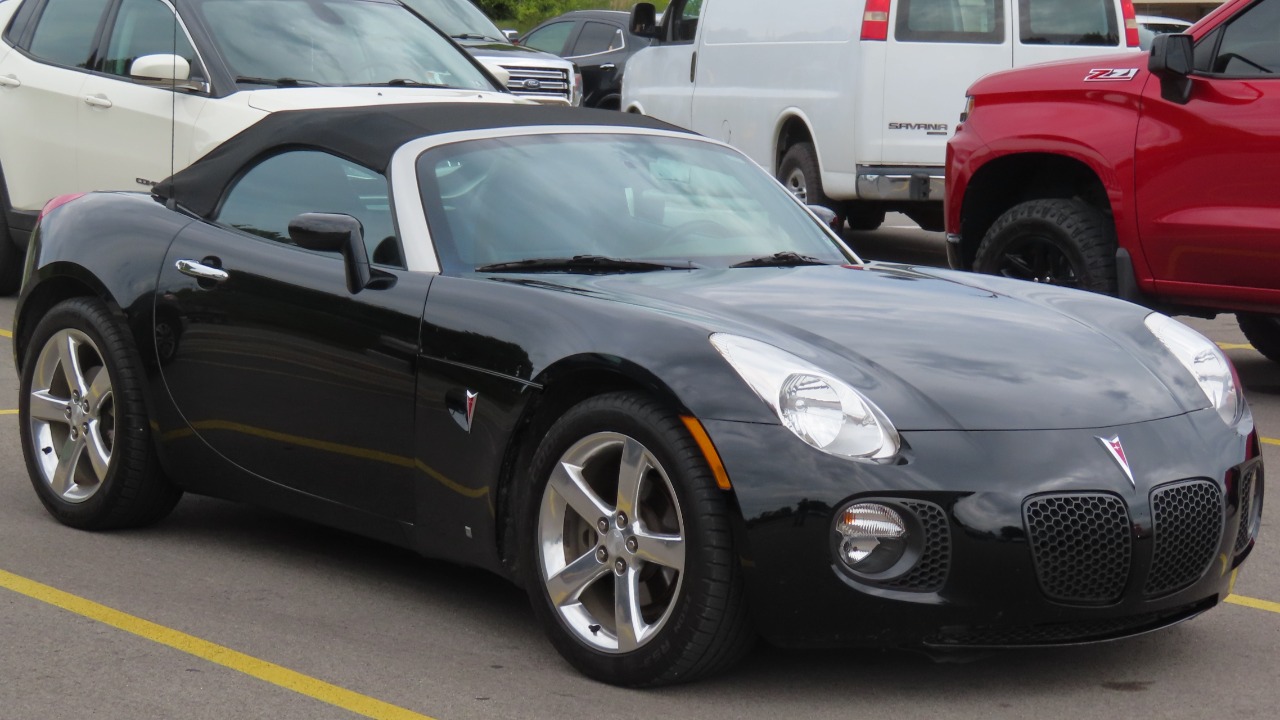

The Mazda Miata has become shorthand for the modern roadster, yet Pontiac quietly built a rival that could outrun it and still slipped from collective memory. The Pontiac Solstice arrived with more power, striking looks, and genuine performance credentials, but it never translated those advantages into lasting fame. I want to unpack how a car that was objectively quicker in key trims ended up as a forgotten footnote instead of the default answer for affordable open-top fun.
GM finally decides it wants a Miata fighter
By the mid 2000s, the Miata had already defined what a small roadster should be, so General Motors went hunting for a way to prove it could do the same formula with more muscle. The Pontiac Solstice was the spearhead of that effort, a compact two-seat convertible that tried to blend classic long-hood, short-deck proportions with the kind of aggressive surfacing Pontiac fans expected. It was not an accident that the car landed in showrooms as a 2006 model, right as Mazda was rolling out a new generation of its own icon, because GM wanted shoppers to cross-shop the two directly.
Inside GM, the project was treated as a statement that the company could still build enthusiast hardware, not just trucks and sedans. The Solstice shared its basic Kappa platform with the Saturn Sky, but Pontiac was positioned as the more extroverted and performance-leaning of the pair, which is why the first production version to reach customers was The Pontiac Solstice rather than its Saturn sibling. From the start, GM framed it as a direct answer to the Japanese benchmark, with more displacement and a bolder design meant to stand out in traffic.
Design drama and the shared spotlight with Saturn Sky
On the street, the Solstice did not look like a cautious corporate response, it looked like a concept car that somehow escaped the auto show stand. The front end was low and rounded, the fenders were pumped up, and the rear haunches gave it a planted stance that made the Miata seem almost delicate by comparison. When the Pontiac Solstice and Saturn Sky finally hit the market for the 2006 model year, they gave GM a pair of visually distinct roadsters that still shared the same bones, a rare moment when the company seemed willing to spend money on style in a niche segment.
The Saturn version leaned into a sharper, more angular aesthetic, while Pontiac kept the curves and the brand’s familiar split grille, which helped each car speak to a slightly different buyer without diluting the engineering investment. For their 2006 model-year debut, the Pontiac Solstice and Saturn Sky took GM into a market it had almost always ignored, and they did it with sheetmetal that still looks fresh today. That visual drama is part of why the Solstice remains striking in photos even if its name no longer comes up in casual car conversations.
Under the hood, Pontiac brought more firepower
Where Mazda stuck to its lightweight, modest-power philosophy, Pontiac tried to win the spec-sheet war. The base Solstice used a 2.4-liter four-cylinder from the Ecotec family, an engine that gave it a clear displacement edge over the Miata and helped the car feel torquier in everyday driving. That motor was not exotic, but it was robust, and it allowed GM to market the car as a step up in grunt without scaring off buyers with high-revving complexity or temperamental behavior.
The real headline, though, arrived when Pontiac added the GXP variant, which bolted a turbocharger onto the same basic architecture and turned the car into a genuine straight-line threat. Under the hood was a boosted four that delivered significantly more power and torque than the naturally aspirated Mazda, a fact that enthusiasts still point to when they argue that GM actually overdelivered on performance. In period testing, the turbocharged Solstice could sprint and pass with an ease that made the Miata feel modest, which is why some retrospectives on how GM tried and failed to beat the Miata highlight that under the hood the Pontiac had more to offer than the Japanese competitor.
Performance specifications and the “quicker than Miata” claim
On paper, the numbers back up the idea that Pontiac built a car that could outrun its Japanese rival in key scenarios. The Pontiac Solstice was General Motors’ attempt at a Miata killer, and in GXP form its Performance Specifications put it well ahead of the Mazda in raw output. That turbocharged version delivered a substantial bump in horsepower and torque over the base car, which already had a displacement advantage, and it translated that into brisk acceleration that made highway merges and back-road straights feel effortless.
Even the naturally aspirated Solstice could claim bragging rights in some tests, especially when conditions favored its extra power rather than the Miata’s lighter weight. Enthusiast discussions still circle back to how the Pontiac stacked up in real-world runs, and they often cite the way its spec sheet looked like something from a more expensive sports car. One detailed breakdown of Performance Specifications notes that The Pontiac Solstice was General Motors’ clearest shot at dethroning the Miata, yet the Miata remained a best-seller despite the Pontiac’s advantages.
Head-to-head with NB and NC Miatas
Numbers are one thing, but enthusiasts care about how cars feel when driven hard, which is why direct comparisons between the Solstice and different Miata generations still spark debate. Some drivers remember track tests where the Pontiac’s extra power helped it pull ahead on straights, only for the lighter Mazda to claw back time in tight corners. That tug-of-war between torque and agility defined much of the conversation, especially as the Miata moved from the NB to the NC generation and changed its own character in the process.
Years after both cars left showrooms, fans still trade stories about which was actually quicker in the real world, sometimes referencing a Japanese video comparison that tried to settle the score. One enthusiast thread recalls watching that clip and notes that the discussion resurfaced at 2:43 in the afternoon, a tiny detail that shows how deeply these matchups lodge in people’s memories. The fact that a forum post can still dissect which was faster, NB Miata, NC Miata or Pontiac Solstice, and even call out the exact figure 43, underlines how seriously enthusiasts took the matchup even if the broader market did not.
Sales success, then a sudden stop
For all the talk about the Miata’s dominance, the Solstice did not flop out of the gate. Introduced in 2006, it (Solstice) was an affordable alternative to the Mazda Miata and in its first year it sold 21,000-plus units, a figure that surprised even some inside GM. That early momentum suggested that buyers were willing to take a chance on a new nameplate if the styling and performance felt special enough, and it briefly looked like Pontiac had found a modern halo car that could sit alongside its muscle offerings.
Dig into the production numbers and the story becomes even clearer. Solstice sales were initially strong, with GM building 21,273 for 2006 and 24,018 for 2007, and those totals actually bested Mazda’s new third-generation roadster in that window. One analysis of the Summer of Solstice points out that the Solstice and Mazda were locked in a genuine sales fight before the financial crisis and GM’s internal turmoil changed the landscape. The car did its part by attracting buyers, but the brand around it was already heading toward the cliff that would eventually lead to Pontiac shutting its doors for good.
Why the Miata still won the war
So how did a car that could outrun the Miata in some trims and even outsell it briefly end up as a historical footnote while the Mazda became a byword for the entire segment? Part of the answer lies in consistency. Mazda kept refining the Miata generation after generation, preserving its core identity while improving comfort, safety, and performance, which built trust with buyers who knew the name would still be around in five or ten years. Pontiac, by contrast, was living on borrowed time, and shoppers who paid attention to GM’s financial troubles had reason to worry about long-term support.
There were also practical compromises that dulled the Solstice’s appeal once the initial excitement faded. The car’s packaging, including its trunk space with the top down and its interior ergonomics, made it less friendly as an everyday companion than the Miata, which had been honed for usability as much as fun. When you add in the fact that the Solstice was more expensive than an equivalent Miata in many trims, even though its base 2.4-liter Ecotec engine and later turbocharged versions offered more power, the value equation tilted back toward Mazda. One retrospective on how this was more expensive than the Miata notes that the GM cars did have some advantages, including that Ecotec and up to 260 lb-ft of torque, but they were not enough to overcome the Mazda’s reputation and polish.
The GXP halo and enthusiast afterlife
Among enthusiasts, the Solstice GXP has become the version that keeps the name alive, even if only in niche circles. Arguably the most exciting and attractive model of the bunch was the Pontiac Solstice in its turbocharged form, which combined the already dramatic styling with serious performance. That car turned the Solstice from a stylish cruiser into something that could legitimately embarrass more expensive machinery in a straight line, and it gave Pontiac a modern halo that felt aligned with its performance heritage.
The GXP’s boosted engine, paired with rear-wheel drive and a manual gearbox, created a package that still looks compelling on the used market, especially for drivers who want more punch than a stock Miata offers. Enthusiast coverage of whether the 260 HP Solstice GXP is really better than Mazda’s NC Miata often highlights how the Pontiac’s distinct styling and power advantage make it feel special even today. One deep dive into why Arguably the most exciting version was the GXP underscores that, in enthusiast memory, the car’s quickest form is the one that still commands attention.
From showroom rival to used-car secret
Today, the Solstice occupies a strange place in the market: it is both a forgotten competitor and a quietly smart buy for people who know what they are looking at. The car’s limited production run, combined with the end of Pontiac as a brand, means there are far fewer of them on the road than Miatas, which helps explain why casual observers rarely see one. At the same time, that scarcity has not yet translated into across-the-board collector premiums, so shoppers can still find cars that deliver serious performance for less money than many newer, less engaging machines.
Some analyses of GM’s forgotten Miata competitors argue that the Solstice and its Saturn twin are now used bargains, especially in turbocharged form, because they offer power and style that would cost much more in a European badge. The fact that the base cars came with that 2.4-liter Ecotec and the top trims delivered up to 260 lb-ft of torque means there is real substance behind the styling. For buyers willing to live with the quirks and the orphan-brand status, the Solstice has become a kind of insider’s choice, a car that once tried to beat the Miata in the showroom and now quietly undercuts it in the classifieds.
Why almost nobody remembers a car that deserved better
When I look back at the Solstice story, what stands out is how much of its fate was decided by forces outside the car itself. The product did what it was supposed to do: it looked fantastic, it went hard in GXP form, and it even managed to outsell the Miata for a brief window. The problem was that Pontiac as a brand was already on the ropes, and no single model, no matter how charismatic, could offset the corporate decisions and economic shocks that were about to reshape GM.
That is why, despite its early success and its genuine performance edge in some trims, the Solstice has faded from mainstream memory while the Miata continues to thrive. Enthusiast circles still talk about how it was Introduced as a fresh alternative and how the Solstice gave Pontiac one last shot of excitement before the lights went out, but those conversations rarely reach beyond people who already care about cars. One detailed look at Introduced Pontiac models notes that Solstice momentum could not change the outcome that eventually led to Pontiac shutting its doors for good. In the end, the Miata’s steady evolution and brand continuity won the long game, while Pontiac’s quicker, flashier rival became a fascinating “remember when” for those of us who still care to look back.
More from MorningOverview