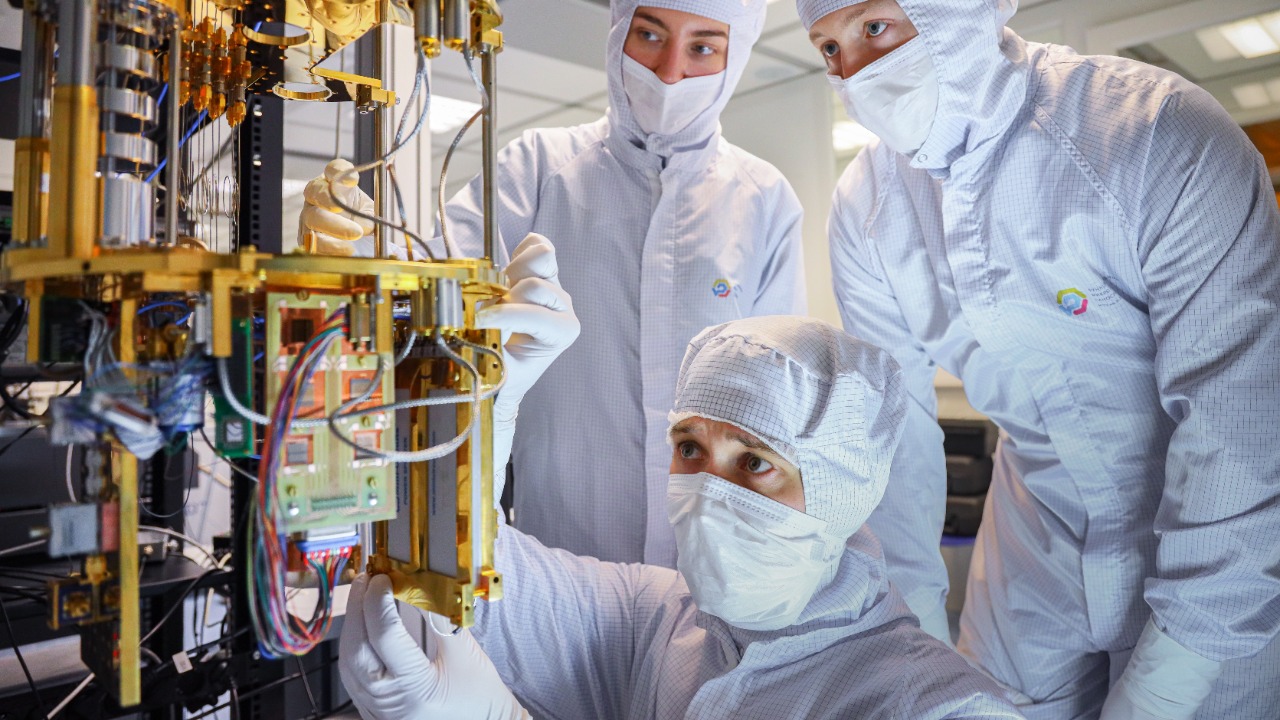

Russia has quietly vaulted into the front rank of quantum powers with a neutral-atom machine that combines a 72-qubit scale with 94% accuracy on two-qubit logic gates. The prototype, built under the state nuclear corporation Rosatom with Moscow academic partners, is not yet a rival to the most advanced Western systems, but it is already good enough to run meaningful experiments and to signal a serious long-term bet on quantum technology. I see this as a pivotal moment, less for what the device can do today than for what it reveals about Russia’s strategy, capabilities, and ambitions in a field that is rapidly becoming a pillar of national power.
From 70-qub milestone to a 72-Qubit neutral-atom leap
Russia’s new platform did not appear in a vacuum, it builds directly on a prior generation of hardware that reached the 70-qub scale. Officials in MOSCOW reported that Russia had completed testing of its first 70-qub system, describing it as a national project managed by Rosatom and framed as a key step in domestic quantum capability, with the announcement explicitly linked to Source Xinhua MOSCOW Dec Russia. That earlier machine established that Russian teams could scale up qubit counts into the tens while keeping the system stable enough to complete formal testing, which is a nontrivial engineering benchmark in its own right.
The new device moves beyond that earlier 70-qub effort by shifting to a neutral-atom architecture and expanding to a full 72-Qubit register in a Prototype that is explicitly described as a Qubit Quantum Computer Prototype. Rosatom and Moscow State University Develop this 72-Qubit platform together, with Rosatom and Lomonosov Moscow State positioned as the core institutional partners that are now anchoring Russia’s push into scalable quantum information processing, as detailed in the description of Rosatom and Moscow State University Develop Qubit Quantum Computer Prototype Rosatom and Lomonosov Moscow State. In my view, that continuity from 70-qub to 72-Qubit is important, it shows that the program is not a one-off demonstration but a sequence of increasingly sophisticated machines.
Inside the 72-qubit architecture and its three-zone layout
At the hardware level, the Russian team has opted for a neutral-atom design that arranges individual atoms into a structured array, and the way they organize that array is central to how the machine works. The architecture features three zones, one for computing and two for storage and readout, which effectively separates the qubits that are actively participating in logic operations from those that are being parked or measured, a layout that can help reduce cross-talk and decoherence during complex sequences of gates, as described in the outline of the architecture features three zones one for computing and two. I see that three-zone structure as a deliberate attempt to bake error mitigation into the physical layout rather than relying solely on software-level correction.
The qubits themselves are single neutral rubidium atoms, trapped and manipulated by laser fields in a way that allows the system to scale up without the wiring complexity that plagues some superconducting designs. Russian researchers have developed and tested a 72-qubit array of these neutral atoms, explicitly described as a 72-qubit device based on single neutral rubidium atoms and linked to Rosatom as the institutional home for the work, which is captured in the description that Russian researchers have developed and tested a 72-qubit. In practice, that means the machine can rearrange its atoms dynamically, a flexibility that is particularly useful for exploring different circuit layouts and interaction graphs as researchers search for algorithms that play to the strengths of neutral-atom hardware.
What 94% two-qubit accuracy really means
The headline figure that has drawn attention is the 94% accuracy on two-qubit logical operations, which is the class of gates that actually entangle qubits and give quantum computers their unique power. The system achieves 94% accuracy in two-qubit logical operations, a level that is high enough to support practical testing and development of quantum algorithms even if it falls short of the 99% plus thresholds that full error-corrected computing will eventually require, as highlighted in the description that the system achieves 94% accuracy in two-qubit logical operations. In my reading, that 94% figure is best understood as a bridge metric, it is not yet at the frontier of global performance, but it is well beyond the toy regime and into territory where algorithm designers can start to probe real-world use cases.
It is also important to put that 94% in context, because multiple platforms now exceed 99.9% fidelity on some operations, especially in superconducting and trapped-ion systems that have been refined over many hardware generations. The Russian team is entering that landscape with a first-generation neutral-atom prototype that already reaches 94%, which suggests that the underlying control systems, lasers, and vacuum hardware are reasonably mature even if they still lag the best in class, a gap that is explicitly acknowledged in the comparison that notes how multiple platforms now exceed 99.9% while still crediting the Russian system with 94% accuracy, as captured in the same Multiple platforms now exceed 99.9 description. I see that as a sign that Russia is not yet chasing absolute performance records, but is instead focused on getting a versatile, mid-fidelity platform into the hands of its researchers.
Scaling pains: more qubits, more errors
Every quantum team that tries to scale up qubit counts runs into the same brutal reality, adding more qubits almost always adds more error channels. The Russian prototype is no exception, and the reporting around it explicitly notes that increasing qubits also increases the errors that are incorporated during computations, a reminder that the 72-qubit scale is both an achievement and a source of new engineering headaches, as described in the observation that However increasing qubits also increases. In my view, that tension between scale and fidelity is exactly why the 94% two-qubit accuracy figure matters, it shows that the team has managed to keep error rates under some control even as they push the system into a more complex regime.
The same analysis notes that, at this stage, the machine is best suited to performing only a specialized function rather than acting as a general-purpose quantum computer, which is a realistic framing for a device that is still a Prototype. That specialization might mean focusing on particular classes of simulation or optimization problems where neutral-atom layouts shine, or on serving as a testbed for error-correction codes that can tolerate 94% gate fidelities, a role that aligns with the description that the system is currently performing only a specialized function in the system’s accuracy and specialized function discussion. I read that as a pragmatic step, rather than overpromising, the Russian program is positioning this machine as a workhorse for targeted research rather than as a magic black box.
How Russia stacks up against Google and IBM
Any assessment of Russia’s new hardware has to be set against the global leaders, particularly the large American programs that have been building quantum machines for more than a decade. A widely shared comparison under the title How Russia’s 70-Qubit Quantum Computer Compares to Google and IBM frames the earlier 70-Qubit effort explicitly against the superconducting devices from Google and IBM, underscoring that those Western systems already operate with higher fidelities and more mature software stacks, as captured in the reference to How Russia 70-Qubit Quantum Computer Compares Google and IBM Russia. From my perspective, that comparison still largely holds for the new 72-qubit neutral-atom prototype, which narrows the gap in qubit count but not yet in gate quality or ecosystem depth.
At the same time, the Russian machine does not need to beat Google or IBM on every metric to matter strategically. By fielding a 72-qubit neutral-atom platform with 94% two-qubit accuracy, Russia is carving out its own technological path rather than simply copying superconducting designs, and it is doing so under a state-backed program that can absorb long development cycles. The fact that the earlier 70-Qubit system was already being discussed in the context of Google and IBM suggests that Russian policymakers and scientists are acutely aware of where they stand in the global hierarchy, and that they see this new Prototype as a way to close some of that distance, a narrative that is reinforced by the juxtaposition in the same Qubit Quantum Computer Compares comparison. I interpret that as a sign that Russia is playing a long game, aiming to be in the conversation rather than to dominate outright in the near term.
Technological sovereignty and Western restrictions
Behind the technical details sits a clear political and economic motive, the drive for technological sovereignty in the face of Western export controls and sanctions. The partnership between Rosatom and Lomonosov Moscow State on the 72-Qubit Qubit Quantum Computer Prototype is explicitly framed as part of Russia’s commitment to technological sovereignty, a phrase that signals a desire to reduce dependence on foreign hardware, software, and expertise in critical fields, as described in the account of its commitment to technological sovereignty. In my reading, that framing is not just rhetoric, it reflects a strategic calculation that quantum computing will underpin future capabilities in cryptography, materials science, and defense, areas where Russia is determined to avoid being locked out by Western technology restrictions.
Social media posts around the launch of the 72-qubit system explicitly reference Western technology restrictions and present the three-zone architecture as a homegrown response that allows Russia to keep advancing despite those constraints. The description that Russia just entered the quantum computing race with a 72-qubit neutral-atom based system with 94% accuracy, tagged with Russia and RosatomQuantum and framed against Western technology restrictions, underscores that the project is being marketed domestically as a breakthrough that defies external pressure, as captured in the reference that Russia just entered the quantum. I see that narrative as part of a broader pattern in which high-profile science projects are used to signal resilience and self-reliance in the face of geopolitical isolation.
Use cases: from quantum teleportation tests to specialized workloads
With 72 qubits and 94% two-qubit accuracy, the Russian machine is not yet ready to crack RSA encryption or simulate complex molecules at industrial scale, but it is already powerful enough to support sophisticated physics experiments. Reporting around the system notes that researchers have achieved the first successful quantum teleportation experiments on the platform, leveraging its 94% accuracy in two-qubit logical operations to move quantum states between different parts of the neutral-atom array, as described in the account of researchers achieving the first successful quantum teleportation where the system achieves 94% accuracy in two-qubit logical operations enabling practical testing. From my perspective, that kind of experiment is exactly what a mid-scale prototype should be doing, stress-testing entanglement and control schemes that will later be embedded in larger, more capable machines.
Beyond teleportation, the system’s current positioning as a device performing only a specialized function suggests that Russian teams are likely focusing on narrow but high-impact workloads, such as small-scale optimization problems, quantum simulation of model systems, or benchmarking of error-correction codes tailored to neutral atoms. The fact that the architecture features three zones, with one for computing and two for storage and readout, makes it particularly well suited to protocols that shuttle quantum information between active and passive regions, a pattern that shows up in many proposed algorithms and communication schemes, as highlighted in the description of the three-zone layout in the architecture features three zones post. I see these early use cases as a proving ground, where Russian researchers can build up algorithmic expertise and software tooling that will carry over as the hardware matures.
Why neutral atoms and 72-qubit scale matter for the next phase
Choosing neutral atoms as the physical qubit platform is not just a technical curiosity, it is a strategic bet on a path that could scale to hundreds or thousands of qubits with relatively modest hardware overhead. The fact that Russian researchers have developed and tested a 72-qubit neutral-atom array based on single rubidium atoms shows that they have already mastered the core ingredients, from laser cooling and trapping to site-resolved control, as described in the account that Russian researchers have developed and tested a 72-qubit. In my view, that positions Russia to ride the same neutral-atom wave that is gaining traction in Europe and the United States, where companies like QuEra and Pasqal are also betting that flexible atom arrays will be a competitive architecture for mid-term quantum advantage.
The 72-qubit scale is particularly significant because it sits at the threshold where classical simulation of the full quantum state becomes extremely challenging, which means that experiments on this machine can probe regimes that are hard to emulate on conventional supercomputers. Combined with 94% two-qubit accuracy, that scale allows for circuits deep enough to explore nontrivial dynamics, even if they still fall short of fault-tolerant computation. The fact that Rosatom and Moscow State University Develop this Qubit Quantum Computer Prototype together, and that it is explicitly described as a 72-Qubit platform tied to technological sovereignty, suggests that the Russian state sees this as a foundation for future, larger systems rather than as an endpoint, a perspective that is reinforced in the description of 72-Qubit Qubit Quantum Computer Prototype. I interpret that as a clear signal that the next phase will focus on pushing both qubit counts and fidelities upward, while building a domestic ecosystem of algorithms and applications around the hardware.
More from MorningOverview