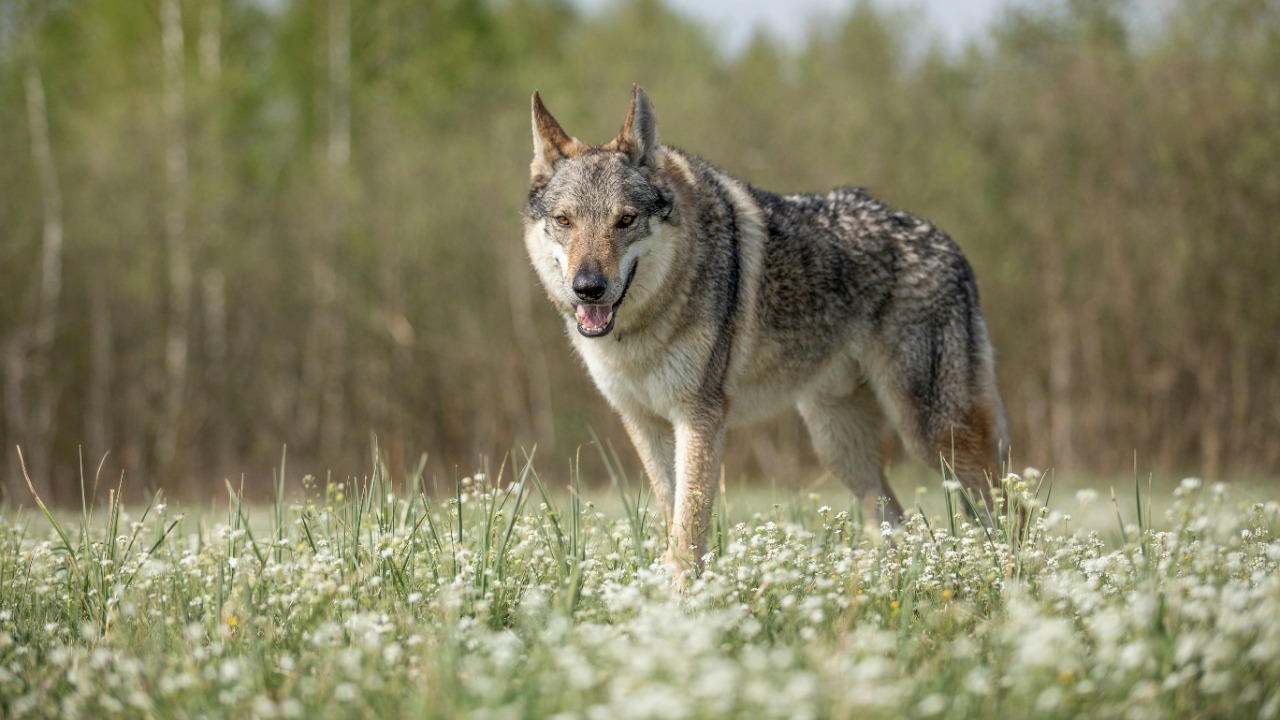

On a wind-battered rock in the Baltic Sea, archaeologists have uncovered a scene that should not exist: gray wolves living side by side with humans on an island that wild packs could never have reached on their own. The evidence now points to a startling conclusion that ancient people deliberately ferried these predators across open water, long before anything resembling a pet dog padded into their homes. That choice, and the relationship it implies, is forcing scientists to rethink when and how humans first began to reshape the lives of wolves.
The discovery turns a remote cave into a kind of time capsule, preserving a moment when people and wolves were experimenting with each other in ways that look less like casual coexistence and more like early animal management. Instead of a simple story in which wolves gradually domesticated themselves on mainland garbage heaps, the Baltic find suggests a more intentional partnership, one that involved boats, planning, and a willingness to share scarce food with sharp-toothed allies.
The unlikely wolves of Stora Karlsö
The animals at the center of this story were found on Stora Karlsö, a small limestone island off the Swedish coast that today is better known for seabirds than for large carnivores. In the Bronze Age, as now, the island had no rivers, forests, or herds of wild ungulates that could support a resident wolf population, and it sits far enough from the mainland that swimming across the cold Baltic would have been lethal for most land mammals. That geographic reality is the first clue that these wolves did not arrive by accident.
Archaeologists working in a cave on the island uncovered bones from several canids that genetic testing later identified as gray wolves rather than dogs or foxes. The remains were found in layers associated with human activity, including hearths and tools, which indicates that the animals were present while people were using the site rather than drifting in as isolated carcasses. Taken together, the location, the geology, and the archaeological context make it very hard to argue that wild packs somehow colonized Stora Karlsö on their own.
A tiny island with no native land mammals
The broader region reinforces that conclusion. Stora Karlsö lies near the larger island of Gotland, yet even that bigger neighbor lacks native populations of large land mammals that could have served as a bridgehead for wolves. Researchers describe the study island as “small (2.5 km2)” and emphasize that, like Gotland, it carries no endemic populations of land mammals that would explain a natural wolf presence. In other words, there was no preexisting terrestrial ecosystem into which wolves could simply slot themselves.
That absence matters because it strips away many of the usual explanations for how predators expand their range. There were no migrating reindeer to follow, no dense forests to hide in, and no chain of stepping-stone populations that could gradually hopscotch across the sea. The only plausible way for sizable canids to appear on such a bare rock is if humans brought them, intentionally or not, in boats that were already plying the Baltic for trade and hunting.
Genomes that point to human transport
Genetic work on the Stora Karlsö bones has turned that geographic suspicion into a much firmer claim. A new genomic study, highlighted in a Research summary, reports that the animals carried wolf ancestry rather than dog-like signatures, yet their genomes also show patterns that do not match fully wild, wide-ranging packs. Instead, the DNA hints at a small, somewhat inbred group, consistent with a handful of animals being moved and then kept in partial isolation.
Those findings dovetail with a separate note from the same project that the wolves had lower genetic diversity than typical mainland populations, a hallmark of either geographic isolation or human-managed breeding. In a follow up, scientists describe how the results “point to humans” as the agents who moved and maintained these canids, a conclusion echoed in a second Research post that frames the animals as isolated or human-managed rather than free-roaming. Genomes alone cannot show a boat, but they can show a bottleneck, and here that bottleneck lines up neatly with the island’s physical isolation.
Archaeology inside the Stora Förvar cave
The bones themselves came from Stora Förvar, a cave on the island that has long attracted archaeologists interested in Stone Age and Bronze Age life around the Baltic Sea. Recent work in the cave uncovered a cluster of canid remains in layers that also contained human bones, tools, and food waste, suggesting that people used the site as a base for hunting and processing marine resources. A detailed summary from one research team notes that the discovery of the “3,000” year old wolves in this context indicates they were part of a broader human occupation rather than stray visitors, a point underscored in a report on Ancient wolves and prehistoric humans.
Another overview from a university team describes how bone analysis from Stora Förvar ties the wolves directly to human activity, with cut marks and deposition patterns that match deliberate handling rather than random scavenging. A separate release from a different institution frames the find as “Ancient wolves on remote Baltic Sea island reveal link to prehistoric humans,” emphasizing that the cave’s stratigraphy shows people and wolves sharing the same confined space for extended periods. That narrative is reinforced in a Communications summary that explicitly links the cave’s canids to prehistoric human behavior.
Living together between 3,000 and 5,000 years ago
Chronology is crucial for understanding what kind of human–wolf relationship played out on Stora Karlsö. Radiocarbon dates place the animals in a window “Between 3,000 and 5,000 years” ago, a span that overlaps with the late Stone Age and early Bronze Age in northern Europe. One synthesis notes that during this period, gray wolves lived in “tight contact with humans” on the island, a phrasing that comes from a detailed feature on Gray wolves and their human neighbors.
Another account focuses on the narrower figure “3,000” years, highlighting that the wolves were already present on the island by that time and had likely been there for generations. That same report stresses that the animals were not fully domesticated dogs but retained many wild traits, which makes their close association with people all the more striking. A separate piece on Gray wolves on a tiny island argues that this time frame “upends the dog domestication debate” by showing that humans were experimenting with wolf relationships long after the earliest proposed domestication dates.
Why boats, not ice, explain their arrival
One of the most striking aspects of the Stora Karlsö wolves is that they appear long after the last glacial ice sheets retreated from the Baltic Sea. That timing rules out the idea that wolves simply walked across frozen straits during an Ice Age cold snap and then became stranded as sea levels rose. Instead, the animals show up in a period when people were already skilled seafarers, moving across the Baltic in wooden boats to hunt seals, trade amber, and connect scattered communities. In that context, transporting a few wolves as cargo or companions becomes not only possible but plausible.
A recent synthesis of the research puts it bluntly: “Researchers have uncovered ancient wolf remains on a remote Baltic Sea island that could only have been transported by people,” a line that appears in a report on Ancient wolves brought by boat. That same piece notes that the island’s isolation and lack of natural prey make human transport the only realistic explanation. When I weigh the geography, the genetics, and the archaeological context together, the boat hypothesis is not a speculative flourish, it is the simplest way to reconcile all the available evidence.
What the bones reveal about human–wolf relationships
The Stora Karlsö wolves are not just a logistical puzzle about ancient shipping routes, they are also a window into how people thought about and used large carnivores. Several reports emphasize that the wolves’ bones show signs of close association with humans, including possible evidence of shared food and selective culling. One feature on the Baltic finds notes that the animals may have been fed on the same marine resources that sustained the human community, suggesting a level of investment that goes beyond opportunistic scavenging. A detailed narrative on Nov describes how the findings suggest humans ferried wolves to the island, shared food with them, and perhaps even raised them as domesticated animals.
Another synthesis from a scientific news outlet frames the island as a kind of controlled environment where people could experiment with wolf management, either for hunting assistance, status, or ritual purposes. That report, which focuses on how “Ancient Humans Introduced Wolves to Remote Baltic Sea” settings, notes that the small “2.5 km2” island would have made it easier to monitor and contain the animals. In that sense, Stora Karlsö may have functioned as an early laboratory for human–wolf interaction, a place where people could test the boundaries between wild predator, working partner, and proto-pet without the risks of a fully wild landscape, as outlined in the detailed account of Ancient Humans Introduced Wolves.
A hunting station, not a permanent village
Archaeologists caution that Stora Karlsö was not a bustling town but more likely a seasonal base. One analysis describes the cave site as a “hunting station,” a place where people came to exploit rich seal and seabird colonies before returning to larger settlements on the mainland or on Gotland. In that scenario, wolves could have served as mobile tools, helping track or manage prey, or they might have been kept nearby for security and ritual reasons. A vivid account on Perhaps the wolves were used to help track seals, though the same source notes that this seems unlikely given the specific hunting methods used in the region.
Even if the wolves were not four-legged seal hunters, their presence at a temporary camp still speaks volumes. Transporting large carnivores to a remote hunting station would have required extra food, handling skills, and a willingness to accept risk, all of which suggest that the animals had perceived value. The same analysis points out that the site’s role as a specialized station fits with broader patterns of Bronze Age mobility in Scandinavia, where people moved seasonally between resource zones. In that mobile world, wolves could have been companions, symbols, or working animals that traveled with their human partners rather than being tied to a single village.
Rewriting the dog domestication debate
The Stora Karlsö discovery lands in the middle of a long-running argument about when and where dogs emerged from their wolf ancestors. Some researchers have argued that domestication began more than 15,000 years ago, while others point to later, regionally specific events. The Baltic wolves do not settle that debate, but they complicate any simple timeline by showing that, even “Between 3,000 and 5,000 years” ago, people were still interacting with full-blooded wolves in ways that look like early domestication experiments. A feature on Between 3,000 and 5,000 years ago explicitly frames the find as a challenge to linear domestication models.
Other work on ancient canids supports the idea that domestication was a messy, multi-stage process rather than a single event. A report titled “Scientists Found Ancient Wolf Remains in a Mysterious Cave” asks, “Did humans domesticate the wolf 5,000 years ago?” and argues that new evidence from another site points to complex, regionally varied relationships between people and wolves. That piece, which highlights the figure “5,000” in its discussion of timelines, underscores that the Baltic find is part of a broader pattern in which humans repeatedly formed and reformed ties with wolves, as summarized in the feature on Scientists Found Ancient Wolf Remains in a Mysterious Cave.
Clues from other Eurasian gray wolves
The Baltic wolves are not the only canids blurring the line between wild and domestic in Eurasia. Another project, summarized in a social media post that asks “Did ancient humans ‘tame’ Eurasian gray wolves?”, describes how “Two wolf-ancestry canids were” found in a different archaeological context, again suggesting close contact between people and non-dog wolves. That work, which is presented as “New archaeological research,” reinforces the idea that Eurasian gray wolves were repeatedly drawn into human orbits in different places and times, as outlined in the post on Did ancient humans tame Eurasian gray wolves.
These parallel finds matter because they show that Stora Karlsö is not an isolated oddity but part of a wider Eurasian pattern. From caves on the mainland to islands in the Baltic Sea, people seem to have been experimenting with wolf relationships in ways that do not fit neatly into a single domestication story. When I put the Baltic evidence alongside these other Eurasian gray wolf cases, the picture that emerges is one of repeated, context-specific attempts to harness or at least coexist with a powerful carnivore, sometimes leading toward dogs, sometimes stopping short.
What this reveals about prehistoric imagination
At its core, the story of wolves on Stora Karlsö is a story about human imagination and risk tolerance. Moving large predators by boat to a “small (2.5 km2)” island in the Baltic Sea required planning, courage, and a willingness to see wolves as something more than threats. It suggests that Bronze Age people around the Baltic Sea were already thinking creatively about how to reshape their environments and their relationships with other species, long before written records captured those ambitions. A university summary on Baltic Sea wolves living alongside humans captures this by noting that the animals “must have been brought there by people,” a simple line with profound implications.
For me, the most striking aspect is not just that ancient people could move wolves by boat, but that they chose to. They were willing to share scarce food, shelter, and space with animals that could easily kill them, betting that the benefits, symbolic or practical, outweighed the dangers. In that choice, glimpsed through bones in a cave and fragments of DNA, I see an early chapter in a much longer story, one that runs from the wolves of Stora Karlsö to the dogs that now sleep at the foot of our beds.
More from MorningOverview