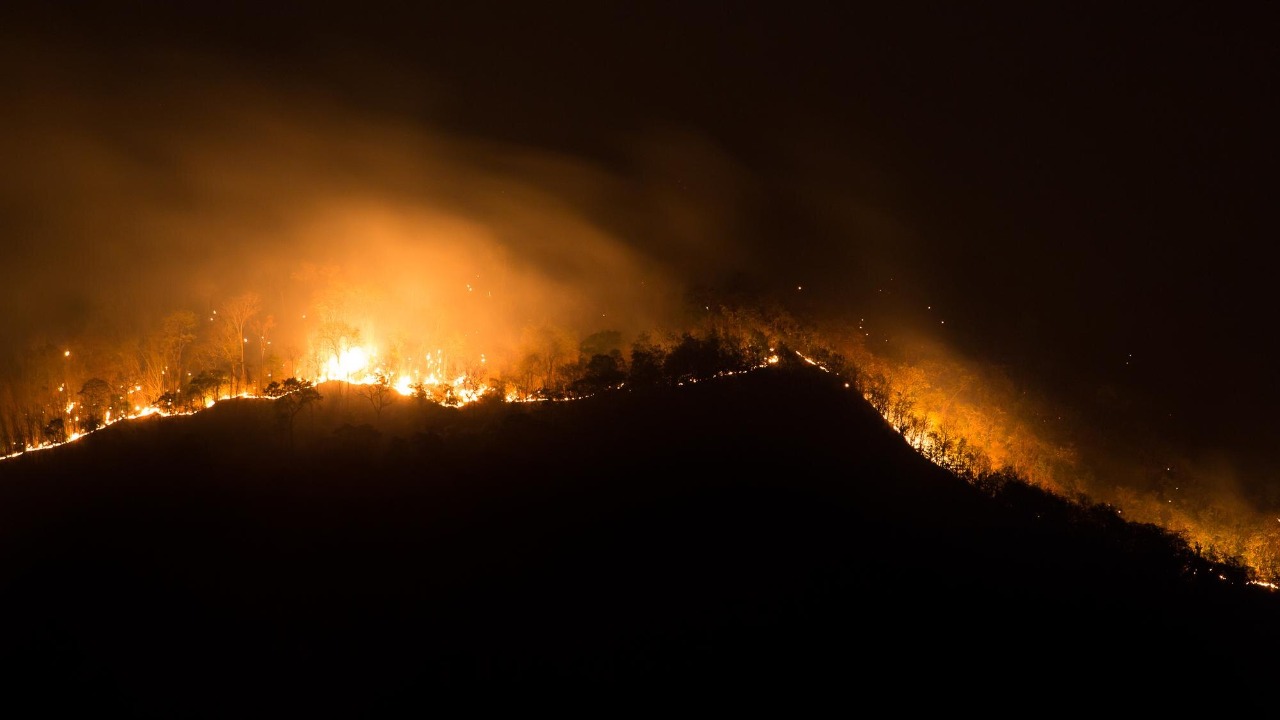

Wildfire smoke is no longer just a short‑lived air quality problem drifting over cities for a few hazy days. New research shows that when these plumes rise high into the atmosphere, they can spawn previously unseen particles that soak up far more sunlight than scientists expected, subtly but powerfully reshaping how the planet warms. That finding, centered on newly identified forms of brown carbon, suggests that the climate impact of fires has been systematically underestimated.
Instead of behaving like a diffuse veil that mostly scatters light, some wildfire smoke appears to harden into compact, strongly light‑absorbing particles that persist and travel long distances. As I look at the emerging evidence, from satellite observations to single‑particle lab analysis, it points to a simple but unsettling conclusion: the physics of smoke is changing in ways that tilt the climate system toward extra heating just as fires themselves are becoming more frequent and intense.
Wildfire smoke is evolving into a new climate wildcard
For years, climate models treated wildfire smoke as a mix of soot, organic droplets, and ash that mostly dimmed sunlight by scattering it back to space. The latest work suggests that is only part of the story, because some plumes lofted miles above Earth are chemically transforming into a new class of particles that behave less like a reflective haze and more like a thin, heat‑trapping blanket. That shift matters because the upper atmosphere is where even small changes in sunlight absorption can ripple through temperature gradients and wind patterns.
Researchers studying one such plume found that as it spread through the upper layers of the atmosphere, it generated particles that were larger and darker than typical smoke, with properties that made them unusually efficient at soaking up solar energy. The smoke, carried high above Earth, effectively turned into a new radiative agent that could not be captured by older assumptions about how Wildfire emissions behave.
Inside the plume, particles grew bigger and darker than expected
The most striking evidence comes from measurements taken inside a dense smoke cloud where scientists detected aerosols roughly 500 nanometers wide, about twice the size of typical wildfire particles. That jump in size is not a trivial detail. Larger particles interact with a broader range of wavelengths, and when they are rich in carbon, they can absorb more visible and near‑infrared light instead of simply scattering it. In practical terms, each particle becomes a more potent microscopic heater.
Those 500‑nanometer aerosols were not just bigger, they were also more solid and internally mixed, a sign that the smoke had undergone chemical aging as it drifted through the upper atmosphere. As the plume evolved, organic vapors condensed and reacted, turning wispy droplets into compact spheres that trapped light more efficiently and converted it into heat. That extra heating, concentrated in a narrow altitude band, has the potential to disturb temperature gradients and even nudge jet streams out of their usual paths, a subtle but consequential way that Inside the smoke can influence large‑scale circulation.
Brown carbon from fires is more powerful than its name suggests
At the heart of this story is brown carbon, a family of organic particles that sit between transparent aerosols and classic black soot in how they interact with light. For a long time, brown carbon was treated as a secondary player, assumed to absorb less light than black carbon and to matter mainly for colorful sunsets rather than global energy balance. New measurements are overturning that hierarchy, especially for the solid, tar‑like particles that wildfires generate in abundance.
One study focusing on wildfire emissions found that dark brown carbon absorbs slightly less light than black carbon on a per particle basis, but because fires release so much of it, the aggregate warming effect can be comparable. In that work, Mishra and Chakrabarty showed that these organic particles are potent climate‑warming agents that complicate the usual picture of soot as the dominant absorber. Their findings imply that any inventory of fire emissions that downplays brown carbon is likely missing a significant slice of the warming pie.
Solid S-BrC “tar balls” change how smoke interacts with sunlight
The most climate‑relevant form of brown carbon emerging from wildfires appears to be solid S‑BrC, often described as tar balls, which are tiny, glassy spheres of carbon‑rich material. Unlike liquid droplets that can evaporate or mix away, these solid particles are resilient and can survive long transport times, which gives them more opportunities to absorb sunlight. Their optical properties are distinct, with a strong preference for absorbing shorter wavelengths, which deepens their warming influence in the upper atmosphere where ultraviolet and visible light are intense.
Researchers using a comprehensive single‑particle and molecular‑level analysis of these solid S‑BrC particles found that their internal chemistry and structure enhance light absorption beyond what bulk measurements would suggest. Here, the team dissected individual tar balls to reveal complex mixtures of aromatic compounds and cross‑linked networks that trap photons efficiently. That level of detail helps explain why plumes rich in tar balls can darken the atmosphere more than expected and why standard parameterizations in climate models, which often treat organic carbon as weakly absorbing, are no longer adequate.
Wildfires are a major source of these strongly absorptive particles
As fires grow larger and more intense, they are injecting unprecedented amounts of solid brown carbon into the air. Wildfires release a large amount of solid‑state strongly absorptive brown carbon, the solid S‑BrC commonly known as tar ball, that is critical to Ear level radiative forcing because it persists and travels. These particles are not a minor byproduct. They are a defining feature of modern megafires that burn through dense forests, peatlands, and even urban fringes, where complex fuels generate especially dark smoke.
In one synthesis of field and lab work, scientists highlighted how Wildfires are now recognized as a dominant global source of these tar‑like particles, with emissions spanning a wide range of sizes and compositions that all share a strong tendency to absorb light. The study, which traced how these particles evolve as they age, underscored that their climate impact is not confined to the fire zone. Instead, the solid S‑BrC can drift across continents and oceans, subtly altering the balance between incoming and outgoing radiation far from the original flames, as documented in detailed measurements of Wildfires and their downwind plumes.
NOAA fire research is rewriting aerosol assumptions
To understand how these particles behave in the real atmosphere, I look closely at coordinated campaigns that combine aircraft, ground stations, and advanced modeling. One such effort, led by a team including Wang, Chakrabarty, Schwarz, Murphy, Levin, and Howell, has focused on the direct and indirect impacts of aerosols and fires on clouds and radiation. By flying through active plumes and sampling smoke at different stages of its evolution, they have been able to map how particle size, composition, and optical properties shift over hours and days.
The work by Wang, Chakrabarty, Schwarz, Murphy, Levin, Howell and colleagues shows that as smoke ages, its brown carbon fraction can become more light‑absorbing, not less, contradicting earlier expectations that atmospheric processing would always bleach organic aerosols. Their measurements feed directly into updated radiative transfer models that now treat wildfire smoke as a dynamic, evolving absorber rather than a static haze. That shift is crucial for weather prediction as well as climate projections, because it affects how forecasters estimate heating rates inside plumes and the resulting feedbacks on cloud formation and storm tracks.
Jet streams and regional weather may feel the heat
When smoke layers absorb more sunlight than expected, they warm the air around them, creating vertical temperature anomalies that can ripple outward. In the upper troposphere and lower stratosphere, where some of these plumes reside, that extra heating can subtly alter pressure gradients that steer the jet streams. Even small shifts in those high‑altitude rivers of air can change where storms track, how long heat waves linger, and how quickly cold fronts move.
The discovery of 500‑nanometer, strongly absorbing particles Inside the smoke cloud helps explain why some recent fire seasons have coincided with unusual weather patterns downstream of major plumes. As those particles heat their surroundings, they can enhance stability in some layers while destabilizing others, a recipe for altered cloud cover and precipitation. Over time, repeated episodes of such plume‑driven heating could imprint a detectable signal on regional climate statistics, especially in mid‑latitude belts where jet streams are already wobbling under the influence of broader warming.
Climate policy and modeling need to catch up with the science
From a policy perspective, the emerging picture of wildfire smoke as a powerful light absorber complicates how I think about mitigation and adaptation. Traditional climate strategies have focused on carbon dioxide and black carbon, with brown carbon treated as a secondary concern. The new findings on solid S‑BrC and dark brown carbon suggest that cutting wildfire risk, through forest management and ignition prevention, may deliver larger near‑term climate benefits than previously counted, because it avoids injecting these highly absorptive particles into the sky.
For modelers, the challenge is to integrate this complexity without overloading simulations. That means updating aerosol modules to distinguish between liquid organic droplets and solid tar balls, incorporating size distributions that include 500‑nanometer particles, and allowing brown carbon absorption to evolve as smoke ages. It also means using field data from teams like Wang, Chakrabarty, Schwarz, Murphy, Levin, and Howell, and molecular‑level studies such as the comprehensive analysis of solid S‑BrC, to calibrate how much extra heating these particles produce. Only then can projections fully reflect how new wildfire smoke particles absorb more light than expected and what that means for the trajectory of a warming planet.
More from MorningOverview