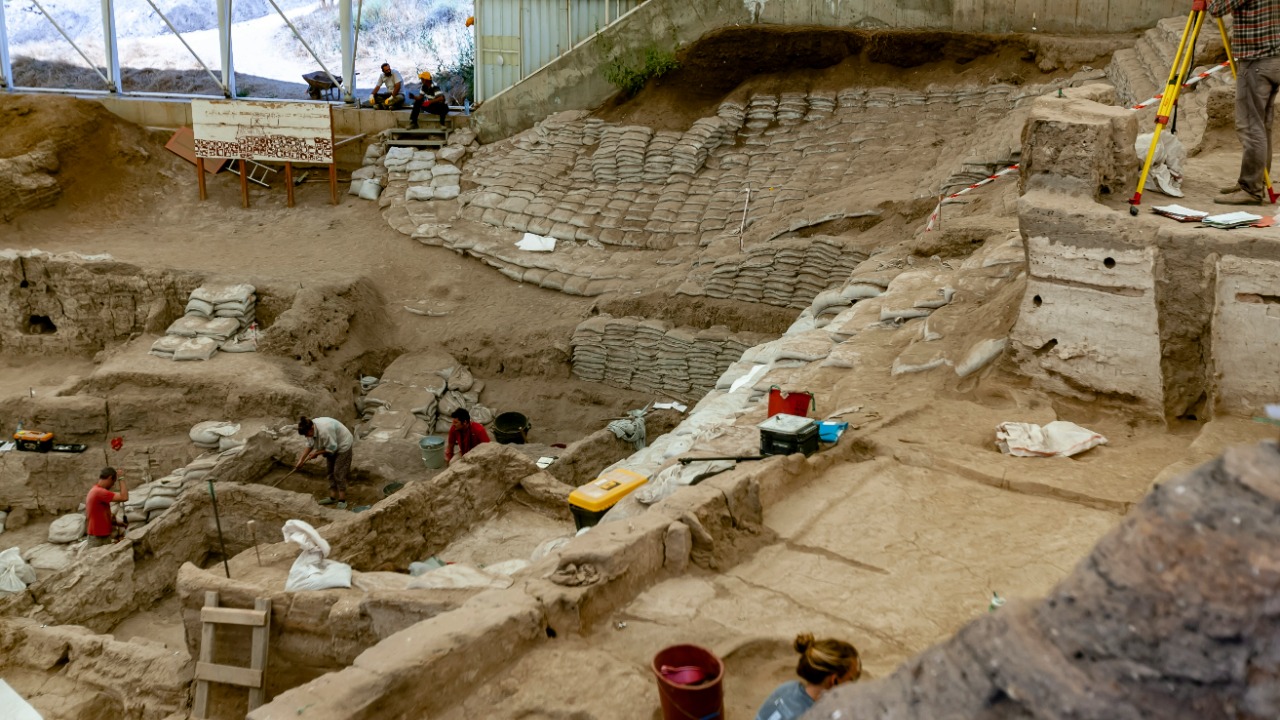

A newly exposed stretch of fortification in Jerusalem has given archaeologists a rare, almost cinematic glimpse of how an ancient city defended itself at a moment of existential danger. The discovery, tucked beneath a former Ottoman prison near the Old City, preserves a long-hidden segment of the First Wall that once ringed Jerusalem and shaped the battles, politics, and faith traditions that converged there.
What has emerged from the soil is not just a line of stones but a 3D cross section of history, from the Hasmonean Kingdom through later conquests and demolitions. As I trace the story of this find, I see how a single surviving wall can illuminate the engineering skill of its builders, the intensity of the fighting it endured, and the way modern Jerusalem still negotiates the layers of its past.
Why this First Wall segment matters now
The newly unearthed section of Jerusalem’s First Wall matters because it is both physically substantial and historically specific, tying a legendary fortification to a precise place and period. Archaeologists have identified it as part of the city’s early defensive ring, a barrier that once defined the limits of Jerusalem and framed the conflicts that raged around it. In a city where many ancient structures survive only as scattered stones or textual references, a continuous run of masonry that can be walked along and measured offers an unusually concrete anchor for reconstructing the urban landscape.
Its exposure also arrives at a moment when the archaeology of Jerusalem is under intense scrutiny, both for what it reveals and for how it is interpreted. The First Wall has long been associated with the Hasmonean rulers who consolidated power after the Maccabean revolt, and the new segment gives researchers a chance to test that association against physical evidence rather than relying solely on later descriptions. By tying this stretch of fortification to the Hasmonean Kingdom and to the later destruction of Jerusalem, the find connects the stones underfoot to the same political and religious dramas that still shape debates over the city’s past.
Unearthing a hidden giant beneath the Kishle
The most striking aspect of the discovery is its scale. Archaeologists working beneath the historic Kishle prison complex have exposed a 131-foot-long run of the ancient city wall, a length that transforms the structure from a curiosity into a defining feature of the site. The Kishle, a layered monument in its own right, has served as an Ottoman barracks and later a prison, but its foundations have now become a viewing window into a much older system of defense. The fact that such a long segment survived intact beneath a heavily used complex underscores how much of ancient Jerusalem still lies sealed under later construction.
Archaeologists describe the wall as having once stood more than 30 feet tall, which means the surviving base represents only the lower portion of a formidable barrier. Even so, the preserved courses of stone are enough to show how the builders stepped the wall along the slope, adjusted its thickness, and integrated it with towers and adjacent structures. The length and height together suggest that this was not a minor retaining wall or ad hoc fortification but a major component of the city’s planned perimeter, a conclusion that aligns with the broader identification of the structure as part of Jerusalem’s First Wall.
From Hasmonean stronghold to Roman ruin
To understand the stakes of this find, I have to place it within the story of the Hasmonean Kingdom and the later Roman destruction of Jerusalem. The First Wall is widely associated with the Hasmonean rulers who expanded and fortified the city after wresting control from Seleucid overlords, turning Jerusalem into a capital that needed serious defenses. The newly exposed section appears to belong to this Hasmonean phase, when the city’s leaders invested in heavy masonry to secure their political and religious center against both external armies and internal rivals.
That same wall later became a target when Roman forces besieged Jerusalem and razed much of the city to the ground. Accounts of the conquest describe systematic demolition of fortifications, and the survival of this segment suggests a combination of collapse, burial, and later reuse that shielded it from complete destruction. The excavation near the Tower of David has revealed what one report calls the Uncovering of the Hasmonean wall, tying the stones directly to the period when Jerusalem was fortified, besieged, and then razed. In that sense, the wall is both a monument to Hasmonean ambition and a scar left by Roman conquest.
A wall built for war at the Tower of David
The location of the find, near the Tower of David, reinforces its military significance. This area has long been recognized as a strategic high point controlling access to the western approach to the city, and the First Wall’s alignment here shows how ancient planners used topography to their advantage. The newly exposed segment appears to run in close association with the Tower of David complex, suggesting that the fortification system combined massive curtain walls with towers that offered elevated firing positions and surveillance over the surrounding valleys.
Archaeologists emphasize that the wall is not a rough or improvised structure but a carefully engineered barrier. One description notes that “The wall is meticulously built”, with stones laid in regular courses and bonded in a way that allowed the structure to withstand both time and assault. That level of craftsmanship reflects not only the resources of the Hasmonean state but also the expectation of serious conflict, since no ruler invests in such a wall unless they anticipate having to defend it.
Reading battle scars and a 2,100-year-old ceasefire
The stones of the First Wall do not just show how the city was built, they also record how it was attacked and, at least for a time, spared. Archaeologists studying the newly exposed segment have identified signs of intense fighting, including damage patterns that suggest concentrated efforts to breach or undermine the fortification. These scars align with historical accounts of sieges in which attackers brought heavy force to bear on the city’s outer defenses, testing the wall’s ability to absorb blows and channel assaults into kill zones.
At the same time, the wall has become a symbol of a moment when violence paused. A video report on the discovery describes how an Ancient Wall Found in Jerusalem Reveals a 2100 Year Old Ceasefire, highlighting evidence that fighting around this sector halted after a negotiated truce. The idea that a ceasefire line once ran along these stones adds a human dimension to the archaeology, reminding me that even in eras defined by conquest and revolt, commanders sometimes chose to stop short of total destruction. The wall thus preserves both the intensity of the battles and the fragile agreements that occasionally interrupted them.
Hanukkah, the Hasmoneans, and a living holiday landscape
The First Wall’s Hasmonean origins give it a direct link to the events commemorated by Hanukkah, which celebrates the rededication of the Temple after the Maccabean revolt. Archaeologists in Jerusalem have framed the discovery as a window into the same era that produced the festival’s core story, noting that the wall belongs to the period of the Hasmonean Kingdom that followed the revolt. In that sense, the fortification is part of the physical infrastructure that allowed the Hasmoneans to consolidate their victory and defend the city whose Temple they had reclaimed.
One report on the excavation describes how Archaeologists uncover an intact section of ancient Jerusalem wall from the Hanukkah era, explicitly tying the structure to the same historical arc that Hanukkah rituals recall. For visitors who encounter the wall today, especially during the holiday season, the stones offer a rare chance to stand beside a surviving piece of the city that the Maccabees fought to control. The discovery turns Hanukkah from a story told in texts and songs into a landscape that can be walked and touched.
Inside the excavation: how archaeologists exposed the First Wall
Reaching this segment of the First Wall required careful excavation in a cramped and historically sensitive environment. The Kishle complex sits within a dense cluster of heritage structures, so archaeologists had to work in stages, removing later floors and fill while documenting every layer they passed through. As they descended, they encountered traces of different eras, from Ottoman and British use of the site down to earlier foundations that hinted at the presence of a major ancient feature. Only after peeling back these later phases did the continuous line of the wall emerge, revealing itself as a coherent structure rather than a scatter of isolated stones.
Reports on the project describe how Archaeologists discovered a portion of Jerusalem’s First Wall tucked inside a historic complex near the Tower of Dav, underscoring the surprise of finding such a substantial ancient feature embedded within a relatively modern building. The team had to stabilize both the wall and the overlying structures, balancing the need to expose enough of the fortification for study and display with the obligation to preserve the Kishle itself. That balancing act is typical of urban archaeology in Jerusalem, where every new discovery sits beneath and beside layers that are themselves historically significant.
What the masonry reveals about ancient engineering
Once the wall was exposed, its construction details became a primary source of information about Hasmonean engineering. The courses of stone show a consistent pattern, with large, roughly rectangular blocks on the exterior faces and smaller stones used to fill the core, a technique that combines strength with efficient use of material. The alignment of the wall along the slope suggests that the builders understood how to distribute weight and resist lateral pressure, while the integration of buttresses and possible tower bases indicates a sophisticated approach to both structural stability and defensive function.
Archaeologists who studied the wall emphasize its precision, noting that the Unparalleled Segment of this Ancient City First Wall stands out for the care invested in its construction. That meticulous work suggests a centralized project overseen by skilled planners rather than a patchwork of local efforts. For me, the engineering details confirm that the Hasmonean Kingdom was not only a political and religious power but also a state capable of organizing large-scale infrastructure, a point that sometimes gets lost when the era is discussed solely through the lens of revolt and ritual.
From Dec discoveries to Dec debates about heritage
The timing of the public announcements about the wall, clustered in Dec, has shaped how the discovery is being discussed both in Israel and abroad. The fact that the find became widely known during a period when many people are already focused on Jerusalem and its holidays has amplified its symbolic resonance. It has also drawn attention to the role of institutions like the Tower of David Museum, which now finds itself stewarding not only medieval and Ottoman remains but also a key segment of the city’s earliest known fortifications.
One detailed account of the project, titled Uncovering Jerusalem First Wall, highlights how the excavation has turned the Tower of David area into a kind of vertical timeline, with Crusader, Ottoman, and modern layers stacked above the Hasmonean wall. As debates continue over how to present and interpret Jerusalem’s past, this discovery will likely become a touchstone for discussions about which periods receive prominence, how to balance religious and secular narratives, and how to share limited space among competing claims on the city’s history.
How a single wall segment reshapes the map of ancient Jerusalem
Beyond its immediate visual impact, the First Wall segment beneath the Kishle forces scholars to refine their mental and drawn maps of ancient Jerusalem. Every new measurement of the wall’s course, thickness, and relationship to nearby features helps constrain models of where the city’s boundaries lay at different times. The 131-foot-long stretch provides enough data points to test previous reconstructions of the First Wall’s path, confirming some hypotheses and challenging others about how the fortifications wrapped around the western hill and connected to other known segments.
For urban historians and biblical scholars, that refined map has cascading implications. It affects how they locate key sites mentioned in texts, how they understand the logistics of sieges, and how they interpret references to gates, towers, and neighborhoods that depended on the wall’s alignment. As more of the First Wall is identified and correlated with finds like the section near the Tower of Dav, the picture of Jerusalem at the time of the Hasmonean Kingdom and the later Roman conquest becomes less abstract and more like a city that can be walked in the mind, street by street and wall by wall.
More from MorningOverview