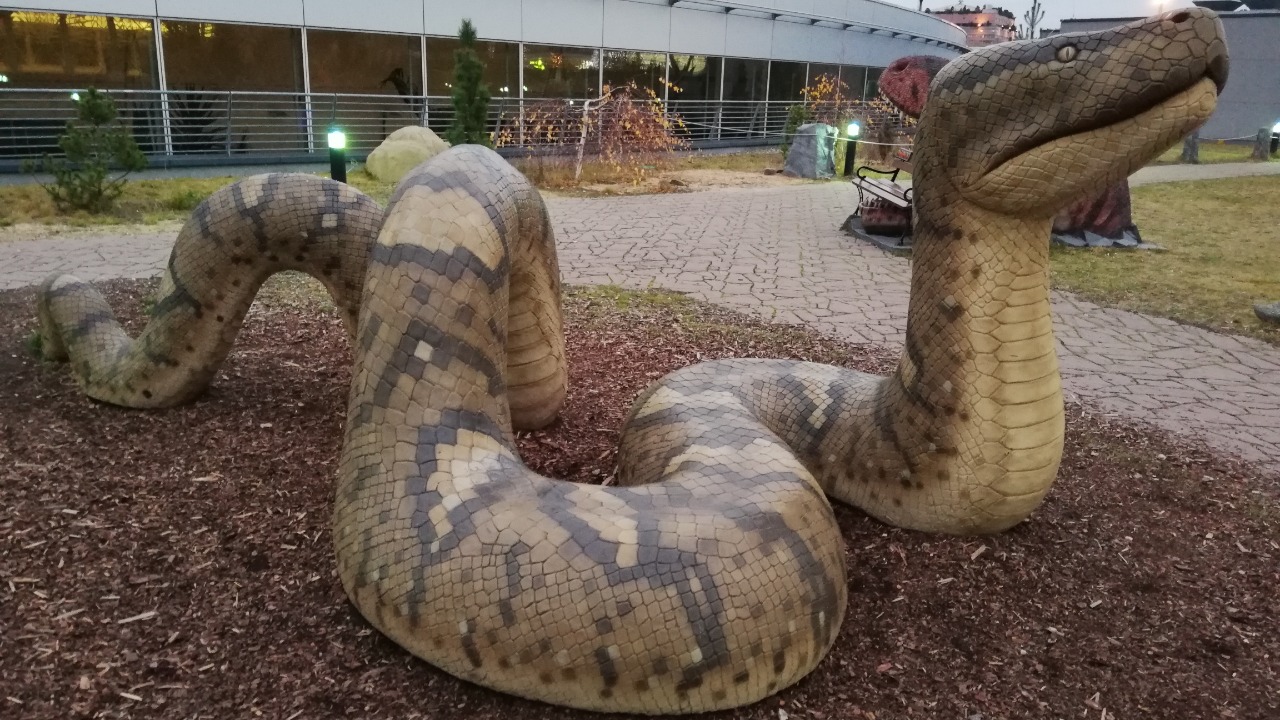

A newly described fossil snake from India is forcing scientists to redraw the record books on reptile gigantism, with some estimates suggesting it stretched longer than a modern city bus and outweighed most cars. For years, Titanoboa has dominated popular imagination as the ultimate mega‑serpent, but the creature now named Vasuki indicus may have been even more imposing in both length and bulk. The discovery is not just a size contest, it is a window into a greenhouse world where snakes the length of a school bus were part of the everyday ecosystem.
Meet Vasuki indicus, the new giant on the block
The newly identified species, Vasuki indicus, comes from fossil vertebrae recovered in a coal mine in what is now India, and the bones point to a snake that pushed the upper limits of what a cold‑blooded predator can be. Researchers working on the material concluded that this animal was not simply large by modern standards, it was a true outlier even among extinct snakes, with a body plan that suggests a slow, heavy ambush hunter rather than a fast, agile constrictor.
In social posts highlighting the find, the animal has been described as a giant snake longer than a school bus, with its vertebrae preserved in a coal deposit that once formed part of a lush tropical wetland. One widely shared description notes that a giant snake called VasukiIndicus, longer than a SchoolBus, lived in India 47 million years ago and that researchers from IIT Roorkee found its vertebrae fossils in a CoalMine, presenting the snake as an ambush predator in a warm, tropical climate, a description captured in a Facebook No post.
How big was Titanoboa, the previous record holder?
To understand why Vasuki indicus is causing such a stir, it helps to recall just how enormous Titanoboa already was. Discovered in the Cerrejón coal mines of Colombia, Titanoboa has long been held up as the archetypal giant snake, a creature that followed the extinction of the dinosaurs and prowled swampy forests filled with crocodile‑like reptiles and giant turtles. Its size estimates have always been staggering, even to specialists who work with large reptiles.
Analyses of the Colombian fossils suggest that Titanoboa clocked in at an estimated 35 to 50 feet long, with the mean estimate around 42 feet in length, a range that already places it far beyond any living snake and firmly into the realm of megafauna, as summarized in a detailed overview of Titanoboa. Other compilations of the fossil record note that researchers have identified about 180 different bones, mainly vertebrae and costae, belonging to 28 individuals, which has allowed paleontologists to refine body size estimates and compare Titanoboa to modern boas and anacondas using a substantial sample of material, as outlined in a 180 bone inventory.
Vasuki versus Titanoboa: who was really bigger?
The headline claim that Vasuki indicus makes Titanoboa look small is rooted in new size estimates that push this Indian snake into truly colossal territory. Researchers studying the vertebrae used comparative measurements with living snakes to extrapolate total body length, a standard approach in vertebrate paleontology when only parts of the skeleton are available. Their calculations suggest that Vasuki may have reached lengths that edge past the upper estimates for Titanoboa, at least in some scenarios.
One analysis of the fossils reports that scientists used two different methods for estimating the size of Vasuki, both based on comparisons with modern snakes, and that these approaches converged on a length of 48 to 50 feet, which would place Vasuki slightly beyond the 43-Foot range often cited for Titanoboa and into a size class that would indeed rival or exceed a school bus in total length, as described in a technical discussion of Vasuki. At the same time, some specialists caution that Titanoboa itself has a broad estimated range, from 35 to 50 feet, so the two species may overlap in size rather than one cleanly dwarfing the other.
Why scientists are cautious about the “biggest snake ever” crown
Even as the numbers for Vasuki indicus circulate widely, researchers are quick to stress that size estimates based on partial skeletons come with significant uncertainty. The vertebrae of snakes can vary along the length of the body, and without a complete series, paleontologists must infer how representative a given bone is of the overall animal. That is why the language around these giants tends to emphasize ranges and probabilities rather than precise, single figures.
One paleontologist, Jacob McCartney, has been quoted emphasizing that caution is always warranted whenever you are extrapolating beyond the available data set, a reminder that each new fossil is only one piece of an ancient puzzle and that claims about absolute records should be treated carefully, a point captured in a discussion that highlights both Caution and Jacob in the context of giant snake estimates in Apr. That same perspective applies to Vasuki, where the temptation to declare a new champion must be balanced against the fragmentary nature of the remains and the statistical noise inherent in scaling formulas.
Inside the fossil evidence: vertebrae, skulls and missing pieces
The physical evidence for Vasuki indicus consists primarily of vertebrae, a pattern that is common in snake paleontology because the backbone is both abundant and relatively robust. Each vertebra carries clues about the animal’s overall proportions, from the width of the neural arch to the shape of the articulating surfaces that link the bones into a flexible column. By comparing these features with those of living snakes, researchers can infer not only length but also whether the animal was slender or thick‑bodied, agile or ponderous.
However, the fossil record of snakes is notoriously patchy, and even in well studied Eocene deposits, it is somewhat surprising that some taxa are represented by a skull bone but no vertebrae, whereas others are known only from vertebrae and lack cranial material entirely, a pattern documented in work on squamate reptiles from the middle Eocene of Lissieu in France that notes how difficult it can be to link isolated elements to a single taxon, while still acknowledging that such a link cannot definitely be rejected, as discussed in a study of squamate reptiles. Vasuki fits into this broader pattern, where vertebrae provide a tantalizing but incomplete picture, leaving open questions about skull shape, dentition and precise feeding strategies.
From India to Africa: what Vasuki reveals about ancient geography
Beyond the spectacle of size, Vasuki indicus carries important clues about how giant snakes spread across ancient continents. The fossils come from a time when India had already collided with Asia, creating new land routes and climatic zones that could be exploited by large reptiles. The presence of such a massive snake in this setting suggests that tropical ecosystems capable of supporting top predators of this scale were more widespread than previously appreciated.
Researchers studying related fossil snakes have argued that their work shows these snakes moved from India to north Africa through southern Eurasia after the Indian plate docked with the rest of the continent, tracing a biogeographic corridor that would have allowed large constrictors to disperse westward into new habitats, a conclusion summarized in a study that notes, in the authors’ words, that Our study has also shown that these snakes moved from India to north Africa through southern Eurasia after the Indian plate collided, a finding detailed in an analysis of movements between India, Africa and Eurasia in Our. Vasuki’s presence in Indian coal deposits therefore fits into a larger story of snake evolution that spans from the subcontinent to Africa and beyond.
A greenhouse world built for mega‑snakes
Both Titanoboa and Vasuki indicus thrived in climates that were significantly warmer and more humid than today’s tropics, conditions that are particularly favorable for cold‑blooded giants. Large ectotherms depend on ambient temperatures to maintain their metabolism, and a hotter world allows them to grow bigger while still remaining active enough to hunt and reproduce. The coal deposits that preserve these snakes’ remains are themselves evidence of dense, swampy forests that would have provided both cover and prey.
Reconstructions of Titanoboa’s habitat in the Cerrejón Formation, for example, depict a lowland rainforest with abundant water channels, where a snake in the 35 to 50 foot range and averaging around 42 feet could lurk in murky pools and ambush passing crocodilians, a scenario supported by the same size estimates that define Titanoboa’s place in the fossil record and that underscore how such a snake would have dominated its ecosystem, as outlined in the synthesis of Titanoboa. Vasuki’s coal‑mine setting in India points to a similarly warm, tropical climate, reinforcing the idea that greenhouse conditions are a prerequisite for snakes of this scale.
How scientists actually measure a fossil snake
Estimating the size of a fossil snake is a more intricate process than simply measuring a bone and multiplying by a constant. Paleontologists start by identifying which part of the vertebral column a given bone comes from, since neck, trunk and tail vertebrae can differ in shape and relative size. They then compare those measurements with a database of modern snakes, looking for statistical relationships between vertebral dimensions and total body length that can be applied to the fossil.In the case of Vasuki indicus, researchers explicitly used two different methods for estimating size, both involving comparisons with living snakes, and found that the results converged on a length of 48 to 50 feet, which suggests that the underlying scaling relationships are robust enough to support the claim that this snake was at least comparable in size to the 43-Foot Titanoboa, as described in a detailed breakdown of how the researchers approached Scientists Uncover Bones of Massive Extinct Snake, Comparable, Size, Foot Titanoboa, Scientists Uncover Bon. These methods do not eliminate uncertainty, but they provide a transparent framework that can be refined as new fossils or better modern analogues become available.
The debate among experts and enthusiasts
Unsurprisingly, the claim that Vasuki indicus might outsize Titanoboa has sparked lively debate among both professional paleontologists and informed enthusiasts. Some argue that the overlap in estimated ranges means it is premature to declare a clear winner, while others point to differences in body robustness that could make one snake heavier even if the other was slightly longer. The discussion reflects a broader tension between the desire for simple records and the messy reality of incomplete fossils.
In one online Comments Section devoted to paleontology, for instance, contributors note that it is kinda uncertain which snake was truly larger, and that based on the estimations used and the general dimensions, one possibility is that Vasuki was more robust and heavier even if the maximum lengths are similar, a line of reasoning captured in a thread that explicitly weighs whether Vasuki indicus is bigger than Titanoboa and that highlights how Based on current data, both interpretations remain plausible, as seen in a discussion on Comments Section. That kind of back‑and‑forth is healthy for the field, forcing researchers to clarify their assumptions and communicate the limits of their models.
Why giant snakes capture the public imagination
Part of the reason Vasuki indicus has broken through into mainstream attention is that giant snakes occupy a special place in popular culture, from mythological serpents to modern monster movies. The very idea of a snake longer than a bus taps into deep‑seated fears and fascinations, making these fossils ideal ambassadors for paleontology even as they challenge audiences to think critically about evidence and uncertainty. When a new contender appears, it naturally invites comparisons with the reigning champion and fuels headlines that frame the story as a showdown.
That dynamic is evident in recent video explainers that open with the line You have heard of Titanoboa, the largest snake ever discovered, or so we thought, before introducing Vasuki indicus as a prehistoric monster snake that made its famous predecessor look modest, and emphasizing that Scientists recently uncovered fossils of this predator that lived millions of years after the dinosaurs, a narrative arc laid out in a widely shared You video. As long as new fossils keep emerging from coal mines and rock quarries, that blend of spectacle and science will continue to draw people into the deeper questions these mega‑snakes raise about climate, evolution and the limits of life on Earth.
More from MorningOverview