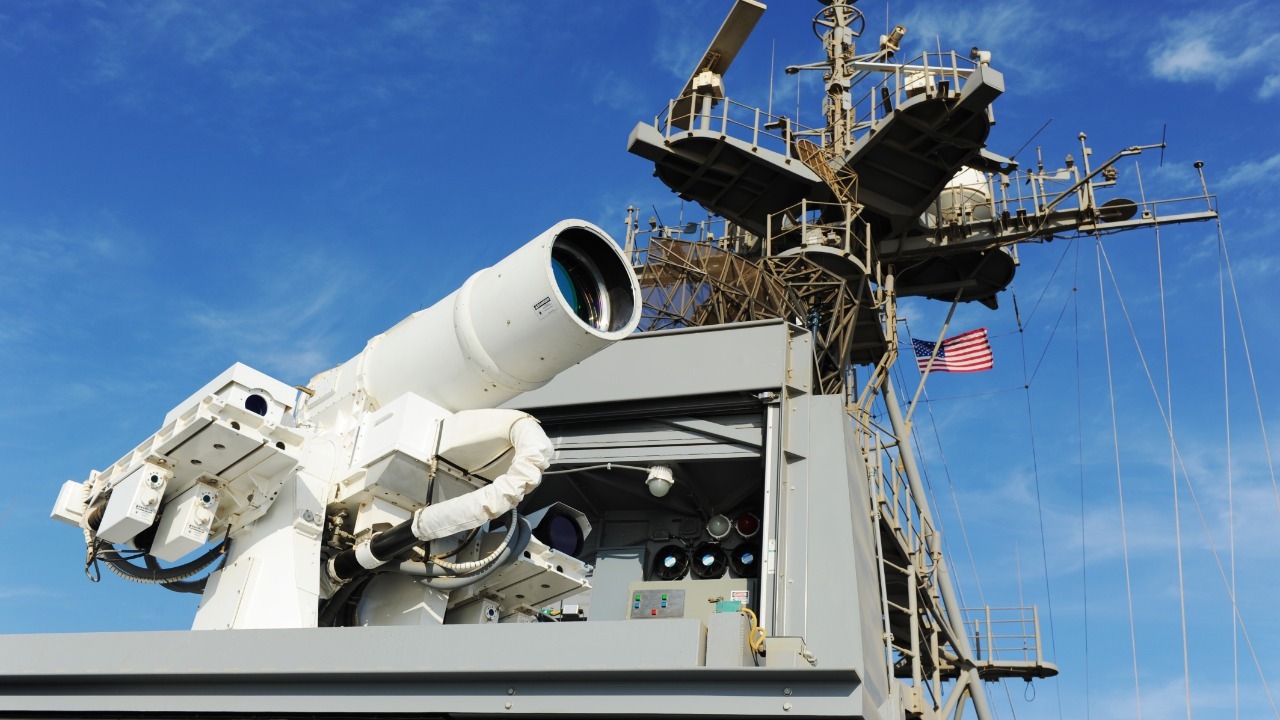

Japan has quietly crossed a threshold in naval warfare, installing a massive high-energy laser on a dedicated test ship and beginning live trials at sea. The system, rated at 100-kilowatt power, is designed to slice through drones and other airborne threats, signaling that directed-energy weapons are moving from lab benches to operational decks.
I see this as more than a flashy technology demo. By mounting such a system on a naval platform, Japan is testing whether lasers can shoulder real defensive duties in crowded air and maritime spaces, reshaping how fleets think about air defense, magazine depth, and the cost of shooting down cheap but dangerous unmanned systems.
Asuka, the quiet testbed carrying a very loud message
The centerpiece of this story is the test ship Asuka, a vessel long used by the Japan Maritime Self-Defense Force as a floating laboratory and now home to a conspicuous new containerized laser module. The system observed aboard Asuka is described as an electric-drive high-power laser, identifiable by a distinctive 40-ft container that houses the core equipment and supporting systems, a configuration that makes it easier to bolt onto existing hulls without a full redesign of the ship’s superstructure, as detailed in reporting on the high-energy laser system. By choosing a test platform rather than a front-line destroyer, Japan can push the technology hard, gather performance data, and refine tactics without disrupting regular fleet deployments.
Asuka’s role is not just technical, it is symbolic. Mounting a containerized laser on a dedicated trials ship signals that the navy is treating directed energy as a serious future capability, not a science project. The ship can host instrumentation, engineers, and observers to monitor how the laser behaves in real sea states, under varying weather, and during complex maneuvers, feeding critical data toward the goal of eventually integrating similar systems into combatants that escort carriers, protect key straits, or guard high-value infrastructure.
A 100-kilowatt leap in shipboard firepower
At the heart of the program is raw power. Japan has begun testing a powerful 100-kilowatt ship-mounted laser weapon, a figure that places the system squarely in the class of high-energy devices capable of burning through metal and disabling drones rather than merely dazzling sensors, according to descriptions of how Japan has begun testing a powerful 100-kilowatt ship-mounted system. That power level matters because it determines how quickly the beam can deposit enough energy on a target to cause structural failure, ignite fuel, or fry electronics before the threat closes the distance.
On land, Japan’s Acquisition, Technology and Logistics Agency, or ATLA, has already confirmed that a 100-kilowatt laser system can cut through metal and destroy drones in mid-flight, demonstrating that the underlying technology is mature enough to move from static ranges to dynamic environments at sea, as noted when Japan trials 100-kilowatt laser weapon were disclosed by ATLA. Translating that performance to a moving ship, with vibration, salt spray, and atmospheric turbulence, is the next big step, and it is precisely what the Asuka trials are designed to probe.
From prototype spotting to official confirmation
The public first got a glimpse of this naval laser when a prototype high-energy weapon was spotted on the deck of an experimental testbed ship, a sighting that showed a boxy module and associated optics sitting where traditional gun mounts might otherwise be, as described in coverage that noted how a prototype high-energy laser weapon was spotted. The Japanese decision to test such a prototype in plain view, rather than hiding it deep inside a secure yard, suggests a degree of strategic signaling, a way to show both domestic and foreign audiences that the country is investing in cutting-edge defenses.
That early sighting has since been backed up by more formal disclosures. On Dec 2, Japan’s Acquisition, Technology and Logistics Agency confirmed in a statement that the laser system under test is part of a broader effort to field operational directed-energy defenses, explicitly tying the sea trials to earlier land-based experiments where the same class of weapon cut through metal plates and intercepted drones, as ATLA explained when Japan’s Acquisition, Technology and Logistics Agency, ATLA detailed the system’s capabilities. The progression from a prototype sighting to an official acknowledgment marks the transition from curiosity to declared program.
Why drones pushed lasers from theory to the test range
I see the timing of this naval laser push as directly linked to the explosion of drone threats. Japan has equipped a naval test ship with a 100-kilowatt laser specifically to take down drones, a mission that plays to the strengths of directed energy, since a beam can be retargeted almost instantly from one small, fast-moving object to another without reloading, as highlighted in reports that Japan has equipped a naval platform with such a system. In an era when relatively cheap quadcopters and fixed-wing drones can carry explosives, sensors, or jammers, traditional missiles start to look like an expensive way to swat flying robots.
Lasers invert that cost equation. Once the generator and optics are installed, each shot is essentially limited by fuel or electrical power, not by a finite magazine of interceptors. That is why ATLA’s demonstration that a 100-kilowatt beam can cut through metal and drones in mid-flight is so important, because it shows that energy-based defenses can, at least in principle, handle swarms of small threats without bankrupting the defender, a point underscored when Japan Just Installed a Massive Laser Weapon on Its Naval Test Ship to focus on hitting drones. For a country that must defend long coastlines, dense ports, and critical infrastructure, the ability to cheaply and repeatedly burn down incoming unmanned systems is a compelling proposition.
Inside the container: how the system is structured
Although the exact internal layout remains classified, the visible structure of the Asuka-mounted laser reveals a modular architecture built around that 40-ft container, which likely houses the power conditioning equipment, cooling systems, and laser generation hardware. On top or adjacent to this container, imagery shows domed or turret-like modules that would contain beam directors and sensors, echoing the way ATLA’s land-based system uses large 12-meter domed modules to protect and steer the optics for its 100-kilowatt beam, as described when the agency detailed how its 12-meter domed modules support the weapon. The containerized approach allows engineers to swap out components, upgrade subsystems, and even move the entire package to another hull if needed.
From a naval architecture perspective, this structure also simplifies integration. Rather than carving out new internal spaces or rerouting major cables through the ship, the container can tap into existing power trunks and cooling loops, with external conduits connecting it to the beam director and sensors. That modularity is crucial if The Japanese navy wants to scale the technology across multiple platforms, because it reduces the time and cost required to retrofit destroyers, frigates, or even auxiliary ships with directed-energy defenses, a point that aligns with descriptions of the system as a prototype that can be iterated and redeployed as a prototype high-energy laser rather than a one-off bespoke installation.
ATLA’s role and Japan’s broader defense shift
Japan’s Acquisition, Technology and Logistics Agency sits at the center of this effort, acting as both the technical brain and the procurement arm for advanced systems like the naval laser. When ATLA confirmed that its 100-kilowatt laser could cut through metal and drones in mid-flight, it was not just touting a lab success, it was laying the groundwork for a portfolio of directed-energy projects that span land, sea, and potentially air platforms, as seen in its detailed explanation of how Japan trials 100-kilowatt laser weapon under its oversight. The agency’s involvement signals that this is not a side project but part of a national strategy to modernize defenses.
I read this as one piece of a broader shift in Japan’s security posture. As regional tensions grow and missile and drone arsenals expand around its periphery, Tokyo is investing in technologies that promise both resilience and cost-effectiveness. Directed-energy weapons fit that bill, offering the potential for deep magazines and rapid engagement cycles, and ATLA’s decision to push a 100-kilowatt system onto a ship like Asuka shows a willingness to move quickly from concept to sea trial, rather than waiting for a perfectly polished product before testing it in the real world.
What this means for future naval warfare
Mounting a massive laser weapon on a naval test ship is not just about Japan’s own defense, it is a signal about where naval warfare is heading. If the Asuka trials prove that a 100-kilowatt beam can reliably track and destroy drones and perhaps other small threats in realistic conditions, it will validate the idea that future surface combatants should carry a mix of missiles, guns, and directed-energy systems, each tailored to different parts of the threat spectrum, a trajectory hinted at when Japan Just Installed such a Massive Laser Weapon on Its Naval Test Ship. In that future, lasers might handle swarms of cheap drones, while missiles are reserved for high-end threats like cruise and ballistic missiles or manned aircraft.
There are still hard questions to answer, from how the beam performs in heavy rain or sea spray to how ships manage the power and cooling demands of sustained firing. Yet by putting a containerized 100-kilowatt system on Asuka and running it through its paces, Japan is turning those questions into engineering problems rather than hypotheticals. The data gathered now will shape not only its own fleet designs but also the expectations of allies and competitors who are watching closely to see whether directed-energy weapons can finally live up to decades of promise in the unforgiving environment of the open sea.
More from MorningOverview