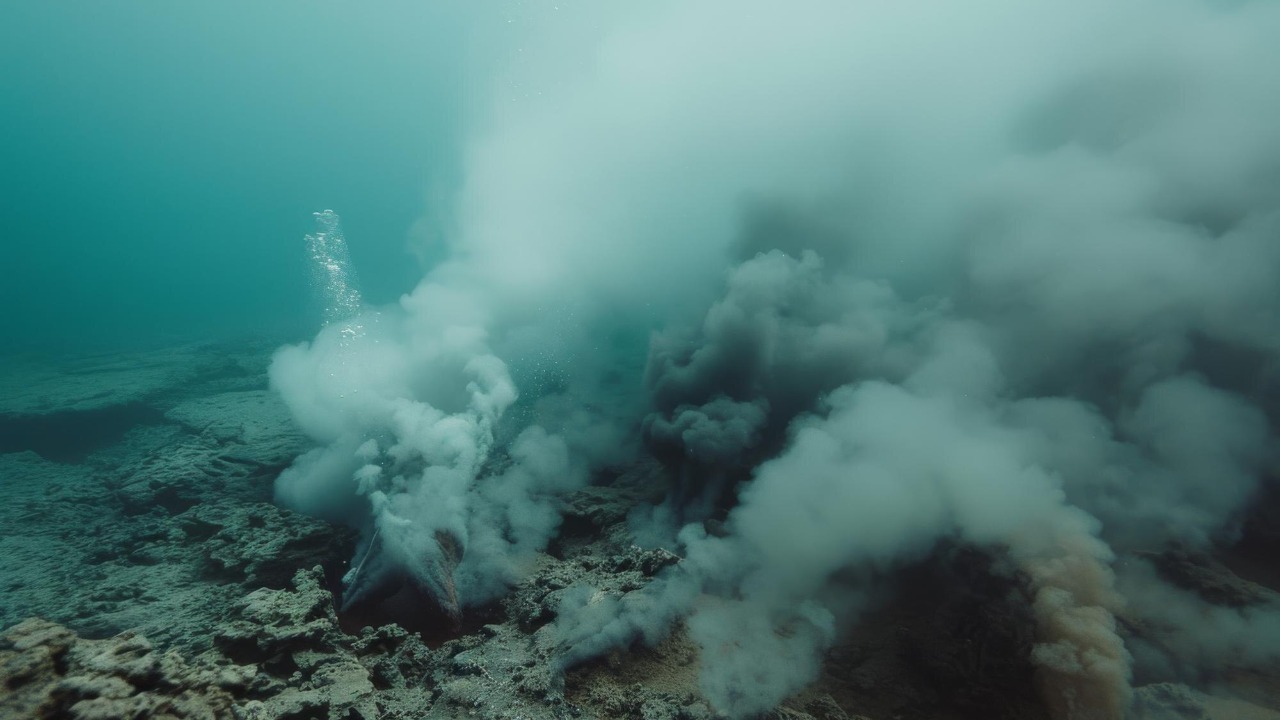

Nearly 12,000 feet beneath the Greenland Sea, in darkness and crushing pressure, the Freya Hydrate Mounds are quietly overturning what I thought I knew about where life can thrive. Lying over 11,940 feet down, these methane rich hills host a dense community of animals that feed not on sunlight, but on chemical energy rising from the seafloor. The discovery of this deep ecosystem shows that even at the limits of cold, pressure, and depth, life is everywhere it can find a foothold.
A hidden landscape at the bottom of the Greenland Sea
The Freya Hydrate Mounds sit on the Arctic seafloor at a depth of 11,940 feet, a realm of near freezing water and permanent night that was long assumed to be sparse and slow. Instead, researchers have found a rugged landscape of gas hydrate structures, where frozen methane and water form solid deposits that shape the terrain into mounds and ridges. At this depth, every movement of equipment is difficult and expensive, yet the payoff has been a first clear look at a part of the planet that had existed only as a contour line on a map.
Earlier work in the same region had already revealed that the world’s deepest methane seeping hydrate mounds are perched 11,942 feet down in the Greenland Sea, marking this as a frontier site for understanding how geology and biology interact in the deep Arctic. That finding, described as the World’s deepest methane seeping hydrate system, set the stage for more detailed surveys that would eventually reveal just how dynamic and densely populated the Freya area really is.
Freya Hydrate Mounds: the deepest Arctic cold seep yet
What makes Freya stand out is not only its depth but its classification as a gas hydrate cold seep, where methane and other hydrocarbons leak from the subsurface and are trapped or channeled by hydrate deposits. The Freya Hydrate Mounds lie over 11,940 feet below the surface, making them the deepest documented gas hydrate cold seep in the Arctic and pushing the known limits of where such systems can operate. That depth places Freya in a pressure and temperature regime that had been poorly explored, yet the site is anything but quiet.
Researchers describe the area in terms that emphasize both its extremity and its vitality, noting that The Freya Hydrate Mounds Lie Over 11,940 Feet Below the Surface and that They are Teeming With Life. That combination of depth and biological richness is what elevates Freya from a geological curiosity to a benchmark site for understanding how cold seeps function in the high Arctic, where ice cover, remoteness, and harsh weather have long limited direct observation.
A deep sea system that is still changing
One of the most striking aspects of Freya is that it is not a static fossil of past activity but a Deep Sea System That is Still Changing. Methane flow appears to vary across the mounds, and the hydrate structures themselves can grow, fracture, or dissolve as conditions shift. That dynamism means the habitat is constantly being reshaped, forcing the animals that live there to adapt to new seepage patterns, fresh surfaces, and changing chemical gradients.
Scientists emphasize that this is a living, evolving environment, not a frozen relic, describing how Various fauna were discovered in the Freya Hydrate Mounds in ways that reflect ongoing seepage, fluid flow, and environmental change. Those observations, highlighted in a discussion of a Deep Sea System That Still Changing, suggest that Freya may wax and wane over time, with pulses of methane creating new hotspots for colonization while older structures are slowly buried or eroded.
Life in a Sclerolinum forest
At the heart of the Freya ecosystem is a dense community of chemosynthetic animals that turn methane and sulfide into food, effectively replacing sunlight with chemistry. Among the most distinctive features is what researchers call a Sclerolinum forest, a thicket of slender tube worms that rise from the sediment and hydrate surfaces like deep sea reeds. These worms host symbiotic bacteria that use seep chemicals as an energy source, creating a foundation for a food web that includes snails, amphipods, and other scavengers.
Images from the site show that, Despite the cold and pressure at 3,640 meters, the Freya area supports a rich community, with more than just Sclerolinum clustered around the hydrate structures. That description of a Sclerolinum dominated habitat underscores how thoroughly life has colonized the seep, turning what might look like bare mineral deposits into a crowded neighborhood of tube dwelling animals and their predators.
Fauna of the Freya mounds: snails, worms, and clams
Beyond the tube worms, the Freya Hydrate Mounds host a diverse cast of invertebrates that have tuned their life cycles to the rhythms of methane seepage. Close up views reveal carpets of small snails grazing on microbial films, amphipods picking their way through crevices, and clams buried in soft patches of sediment where seep fluids reach the surface. Each group exploits a slightly different niche, but all are tied to the chemical energy that seeps from below rather than to falling detritus from the surface ocean.
One detailed IMAGE set, labeled Fauna of the Freya, includes a Caption that points out in situ hydratemound fauna, including Sclerolinum forest and Tube dwelling organisms that cluster on and around the hydrate blocks. That visual record, available through a Fauna of the Freya gallery, confirms that the mounds are not just isolated patches of life but continuous mosaics of animals, with different species dominating different microhabitats depending on fluid flow and substrate.
Small snails and a deep sea wonderland
Among the more unexpected residents of Freya are Small sea snails with their shells coated in orange material, which likely reflects iron rich deposits or microbial growth tied to seep chemistry. These snails, along with amphipods, tube dwelling worms, and deep sea clams, form a community that looks more like a hydrothermal vent field than a typical Arctic abyssal plain. Their presence shows that even tiny grazers and scavengers can carve out a living in a place where the only reliable energy source is methane rising from the crust.
Reports from the site describe how these Small animals cluster around seep outlets and hydrate blocks, creating a patchwork of life nearly 12,000 feet beneath the Greenland Sea that has been likened to a deep sea wonderland. That characterization is echoed in coverage of a mysterious life rich ecosystem at similar depths in the Arctic, reinforcing the idea that Freya is part of a broader pattern in which cold, dark seafloors can still support dense, specialized communities.
Geological roots: sediment, Vestnesa, and Miocene oil
The Freya Hydrate Mounds do not exist in isolation, but are part of a larger geological system that includes the Vestnesa Ridge and deep sedimentary basins that have been leaking methane for tens of thousands of years. Sediment cores from Vestnesa reveal that this site has had active seeping with variable intensity over the last 45,000 years, indicating a long history of fluid migration and gas release. That history helps explain why hydrate mounds like Freya have had time to grow and why their biological communities have had time to specialize.
Geochemical work at related hydrate deposits shows that Crude oil sampled from the hydrate deposits indicates a young Miocene source rock formed in a fresh brackish water paleoenvironment, linking present day seepage to ancient organic rich layers buried deep below the seafloor. That connection between modern methane flux and Miocene source rocks is documented in a study of Crude driven hydrate mounds, while the long term seep record at Sediment rich Vestnesa helps frame Freya as one expression of a persistent Arctic methane system.
Rewriting the Arctic deep sea playbook
For decades, the deep Arctic was treated as a relatively uniform, low energy environment, with life limited mainly by the slow rain of organic particles from the surface. Freya challenges that view by showing that gas hydrate mounds can create hotspots of productivity and diversity even at extreme depths. The discovery has been described as rewriting the playbook for Arctic deep sea ecosystems, because it forces scientists to account for chemosynthetic oases that had been largely overlooked in models of polar biodiversity and carbon cycling.
Coverage of the site notes that the Freya Hydrate Mounds link deep geology, methane chemistry, and unusual animal communities in ways that will shape Future surveys in the deep Arctic, pushing researchers to look for similar systems elsewhere on the polar seafloor. That perspective is captured in an analysis of how Future work in the Arctic will need to integrate seep habitats into broader assessments of ocean health, climate feedbacks, and the resilience of deep sea life.
Methane, climate, and an active Arctic seafloor
Beyond biology, the Freya Hydrate Mounds matter because they sit at the intersection of methane storage and release in a warming world. Gas hydrates are stable only within a narrow range of temperature and pressure, and changes in ocean conditions could alter how much methane remains locked in solid form versus escaping into the water column. Observations at Freya show that methane is not simply trapped but is actively moving through the system, feeding microbes and animals while also representing a potential climate feedback if large amounts were to reach the atmosphere.
Researchers describe the site as the Deepest gas hydrate cold seep ever discovered in the Arctic and highlight a Key finding on Freya hydrate mounds, namely that the observation of methane in the water column indicates the system is not dormant but rather active and evolving. That conclusion, detailed in a report on the Deepest Arctic cold seep, underscores why Freya is relevant to climate science as well as to ecology, even though most of the methane currently appears to be consumed within the ocean rather than reaching the air.
From deep sea wonderland to global context
Freya has quickly become a touchstone for how scientists think about extreme ecosystems, joining a growing list of sites where life flourishes in conditions once thought nearly sterile. The community there has been compared to a Deep Sea Wonderland Found Thriving Where Humans Have Never Been, a phrase that captures both the remoteness of the site and the exuberance of its fauna. That sense of discovery is not just aesthetic; it signals that our inventory of Earth’s habitats is still incomplete, especially in the deep ocean.
Reports on the world’s deepest gas hydrate discovered teeming with life off Greenland emphasize that such systems thrive in the cold temperatures of the deep ocean and that they may be more common than previously assumed. One account, framed as Related to a Deep Sea Wonderland Found Thriving Where Humans Have Never Been, situates Freya within a broader global pattern in which chemosynthetic ecosystems appear wherever geology, fluids, and microbes align, from hydrothermal vents to cold seeps and hydrate mounds.
How scientists reached Freya and what comes next
Reaching a site like Freya requires a combination of advanced mapping, remotely operated vehicles, and careful survey planning, since direct human presence at 11,940 feet is impossible. Researchers first identify promising structures using sonar and seismic data, then send down cameras and sampling tools to confirm the presence of hydrates, bubbling methane, and associated fauna. Each dive yields only a narrow window of observation, so teams must decide in advance which mounds to prioritize and which measurements will best capture the interplay of geology, chemistry, and biology.
Accounts of the work stress that The Freya Hydrate Mounds will guide survey strategies for future expeditions, with scientists planning more detailed mapping of seep fields and targeted sampling of animal communities and microbial mats. One overview of how Freya fits into broader Arctic research notes that future survey work will need to integrate physical oceanography, methane flux measurements, and detailed faunal inventories, so that the lessons from this single site can be scaled up to the basin level and incorporated into climate and biodiversity models.
More from MorningOverview