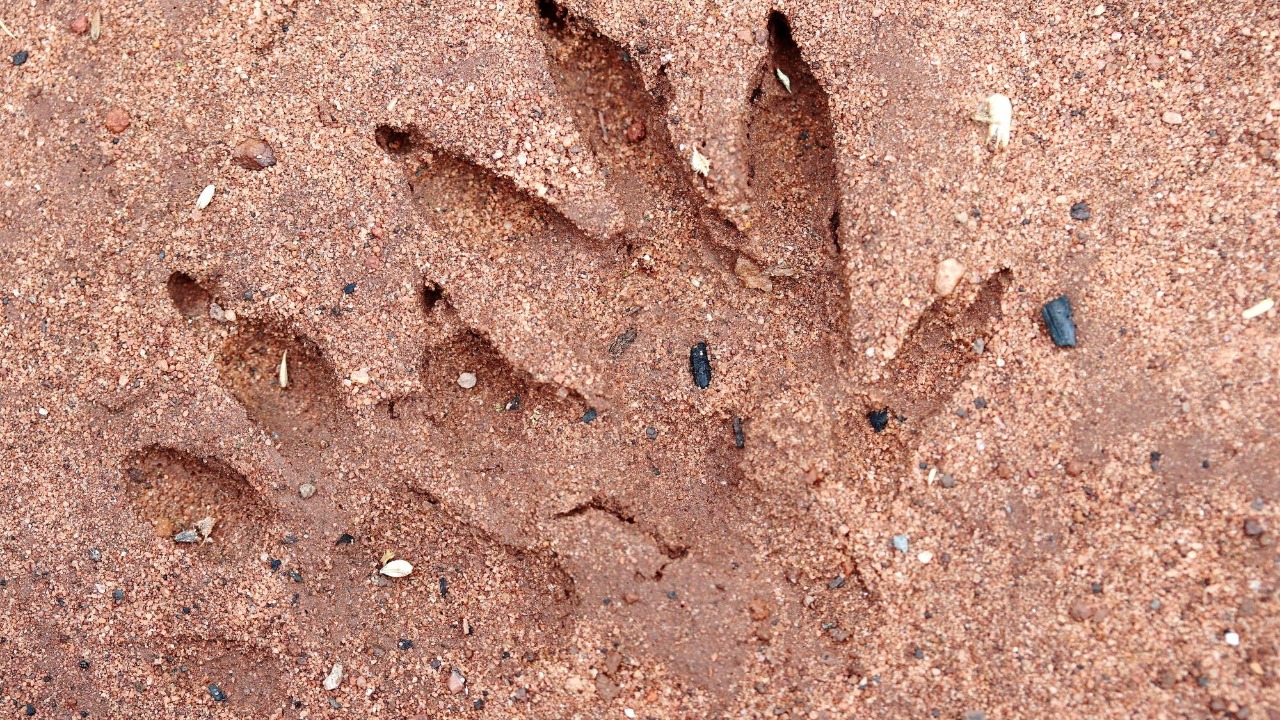

A single fossilized footprint, roughly 1 meter long, has pushed paleontologists to redraw the upper limits of dinosaur size after sitting in storage for nearly two decades. The track, nicknamed “Bigfoot,” was collected 20 years ago, but only now has detailed analysis confirmed that it represents a record-setting impression from one of the largest land animals ever to walk the planet. I see this belated recognition not just as a curiosity of museum backrooms, but as a reminder of how much of prehistory still lies hidden in plain sight.
The rediscovery of “Bigfoot” in the archives
When researchers first lifted the massive slab containing the 1 meter footprint from the field, they knew they had found something unusual, but they did not yet grasp its full significance. The track was cataloged, labeled with a field number, and moved into long-term storage, where it joined thousands of other fossils awaiting closer study. Only after a new generation of scientists returned to the specimen, armed with refined measurement techniques and comparative data, did it become clear that this single print was large enough to challenge existing records for dinosaur tracks.
I see this delayed recognition as a familiar pattern in paleontology, where the pace of discovery often depends less on what is found in the ground than on what is revisited on the shelves. The footprint’s 1 meter length, once just a striking field note, now stands as a benchmark that forces experts to reconsider how big some dinosaurs could grow and how much weight their limbs and feet had to support. The fact that “Bigfoot” spent 20 years in quiet obscurity before emerging as a world record underscores how museum collections can still yield headline discoveries long after the fieldwork trucks have driven home.
How a 1 meter footprint breaks a world record
To understand why this track matters, I start with the basic geometry. A footprint that measures about 1 meter from heel to toe is not just large, it is at the extreme edge of what any known land animal can produce. When paleontologists compared the dimensions of “Bigfoot” with previously documented dinosaur tracks, they found that it exceeded earlier contenders by crucial centimeters, enough to classify it as the largest known print of its type. That incremental difference, measured carefully along the slab, is what allows scientists to say that this fossil has broken a world record that had stood for roughly two decades.
World records in paleontology are not like athletic records that fall every season; they are constrained by the finite fossil record and by the rarity of exceptional preservation. For a footprint to qualify, it must be complete enough to measure, undistorted by erosion, and clearly attributable to a single step rather than overlapping tracks. The 1 meter length of “Bigfoot” meets those criteria, giving researchers confidence that they are not just looking at a lucky smear of sediment but at a genuine maximum for a particular group of dinosaurs. That is why the phrase “20 Years Later, It Breaks, World Record” is more than a catchy line; it reflects a careful comparison against decades of accumulated data on dinosaur tracks.
What the track reveals about the dinosaur’s body
From a single footprint, paleontologists can infer surprising details about the animal that made it, and I find that interpretive leap one of the most compelling parts of this story. The broad, rounded outline of “Bigfoot,” combined with its 1 meter span, points to a gigantic plant-eating dinosaur with a long neck and massive frame rather than a predator with narrow, clawed toes. The proportions suggest a sauropod-like body plan, with columnar limbs that spread the animal’s weight over a wide area of sediment, leaving a deep, clean impression that later hardened into rock.
By comparing the footprint’s dimensions to limb and foot bones from related species, researchers can estimate the dinosaur’s hip height and overall length, even though no skeleton was found directly attached to the track. A 1 meter foot implies a hip height that could easily exceed several meters, and a body stretching many times that distance from head to tail. The track’s depth and clarity also hint at the animal’s mass, since only a truly heavy creature could press so deeply into the substrate without losing the definition of its toes and heel. In that sense, “Bigfoot” functions like a scale and a ruler combined, capturing a fleeting moment when a long-necked giant transferred its full weight onto a single step.
Why “Bigfoot” matters for dinosaur size limits
For years, debates over the largest dinosaurs have revolved around fragmentary bones and extrapolated body masses, with estimates for some species swinging wildly as new fossils come to light. A footprint like “Bigfoot” adds a different kind of constraint, one rooted in biomechanics rather than just bone length. If a dinosaur’s foot is large enough to leave a 1 meter track, its leg bones must be proportionally thick and strong, and its muscles powerful enough to lift and move that bulk without collapsing the joints. That physical reality sets a lower bound on the animal’s size and helps narrow the plausible range for its total mass.
I see this as a crucial check on more speculative reconstructions of dinosaur giants. While isolated vertebrae or limb fragments can tempt researchers to imagine ever-larger animals, a complete footprint forces them to confront how that mass would actually interact with the ground. The 1 meter span of “Bigfoot” suggests that some long-necked dinosaurs approached the upper limits of what terrestrial skeletons and soft tissues can support, edging close to the threshold where bone strength, blood pressure, and heat dissipation all become serious constraints. In that way, the track is not just a record-breaker, it is a data point in the broader question of how big life on land can get.
From field nickname to scientific landmark
The nickname “Bigfoot” might sound playful, but it reflects a long tradition of field teams giving memorable names to standout finds before the formal descriptions catch up. In this case, the label stuck because the track’s sheer size made it an instant reference point among the researchers who excavated it. Over time, as the fossil moved from the field to storage and then back into the spotlight, “Bigfoot” evolved from a casual in-joke into a shorthand for one of the most impressive dinosaur traces ever documented.
What I find striking is how that informal name now anchors a serious scientific narrative about dinosaur gigantism. When scientists describe “Bigfoot” as evidence that “Bigfoot was real… but it belonged to a dinosaur,” they are using the cultural resonance of the mythical creature to highlight the very real scale of the animal that left this track. The phrase captures the idea that the largest dinosaurs were not just big by prehistoric standards, they were big by any standard, rivaling or surpassing the size of modern legends in the public imagination. By tying the fossil to a familiar myth, researchers make the abstract numbers of meters and tons more tangible for a wider audience.
The long road from discovery to recognition
The 20 year gap between the footprint’s discovery and its recognition as a record-setter illustrates how scientific progress often unfolds in fits and starts rather than in a straight line. When the track was first collected, the priority was to rescue it from erosion and document its basic features, not to immediately situate it within a global ranking of dinosaur footprints. Only later, as more comparative material accumulated and as analytical tools improved, did it become possible to say with confidence that this particular slab represented something unprecedented.
I see this timeline as a reminder that the story of a fossil does not end when it leaves the ground. The label “They Found, Meter Dinosaur Foot, Years Later, It Breaks, World Record” captures that arc from initial find to belated acclaim, emphasizing that the most important insights can emerge long after the field season is over. In practical terms, it also highlights the value of sustained investment in curation, cataloging, and reanalysis, since without those quiet, behind-the-scenes efforts, “Bigfoot” might still be just another large but unremarked specimen in a crowded collection.
What the footprint tells us about ancient landscapes
Beyond the animal itself, a track of this size offers clues about the environment that supported such a giant. For a dinosaur with a 1 meter foot to move across the landscape, the ground had to be firm enough to bear its weight yet soft enough to record a detailed impression, which points to a setting like a floodplain, lake margin, or coastal flat with fine-grained sediment. The preservation of the print suggests that the surface dried or was buried quickly after the step, protecting the outline from being washed away or trampled by other animals.
From that snapshot, I infer a dynamic ecosystem where enormous herbivores with long necks and massive frames roamed in search of vegetation, leaving behind tracks that crisscrossed mudflats and riverbanks. The presence of such giants implies abundant plant life, stable water sources, and a climate capable of sustaining large-bodied animals over long lifespans. In that sense, “Bigfoot” is not just a record of a single step, it is a window into a world scaled to creatures whose daily movements reshaped the ground beneath them.
How “Bigfoot” reshapes public imagination
Stories about giant dinosaurs have always captured public attention, but a concrete measurement like a 1 meter footprint gives that fascination a new anchor. It is one thing to hear that a dinosaur was as long as a city bus, and another to imagine standing next to a track that stretches from your toes to your chest. I find that kind of physical comparison especially powerful in museums and science centers, where life-size casts of “Bigfoot” could allow visitors to literally step into the space once occupied by a prehistoric giant.
The playful echo of the mythical Bigfoot also helps bridge the gap between folklore and science. By revealing that “Bigfoot” was real in the sense that a dinosaur with a 1 meter foot actually walked the Earth, researchers invite people who might be drawn in by legends to engage with the evidence-based story of deep time. When I look at the phrase “Bigfoot was real… but it belonged to a dinosaur” linked to the fossil’s long neck and massive frame, I see a deliberate effort to harness popular culture in service of scientific literacy, turning a record-breaking footprint into a gateway for broader curiosity about evolution and the fossil record.
Why this record will be hard to beat
Even in a field that thrives on surprises, I think the 1 meter footprint of “Bigfoot” will be difficult to surpass. The conditions required to preserve such a large, clear track are rare, and the number of dinosaurs capable of leaving one is limited to a handful of the most massive species. While it is always possible that another, even larger print lies buried in an unexplored outcrop, the combination of size, completeness, and scientific scrutiny that defines a world record sets a high bar for any future contender.
At the same time, the story of “Bigfoot” serves as a quiet challenge to paleontologists and collectors to look again at the material they already have. Somewhere in a drawer or on a warehouse shelf, another overlooked specimen might be waiting to rewrite the record books, just as this 1 meter track did after two decades in the shadows. For now, though, the fossil that began as a field nickname and a striking measurement stands as the largest known dinosaur footprint, a testament to both the scale of ancient life and the patience of the science that studies it.
Connecting “Bigfoot” to the broader fossil record
When I place “Bigfoot” alongside other famous dinosaur traces, from trackways that record herds on the move to nests that capture parental care, it becomes part of a larger narrative about how behavior and biology are preserved in stone. A single 1 meter footprint may not tell us everything about the species that made it, but it complements skeletal finds by showing how that body interacted with its environment in real time. The angle of the toes, the distribution of pressure across the print, and the spacing to any nearby tracks can all hint at gait, speed, and even social behavior if multiple individuals walked together.
In that context, the description that “They Found a 1-Meter Dinosaur Foot, 20 Years Later, It Breaks, World Record” is not just a headline-worthy twist, it is a reminder that the fossil record is a living archive, constantly reinterpreted as new questions are asked. Each new analysis of “Bigfoot” can be cross-referenced with other long-necked giants whose bones and tracks have been documented in different parts of the world, helping to refine global patterns of dinosaur distribution and evolution. The footprint’s combination of sheer size and detailed preservation makes it a touchstone for future studies that seek to understand not only how big dinosaurs were, but how they lived, moved, and left their mark on the landscapes they dominated.
More from MorningOverview