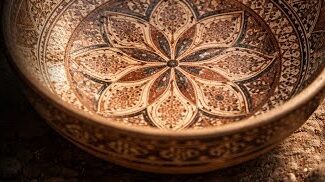

On a set of broken clay bowls from northern Mesopotamia, delicate flower patterns have turned out to be something far more radical than decoration. New analysis of this ancient art suggests that early farmers were quietly exploring ideas of symmetry, counting, and geometric structure thousands of years before anyone carved numerals into clay. What looks like simple floral pottery now appears to record a cognitive shift, as settled communities began to see the world in terms of pattern and order as well as plants and petals.
Researchers argue that these motifs, created roughly 8,000 years ago, capture a moment when visual art became a tool for organizing reality, not just adorning it. By arranging petals, leaves, and stems into repeating sequences, early artists encoded relationships that modern mathematicians would recognize as systematic and rule bound, even if no one at the time spoke of “equations” or “geometry.”
Unearthing the world’s earliest botanical art
The story begins with a specific culture and a specific landscape. Archaeologists working in northern Mesopotamia have traced the pottery to the Halafian communities that flourished around 6200–5500 BCE, a period when small farming villages were spreading across the region. These settlements, scattered across what is now parts of Iraq, Syria, and Turkey, produced fine painted ceramics whose floral designs are now being reinterpreted as the world’s earliest systematic botanical art, rather than generic ornamentation, in a new study of Halafian Mesopotamia BCE.
Instead of isolated flowers, the vessels show carefully organized plant motifs that repeat around the circumference of bowls and jars. Each petal or leaf is stylized, yet the overall compositions still evoke recognizable blossoms and stems, suggesting that the artists were paying close attention to real plants while also abstracting them into repeatable units. That combination of observation and stylization is what allows researchers to treat the imagery as a deliberate botanical system, not just a scatter of pretty shapes.
From village life to visual mathematics
What makes these designs so striking is not only their age but the mental world they imply. Over 8,000 years ago, early farmers in these villages were already arranging petals and leaves into patterns that obeyed consistent rules of spacing, rotation, and repetition. According to the project known as Hidden Numeric, this shift in how people composed images reflects a broader cognitive change tied to settled village life, where counting harvests, tracking seasons, and coordinating communal work made abstract order newly valuable.
In that context, floral art became a quiet laboratory for thinking in terms of symmetry and sequence. Instead of simply painting a single flower, potters repeated a motif around a rim, mirrored it across an axis, or nested smaller blossoms inside larger ones. Those choices suggest that the artists were not just copying nature but experimenting with how many petals would fit, how evenly they could be spaced, and how the pattern would look when wrapped around a curved surface, all of which point to an emerging awareness of geometric structure and numerical order long before formal mathematics existed.
Inside the Arpachiyah discoveries
The most vivid evidence for this hidden structure comes from a specific excavation. At the site of Arpachiyah in Iraq, a dig led by Nax Mallowan uncovered a cache of Halafian pottery whose floral motifs have become central to the new analysis. These vessels, now held in museum collections, show repeated flower heads, radiating petals, and banded stems that circle the bowls in precise sequences, prompting researchers to argue that the art from Arpachiyah, Iraq, was designed according to consistent rules rather than improvised brushwork, a pattern highlighted in new work on Scientists Found Hidden Math.
When the fragments from Arpachiyah are reassembled, the bowls reveal rings of blossoms that are evenly spaced and carefully aligned with the vessel’s curvature. The petals do not drift or collide; they keep their distance, as if the painter had a mental template for how many units should fit around the rim. That regularity is what leads scholars to describe the designs as reflecting an underlying mathematical structure, even though the people who made them left no written numbers or diagrams to explain their choices.
Counting petals without numbers
To test whether this regularity was intentional, researchers turned to scale and statistics. By closely inspecting more than 700 pottery fragments adorned with plant motifs, the team led by Garfinkel and Krulwich found that certain petal counts and arrangements recur far more often than chance would predict. Instead of random clusters, they saw preferred numbers of petals, consistent angular spacing, and repeated combinations of large and small blossoms, which together suggest that the artists were informally counting and measuring as they worked.
Garfinkel and Krulwich argue that this patterning amounts to early geometry in practice, even if it was never formalized in written rules. A potter who decides that six petals look right around a flower head, then repeats that choice across dozens of vessels, is effectively using a stable numerical scheme. The fact that these schemes appear across many fragments, and across different workshops, points to shared conventions about how to build a floral design, conventions that encode counting and proportion in visual form rather than in explicit numerals.
How early farmers did math “before math”
What emerges from this body of evidence is a picture of communities doing mathematics long before they had symbols for it. Long before numbers were written down or equations etched into clay tablets, early farming villages were already manipulating quantities and relationships through repeated motifs, as highlighted in recent analysis of how humans were doing math Long before formal mathematics. When a potter decides how many flowers will fit around a bowl, or how to alternate large and small petals, that decision rests on an intuitive sense of number, ratio, and symmetry, even if it is never verbalized.
In that sense, the floral pottery acts as a bridge between everyday tasks like counting grain and the later emergence of explicit mathematical notation. The same minds that tracked livestock or measured out seed were also arranging petals into balanced sequences, training themselves to think in terms of repeatable units and predictable patterns. The art does not prove that these villagers could solve algebraic problems, but it does show that they were comfortable working with structured relationships, a prerequisite for the more formal mathematics that would appear centuries later in the same broader region.
Evidence from JERUSALEM, Dec excavations
Additional support for this interpretation comes from work by Israeli researchers who have examined botanical art created over 8,000 years ago and linked it to early farming communities in the Near East. In a statement from JERUSALEM, Dec, they describe how these early villagers painted plant motifs on pottery in ways that suggest a grasp of order and repetition long before formal mathematics existed, a conclusion summarized in a report from Xinhua Israeli sources.
These researchers emphasize that the botanical art is not an isolated curiosity but part of a broader pattern in which early agricultural societies encoded practical knowledge in visual form. The same communities that domesticated crops and managed irrigation also invested time in painting regular, repeating plant designs on their vessels, suggesting that the aesthetic pleasure of symmetry was intertwined with a functional appreciation of order. The 8,000 year span since those bowls were fired underscores how deeply rooted this link between visual pattern and cognitive structure may be in human history.
What the patterns reveal about ancient minds
Taken together, the Halafian bowls, the Arpachiyah finds, and the broader Near Eastern botanical art point to a shared mental toolkit. These artists were not simply copying what they saw in fields and gardens; they were selecting, simplifying, and repeating elements in ways that reveal an ability to abstract from the messy details of real plants. That abstraction, the decision to treat a petal as a repeatable unit that can be rotated or mirrored, is a hallmark of mathematical thinking, even when it appears in the guise of flower art.
For cognitive scientists and archaeologists, this makes the pottery a rare window into how people thought in an era without written records. The consistent use of symmetry, the preference for certain petal counts, and the careful spacing around curved surfaces all suggest that these communities valued regularity and balance. Those values, expressed in clay and pigment, hint at a worldview in which order was not just a practical necessity for farming but also a source of beauty, a way to make sense of both nature and the built environment.
Rewriting the timeline of mathematical culture
The discovery of sophisticated structure in such early floral art forces a reconsideration of when mathematical culture truly began. Instead of treating mathematics as a sudden invention of later city states with scribes and schools, the evidence from Halafian Mesopotamia and related sites suggests a much longer prehistory in which villagers experimented with pattern and number through everyday objects. The bowls and jars from Arpachiyah and other settlements show that the seeds of geometry and counting were already present in domestic spaces, long before they appeared in formal texts.
For me, the most striking implication is that the line between art and science in early societies was far blurrier than modern categories suggest. A potter painting petals around a rim was at once an artist, a craftsperson, and an informal mathematician, using intuition and practice to solve problems of spacing and symmetry. Recognizing that complexity does not just enrich our understanding of ancient aesthetics; it also expands the story of mathematics itself, revealing it as a deeply human habit that began with hands, eyes, and flowers, not only with numbers on a tablet.
More from MorningOverview