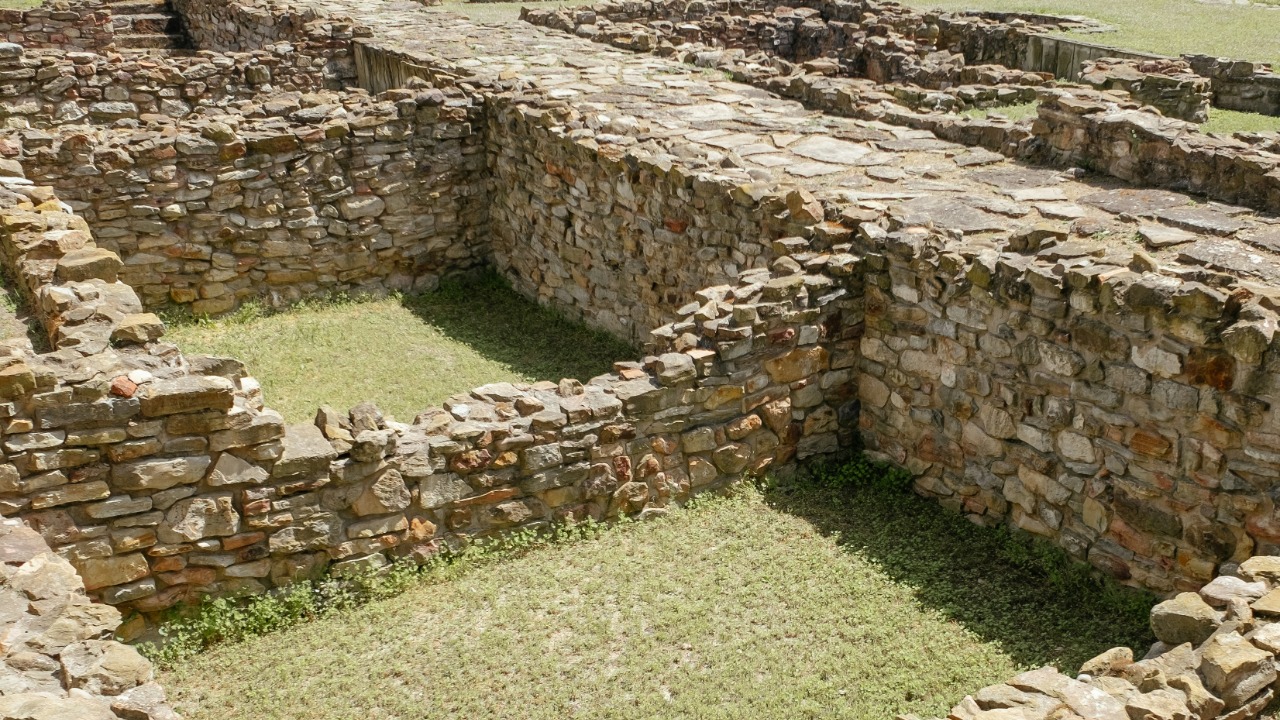

A buried stretch of fortification that once guarded ancient Jerusalem has reappeared in the unlikeliest of places, beneath a former prison and beside a museum courtyard. Archaeologists say the newly exposed section of the Hasmonean “First Wall” is the most definitive and extensive piece of this legendary barrier yet identified, a missing link that helps redraw the map of the city at the time of the Maccabees. For a city where every stone is contested memory, the return of this lost line of defense is more than an academic footnote, it is a fresh, physical argument about power, faith and survival in the second century b.c.e.
The wall that once defined ancient Jerusalem
The discovery matters because the “First Wall” was not just another fortification, it was the outer skin of a city that has been fought over for millennia. In the Hasmonean period, when a Jewish dynasty ruled after the Maccabean revolt, this line of stone marked the edge of a capital that was rapidly expanding and fortifying itself against rivals. For modern researchers trying to understand how ancient Jerusalem grew from a hilltop stronghold into a regional power, pinning down the exact course of that wall has been a long running puzzle.
Until now, most of the First Wall was known only from scattered traces and later descriptions, leaving large gaps in the picture of how the Hasmonean city was defended. The newly exposed segment, tied securely to the Hasmonean era by its construction style and associated finds, gives archaeologists a continuous stretch they can measure, date and compare with historical accounts. It turns an abstract line on a reconstruction drawing into a tangible structure that once loomed over traders, soldiers and pilgrims entering the city.
A 40 meter clue beneath a prison yard
The breakthrough came where few visitors would think to look, under the grounds of a former British Mandate prison near the Tower of David. Excavators working beside the museum uncovered a massive 40-meter-long stretch of wall that specialists quickly recognized as part of the First Wall, built in the Hasmonean period. The segment, preserved to a height of several courses and anchored on bedrock, shows the kind of heavy stonework expected from a dynasty intent on projecting strength after seizing control of the city.
Archaeologists describe this section as the most definitive piece of the First Wall yet identified, both because of its length and because it sits exactly where historical reconstructions had long suspected the line should run. Its location near the Tower of David, a landmark that has anchored fortifications for centuries, reinforces the idea that the Hasmonean rulers were already using this ridge as a defensive spine. The fact that the wall survived beneath a prison complex, spared from later building foundations that chewed up other stretches, is a stroke of luck that now pays off in new data about the city’s ancient footprint.
UNCOVERED: the longest intact Hasmonean stretch
What sets this find apart is not only that it confirms the First Wall’s course, but that it preserves one of the longest continuous Hasmonean fortification segments ever exposed. Archaeologists report that they have UNCOVERED the longest known section of a 2,100-year-old wall foundation from the Hasmonean period, giving them an unbroken run of masonry to study. The phrase “2,100-year-old” is not just a flourish, it reflects the second century b.c.e. date that ties this structure directly to the era of the Maccabean rulers.
Because the wall segment is so extensive, researchers can trace subtle changes in construction along its length, from foundation cuts into the bedrock to the way stones were dressed and fitted. That level of detail is rarely possible when only a few meters survive. The continuity also allows them to compare this stretch with other Hasmonean remains in Jerusalem, including a large wall segment from the second-century b.c.e. Hasmonean kingdom that was revealed under the same former prison complex, strengthening the case that these are all parts of a single, city defining system.
More massive than the current Old City walls
One of the most striking revelations from the excavation is just how imposing the Hasmonean fortifications were compared with what visitors see today. The newly exposed First Wall section is described as more massive than the current walls of the Old City, a reminder that the Hasmonean dynasty invested heavily in stone defenses as a statement of sovereignty. Archaeologists in Jerusalem have emphasized that this was the most massive wall ever built in the city, a “monster” structure that would have dominated the skyline.
Reports from the dig describe a wall roughly five meters thick, a width more commonly associated with fortifications that encircled entire cities rather than inner compounds. One detailed account notes that the newly found section, located in Jerusalem, was a “monster edifice” whose thickness alone would have been enough to wall lesser cities. That comparison underlines how seriously the Hasmonean rulers took the task of defending their capital, and how much stone and labor they were willing to marshal to secure it.
How archaeologists pieced the First Wall together
Reconstructing the course of a vanished fortification is part detective work, part engineering analysis, and the First Wall is a textbook example. Archaeologists in Jerusalem have finished uncovering the longest continuous remains of the ancient wall that encircled the city, then matched its alignment with earlier, fragmentary finds. By comparing the masonry style, the way the foundations cut into the bedrock and the pottery and coins trapped in the fill, they can tie this new stretch securely to the Hasmonean period.
The work has also drawn on a broader cluster of discoveries around the Old City. Israeli specialists report that they have uncovered the longest known section of a 2,100-year-old wall foundation from the Hasmonean era, and that this and other segments line up with the newly exposed First Wall beneath the former prison. Each additional piece helps refine the city’s ancient outline, turning what used to be a speculative line on a map into a route anchored by measurable stones and datable artifacts.
Digging under modern Jerusalem’s surface
The excavation has unfolded in the middle of a living city, with all the logistical and political complexity that implies. Workers from the Israel Antiquities Authority have been cleaning and documenting the wall section in tight spaces hemmed in by modern buildings, including the former prison and the Tower of David Jerusalem Museum. Their work involves not only careful excavation but also stabilizing the exposed stones so they can be preserved and, where possible, displayed to the public.
The dig has also intersected with contemporary religious life. Reports note that Workers were still on site as Jews prepared to celebrate Hanukkah, the eight day holiday that this year begins on Dec. 14, a festival that itself commemorates the Maccabean revolt and the rededication of the Temple. That overlap between the calendar of excavation and the religious calendar has sharpened public interest, turning the wall into a tangible backdrop for rituals that recall the same Hasmonean rulers who ordered its construction.
From Hasmonea to Hanukkah: politics in stone
The wall’s Hasmonean identity is not just a chronological label, it is a political statement carved into the bedrock of the city. The dynasty that built it, often referred to in sources as Hasmonea, came to power after the Maccabean revolt against Seleucid rule, an uprising remembered in the Hanukkah story of Antiochos IV Epiphanes. Strengthening the city’s defenses with a massive outer wall was part of consolidating that hard won independence, a way of signaling that Jerusalem was no longer a provincial outpost but the fortified capital of a kingdom.
Modern accounts of the excavation explicitly link the newly exposed First Wall to that political moment, noting that the Hasmonean rulers built it after driving out foreign rulers and reshaping the city’s defenses. One detailed report on the Israel led excavation stresses that the wall’s scale and location reflect a deliberate choice to project power toward the western approaches to the city. In that sense, every newly cleaned stone is also a piece of political messaging from a regime that used architecture as a tool of legitimacy.
Why ancient walls fall, and why that matters
Finding such a long, intact stretch of the First Wall naturally raises the question of what happened to the rest. In other parts of the city, archaeologists have documented fortifications that were violently destroyed, leaving toppled stones and arrowheads as clues to past conflicts. One study of a biblical era wall in Why it was destroyed, After analyzing the site and its artifacts, including ancient arrowheads, researchers proposed two different military related scenarios, both involving power struggles that left the defenses in ruins.
The First Wall segment beneath the former prison appears to have escaped that kind of catastrophic destruction, perhaps because later builders buried rather than dismantled it. Yet the broader pattern in Jerusalem is clear, walls rise and fall with regimes, and their fate often reflects the outcome of violent contests for control. Understanding whether the Hasmonean First Wall was breached, systematically dismantled or simply rendered obsolete by new lines of defense is part of the larger effort to trace how each wave of conquest reshaped the city’s physical and political landscape.
Redrawing the map of a 2,100 year old city
For historians and urban archaeologists, the newly exposed First Wall is a tool for recalibrating everything from population estimates to the location of key religious and administrative buildings. Knowing exactly where the Hasmonean city limits lay helps refine calculations about how many people could have lived within the walls, how far pilgrims had to travel from the gates to the Temple, and where markets and barracks might have clustered. The fact that the wall is securely dated to the Hasmonean period, and that it is part of a map of the ancient world that archaeologists are steadily filling in, gives those reconstructions a firmer empirical base.
The find also feeds into broader debates about continuity and change in the city’s layout across different empires. By comparing the Hasmonean First Wall with later fortifications, including the Ottoman walls that define the Old City today, researchers can see which defensive lines were reused and which were abandoned. The newly documented segment beneath the former prison, together with other Hasmonean remains in Jerusalem, suggests a city that kept returning to the same strategic ridges even as rulers and religions changed. In that sense, the lost “first wall” has not only resurfaced, it has begun to reshape how I, and many others, picture the ancient city behind today’s familiar skyline.
More from MorningOverview