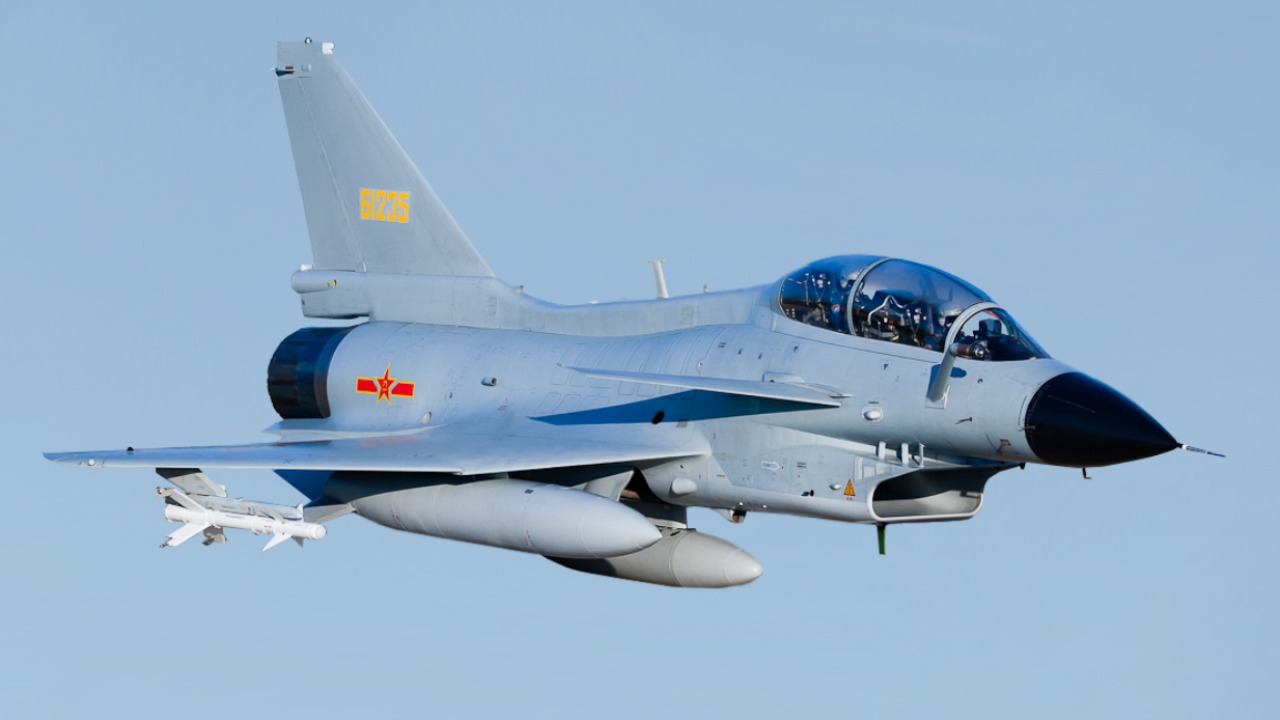

Fresh imagery of a Chinese J-10C fighter carrying what appears to be a YJ-21E anti-ship ballistic missile has injected new urgency into debates about the balance of power in the western Pacific. If confirmed, the pairing would give a relatively light, single engine fighter the ability to threaten large surface combatants at long range, a role usually reserved for bombers or heavy strike aircraft. I see this as part of a broader pattern in which Beijing is trying to saturate contested seas with more numerous, missile heavy platforms rather than relying solely on a few high end assets.
What the new imagery appears to show
The latest photographs and video clips show a J-10C with a large, dark missile slung under its centerline, noticeably bulkier than the air to air and air to surface weapons the type usually carries. The missile’s proportions and fin layout have prompted analysts to link it to the YJ-21E family, a weapon widely described as a hypersonic, anti-ship ballistic system adapted for air launch. In the material attributed to China Military Online, the aircraft is clearly identified as part of the PLA Air Force, and the loadout is presented in a way that looks more like an official reveal than a casual training snapshot, which suggests that Beijing is comfortable signaling this capability even if it has not formally announced it.
New imagery released by China Military Online and circulated through Dec social channels shows a PLA Air Force J-10C carrying a large missile that closely matches the silhouette associated with the YJ-21E, and the framing of the footage implies a deliberate decision to showcase the weapon on this particular platform rather than on a bomber or a larger fighter. In one widely shared clip, the camera lingers on the centerline pylon, highlighting the missile’s length relative to the J-10C’s fuselage, which reinforces the impression that this is not a standard cruise missile but a heavier anti-ship ballistic round that would significantly expand the aircraft’s maritime strike role, as seen in the New imagery released by China Military Online.
Why the YJ-21E matters
From my perspective, the reported presence of a YJ-21E under a J-10C is significant because it suggests that China is pushing hypersonic anti-ship technology down to smaller, more numerous fighters. The YJ-21E has been described as a hypersonic missile capable of very high terminal speeds and complex flight paths, characteristics that are designed to stress shipboard air defenses and reduce reaction time for vessels such as destroyers or carriers. If that class of weapon is now compatible with a single engine tactical jet, it means the People’s Liberation Army can potentially launch such strikes from a wider range of airfields and with more flexible sortie patterns than if it relied only on large bombers.
Reports that characterize the YJ-21E as a hypersonic anti-ship ballistic system emphasize its role in targeting high value naval assets, and the description of a J-10C fighter spotted carrying a YJ-21E hypersonic missile underscores how Chinese planners appear to be integrating this class of weapon into lighter, more numerous tactical platforms rather than limiting it to heavy aircraft. In coverage that frames the event as a breakthrough in Chinese Airpower, the J-10C is presented as moving from a primarily tactical role to one that can deliver a hypersonic missile against maritime targets, a shift that is captured in analysis of the Fighter Spotted Carrying YJ hypersonic missile.
How the J-10C evolved into a maritime striker
The J-10C began life as a multirole fighter optimized for air defense and precision strike over land, but over the past several years it has steadily accumulated more sophisticated sensors and weapons for maritime operations. I see the reported YJ-21E integration as the latest step in that evolution, building on earlier work to equip the type with advanced anti-ship cruise missiles and to refine its datalink and targeting capabilities for over water engagements. The aircraft’s active electronically scanned array radar and modern avionics give it the situational awareness needed to employ complex standoff weapons, and pairing that with a hypersonic anti-ship ballistic missile would turn a relatively modest airframe into a serious threat to surface groups operating within its radius.
New footage released by the Chinese People Liberation Army Eastern Theatre Command Air Force has already shown J-10C fighters carrying large anti-ship ballistic missiles, with reporting noting that these weapons can reach targets at ranges that complement shorter 500 kilometre systems and extend the reach of the Eastern Theatre Command’s air units over key maritime approaches. In that material, the Chinese People Liberation Army Eastern Theatre Command Air Force is portrayed as using the J-10C as a testbed and eventual frontline carrier for anti-ship ballistic missiles, which aligns with the more recent imagery of a J-10C allegedly seen carrying a YJ-21E and suggests a deliberate program to turn this fighter into a core maritime strike asset, as detailed in the New footage released by the Chinese People Liberation Army Eastern Theatre Command Air Force.
Competing interpretations of the missile loadout
Not everyone looking at the new images agrees that the missile is definitively a YJ-21E, and I think that uncertainty is important to acknowledge. Some analysts point out that the resolution and angles available so far leave room for confusion with other large anti-ship weapons in the Chinese inventory, including long range cruise missiles that share similar external features. The description of the weapon as “possible” in some coverage reflects that caution, and it is consistent with a broader pattern in which outside observers must infer capabilities from limited visual cues and occasional official hints rather than detailed technical disclosures.
Imagery described as showing China J-10 Fighter Seen With Possible YJ hypersonic anti ship missile in new images explicitly uses the qualifier “possible,” underscoring that while the missile’s size and shape match expectations for a YJ-21E class weapon, there is still room for alternative identifications. At the same time, other reports refer to China J-10C Allegedly Seen Carrying YJ Anti Ship Ballistic Missile for the First Time and state that the YJ spotted on the aircraft is consistent with earlier depictions of the YJ-21E, which leans more strongly toward confirmation even as it retains the word “allegedly” to signal that official technical data remain limited, a balance captured in the description of Fighter Seen With Possible YJ hypersonic anti ship missile in new images.
What the reports say about “first time” integration
Several of the accounts frame the J-10C’s new loadout as a first of its kind event, and that language matters because it hints at a transition from testing to operational messaging. When I see phrases like “for the first time” attached to footage released by official or semi official channels, I read them as a signal that the capability is mature enough to be showcased, even if it is not yet fully deployed across all units. In this case, the suggestion that a J-10C has been seen with a YJ-21E class missile for the first time implies that integration work has progressed beyond the conceptual stage and into at least limited flight trials, if not initial operational capability.
One detailed account describes China J-10C Allegedly Seen Carrying YJ Anti Ship Ballistic Missile for the First Time and notes that the YJ spotted on the aircraft appears to be the export designated YJ-21E, a version of the missile family intended for international customers. That same reporting emphasizes that the event marks the first time a J-10C has been publicly associated with this class of anti ship ballistic missile, which dovetails with earlier footage of the Chinese People Liberation Army Eastern Theatre Command Air Force using the type with other large anti ship ballistic systems and suggests a phased approach in which domestic variants are proven first before an export focused YJ-21E is highlighted, as reflected in the description of China Allegedly Seen Carrying YJ Anti Ship Ballistic Missile for the First Time.
The J-10C’s place inside the PLA Air Force
To understand why putting a YJ-21E class weapon on a J-10C matters, I find it useful to look at where the aircraft sits in the broader Chinese fleet. The J-10C is one of three fighter classes in production today for the Chinese People Liberation Army PLA Air Force, alongside heavier platforms such as the J-16 and the J-20 heavyweight fifth generation platform. That means it is numerically important and likely to be widely distributed across different theatre commands, which in turn gives any new weapon integrated on it a broad potential footprint across China’s airpower posture.
Reporting that focuses on a new cruise missile confirmed for China’s J-10C fighter describes the aircraft as a key pillar of the Chinese People Liberation Army PLA Air Force, noting that it is produced in parallel with the J-16 and the J-20 heavyweight fifth generation platform and that its relatively low operating costs make it attractive for both domestic use and export. In that context, adding an anti ship weapon to boost export prospects is portrayed as a logical step, and the same logic would apply to integrating a YJ-21E class anti ship ballistic missile, since a J-10C that can credibly threaten surface vessels would be more appealing to navies and air forces that face maritime security challenges, a point highlighted in analysis of the new cruise missile confirmed for China’s J-10C fighter.
From cruise missiles to ballistic anti-ship weapons
Even before the latest imagery, the J-10C had already been linked to new anti-ship cruise missiles, and I see the reported YJ-21E integration as part of a continuum rather than a sudden leap. Equipping the fighter with a modern cruise missile gave it the ability to strike ships at significant range while staying outside the densest layers of naval air defenses, and that capability alone would have represented a meaningful upgrade for coastal defense and sea denial missions. Moving from cruise missiles to a hypersonic anti-ship ballistic weapon would further compress reaction times for targeted vessels and complicate interception, especially if the missile can maneuver in its terminal phase.
Accounts that discuss a new cruise missile confirmed for the J-10C emphasize that the weapon is an anti ship system intended to boost export prospects, and they describe how the Chinese People Liberation Army PLA Air Force has been methodically expanding the fighter’s maritime strike portfolio. Those same sources sit alongside material that shows the J-10C carrying anti ship ballistic missiles under the auspices of the Chinese People Liberation Army Eastern Theatre Command Air Force, which suggests a layered approach in which cruise missiles provide one tier of capability and ballistic or hypersonic systems like the YJ-21E add another, a progression that is consistent with the broader narrative of China J-10C anti ship ballistic missile integration described in China J-10C anti ship ballistic missile.
Implications for regional naval balance
If I take the reports at face value and assume that the J-10C can now carry and employ a YJ-21E class missile, the implications for regional navies are significant. A single engine fighter that is relatively cheap to operate and can be fielded in large numbers would be able to launch hypersonic anti-ship ballistic attacks from dispersed bases, making it harder for an adversary to preemptively neutralize the threat. For carrier strike groups or amphibious task forces operating within range of Chinese airfields, the risk calculus would shift, since they would have to account not only for traditional anti-ship cruise missiles and land based ballistic systems but also for fast, flexible sorties by J-10C units armed with YJ-21E class weapons.
Regional analysis that frames the J-10C’s new role as a breakthrough in Chinese Airpower stresses that integrating a hypersonic missile on a lighter, more numerous tactical platform changes the density of potential launchers that an opposing navy must track and counter. When combined with imagery of China J-10 Fighter Seen With Possible YJ hypersonic anti ship missile in new images and descriptions of China J-10C Allegedly Seen Carrying YJ Anti Ship Ballistic Missile for the First Time, a picture emerges of a force that is deliberately spreading advanced anti ship capabilities across multiple aircraft types and theatre commands, which in my view will complicate planning for any navy that expects to operate near China’s maritime periphery.
More from MorningOverview