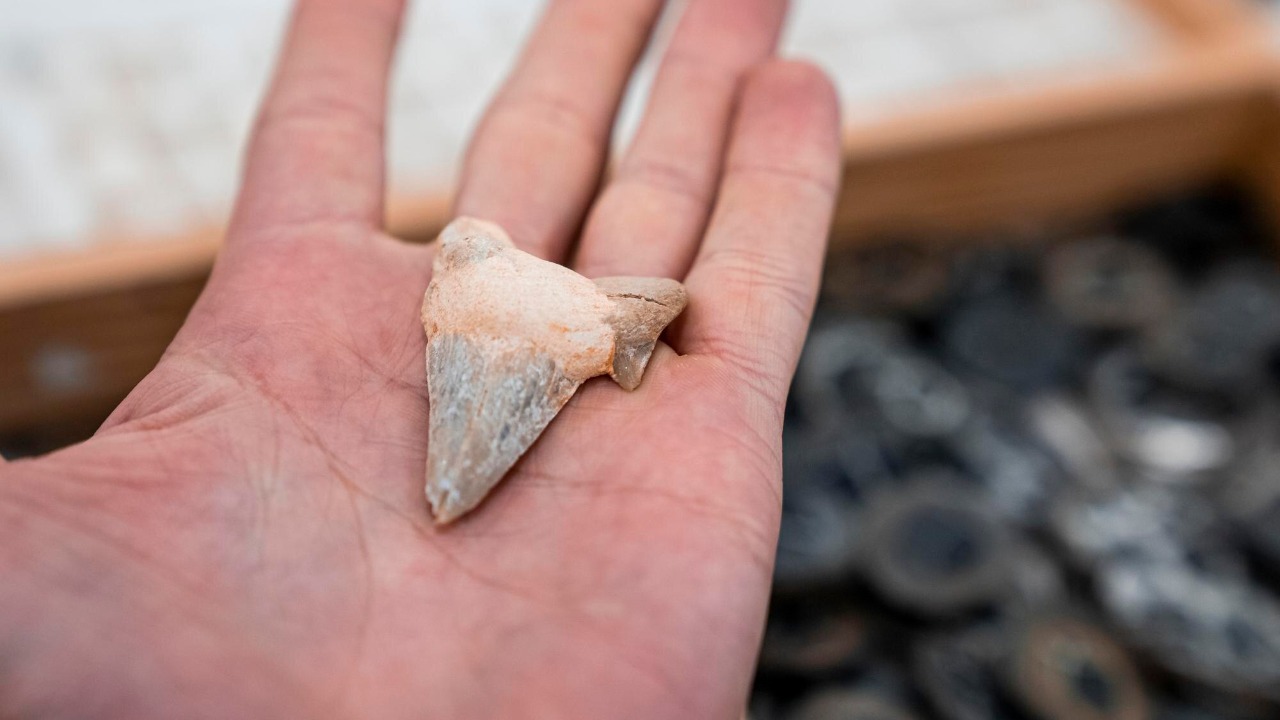

A fossil smaller than a human fingernail has revealed a complete ancient brain, turning a speck of stone into a detailed map of early animal evolution. Encased inside this tiny creature are preserved neural tissues and internal organs that push scientists to rethink how quickly complex body plans emerged on Earth. I see this discovery as part of a broader pattern in paleontology, where ever smaller fossils are yielding ever bigger insights into how brains, skeletons and sensory systems first took shape.
A brain the size of a pinhead, frozen in deep time
The headline discovery is a minuscule animal whose entire body, including its brain, would fit comfortably on a nail, yet its internal anatomy is preserved with astonishing clarity. For decades, paleontologists assumed that soft tissues like brains vanished almost instantly after death, leaving only shells and bones to tell the story of early life. Finds like this one overturn that assumption, showing that under the right chemical and sedimentary conditions, even delicate neural structures can survive for hundreds of millions of years as thin films or three dimensional replicas inside the rock.
What makes this tiny fossil so important is not just its size, but its age and level of detail. It belongs to the same broad window of time as a 520-million-year specimen in which both brain and guts are preserved, a period when complex Animal body plans were coming together with surprising speed. When I compare these finds, I see a consistent message: early animals were not simple, half formed experiments, but already carried sophisticated nervous systems that look far more modern than textbooks once suggested.
How a 520-Million-Year brain rewrites early animal history
To understand why a nail sized fossil brain matters, I look at it alongside other Cambrian age discoveries that preserve entire nervous systems. One standout example is a 520-Million-Year Old Larval Arthropod Fossil Reveals a Fully Preserved Brain and Nervous System in three dimensions, something that would have seemed impossible a generation ago. In that case, scientists could trace individual nerve cords and ganglia, showing that even larval stages of early arthropods had complex wiring that rivals modern crustaceans and insects. When I place the new nail sized fossil next to that larval specimen, the pattern is clear: intricate brains were already standard equipment very early in animal history.
These fossils also help calibrate the pace of evolution. If a larval arthropod already carried a Fully Preserved Brain and Nervous System at 520 Million Year scales, then the genetic and developmental machinery for building such organs must have evolved even earlier. The tiny fossil with a preserved brain fits into this timeline as another data point showing that neural complexity did not creep in slowly over eons, but appears abruptly in the record. For me, that sharp appearance supports the idea that once certain developmental toolkits evolved, they could be rapidly reused and modified across different lineages, producing a burst of innovation in body plans and behavior.
A 525-million-year puzzle for brain evolution
The story becomes even more intriguing when I factor in a 525-million-year fossil that preserves a full nervous system, including a brain, and directly challenges standard diagrams of how brains evolved. That specimen, analyzed in a study published in Science and led by Nicholas Strausfeld, a Regents Professor in the University of Arizona Department of Neuroscience, shows a pattern of nerve cords and brain segments that does not fit neatly into the expected sequence from simple nerve nets to centralized brains. Instead, it suggests that complex brains may have appeared early, been lost in some lineages, and reconfigured in others, rather than following a single linear path.
When I compare the nail sized fossil brain to the 525-million-year specimen, I see a shared message about evolutionary experimentation. Both fossils show that early animals were already playing with different ways of organizing neurons, from compact brain centers to extended nerve ladders. The involvement of Nicholas Strausfeld as a Regents Professor in the University of Arizona Department underscores how seriously neuroscientists now take these paleontological data. They are not curiosities, but hard constraints on any theory of brain evolution, forcing researchers to account for the fact that sophisticated nervous systems existed far earlier than many models predicted.
Tiny bodies, giant clues: what small fossils reveal
One reason the nail sized fossil is so powerful is that it joins a broader wave of discoveries where very small specimens carry outsized scientific weight. In vertebrate paleontology, for example, a diminutive dinosaur skull has been used to reconstruct growth patterns, sensory abilities and even social behavior, despite being only a few centimeters long. At the Natural History Museum of Los Angeles County, Luis Chiappe, NHM Senior Vice President of Research and Collections and Director of the Dinosaur Institute, has highlighted how a tiny dinosaur specimen can anchor a “big discovery” about how birds evolved from their theropod ancestors. When I look at that work, I see a direct parallel: small size does not limit scientific value, it often enhances it by preserving delicate structures that larger, more weathered bones have lost.
The same logic applies to the nail sized fossil brain. Its small body may have been buried quickly and sealed in fine grained sediment, conditions that favor the preservation of soft tissues like eyes, nerves and digestive tracts. In that sense, the fossil is not an exception but part of a pattern in which tiny animals, from juvenile dinosaurs to larval arthropods, become key witnesses to evolutionary transitions. For me, the lesson is that paleontologists ignore small, fragmentary looking specimens at their peril, because those are often the ones that still carry the original biological information at cellular or even subcellular scales.
From Ottawa fish to Myanmar flies: the power of miniature anatomy
The importance of small fossils is not limited to land animals or arthropods. In Ottawa, an international team led by scientists from the Canadian Museum of Nature and the University of Ottawa has described a tiny fossil fish that reshapes how we think about early vertebrate feeding. That specimen, only a few millimeters long, preserves jaw elements and toothlike structures that show how early fishes may have “invented” new ways to capture food, long before the classic sharks and bony fishes of later eras. When I set that Ottawa fish alongside the nail sized fossil brain, I see a shared theme: miniature skeletons and skulls can capture transitional stages in anatomy that are missing from larger, more derived species.
In the world of insects, the same principle appears in amber. A study of Cretaceous amber from Myanmar describes an extant genus of fungus gnat, Paleoplatyura Meunier, preserved with exquisite detail in its wings and body. The formal Diagnosis notes a Wing length: 3.8 m, a scale that might sound trivial until one realizes how much aerodynamic and ecological information is encoded in that measurement. For me, the Myanmar gnat, the Ottawa fish and the nail sized fossil brain all demonstrate that evolution often leaves its clearest fingerprints in the smallest, best preserved bodies, where fine structures like sensory hairs, tooth cusps and nerve canals are still intact.
Why brains almost never fossilize, and why this one did
To appreciate how extraordinary a preserved brain is, I have to consider the chemistry of decay. Neural tissue is rich in lipids and water, and in most environments it collapses and liquefies within days, leaving no trace in the sediment. For a brain to fossilize, the body must be buried rapidly in an anoxic setting, often with mineral rich waters that can infiltrate and replace soft tissues before they rot. In the case of the nail sized fossil, the same conditions that preserved its brain likely also captured parts of its digestive system and sensory organs, similar to the way the 520-million-year arthropod preserved both brain and guts together.
These rare preservation windows, sometimes called Konservat-Lagerstätten, act like time capsules for entire ecosystems. When I look at the nail sized fossil brain in that context, I see more than a single lucky specimen. It is part of a broader snapshot of early marine communities, where sediment chemistry, microbial mats and rapid burial combined to lock in details of soft anatomy across multiple species. That is why each new brain or nerve cord from this interval carries such weight: it is not just an anatomical curiosity, but a data rich anchor point that can be compared across taxa, from arthropods to early vertebrates, to test hypotheses about how centralized nervous systems evolved.
Rethinking the pace and pattern of early evolution
When I assemble the evidence from the nail sized fossil brain, the 520-Million-Year larval arthropod, the 525-million-year nervous system and the tiny Ottawa fish, a consistent picture emerges. Early in the Cambrian and slightly before, animals were already experimenting with complex brains, sensory organs and feeding structures that look remarkably modern. The Science study led by Nicholas Strausfeld shows that some of these nervous systems defy simple linear models, while the Fully Preserved Brain and Nervous System in the larval arthropod demonstrates that even juvenile stages were neurologically sophisticated. For me, this convergence suggests that the genetic toolkit for building complex organs was in place very early, and evolution proceeded by remixing that toolkit rather than inventing new parts from scratch.
The nail sized fossil, with its intact brain, becomes a symbol of this rapid, modular evolution. Its tiny body encapsulates a full suite of features, from sensory input to motor control, that would have allowed it to navigate, feed and perhaps even engage in simple social behaviors. When I think about how such a creature fits into the broader tree of life, I see it as one of many early experiments in neural architecture, some of which led to modern arthropods, vertebrates and other groups, while others left no living descendants. The fact that we can now read those experiments directly from the rock, at the scale of individual brains and nerves, marks a turning point in how we reconstruct the deep history of Animal life.
What a nail sized brain fossil means for future research
Looking ahead, I expect the nail sized fossil brain to influence both fieldwork and lab techniques. In the field, paleontologists may increasingly target fine grained deposits known to preserve soft tissues, and they may pay closer attention to tiny, easily overlooked fragments that could hide internal organs. The success of studies on small specimens, from the tiny dinosaur championed by Luis Chiappe at NHM to the Ottawa fish and the Myanmar gnat with its 3.8 m wing, shows that high resolution imaging and micro preparation can turn what once looked like unremarkable specks into headline discoveries. I see the nail sized brain fossil as encouragement to expand that strategy, especially in Cambrian and Precambrian rocks where soft tissue preservation is possible.
In the lab, the presence of preserved brains and nerves will push researchers to refine imaging methods like synchrotron tomography, micro CT scanning and elemental mapping, so they can distinguish genuine neural tissues from lookalike mineral patterns. The detailed 3D reconstructions of the 520-Million-Year Old Larval Arthropod Fossil Reveals a Fully Preserved Brain and Nervous System provide a template for how to do this work rigorously, combining anatomical expertise with cutting edge physics. For me, the broader implication is that paleontology is moving closer to developmental biology and neuroscience, using fossils not just to name species, but to test how brains, guts and skeletons first assembled. A brain smaller than a nail, preserved for more than half a billion years, is now one of the clearest guides we have to that ancient process.
More from MorningOverview