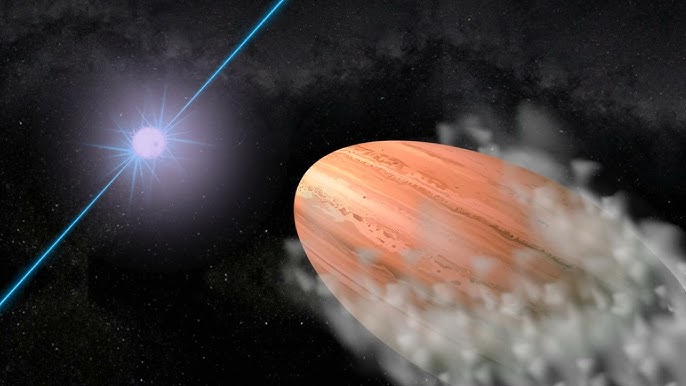

The James Webb Space Telescope has turned up a world that looks more like a squeezed citrus fruit than a planet, a distorted exoplanet locked in a frantic orbit around a rapidly spinning pulsar. Instead of a familiar spherical globe, this object is stretched into a lemon-like shape by brutal tides and wrapped in an atmosphere that defies standard models of how planets form. The discovery pushes planetary science into territory that, until now, belonged mostly to theory and science fiction.
By catching this strange world in the act of circling a dead stellar remnant, astronomers are being forced to rethink what kinds of planets can survive in the most hostile corners of the galaxy. I see this as a stress test for our assumptions: if a lemon-shaped planet can cling to life around a pulsar, then the universe’s inventory of possible worlds is far more varied than the tidy diagrams in textbooks suggest.
Meet PSR J2322-2650b, the lemon world
The newly scrutinized planet, PSR J2322-2650b, orbits a compact stellar corpse known as a pulsar and is so distorted by gravity that its bulk resembles a lemon rather than a sphere. Astronomers had hints of this object before, but it is the James Webb Space Telescope, often shortened to JWST, that has now revealed its extreme shape and composition in detail, showing a world unlike anything seen in the catalog of thousands of known exoplanets. Reporting on the system describes PSR J2322-2650b as an object whose very geometry is sculpted by the intense pull of its host, a configuration that would be impossible around a more ordinary star, which is why early coverage framed it as a planet “unlike anything seen before” once JWST pinned down its shape.
In technical terms, PSR J2322-2650b is a close-in companion to a rapidly rotating neutron star, and its orbit is so tight that the planet completes a lap in just hours rather than days or years. Detailed descriptions of the system note that PSR J2322-2650b is around Earth’s size but far denser, with a mass and internal structure that hint at an exotic composition dominated by carbon and stripped of lighter elements. As astronomers have explained, this combination of compact size, high density, and extreme tidal distortion is what makes PSR J2322-2650b stand out from the more familiar hot Jupiters and rocky super-Earths that populate exoplanet surveys, a point underscored in analyses of the lemon-shaped exoplanet.
The bizarre pulsar that hosts it
To understand why this planet is so distorted, I have to start with its host: a pulsar that is itself an astrophysical oddity. A pulsar is a neutron star, the collapsed core of a massive star that exploded as a supernova, which spins rapidly and sweeps beams of radiation through space like a lighthouse. In this case, the pulsar that anchors PSR J2322-2650b is described as “completely bizarre,” a compact object that emits steady beams of energy and exerts a gravitational pull so strong that it drags the planet into a tight orbit lasting less than eight hours, a configuration highlighted in accounts of the planet’s extreme orbit.
Because pulsars are so dense, with masses comparable to the Sun squeezed into a city-sized sphere, their gravity can shred nearby material and strip companions down to their cores. In some systems, this process creates what astronomers call “black widow” binaries, where the pulsar gradually erodes a partner star, and one possibility raised in early interpretations is that PSR J2322-2650b could be the remnant of such a devoured companion. That scenario would help explain why the planet is so compact and carbon rich, and it fits with the idea that the pulsar’s relentless radiation and tidal forces have peeled away lighter layers over time, a line of reasoning that appears in discussions of how one possible black widow system could produce a lemon-shaped world.
How JWST spotted a world in a death zone
Finding a planet around a pulsar is hard enough, but characterizing its atmosphere and shape is even more challenging, which is where the James Webb Space Telescope comes in. Using NASA’s James Webb Space Telescope, researchers targeted the system with infrared instruments that can pick up the faint glow of a small planet even in the glare of a compact star, then combined those measurements with precise timing of the pulsar’s radio pulses to infer the planet’s orbit and distortion. The observing campaign relied on the telescope’s ability to detect tiny changes in brightness and spectrum as the planet moved, a technique that allowed scientists to isolate the signature of a carbon-rich atmosphere and confirm that the object is being stretched by gravity, as described in reports on using NASA’s James Webb Space Telescope to study the system.
Scientists using NASA’s James Webb Space Telescope then pushed further, using spectroscopy to break the planet’s light into its component wavelengths and search for specific molecules. That analysis revealed an atmosphere whose chemical mix does not match standard models, with strong signatures of carbon-bearing species and a puzzling lack of the oxygen and nitrogen that dominate many other exoplanet atmospheres. The same data also showed that the planet’s dayside is intensely heated by the pulsar’s radiation, while the nightside may be cooler but still far from hospitable, a picture that aligns with the description of an entirely new type of exoplanet whose atmospheric chemistry is unlike anything previously cataloged in observations that scientists using NASA’s James Webb Space Telescope have now outlined.
Why the planet is shaped like a lemon
The planet’s distinctive geometry is not a cosmetic quirk, it is the direct result of physics. Gravitational forces from the much heavier pulsar are pulling the exoplanet into an elongated shape, stretching it along the line that connects the two bodies and compressing it at the poles, so that the world bulges into something closer to a lemon than a sphere. Because the orbit is so tight, with a period of just 7.8 hours, the tidal forces never let up, and the planet is likely tidally locked, always showing the same face to its host, a configuration that is explicitly described in NASA’s technical summary of how gravitational forces from the much heavier pulsar are reshaping the planet.
From my perspective, what makes this especially striking is that the planet has not been torn apart despite living in what amounts to a gravitational death zone. Instead, the object has settled into a stable, if tortured, configuration where its internal structure and atmosphere are constantly being kneaded by tides. Researchers found that this world has a bizarre atmosphere and that it is distorted by gravity into the shape of a lemon, and some analyses go further, suggesting that the immense pressures inside such a carbon-rich body could condense its carbon into diamonds, an idea raised when researchers found that this world might be dense enough for diamond formation.
A carbon-rich atmosphere that breaks the rules
Beyond its shape, PSR J2322-2650b is rewriting the rulebook on planetary atmospheres. Observations indicate that the planet’s air is dominated by molecular carbon and related species, with far less hydrogen, oxygen, and nitrogen than expected for a world of its size and temperature. One researcher put it bluntly, explaining that in order to have molecular carbon in the atmosphere, you have to get rid of pretty much everything else, all of the oxygen and nitrogen, a statement that captures how radical this composition is and appears in detailed coverage of how the strange lemon-shaped exoplanet defies the rules of planet formation.
That carbon-heavy mix suggests a violent history in which lighter elements were stripped away by the pulsar’s radiation or lost during earlier phases of the system’s evolution, leaving behind a chemically processed remnant. Using NASA’s James Webb Space Telescope, researchers have spotted an exoplanet with an atmosphere unlike anything previously observed, and they argue that this may represent a new class of carbon-rich worlds that form or evolve in the vicinity of compact objects, a conclusion that is echoed in technical write-ups of how using NASA’s James Webb Space Telescope has opened a window on such exotic atmospheres.
Why astronomers are genuinely baffled
For all the data JWST has delivered, PSR J2322-2650b still refuses to fit neatly into existing theories, and astronomers have been candid about their confusion. Because PSR J2322-2650b is so close to its pulsar and so heavily processed by radiation, it does not resemble the rocky planets of our Solar System or the gas giants that dominate many exoplanet surveys, leading one scientist to describe it as a type of object they had not really been looking at before. That sense of surprise comes through clearly in accounts that emphasize how scientists are baffled by this bizarre lemon-shaped exoplanet.
Part of the puzzle is formation: standard models do not easily produce a dense, carbon-rich planet in such a tight orbit around a pulsar, especially if the system began as a normal star with a companion. The team is not certain how the exoplanet was formed, and one of the lead researchers has been quoted as saying, “It’s extremely different from what we expected,” a sentiment that captures the gap between theory and observation and is repeated in coverage that notes how astronomers find a mysterious lemon-shaped exoplanet that deepens, rather than resolves, the mystery of how such systems come to be.
From niche discovery to viral “space lemon”
Despite the technical complexity, the idea of a lemon-shaped planet orbiting a dead star has resonated far beyond the astronomy community. Visualizations and artist’s concepts of the system, showing a bright yellow, elongated world hugging a tiny pulsar, have circulated widely on social media, turning PSR J2322-2650b into a kind of cosmic mascot for weird exoplanets. One popular clip describes how The James Webb Space Telescope’s (JWST) latest discovery has unveiled a unique exoplanet, PSR J232252.0+062814, with a lemon-like profile located roughly 1 million miles away from its host, a framing that helped the story spread as users shared an Instagram reel about The James Webb Space Telescope and its latest oddball planet.
Traditional science outlets have leaned into that public fascination, using playful language to draw readers into a genuinely difficult piece of astrophysics. One widely shared feature framed the discovery under the banner “When the Universe Gives You Lemons,” arguing that this is the sort of planet astronomers never even imagined and that science is made when researchers stumble onto such unexpected corners of the cosmos, a sentiment that appears in coverage titled When the Universe Gives You Lemons, Bizarre Lemon-Shaped Exoplanet Defies Explanation. I see that blend of humor and rigor as a healthy sign: it shows that the public can handle nuance as long as the story has a vivid hook.
What this means for planet formation theories
Underneath the memes and metaphors, PSR J2322-2650b is forcing a serious re-evaluation of how planets form and evolve in extreme environments. Traditional models assume that planets coalesce in relatively calm protoplanetary disks around young stars, then migrate or settle into stable orbits, but a carbon-rich, lemon-shaped world hugging a pulsar suggests that some planets are forged or reshaped in the aftermath of stellar death. Astronomers have already noted that the new research revealed that powerful gravity from its nearby pulsar has sculpted the planet and that the system endures more extreme conditions than scientists thought possible, a conclusion highlighted in reports that describe how astronomers discovered a lemon-shaped planet with properties they had never seen before.
Some researchers now suspect that PSR J2322-2650b could be the stripped core of a former star or a massive planet that lost its outer layers, which would make it a kind of hybrid object, part planet and part stellar remnant. That possibility dovetails with the idea that the system might be a black widow binary in which the pulsar has spent eons eroding its companion, a scenario that was raised when one analysis noted that one possibility is that this configuration is actually a type of star system known as a black widow binary, a point made explicitly in discussions of how one possibility is that this configuration could explain the planet’s density and composition. If that interpretation holds up, PSR J2322-2650b will not just be a curiosity, it will be a crucial data point in understanding how compact objects recycle and reshape the material around them.
JWST’s growing legacy of weird worlds
PSR J2322-2650b is not the first strange planet to cross JWST’s field of view, but it may be the most visually arresting example of how the telescope is expanding the known diversity of exoplanets. Earlier observations have already revealed atmospheres packed with unexpected molecules, clouds made of exotic condensates, and temperature patterns that challenge simple models, and the lemon-shaped pulsar companion now joins that list as a flagship case of an object that simply could not have been characterized with previous instruments. The powerful James Webb Space Telescope has given astronomers a glimpse into distant corners of our universe where such oddities lurk, and its sensitivity is what allowed them to pick out the subtle signals of the weird lemon-shaped exoplanet orbiting a bizarre star.
As I see it, the lesson is that every time JWST stares at an unusual target, it risks upending a tidy narrative, and that is precisely what a frontier observatory should do. The James Webb Space Telescope’s latest discovery has already been framed as a unique exoplanet with a lemon-like profile, and technical briefings emphasize that the telescope’s infrared instruments and high-resolution spectroscopy were essential to teasing out its properties, a point that is reinforced in coverage of how the James Webb Space Telescope discovers a lemon-shaped exoplanet that defies expectations. If this is the tip of the cosmic iceberg, as some researchers have suggested, then the era of neat planetary categories is over, and the age of truly strange worlds has begun.
More from MorningOverview