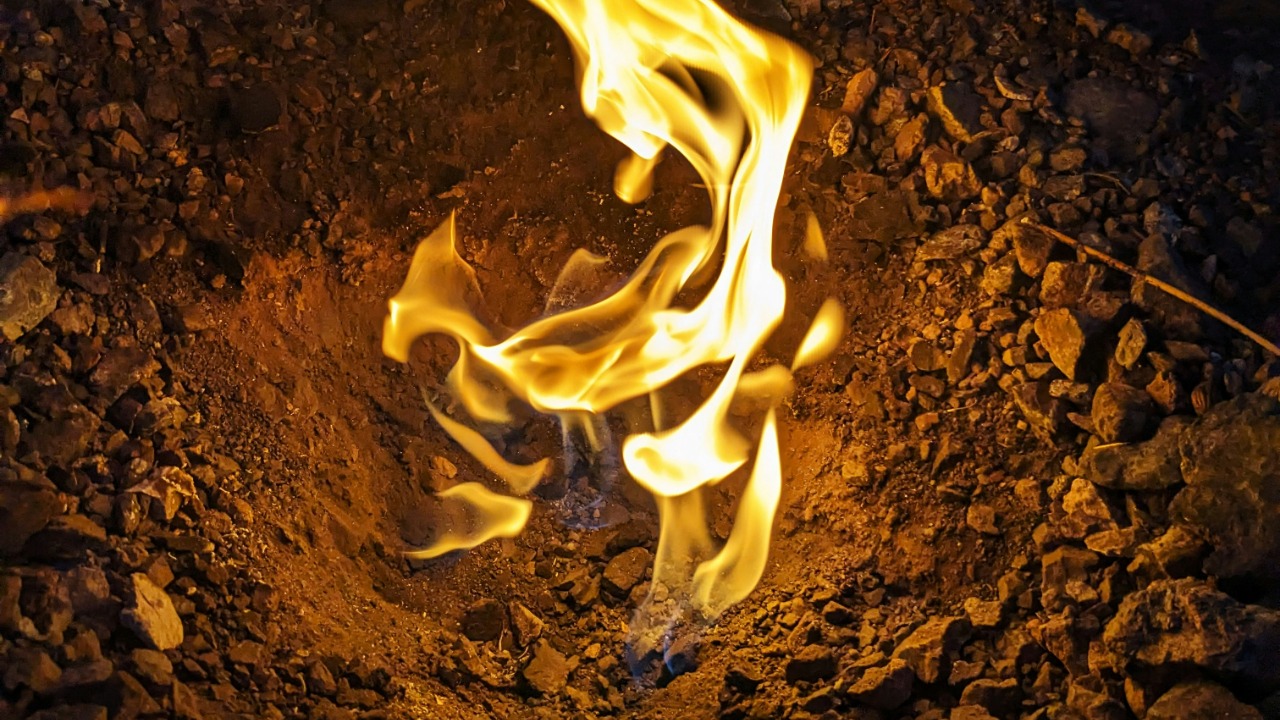

Archaeologists working in eastern England say they have uncovered the earliest known evidence of humans deliberately making fire, pushing the origin of this technology back to roughly 400,000 years ago. If that interpretation holds, it means people were striking sparks around 350,000 years earlier than most researchers had believed, forcing a rethink of how quickly our ancestors mastered heat, light, and cooking.
The claim rests on a dense cluster of stone tools, burned bone and soil, and specialized fire-starting rocks buried beneath a modern forest, all pointing to repeated visits by ancient humans who knew how to ignite flames on demand. I see this as more than a tweak to the timeline, it is a challenge to long-held assumptions about when complex planning, social cooperation, and perhaps even language began to shape human evolution.
The Suffolk site that rewrites the fire timeline
At the heart of the new research is a site in eastern Britain where layers of sediment preserve a snapshot of life beside an ancient river. Buried beneath a Suffolk forest, archaeologists uncovered a dense scatter of stone tools, butchered animal remains, and traces of burning that had been sealed for hundreds of thousands of years, a context that researchers at Leiden described simply as Buried beneath a Suffolk forest. The sediments and fossils point to a temperate landscape visited repeatedly by early humans, not a one-off campsite washed together by chance.
The new study, published in Nature, argues that this Suffolk locality preserves the oldest secure evidence of people making, not just using, fire. The team links the burned material to a specific occupation surface associated with stone handaxes and other tools, which indicates that the flames were part of a broader pattern of activity rather than a stray lightning strike or wildfire. In my view, that tight association between tools, bones, and heat damage is what elevates the site from interesting curiosity to a genuine pivot point in human prehistory.
From natural flames to deliberate fire-making
For decades, many archaeologists assumed that early humans first learned to exploit natural fires, then only much later figured out how to spark their own. Evidence of ancient hearths has turned up at sites tens of thousands of years old, including 26,000-year-old fireplaces in Ukraine where Scientists used microstratigraphic analysis, micromorphology, and colorimetric techniques to show that Scientists employed the most advanced technologies to confirm controlled burning. Yet those Ice Age hearths were already part of a well-established tradition, leaving a huge gap between opportunistic use of wildfires and routine, intentional ignition. The Suffolk discovery helps fill that gap by tying fire directly to specialized equipment for starting it. Researchers report that the site contains not only burned sediments and bones but also distinctive stones that had been repeatedly struck together, suggesting that ancient visitors were not waiting for lightning but actively generating sparks. That pattern supports the idea that by around 400,000 years ago, humans had crossed a crucial threshold, shifting from passive users of natural flames to reliable fire-makers who could carry their technology into new environments whenever they chose.
Iron pyrite, flint, and the toolkit of ancient fire-makers
The most striking artifacts from the Suffolk site are fragments of iron pyrite and flint that appear to have been used together as a primitive lighter. When struck, iron pyrite can shower hot sparks onto dry tinder, a trick familiar to traditional fire-makers and survival instructors today. At this British locality, archaeologists found that Fragments of iron pyrite were clustered near stone tools and burned deposits, a pattern highlighted in reporting that described how Fragments of this rock can be used with flint to ignite a blaze.
Additional coverage of the same research notes that these fire-starting stones come from a 400,000-year-old context, making them the oldest known fire-making materials associated directly with human activity. One detailed account put it plainly, explaining that Fire-making materials at a 400,000-year-old site are the oldest evidence of humans making fire, and that Fragments of iron pyrite, a rock that can be used with flint, were found beside an old hearth in eastern Britain. To my eye, that combination of raw materials and context is exactly what you would expect from a community that had mastered a repeatable ignition technique.
Why archaeologists are confident this was not a wildfire
One of the biggest challenges in fire archaeology is distinguishing deliberate burning from natural events. Charred wood or reddened soil can result from lightning strikes, grass fires, or even slow chemical changes in sediments, which is why some earlier claims about very ancient hearths have been controversial. In this case, the research team emphasizes that the burned layers at the Suffolk site are tightly associated with stone tools and bones, and that the pattern of scorching suggests repeated, localized burning in the same spot rather than a sweeping blaze that passed through once and moved on.
Summaries of the work stress that the deposits show signs of controlled heating rather than a landscape that simply burned due to a wildfire, a distinction that is central to the argument that humans were making and using fire 350,000 years earlier than previously thought. A detailed briefing on the project notes that Humans were making and using fire 350,000 years earlier than previously thought and that the deposits were not simply burned due to a wildfire. For me, that careful separation between natural and cultural fire is what gives the claim its weight.
Peer-reviewed science and a 40-year career highlight
The Suffolk findings are not a quick announcement based on a single odd rock, they come from a Peer-reviewed study that has been scrutinized by specialists in multiple disciplines. The project was Publicly released on a Thu morning in Dec, with one summary emphasizing that it was vetted as Peer-reviewed research before being shared with the wider public. That process matters, because claims that rewrite evolutionary history demand more than a compelling story, they require data that can survive skeptical cross-examination.
One of the senior researchers involved described the discovery as the most exciting of his 40-year career, a remark that captures how unusual it is to find such a clean window into deep time. Coverage of the announcement noted that the work was published on a Wednesday in the journal Nature and quoted the scientist saying, “It’s the most exciting discovery of my 40-year career.” When a veteran who has spent decades in the field reacts that way, I take it as a sign that the evidence is not just intriguing but unusually robust.
Who were these early fire-makers in Britain?
The Suffolk site sits within a broader pattern of early human occupation in Britain, a region that saw waves of hominin arrivals and departures as climates shifted. Reports from LONDON describe how Scientists in Britain linked the fire-making evidence to ancient humans who lived in a landscape of rivers, forests, and large mammals, returning to the same location repeatedly to butcher animals and tend flames. One account summarized the finding by noting that Scientists in Britain say ancient humans may have learned to make fire far earlier than previously believed, based on evidence of repeated burning in the same location.
Other coverage frames the discovery as a major chronological shift for the region, with Archaeologists in London describing how the 400,000-year-old evidence from England forces a re-evaluation of when complex behavior emerged in Europe. One report on the broader implications explained that Archaeologists solved a 1,800-year-old Roman fresco puzzle in London while also highlighting that the 400,000-year-old discovery in England represents a major chronological shift. I read that pairing as a reminder that the same city now curates both classical art and evidence of some of the earliest technological experiments by our distant relatives.
How far this pushes back the fire timeline
Before the Suffolk work, many researchers placed the first solid evidence of deliberate fire-making around 50,000 years ago, long after the appearance of Homo sapiens. The new study argues that Humans made fires as early as 400,000 years ago, pushing the timeline of this crucial human innovation back a staggering 350,000 years, a claim summarized in one analysis that noted that Humans made fires as early as 400,000 years ago, pushing the timeline back 350,000. That shift is not a minor adjustment, it effectively multiplies the known duration of human fire technology by a factor of eight.
Several summaries emphasize the same figures, noting that the UK discovery reveals use of fire 400,000 years ago and sheds new light on evolution, and that this means humans were making fire 350,000 years earlier than thought. One report put it succinctly, explaining that the UK discovery reveals use of fire 400,000 years ago and that humans were making fire 350,000 earlier than thought. Another academic commentary described how Ancient humans were making fire 350.000 years earlier than previously thought, using that exact figure of 350.000 to underline the scale of the revision. When multiple independent summaries converge on the same numbers, I take that as a sign that the core chronology is on solid ground.
What fire meant for bodies, brains, and language
Fire is not just a handy tool, it is a force that reshapes biology, diet, and social life. Cooking softens food and releases more calories, which some evolutionary theorists argue helped fuel the growth of large brains in our lineage. The Suffolk evidence suggests that this caloric and cognitive boost may have been available far earlier than many models assumed, giving ancient populations hundreds of thousands of extra years to adapt to a world where hot meals and warm shelters were part of daily life. One academic discussion of the site explicitly links it to questions about social bonds and communication, noting that the Suffolk forest context offers clues to the beginnings of language and complex relationships around a hearth.
That idea is echoed in a broader reflection on the discovery, which points out that traces of fire use are difficult to come by, leaving archaeologists’ attempts to date these developments frustrated, but that the new evidence points to much earlier complex relationships around a hearth. A detailed analysis framed it this way, explaining that Dec was the moment when researchers could finally say that Ancient Humans Were Making Fire 350,000 Years Earlier than scientists thought, opening new questions about how those hearths shaped conversation, cooperation, and perhaps the earliest storytelling.
Reconstructing the act of making fire
One of the most vivid aspects of the Suffolk research is the way it allows us to imagine the physical act of making fire in deep time. The combination of flint and iron pyrite suggests a technique in which a person would hold one stone and strike it sharply against the other, showering sparks onto a carefully prepared bed of tinder. A press briefing from the Natural History Museum described how a team of researchers, including Dr Silvia Bello, concluded that the fire-making materials at the site were used by people on several occasions, emphasizing that this was not a one-off experiment but a practiced skill. That account highlighted the discovery as a Groundbreaking discovery and quoted Dr Silvia Bello by name.
Another detailed commentary on the broader significance of the work stressed that the controlled use of fire was a key part of the development of human technology, with a range of uses from cooking to protection, and that the new evidence shows people deliberately striking stones in order to ignite a fire. That analysis explained that the controlled use of fire was a key part of the development of human technology and that people were striking stones in order to ignite a fire, a point captured in a discussion of order to ignite a fire. When I picture those repeated, practiced motions, I see not just survival but the beginnings of a technological tradition passed from one generation to the next.
Why this discovery matters beyond Britain
Although the Suffolk site sits in eastern Britain, its implications ripple far beyond the island. If humans in this region were making fire 400,000 years ago, it raises the possibility that similar techniques were in use across Eurasia, even if the evidence has not yet been found or recognized. One summary of the research framed it as part of a broader pattern, noting that Dec brought news that humans were making fire 350,000 years earlier than thought and that this sheds new light on evolution and the spread of our species. Another report described how a team of researchers, including specialists from the British Museum, concluded that Humans were making fire 350,000 years earlier than previously thought, underscoring the global significance of the find.
Other commentators have pointed out that the Suffolk discovery slots into a growing body of work that uses advanced analytical techniques to detect subtle traces of ancient burning. From the Ice Age fireplaces in Ukraine to younger hearths scattered across Africa and the Middle East, researchers are increasingly able to distinguish human-controlled fires from natural ones, even when only microscopic clues remain. In that sense, the British site is both a singular breakthrough and part of a methodological shift, one that combines careful excavation with laboratory tools to illuminate some of the most elusive moments in our species’ story.
More from MorningOverview