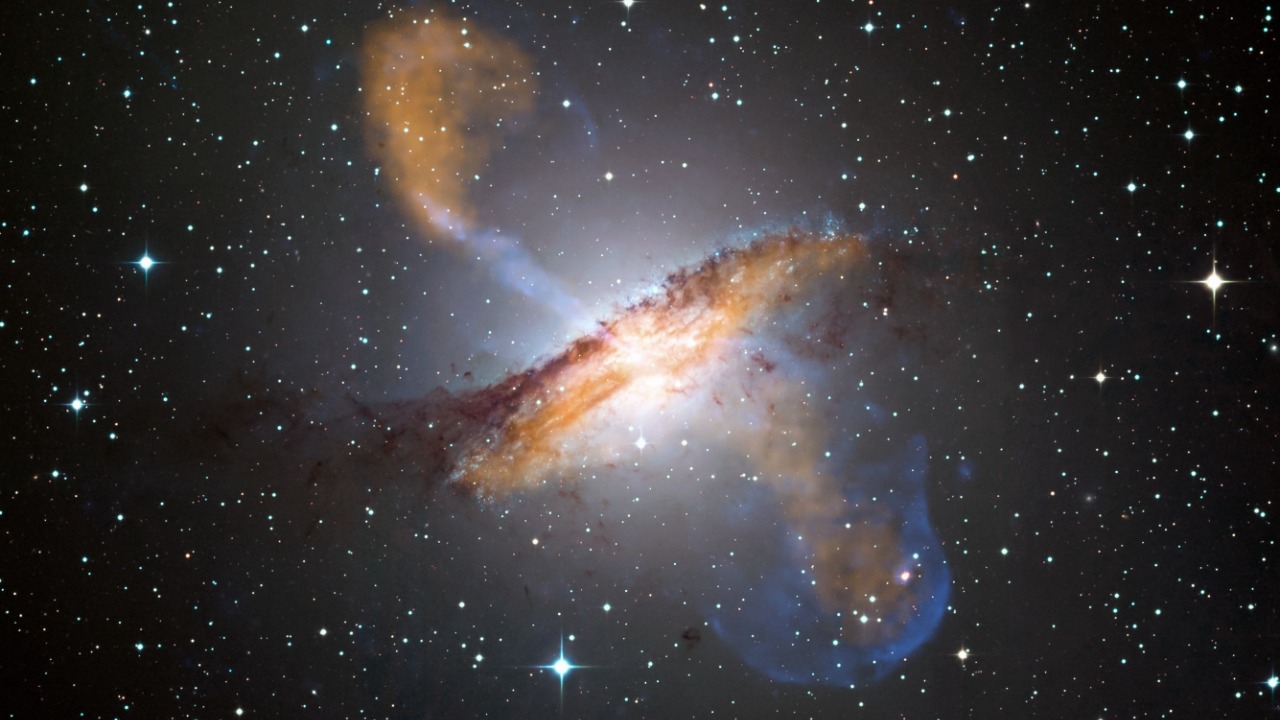

Physicists have started to treat a once-fringe idea with surprising seriousness: that our entire observable universe might be the interior of a black hole that formed in some larger cosmos. The notion sounds like science fiction, yet it grows out of real attempts to explain the Big Bang, dark energy, and puzzling patterns in the way galaxies spin. If Earth is part of such a cosmic nesting doll, the evidence would be written not in our skies as a visible boundary, but in the deep structure of space, time, and gravity itself.
Instead of picturing Earth plunging into a nearby monster black hole, researchers are asking whether the Big Bang was itself the birth of a new region of space inside a collapsing star in another universe. That shift in perspective turns the question from a disaster scenario into a subtle test of competing theories of gravity, quantum physics, and cosmology, with telescopes and particle experiments probing whether our cosmic home really sits behind an event horizon.
From sci‑fi thought experiment to serious cosmology
When people hear “Earth inside a black hole,” they usually imagine our planet being torn apart by tidal forces, not a quiet, hidden interior that has been expanding for billions of years. Yet some theorists argue that the mathematics of general relativity naturally allows a black hole to contain a growing region of space that looks, from the inside, like a universe with its own Big Bang. In this view, the violent collapse that forms a black hole in a parent universe could trigger a bounce that seeds a new cosmos, with our familiar galaxies and clusters emerging long after that initial crunch.
Early versions of this idea were often treated as curiosities, but over time they have been refined into what is sometimes called black hole cosmology or Schwarzschild cosmology, which treats the interior of a black hole as a full-fledged universe rather than a dead end. Popular explainers now walk through how the equations of relativity permit such nested universes and why some physicists say we live in a black hole, not metaphorically and not just during tax season but literally, a framing that has been explored in detail in videos such as Is Our Universe Inside a Black Hole? This Makes it Plausible.
What black holes really are, and why the Big Bang looks similar
To understand the argument, I need to start with what a black hole actually is in modern physics. In Einstein’s theory, a sufficiently dense mass warps spacetime so severely that it creates an event horizon, a boundary from which nothing, not even light, can escape. Inside that horizon, classical equations predict a singularity where density and curvature become infinite, although most physicists expect quantum effects to replace that singularity with something more physical, such as a region of extreme but finite density or a bounce.
The Big Bang, at first glance, looks like the time-reverse of a black hole collapse, with the universe starting from an incredibly hot, dense state and then expanding. Some writers have compared this to a black hole’s “bizarro twin,” but as one analysis of cosmology and gravity points out, the Big Bang singularity is not a point in space that you could fly toward, it is a boundary in time that every comoving observer shares, which is why But unfortunately, that’s where the similarities end between a standard black hole and our cosmic origin.
Nikodem Poplawski and the “universe in a black hole” proposal
Among the most prominent advocates of the nested-universe picture is Polish theoretical physicist Nikodem Poplawski of the University of New Haven, who has spent years developing models in which black holes give birth to new universes. Poplawski works on general relativity, analytical mechanics, and classical and quantum field theory, and he has argued that when matter collapses inside a black hole, torsion in spacetime can prevent a true singularity from forming, instead creating a bounce that launches a new expanding region of space on the other side of the horizon. In that scenario, our own cosmos could be the interior of such a bounce, with the Big Bang marking the moment that new region began to grow.
Poplawski’s work has been profiled as a revolutionary theory of black holes that links gravity at extreme densities to the origin of cosmic expansion, and his faculty biography notes that About Nikodem Poplawski includes extensive media coverage of this idea. Earlier treatments of his model described how a black hole in a parent universe could contain a baby universe inside, with nested universes forming whenever massive stars collapse, an approach that was already being discussed when reports explained that Poplawski had expanded on the thinking behind the claim that Poplawski and Nested universes might explain our own Big Bang.
How James Webb and galaxy spins revived the debate
For years, black hole cosmology lived mostly on chalkboards, but new astronomical data have given its supporters fresh talking points. A recent study of 263 g galaxies used observations from major observatories to look at how these systems rotate, and the researchers reported that a surprisingly large fraction of them appear to spin in the same direction. That pattern challenges the expectation that, on the largest scales, galaxy spins should be randomly oriented, and it has been cited as potential evidence that our universe is the interior of a black hole whose rotation imprints a preferred direction on everything inside.
The same work has been linked to the idea that our cosmos might be trapped inside a rotating black hole, with the alignment of galaxy spins reflecting the angular momentum of the parent object. Coverage of the study notes that this challenges the assumption that any given universe would have half of them spinning one way, with the rest spinning the other way, and that the lead author of the research told Space.com that such a bias could fit naturally into a black hole origin story, a claim that has been amplified in pieces explaining why This challenges the assumption of random spin directions and in reports that a new study of 263 g rotating in the same direction hints we could be living inside a black hole.
Born in a black hole: what Schwarzschild cosmology actually says
In the more formal language of Schwarzschild cosmology, our observable universe is modeled as the interior region of a black hole that formed in some external spacetime, with the event horizon of that black hole corresponding to a boundary we can never see from within. In this picture, the Big Bang is not the absolute beginning of everything, but the moment when matter collapsing in the parent universe reached such densities that quantum gravity effects caused a bounce, creating a new expanding region that we experience as cosmic inflation and subsequent expansion. The interior then evolves according to the same equations that describe standard cosmology, but with parameters set by the mass, spin, and other properties of the parent black hole.
Recent coverage of this framework has emphasized that black hole cosmology, also known as Schwarzschild cosmology, suggests that our observable universe might have been Born in a black hole, with the bounce that replaces the singularity acting as the trigger for expansion and potentially explaining why the universe appears so uniform on large scales. Reports on James Webb Space Telescope results have revisited this idea, noting that Born in a black hole, Black and Schwarzschild cosmology could, in principle, leave subtle signatures in how galaxies cluster and how the cosmic microwave background is patterned, although those tests remain challenging.
Could Earth itself be inside a black hole right now?
When I narrow the question from “our universe” to “Earth,” the physics becomes more concrete. If our planet had somehow drifted inside the event horizon of a stellar-mass or supermassive black hole, the tidal forces would be extreme, stretching and compressing matter in a process often called spaghettification. For a distant observer outside, time for us would appear to slow and then freeze at the horizon, while from our perspective we would cross the boundary in finite time and be pulled toward the interior, with gravity varying so sharply across our bodies that it would tear us apart long before we reached any central region.
Astrophysicists who have walked through this scenario emphasize that for a distant observer outside, the light from Earth would become increasingly redshifted and dim as the planet approached the horizon, effectively fading from view as the black hole is feasting on new material. Detailed descriptions of this process explain that Worse than that, your arms, by virtue of the fact that they are not at the center of your body, will be attracted in a slightly different way than your torso, leading to intense stretching, a picture laid out in guides to For a distant observer outside and echoed in online discussions where one commenter notes that the discrepancy as to whether or not we live or die is inconsequential if the entire planet is consumed, since Mar 28, 2012 debates focus more on the physics than on survival.
Why we probably would not notice a cosmic event horizon
Paradoxically, some researchers argue that if the entire universe is inside a much larger black hole, we might not notice anything locally at all. The key is that the event horizon in that case would lie outside our observable region, and the interior spacetime could look, to its inhabitants, like a standard expanding universe with galaxies, stars, and planets evolving according to familiar laws. Locally, gravity would still follow the same inverse-square behavior, and the motions of planets in the Solar System would remain governed by the mass of the Sun and nearby bodies, not by some distant boundary we can never reach.
Popular explainers have even suggested that if Earth were swallowed by a sufficiently large black hole, we might not immediately notice, because the tidal forces at the horizon of a supermassive object can be gentle over planetary scales. One widely shared piece put it bluntly: But a new study suggests they may not be all doom and gloom after all, noting that There are several theories as to what would happen if our world crossed such a threshold, including the craziest idea out there that life on the surface might continue for a time as if nothing had changed, a scenario explored in detail in discussions of how Jun, But, There could be surprisingly little drama at the horizon itself.
What mainstream relativity says about living in a black hole
General relativity, as it is usually taught, treats black holes and cosmological expansion as distinct solutions to Einstein’s equations, but the mathematics does allow for more exotic combinations. Some exact solutions describe regions that look like expanding universes inside black hole-like structures, and theorists have explored whether such models can be matched smoothly to an external spacetime. However, most working cosmologists still favor the standard Big Bang model with inflation, dark matter, and dark energy, because it has been tested extensively against observations of the cosmic microwave background, large-scale structure, and supernova distances.
Analyses of the black hole interior idea often stress that while the equations permit such constructions, there is no direct evidence that our universe actually sits inside an event horizon, and that the Big Bang singularity is better understood as a limit of the theory rather than a literal point of infinite density. One detailed discussion notes that Apr, But the similarities between a black hole and the Big Bang largely stop at the shared presence of a singularity in the classical equations, and that more sophisticated treatments of quantum gravity are likely to smooth out both extremes in different ways, a caution that appears in pieces asking Do We Live inside a Black Hole? and in explainers that walk through why the Big Bang singularity is not a location in space.
Evidence for and against: what the data actually show
Supporters of the black hole universe idea point to several intriguing hints, from galaxy spin alignments to the apparent acceleration of cosmic expansion. Some argue that a bounce inside a black hole could naturally produce a period of rapid early expansion that mimics inflation, while the properties of the parent black hole might set the effective value of dark energy in the child universe. Others suggest that the distribution of matter on the largest scales, including filaments and voids, could reflect initial conditions inherited from the collapse in the parent cosmos, though these claims remain speculative and difficult to test.
On the observational side, astronomers have been refining measurements of black hole behavior in our own universe, looking for patterns that might inform these cosmological models. Evidence for quasi-periodic oscillations and other signatures in X-ray data from accreting black holes has long been debated by the astronomy community, but recent work by an international team has strengthened the case that certain timing features are real, thanks to the quality and volume of the data they used. Reports on this research note that Evidence for this behaviour has long been contested, However the new analysis provides a clearer view of how matter behaves near event horizons, which in turn feeds back into theoretical work on what might happen in the deepest interior.
How popular science and online debates shape the conversation
Beyond formal papers, the idea that we might live inside a black hole has flourished in videos, forums, and explainers that translate dense equations into vivid imagery. Science communicators such as Anton have produced long-form breakdowns of the theory, with one video opening, “hello wonderful person this is Anton. and today I wanted to revisit one of the more mind-bending theories and propositions,” before walking through how a black hole interior could resemble our expanding universe and what observational clues might support or refute that claim, as seen in Oct, Anton revisiting the topic.
Online communities have also latched onto the theme, with posts summarizing recent studies under headlines like “scientists now believe our universe is inside of a black hole” and commenters debating whether the bounce that replaces a singularity could be what triggered the Big Bang in our universe. One widely shared thread framed it this way: So here’s a wild but scientifically grounded idea, suggesting that matter collapsing into a black hole in a parent universe could be crushed into a true singularity in classical theory, but that quantum effects might instead cause a rebound that seeds a new cosmos, a scenario laid out in discussions where So here’s a wild but compelling picture of the Big Bang emerges.
Why some physicists embrace the idea, and others push back
Physicists who take the black hole universe hypothesis seriously often do so because it offers a way to reconcile paradoxes that arise when studying black holes and the early universe. In an attempt to reconcile some of the paradoxes discovered when studying them, researchers have proposed stranger hypotheses, including the possibility that every black hole could be a gateway to a much larger universe, and that our own cosmos might be one such interior. Advocates argue that this could address questions about information loss, the nature of singularities, and why the constants of nature take the values they do, by embedding our universe in a broader multiverse of black hole-born offspring.
At the same time, many experts remain skeptical, insisting that extraordinary claims require clear, testable predictions. One overview notes that If the implications of the theory are ruled out by an experiment, then we could say the assumptions are inconsistent with reality, a standard that applies as much to black hole cosmology as to any other speculative framework. Commentators have highlighted that Sep, If the predictions of a black hole interior model fail to match observations of the cosmic microwave background or galaxy distributions, then the theory would have to be revised or discarded, a point echoed in analyses that explain why some physicists think we are living inside a black hole while others see the idea as an elegant but unproven story, as summarized in pieces asking In an attempt to reconcile black hole paradoxes with a much larger universe.
Where the debate stands, and what could settle it
Right now, the notion that Earth and its surrounding cosmos sit inside a black hole remains a bold but unconfirmed hypothesis, one that sits at the intersection of gravity, quantum theory, and observational astronomy. The most concrete progress is likely to come not from dramatic visual signatures, but from careful statistical studies of galaxy spins, cosmic background radiation, and the behavior of matter near known black holes in our own universe. If patterns like the reported spin alignment of distant galaxies hold up under scrutiny and can be uniquely tied to a rotating parent black hole, the case for a nested universe could strengthen; if they fade with better data, the idea may retreat again to the fringes.
In the meantime, the debate itself is reshaping how physicists think about singularities, horizons, and the meaning of the Big Bang. Whether or not our universe truly lies behind an event horizon, the effort to test that possibility is driving new work on quantum gravity and inspiring both technical papers and accessible explainers, from detailed breakdowns of how Could Earth and And for that matter, could our universe be inside a black hole, to thought experiments that ask what it would feel like To Earthli if such a scenario were real, as explored in discussions of Jun, Could Earth, And for, To Earthli and in more speculative videos and essays that keep the question alive in the public imagination.
More from MorningOverview