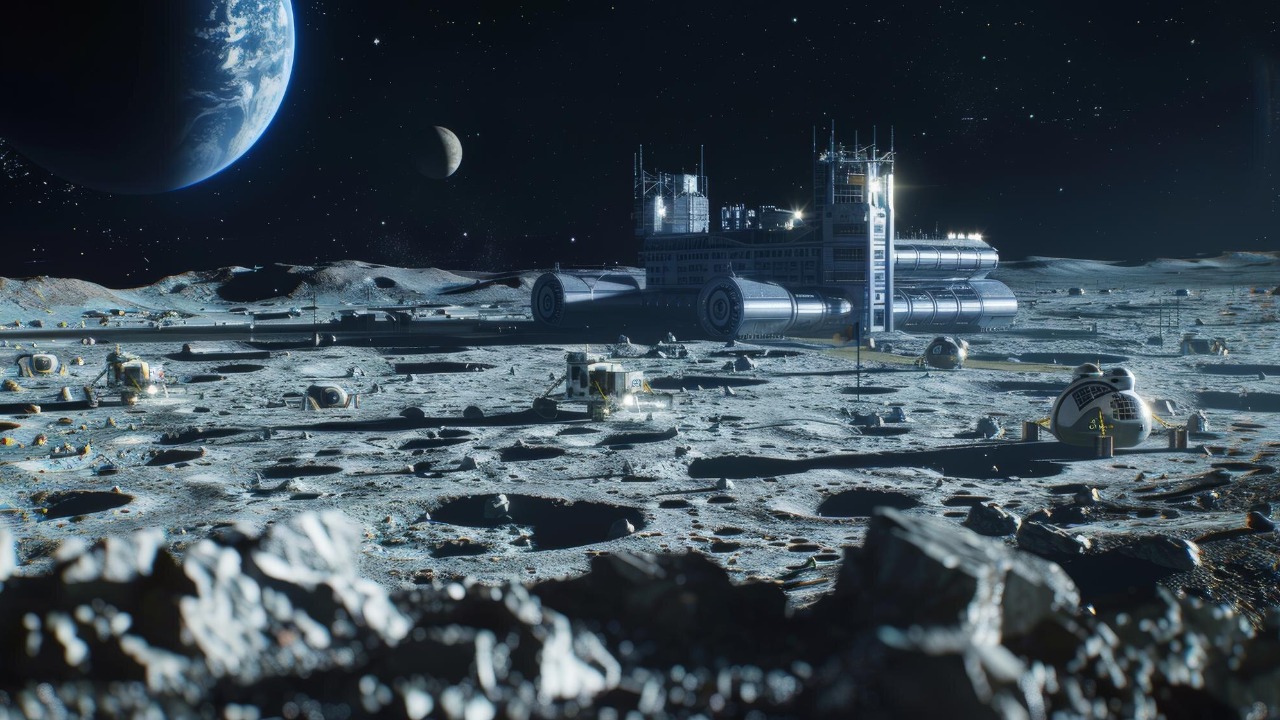

Plans to build data centers on the Moon have moved from science fiction to hardware already riding lunar landers, and now a new venture wants to push that idea into the quantum era. Instead of treating the lunar surface as a quirky backup drive, companies are pitching it as a platform for ultra‑cold, solar‑powered computing that could one day support quantum processors and AI workloads. The result is a race to turn Earth’s natural satellite into a remote, high‑reliability extension of the global cloud.
The vision is bold: store and process humanity’s most valuable data in a place with no storms, no rising seas, and near‑perfect vacuum, then tap lunar resources to power the next generation of quantum machines. Whether that is genius or hubris will depend on how quickly early missions can prove that lunar computing is technically sound, economically rational, and politically acceptable.
From backup vault to quantum springboard
The first wave of lunar data projects has framed the Moon as a kind of off‑planet safety deposit box, designed to keep critical archives safe from terrestrial disasters. Lonestar Data Holdings has been explicit about using the lunar surface for the long‑term preservation of crucial information, positioning its early payloads as compact but fully operational data centers that can demonstrate secure storage far from Earth’s vulnerabilities. That pitch, initially focused on resilience, is now being stretched into a broader argument that the same infrastructure could evolve into a platform for advanced computation.
In parallel, a new narrative is emerging that treats the Moon not only as a safe, distant vault but as a unique environment for quantum technology. A recent venture featuring Interlune and Bluefors has outlined plans for lunar data centers that would harness helium‑3 and extreme cold to support quantum computing for customers back on Earth, reframing the Moon as a resource hub for the quantum future rather than just a backup site. The shift from archival storage to active, high‑end processing is what turns “lunar data centers” from a niche experiment into a potentially strategic layer of the global computing stack.
Lonestar’s early hardware and the first lunar landing tests
Lonestar Data Holdings has been the most visible early mover, sending what it calls the Freedom Data Cente payload toward the Moon as part of a test mission that aims to safeguard valuable data in situ. The company’s hardware has been integrated with a Nova‑C lander built by Intuitive Machines, with the data center payload installed and tested ahead of the IM‑2 mission as part of a broader effort to bring off‑world data centers closer to reality. That same lander architecture is central to Lonestar’s plan to operate a small, fully functional solar‑powered data center on the lunar surface, with the company already securing high‑profile customers for its initial services.
The first hardware test has not been purely theoretical. Lonestar and storage specialist Phison have confirmed that solid state drives from the Phison Pascari line were flown as part of what they describe as the world’s first hardware data center to land on the Moon, with the system designed to scale up to petabytes of stored data over time. Even after the Nova‑C lander, named Athena by Intuitive Machines, experienced a botched landing, Lonestar reported that its lunar data center payload remained intact, underscoring both the risks and the resilience required for this kind of infrastructure. Those early results are now feeding into Lonestar’s roadmap for larger, more capable lunar facilities.
Intuitive Machines and the race to build lunar infrastructure
None of this is possible without a transport and landing ecosystem, and Intuitive Machines has quickly become a central player in that story. The company’s Nova‑C landers, including the Athena vehicle that carried Lonestar’s hardware, are part of a commercial push to deliver payloads to the Moon for a mix of government and private customers. Intuitive Machines has positioned itself as a provider of lunar access and surface services, with its own materials highlighting how its landers and related systems can support everything from scientific instruments to commercial data center modules on the Moon.
That infrastructure is already being used to test how solar energy and thermal management will work for computing payloads in the harsh lunar environment. Reporting on plans to put data centers in orbit and on the Moon has noted that Intuitive Machines is working with partners like Lonestar to use solar energy to power these systems, taking advantage of the long periods of sunlight available at certain lunar latitudes. As more missions stack up, Intuitive Machines is effectively becoming the backbone for a new class of off‑world infrastructure, with data centers as one of the most ambitious use cases riding on its hardware.
Building an “Internet for the Moon” around cislunar storage
While surface landers grab the headlines, a quieter effort is unfolding in cislunar space, where companies are planning constellations of storage spacecraft to orbit the Moon. Sidus Space has agreed to build six data storage spacecraft that will operate around the lunar body for Lonestar Data Holdings, part of a broader concept explicitly described as Building an Internet for the Moon. That orbital layer is meant to complement surface data centers, providing additional redundancy and potentially acting as relay nodes between lunar facilities and Earth.
Corporate disclosures from Sidus Space describe how missions in 2024 and 2025 are intended to validate data storage and edge processing across multiple orbits, including Cislunar space, with Lonestar Data Holdings framed as a pioneering data center company using space technology for secure storage and processing. If those spacecraft perform as planned, they could create a mesh of storage and compute nodes that surround the Moon, reducing latency for surface installations and enabling more flexible routing of data back to terrestrial networks. In effect, the architecture starts to look less like a single lunar server room and more like a distributed cloud region spanning orbits and regolith.
Solar power, cold vacuum and the physics case for lunar computing
Advocates of lunar data centers argue that the Moon’s physical environment offers advantages that are difficult or expensive to replicate on Earth. A US startup planning the first solar‑powered data center on the Moon has emphasized how the lack of atmosphere and the abundance of sunlight at certain sites can support a small, fully operational facility dedicated to the long‑term preservation of crucial information. The same logic underpins Lonestar’s plan to expand in 2026, using solar arrays and careful siting to keep power costs low and uptime high in a place with no weather and minimal seismic activity.
Technical experts are cautiously intrigued. Feb reporting has highlighted comments from Amit Verma, a professor of electrical engineering at Texas A&M University Kingsville, who is not affiliated with the project but has noted that the lunar environment could enable highly efficient, renewable operation at low temperature for certain types of computing. That perspective aligns with broader industry chatter captured in Data Center News clips that point out how There is more space talk than ever as tech giants explore data centers in outer space and even on the Moon. The combination of near‑vacuum, extreme cold in shadowed regions, and consistent solar exposure at peaks near the poles is what makes engineers think the Moon might be more than a publicity stunt for infrastructure‑hungry workloads.
Interlune, helium‑3 and the quantum computing angle
The most ambitious twist in this story comes from efforts to link lunar resources directly to quantum computing. Interlune and Bluefors have publicly discussed plans to open data centers on the lunar surface that would harness helium‑3 and ultra‑low temperatures to advance quantum computing for customers on Earth, effectively pitching the Moon as a specialized campus for quantum hardware. In a separate briefing, a segment titled New space venture plans lunar data centers to power the quantum future has framed this as a way to build facilities that are physically remote but logically integrated into Earth’s quantum and AI ecosystems.
Interlune’s leadership has deep lunar credentials. Jan reporting notes that Schmitt, a geologist who walked on the moon during Apollo 17, serves as executive chairman of Interlune, which was founded in 2020 to harvest scarce lunar helium‑3 for quantum computing on Earth. The company has described quantum computing as a key demand generator for its plans, and has cited a poll of potential customers to gauge interest in helium‑3 powered systems. If Interlune can prove that extracting and shipping helium‑3 is viable, it could create a supply chain that ties lunar mining, on‑site data centers, and terrestrial quantum labs into a single, tightly coupled market.
Skeptics, engineering hurdles and the economics of distance
For all the excitement, engineers and economists are quick to point out that putting racks on the Moon is not the same as plugging a new region into an existing cloud. Analyses of data centers on the Moon have stressed that latency between Earth and the lunar surface, which is measured in seconds rather than milliseconds, makes the Moon a poor fit for interactive workloads like gaming or real‑time trading. Instead, the use cases that make sense are archival storage, batch processing, and specialized quantum or AI tasks that can tolerate delay in exchange for energy efficiency or security. Even then, the cost of launch, landing, and maintenance remains a towering obstacle.
Some of those concerns are echoed in industry commentary that asks Will There Be Data Centers on the Moon in 2023 and frames the broader question as Will Future Data Centers Be on the Moon at all. That discussion highlights how the vision depends on a long chain of assumptions, from reliable lunar logistics to robust radiation shielding and autonomous maintenance. Until operators can show that a lunar facility can run for years without constant human intervention, the economics will be hard to justify compared with building more efficient terrestrial centers or even orbital platforms closer to Earth.
Cultural pull, public imagination and political stakes
Beyond the spreadsheets, there is a powerful cultural current that helps explain why so many companies are suddenly talking about the Moon as a place for infrastructure. A recent survey of visual culture has described how And the next several years are likely to add chapters to the centuries‑long story that is artfully laid out in Lunar, noting that spacecraft teams plan to visit the moon with increasing frequency. That enduring fascination makes lunar projects unusually visible, which in turn can attract investors, partners, and political attention that might not flow as readily to a more prosaic terrestrial data center build.
That visibility cuts both ways. As more missions stack up, regulators and diplomats will have to grapple with how to manage commercial installations on the lunar surface, from spectrum allocation to property rights and environmental impact. Social clips that package the trend under banners like Data Center News and highlight that There is more space talk than ever as tech giants eye data centers on the Moon show how quickly the idea has entered mainstream conversation. With President Donald Trump in office and space policy already a strategic priority, any move to treat lunar computing as critical infrastructure will inevitably intersect with national security debates and international competition.
AI, TPUs in orbit and the path from experiments to a lunar cloud
While lunar data centers remain experimental, related projects in nearer space are already testing how advanced compute hardware behaves off‑planet. A post titled Project Suncatcher: Building ML Compute in Space with TPUs has highlighted how Lonestar Data Holdings is Focusing on secure data storage and edge processing, including planned missions to the Moon, as part of a broader push to process the demanding workloads of next‑generation AI in space. Those efforts suggest a roadmap in which AI accelerators first prove themselves in Earth orbit, then gradually migrate to more distant environments like cislunar space and the lunar surface.
At the same time, mainstream coverage of plans to put data centres in orbit and on the Moon has underscored how companies like Intuitive Machines and Lonestar are already sending data payloads to the Moon and exploring how to use solar energy to power them. That interplay between orbital experiments and surface deployments will likely define the next decade of off‑world computing. If early missions can show that hardware survives launch, radiation, and thermal cycling while still delivering reliable performance, the idea of a lunar cloud region dedicated to quantum and AI workloads will start to look less like a moonshot and more like a logical extension of the space economy.
What success would actually look like
For lunar data centers to move beyond headlines, they will need to hit a series of concrete milestones that go far beyond a single lander touching down. Lonestar’s own trajectory hints at what that path might involve, from early demonstrations aboard the International Space Station to the first solar‑powered Moon data center and then expansion in 2026, all while securing early customers who are willing to trust their archives to a distant, experimental facility. Each step will have to prove not only that the hardware works, but that the service model, pricing, and legal framework make sense for enterprises that are used to spinning up cloud instances with a few clicks.
There is also a broader ecosystem question. As more players like Interlune, Bluefors, Sidus Space, Intuitive Machines, and Lonestar Data Holdings converge on the Moon, coordination will be essential to avoid a patchwork of incompatible systems. The fact that Lonestar Data Holdings has already reached a historic milestone en route to the Moon, with its lunar data center infrastructure framed as serving the world, shows how quickly companies are willing to claim global relevance for their off‑world projects. Whether those claims hold up will depend on how well they can integrate lunar computing into the messy, latency‑sensitive, regulation‑heavy reality of Earth’s digital economy.
The next decade of lunar computing
If the current plans stay on track, the coming years will see a steady escalation from small test payloads to more capable lunar facilities. A US startup’s push to establish the first solar‑powered data center on the Moon in February, Lonestar’s Freedom Data Cente missions with Intuitive Machines, and Sidus Space’s work on cislunar storage spacecraft all point toward a future in which the Moon hosts a mix of archival vaults, edge processors, and eventually quantum‑ready infrastructure. Alongside that, Interlune’s focus on helium‑3 for quantum computing on Earth suggests that resource extraction and data center construction could become tightly linked industries on the lunar surface.
At the same time, the debate over whether this is genius or foolhardy will only intensify. Technical voices like Amit Verma at Texas A&M University Kingsville will continue to weigh the benefits of renewable operation at low temperature against the immense complexity of building and maintaining hardware so far from home. Commentators asking Will Future Data Centers Be on the Moon will keep pressing on the business case. And as more spacecraft teams plan to visit the moon, the question will shift from whether we can put data centers there to what kind of computing we actually want orbiting, landing on, and ultimately reshaping our closest celestial neighbor.
More from MorningOverview