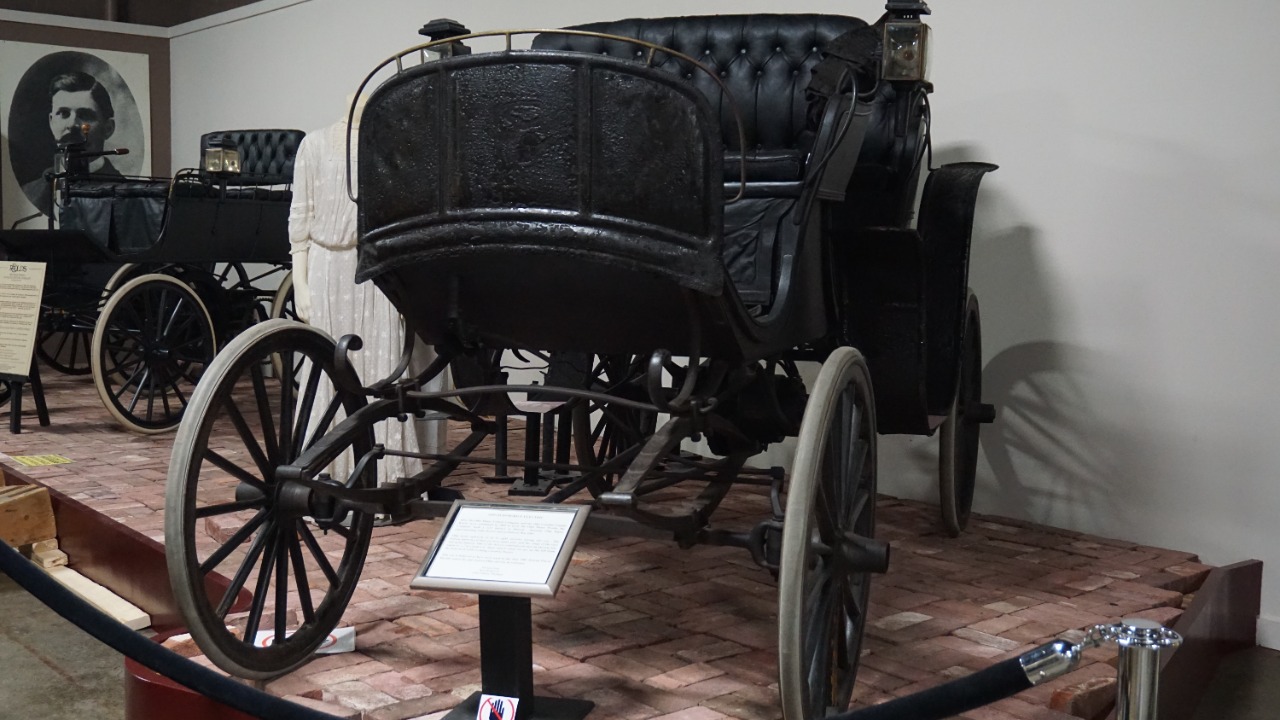

At a time when modern performance cars chase four-figure horsepower and 16-cylinder engines, Oldsmobile once built a best seller with just a single cylinder doing all the work. The tiny powerplant in the Oldsmobile Curved Dash did not just move a car, it helped launch American mass motoring. That one-lung runabout proved that a simple, durable machine could replace the horse and survive real roads, not just smooth city boulevards.
What sounds like a mechanical curiosity was in fact a carefully engineered product from a company already thinking in terms of volume, standardization, and reliability. The Olds Motor Vehicle Company turned its minimalist one-cylinder car into a practical tool for early drivers, and in the process showed how modest power, smart packaging, and assembly line discipline could beat more exotic rivals.
The unlikely heart: a single-cylinder Oldsmobile engine that worked
The core of Oldsmobile’s early success was a single-cylinder, four-horsepower engine that looked closer to stationary farm equipment than to a modern car motor. This compact unit powered the Oldsmobile Curved Dash runabout, relying on one cylinder and one piston to move the entire vehicle and its passengers. Rather than chasing speed, the design prioritized simplicity, with fewer moving parts to break and a layout that early mechanics could understand and service without specialized tools, which was crucial when automobiles were still novelties.
That one-cylinder engine was not a prototype or a dead-end experiment, it was the production powerplant for a car that reached real customers in real numbers. The unit used in the Oldsmobile Curved Dash was built to be robust enough for rough roads and basic fuel, and it sat at the center of a drivetrain that included a simple transmission and chain drive. Surviving examples, such as the preserved Oldsmobile 1-cylinder engine, show how compact the package was compared with the multi-cylinder engines that would follow only a few years later.
Ransom Eli Olds and the decision to go small
The one-cylinder Oldsmobile did not appear by accident, it was the product of deliberate choices by Ransom Eli Olds. Before settling on gasoline power for his early cars, Ransom Eli Olds experimented with steam and electric automobiles, testing different propulsion systems to see which could be built reliably and sold at scale. By the time he committed to the Oldsmobile Runabout, he had concluded that a light gasoline car with a simple engine offered the best balance of cost, range, and ease of use for the customers he wanted to reach.
That focus on practicality shaped the entire vehicle. The Oldsmobile Runabout was designed as a small, relatively affordable machine that could appeal to buyers who might otherwise stick with horses and carriages. The car’s compact size and modest power output were not limitations so much as strategic decisions to keep weight, complexity, and price under control. Period accounts of the 1904 Oldsmobile Runabout emphasize how Ransom Eli Olds used his early experiments to refine a gasoline layout that ordinary drivers could actually live with.
From Lansing workshop to early mass production
Oldsmobile’s one-cylinder car emerged from a company that was already thinking beyond bespoke coachbuilding. Early Oldsmobiles were first manufactured by the Olds Motor Vehicle Company in Lansing, Michigan, where the firm began to apply a more systematic approach to building cars. Instead of crafting each vehicle as a one-off, the company organized work into stations and repeated tasks, a step toward the moving assembly line that would later define American manufacturing. This structure allowed Oldsmobile to produce more cars, more consistently, than many of its early competitors.
The Curved Dash Oldsmobile became the centerpiece of this strategy. By standardizing the one-cylinder engine and the basic chassis, the Olds Motor Vehicle Company could build cars in batches and refine the process as it went. Historical accounts of Early Oldsmobiles describe how work was divided so that each station performed a specific task before the car moved on, a method that helped turn what might have been a niche curiosity into a recognizable product line from Lansing, Michigan.
Why the Curved Dash layout mattered
The Oldsmobile Curved Dash Runabout was more than a small car with a small engine, it was a carefully considered package that made early motoring less intimidating. The signature curved front panel, which gave the model its name, echoed the splash guards of horse-drawn vehicles and helped shield occupants from dirt and debris thrown up by the road. Underneath that familiar-looking front, the car hid its compact powertrain, with the one-cylinder engine and simple transmission arranged to keep weight low and the wheelbase short, which improved maneuverability on narrow, rutted streets.
Later interpretations of the model, such as the 1904 Oldsmobile Curved Dash Runabout displayed at the Audrain Auto Museum, highlight how the car’s proportions and layout made it approachable. The high seating position, simple controls, and open bodywork gave drivers a clear view of the road and an experience that felt like an evolution of the carriage rather than a complete break from it. That familiarity helped the one-cylinder car gain acceptance among buyers who might have been wary of more radical designs.
Inside the Model R: a practical one-cylinder runabout
The 1902 Oldsmobile Model R Curved Dash Runabout distilled Oldsmobile’s early ideas into a specific configuration that owners could use every day. The car’s body incorporated a curved dash panel that, as on horse-drawn vehicles, protected passengers from mud and debris thrown up by the front wheels. Behind that panel sat the compact one-cylinder engine, which drove the rear wheels through a straightforward transmission and a center chain drive, a layout that reduced the number of parts and made maintenance more manageable for early motorists.
Contemporary descriptions of the 1902 Oldsmobile Model R Curved Dash Runabout emphasize how the car’s mechanical simplicity matched its modest performance. The one-cylinder engine did not deliver high speed, but it provided enough torque to move the lightweight runabout along unpaved roads, while the chain drive and basic transmission kept the drivetrain compact and accessible. For buyers transitioning from horse-drawn transport, this combination of familiar bodywork and straightforward machinery made the Model R a realistic first step into gasoline motoring.
Rough roads, real use: proving the one-cylinder concept
The real test for any early automobile was not how it looked in a showroom but how it handled the rough, rutted roads of the era. The Curved Dash Oldsmobile faced those conditions with its one-cylinder engine and simple suspension, and it proved more capable than its modest specifications might suggest. Period images show Jonathan D. Maxwell driving a Curved Dash Oldsmobile on rough terrain, a reminder that the car was expected to cope with surfaces that would challenge even modern off-road vehicles. The combination of light weight, flexible frame, and tractable low-speed power helped the car survive these conditions.
Accounts of the Curved Dash Oldsmobile underline that its single-cylinder, four-horsepower engine was not a laboratory exercise but the heart of a car produced in large numbers. The fact that drivers like Jonathan Maxwell Driving a Curved Dash Oldsmobile on Rough Terrain could take the car beyond city streets showed that the design was robust enough for everyday use. That durability, more than outright speed, helped convince skeptical buyers that a one-cylinder gasoline car could be a dependable replacement for the horse.
The first mass-market American car, built around one cylinder
What makes the Curved Dash Oldsmobile historically significant is not just its unusual engine layout but its production scale. The Curved Dash Oldsmobile is widely recognized as the world’s first mass-produced gasoline car, with output rising from about 425 vehicles in 1901 to roughly 2,500 vehicles in 1902. Those numbers were unprecedented for a gasoline automobile at the time and showed that a standardized, one-cylinder design could be built and sold in volumes that hinted at a future of widespread car ownership.
Company records for the 1903 Oldsmobile Curved Dash Runabout reinforce this picture of early mass production. The Curved Dash Oldsmobile was built in a way that allowed the company to increase output quickly, using standardized parts and repeatable processes. That approach turned the one-cylinder runabout from a curiosity into a product that could reach customers across the United States, setting a template for later manufacturers who would scale up even more dramatically.
Oldsmobile’s broader legacy of innovation
The success of the one-cylinder Curved Dash did not happen in isolation, it fit into a broader pattern of innovation at Oldsmobile. The brand, which would later become a pillar of American automotive history, built its reputation on trying new ideas and bringing them to market in practical form. From its earliest days, Oldsmobile balanced experimentation with a focus on what could be produced reliably and sold to real customers, a mindset that began with the Curved Dash and continued through later multi-cylinder models and more advanced technologies.
Historical overviews of Oldsmobile describe how the founding vision of Ransom E. Olds set the tone for the company’s long history of innovation. The decision to back a one-cylinder car as a volume product reflected a willingness to challenge assumptions about what an automobile needed to be. That same spirit would later lead Oldsmobile to adopt new engine technologies and body designs, but the Curved Dash era remains a clear example of how the brand turned a seemingly modest technical choice into a transformative product.
How a one-cylinder antique compares to modern performance
Seen from today’s performance-obsessed perspective, a four-horsepower, one-cylinder car sounds almost comically underpowered. Modern supercars and hypercars use massive powertrains, going as big as 16-cylinder engines, to deliver acceleration and top speeds that early motorists could not have imagined. Yet the contrast highlights how different automotive priorities were at the dawn of the industry, when simply replacing the horse and surviving a trip on unpaved roads counted as a major achievement.
Contemporary commentary on this contrast, such as discussions of how Modern supercars compare with early one-cylinder Oldsmobiles, underscores that different eras solve different problems. The Curved Dash Oldsmobile focused on accessibility, durability, and ease of use, with its one-cylinder engine mounted under the seat and simple controls placed at the center of the bench seat. That layout, combined with the car’s modest performance, made it a practical tool for first-generation drivers, even if it would be outpaced by almost any vehicle on the road today.
More from MorningOverview