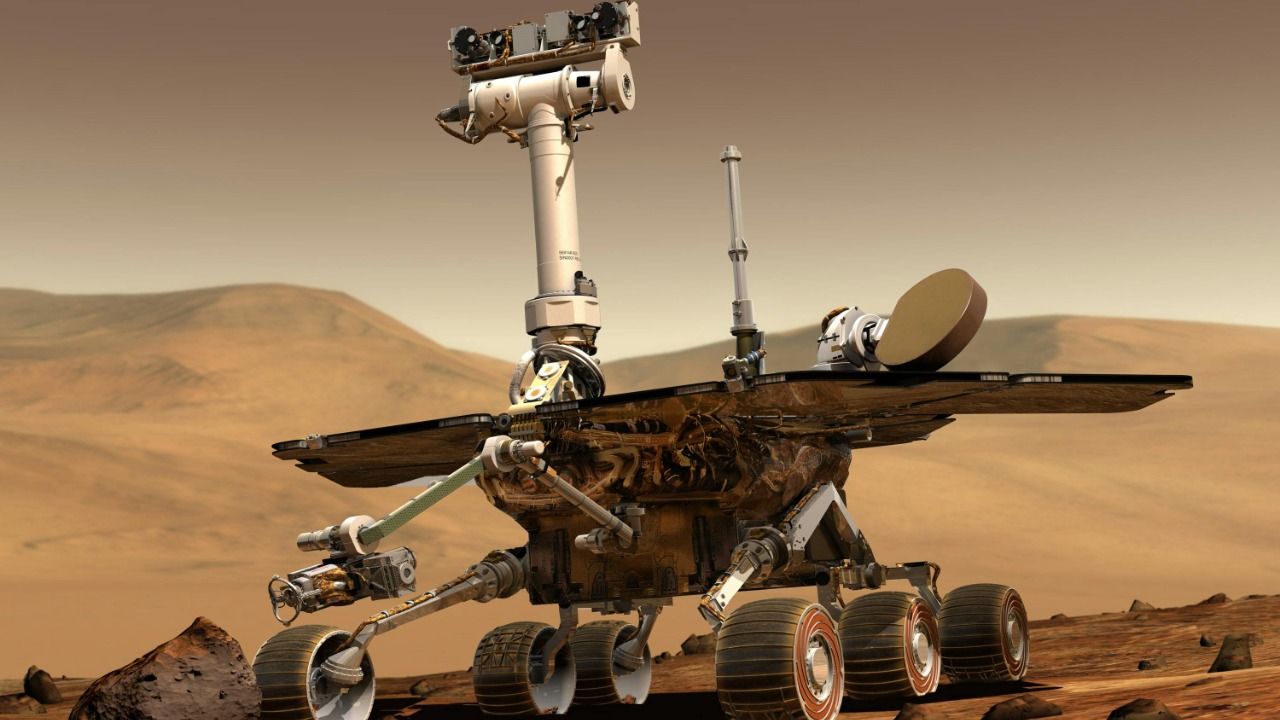

A metallic-looking rock sitting on the Martian surface has jolted a mission that was already rewriting what we know about the Red Planet. After years of scanning dust, dunes and ancient lakebeds, a rover has stumbled on an object that appears to come from somewhere else entirely, a visitor that does not match the geology around it and has never been recorded on Mars in this form before. The find is baffling scientists not because it proves life, but because it forces them to rethink how material from deep space, ancient water and Martian chemistry all intersect on a world that is starting to look less dead than it once did.
What makes this discovery so striking is the timing. It arrives just as a series of Martian rocks, ridges and strange textures are delivering the strongest hints yet that Mars once hosted habitable environments, and perhaps even microbial life. Instead of a single smoking gun, the planet is offering a cascade of puzzles, from spiderweb-like patterns in the dust to hollow spherules in enigmatic stones, each one nudging the story of Mars away from a simple desert and toward a complex, evolving world.
The “visitor” that should not be on Mars
The latest jolt came when a rover camera locked onto a shiny, metallic-looking rock that did not resemble the surrounding terrain at all. The object, perched on the surface like a dropped tool, immediately stood out as something that did not belong in the local bedrock, which is why mission scientists quickly began treating it as a likely meteorite. After nearly five years of methodical driving, the rover had finally found what looked like a fresh piece of space debris, a find that is rare enough on Earth and even more striking on a planet where every gram of material is precious data.
Mission teams have given this possible meteorite a nickname, “Phippsaksla,” and early analysis suggests it is a dense, metal-rich rock that formed in a very different environment from the surrounding Martian crust. The rover’s instruments have already captured detailed images and spectra of the object, and the team expects to refine its composition when more data are downlinked and compared with other suspected meteorites that NASA’s Perseverance rover has seen on Mars. In a separate report, the same rover was described spotting a “mysterious visitor from outer space” on the surface, a shiny metallic rock that again looked alien to its surroundings, underscoring how unusual these finds are even after years of exploration by NASA’s Perseverance rover on Mars.
A rock “totally alien” to the Red Planet
What makes Phippsaksla and its cousins so compelling is not just that they are foreign, but that they are geologically out of place. One analysis described an odd-looking rock as “totally alien to the Red Planet,” a phrase that captures how its mineral makeup diverges from the basaltic and sedimentary materials that dominate Mars. The rover team has cataloged a growing menagerie of such objects, including a “spider” rock and a “turtle-shaped” formation, each one hinting at processes that either began far from Mars or unfolded under conditions that no longer exist there.
These finds are not just curiosities. They are test cases for how well the rover’s instruments can discriminate between native Martian rocks and imported material, a crucial skill if scientists hope to untangle the planet’s true history. When a rock is labeled “totally alien,” it signals that its chemistry and texture do not match the local bedrock, which in turn helps researchers map out where Mars has been bombarded by debris from elsewhere in the solar system. That context is especially important in Jezero crater, where Perseverance has found many different rocks since landing within Mars’ Jezero crater, building a catalog that separates the truly Martian from the imported.
Cheyava Falls and the strongest hints of ancient life
While the metallic visitor grabs headlines, the deeper scientific shock is unfolding in a very different kind of rock. At a site nicknamed Cheyava Falls, a sample drilled from ancient sediment has delivered what some researchers are calling our best proof yet that Mars once hosted microbial life. The rock, part of a layered deposit that formed in an ancient river or lake system, contains a suite of chemical and textural clues that together look remarkably like biosignatures seen in certain rocks on Earth. The excitement is not about a single molecule, but about a pattern that, taken as a whole, is hard to explain without biology.
NASA has been careful to frame Cheyava Falls as “potential evidence of past microbial life,” not a definitive detection, but the language is notably stronger than in earlier Martian announcements. The sample sits within a broader campaign that has already flagged other promising rocks, including one described as a 3.5 billion year old piece of the Red Plane that could preserve traces of ancient organisms. In that case, NASA highlighted a 3.5 billion year old rock discovered on the Red Plane as a possible archive of life that might have thrived there billions of years ago, a reminder that Mars was once a very different world.
Sapphire Falls and the selfie that changed the tone
The Cheyava Falls sample is not the only rock reshaping the conversation. At another site, dubbed Sapphire Falls, the rover drilled into a finely layered stone that again showed chemical signatures consistent with long-standing water and potential habitability. To mark the moment, the mission team stitched together a dramatic selfie, made from 62 individual images, showing the rover posed next to the freshly cored rock. The image is more than a public relations flourish, it is a visual record of the exact context in which one of the mission’s most important samples was taken.
Scientists studying Sapphire Falls have also noted that the surrounding terrain contains other features that look like they formed in water rich environments, strengthening the case that this region of Mars once hosted stable lakes or rivers. The same rover that captured the selfie made up of 62 individual images has been systematically collecting cores that will eventually be candidates for return to Earth, where laboratories can test them for subtle isotopic and molecular traces that are far beyond the reach of any instrument on Mars today.
Curiosity’s “spiderwebs” and intersecting ridges
While Perseverance prowls Jezero crater, Curiosity is still at work on the other side of Mars, climbing the lower slopes of Mount Sharp and sending back its own baffling images. One recent set of pictures shows delicate, branching patterns in the rock that look like spiderwebs frozen in stone. These features, etched into the sediment at the foot of the mountain, likely formed when mineral-rich water percolated through fractures and then hardened, leaving behind a lacework of veins that now stand out as the softer rock erodes away.
Curiosity has also imaged three intersecting ridges that cross each other at sharp angles, a geometry that hints at multiple episodes of fracturing and fluid flow in the same patch of ground. The ridges, captured in a “photo of the day” sequence, are another reminder that Mars’ surface has been repeatedly reshaped by water, wind and time. At the foot of Mount Sharp, NASA’s Curiosity rover takes a closer look at ‘spiderwebs’ on Mars, while another sequence shows how Curiosity rover images 3 intersecting Mars ridges, giving geologists a three dimensional puzzle that speaks to a complex, water rich past.
Enigmatic hollow spherules and an “intriguing” rock
Not all of Mars’ mysteries are large scale. Some are packed into a single hand sized stone. Earlier in the mission, the rover spotted an Enigmatic Martian Rock studded with hollow spherules, tiny spheres that appear to have formed inside the rock and then partially emptied out. These features are intriguing because on Earth, similar structures can form when gas bubbles are trapped in lava or when minerals grow around a nucleus in water rich environments, processes that can sometimes intersect with biology.
The hollow spherules are part of a broader pattern of odd textures that have caught the attention of mission scientists. In a separate briefing, the team described another target simply as an “intriguing Mars rock,” a reminder that even after years of fieldwork, the planet still serves up surprises at the scale of a single camera frame. The official mission site highlighted how Discovered by Perseverance Rover, an Enigmatic Martian Rock with Hollow Spherules Intrigues NASA, while another update from the Jet Propulsion Laboratory described how NASA’s Perseverance Rover Scientists Find Intriguing Mars Rock, but further research is needed before anyone can say exactly how these textures formed.
New findings and the “strongest hints yet” of life
All of these rocks, ridges and spherules feed into a larger narrative that is starting to shift the tone of Mars science. In a recent summary of mission results, NASA scientists described their latest data as the strongest hints yet of potential signs of ancient life on Mars. The language is cautious, but it marks a step change from earlier years, when the focus was primarily on proving that Mars was once habitable, not on whether anything actually lived there. Now, with multiple samples from ancient lakebeds and river deltas in hand, the conversation is edging closer to that more profound question.
The new findings include detailed chemical analyses of drilled cores, high resolution images of sedimentary structures and cross comparisons with similar rocks on Earth. Together, they suggest that parts of Mars once had stable water, energy sources and the right chemistry to support microbes. A recent overview framed these as New findings by NASA Mars rover provide strongest hints yet of potential signs of ancient life, while also noting that NASA is seeking cheaper, quicker options to bring at least some of these samples back to Earth for definitive testing.
How Perseverance and Curiosity were built for this moment
The reason these discoveries keep stacking up is that the current generation of rovers was designed from the start to hunt for habitability and, if possible, biosignatures. Perseverance carries a sophisticated suite of cameras, spectrometers and drills that can read the mineral and chemical history of rocks in fine detail, while also caching cores for a future sample return mission. Curiosity, which landed earlier, was built to test whether its landing site ever had the conditions necessary for life, a question it has effectively answered in the affirmative by finding ancient lake sediments and organic molecules.
Engineers and scientists have emphasized that the two rovers are part of an evolutionary line of design. They share a common chassis and many systems, but They also differ in important mission specific ways that reflect how the questions have sharpened over time. A detailed comparison notes that They ( The two rovers ) also differ in important mission-specific ways, with Perseverance explicitly built to collect samples that a future mission could bring back to Earth. That design choice is what makes the baffling metallic rock, the Cheyava Falls core and the Sapphire Falls sample more than just pretty pictures, they are physical archives that could one day sit in terrestrial labs.
Why Martian landscapes feel “totally foreign”
Part of the fascination with these discoveries is visual. The images coming back from Mars show landscapes that are at once familiar and deeply strange, a mix that can be hard to process even for seasoned geologists. One planetary scientist captured this tension by noting that, as you might expect, you see some things that are totally foreign, like nothing you see on Earth, when you study other worlds. That sense of alienness is not just aesthetic, it is a scientific clue that the processes shaping Mars have followed paths that diverge from our home planet’s history.
When I look at the spiderweb veins, the intersecting ridges and the hollow spherules, I see exactly the kind of “totally foreign” features that invite new theories rather than tidy answers. They force researchers to ask whether similar structures on Earth formed in the same way, or whether Mars has its own playbook of geological tricks. The quote about seeing things like nothing on Earth ( the Earth ) comes from a profile of a scientist who studies planetary landscapes, a reminder that Earth, Perr and their colleagues have long expected Mars to surprise them. The metallic visitor that should not be there, the ancient rocks that may hold traces of life and the webs of mineral veins all fit that expectation, turning the Red Planet into a laboratory of the unfamiliar.
The stakes of bringing these mysteries home
For now, the baffling rock that does not belong, the possible meteorite Phippsaksla and the ancient cores from Cheyava and Sapphire Falls all remain on Mars, their secrets locked behind the limits of remote sensing. The rover can zap, drill and image, but it cannot match the sensitivity of instruments in a terrestrial lab or the creativity of scientists who can slice, polish and experiment on a sample directly. That is why so much of the current strategy revolves around caching the most promising rocks for a future mission that can retrieve them.
In the meantime, every new image and spectrum adds another piece to a puzzle that is already more complex than anyone expected when the first landers touched down. Reports have described how Phippsaksla, NASA and its team have already captured photos from near and far to prepare for deeper analysis, while another account noted how Elisha Sauers, Sat, PST, NASA, Perseverance chronicled the rover taking a selfie on Mars as it continued its hunt. Each of these moments is a reminder that the story of Mars is no longer a distant abstraction. It is unfolding in real time, one baffling rock at a time, and the next surprise may already be sitting in a rover’s camera frame, waiting for someone on Earth to notice.
More from MorningOverview