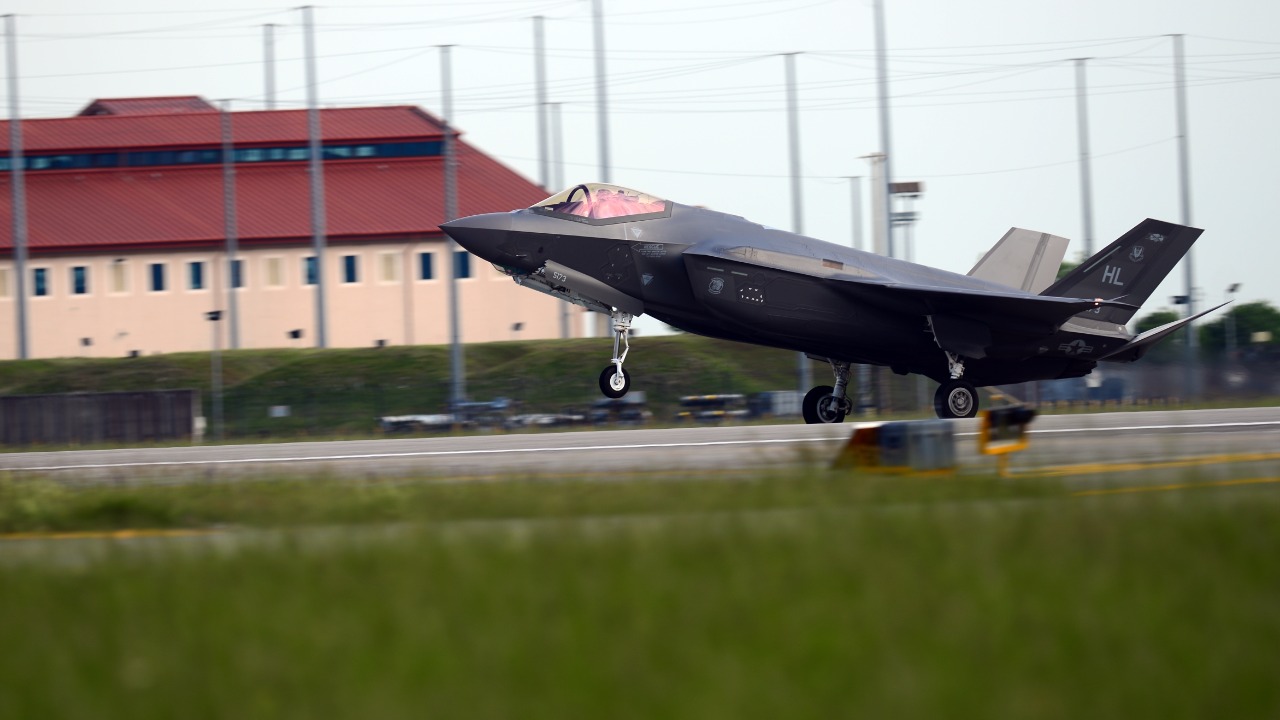

The U.S. decision to equip frontline F-35 fighters with a new generation of digital decoys marks a quiet but consequential shift in how American airpower plans to survive modern missile threats. By selecting Leonardo UK’s BriteCloud system for the Lightning II fleet, the Navy is betting that compact, disposable jammers can buy pilots the seconds they need when stealth and maneuver are no longer enough.
At its core, the move reflects a broader recognition that advanced surface-to-air and air-to-air weapons are catching up with traditional countermeasures. I see the BriteCloud deal as both a technical upgrade and a strategic signal that U.S. forces expect to operate F-35s in dense, contested airspace where every layer of protection matters.
The contract that put Leonardo UK on the F-35 map
The breakthrough for Leonardo UK came when The US Navy awarded the company a $33-million contract to supply missile-luring electronic warfare decoys tailored for the F-35. That initial award, described as a $33-million effort to Provide Missile protection, effectively locked in BriteCloud as the preferred active expendable solution for the U.S. variant of the jet. For Leonardo UK, it was not just another export win, it was an endorsement from one of the most demanding combat aviation customers in the world.
Follow-on reporting shows that the Navy has since moved from concept to procurement, acquiring an undisclosed number of BriteCloud Active Expendable Decoys specifically for the F-35 Lig family. The service is using a contract structure that allows a base order and up to one option, giving the Navy flexibility to scale buys as integration and testing progress on the F-35C and other variants of the 35 series. The language around an undisclosed quantity of Active Expendable Decoys underscores how sensitive the exact inventory numbers have become in an era of renewed great-power competition.
Why the Navy wants active expendable decoys on stealth jets
Stealth has always been the F-35’s calling card, but the Navy’s push for BriteCloud reflects a sober assessment that low observability alone cannot guarantee survival against modern radars and missiles. An active expendable decoy, or AED, adds a new layer by acting as a miniature jammer that leaves the aircraft and draws incoming weapons away from the real target. Testing of an AED capability on U.S. F-35 stealth fighters led directly to a decision to field such systems operationally, with planning that stretches from fiscal year 2025 through fiscal year 2027 according to detailed coverage of the AED roadmap.
From the Navy’s perspective, this is about stacking the odds in favor of the pilot when a missile has already been launched. Instead of relying solely on onboard jammers or flares, the F-35 will be able to spit out a self-contained device that mimics the jet’s radar signature and actively confuses the seeker. That approach aligns with broader U.S. efforts to harden high-value platforms against sophisticated integrated air defense systems, and it helps explain why the service is willing to invest in a specialized decoy for a stealth aircraft that was originally marketed as needing fewer such add-ons.
How BriteCloud works and why DRFM matters
BriteCloud’s appeal lies in its combination of compact size and advanced signal processing. At its heart is Digital Radio Frequency Memory, or DRFM, technology that captures hostile radar pulses, manipulates them, and then replays them to create convincing false targets. Leonardo describes BriteCloud as the world’s first Digital Radio Frequency Memory based Expendable Active Decoy, or EAD, designed to deliver increased platform protection in a package small enough to fit standard dispensers, with published dimensions in the “2x1x8” class for the core cartridge. That positioning as a DRFM powered Expendable Active Decoy is central to Leonardo UK’s pitch.
Independent technical descriptions reinforce that BriteCloud is a battery-powered, self-contained expendable active decoy that uses Digital Radio Frequency Memory to generate deceptive signals. Instead of simply blasting noise, the decoy analyzes incoming radar energy, stores it, and then retransmits tailored waveforms that mislead tracking systems by creating false targets and obscuring the real aircraft’s position. That DRFM based approach, detailed in open references to the Digital Radio Frequency Memory design, is what allows a decoy the size of a flare cartridge to punch far above its weight in the electronic warfare fight.
F-35 integration: from dispenser to AN/ALQ-260(V)
Integrating BriteCloud on the F-35 is not simply a matter of loading new cartridges, it requires careful alignment with the jet’s existing countermeasure architecture. For the F-35A Lightning and its siblings, reporting indicates that BriteCloud will be launched from standard countermeasures dispensers, allowing the aircraft to fire the decoy much like a traditional flare or chaff bundle. In the case of the F-35 (F-35A Lightning), the decoy effectively becomes a digital radio frequency memory jammer that leaves the aircraft, a concept described in detail in analyses of how In the Lightning’s dispenser system will handle the new payload.
On the systems side, the U.S. configuration is being formalized under the designation The AN/ALQ-260(V), which is described as a capable addition to the F-35 Lightning II’s AN/ALE-47 countermeasure dispenser. That pairing means the AN/ALQ-260(V) will sit within the broader electronic warfare suite of the Lightning II, drawing on the jet’s sensors and threat libraries while still functioning as an autonomous expendable when released. The way The AN and ALQ family are being integrated into the Lightning II architecture, as outlined in detailed coverage of the ALQ 260 concept, underscores that BriteCloud is being treated as a core survivability upgrade rather than a bolt-on accessory.
From requirement to order: NAVAIR’s path to BriteCloud 218
The Navy’s journey to BriteCloud started with a formal requirement from The Naval Air Systems Command, or NAVAIR, which publicly signaled its intent to procure an active expendable decoy for the F-35 fleet. In a contract opportunity notice, NAVAIR laid out a need for a system that was already qualified and ready for immediate production, a description that strongly pointed to BriteCloud as the likely candidate. That early framing of The Naval Air Systems Command’s requirement, captured in detailed summaries of how NAVAIR approached the market, set the stage for a relatively swift downselect.
By the time the contract was awarded, the Navy had zeroed in on the BriteCloud 218 variant, a form factor tailored to fit existing dispensers on the F-35. Reporting notes that the US Navy orders Leonardo BriteCloud 218 active decoys for F-35 self-protection, with the service turning to Leonardo as the contractor to meet the requirement. That same coverage highlights that Leonardo’s UK based electronic warfare arm had already qualified the 218 version and declared it ready for immediate production, a key factor in NAVAIR’s decision to move quickly from requirement to signed deal. The explicit reference to Leonardo Br 218, and the note that They were already qualified, shows how the Navy prioritized maturity over developmental risk.
Scaling up: from initial buys to thousands of decoys
Once the technical choice was made, the Navy’s next challenge was scale. Early orders focused on getting enough BriteCloud 218 rounds into the pipeline to support testing, tactics development, and initial operational capability on the F-35C. However, planning documents and subsequent reporting indicate that the service is preparing to go far beyond a token buy. According to one detailed account, the Navy prepares to order up to 6,000 active expendable decoys for F-35 and F-18 self-protection, a figure that hints at a future where every deployed squadron carries a deep magazine of digital decoys. Company literature cited in that same analysis notes that BriteCloud’s performance led to a formal recommendation for the 218 version, reinforcing the logic behind such a large potential order of Still the decoys.
Operational reporting adds texture to this ramp-up. The Navy’s Air Systems Command announced that BriteCloud would be fielded on carrier-based F-35Cs, with imagery of a Navy F-35C landing at Iwo To (Iwo Jima), Japan, underscoring the forward-deployed nature of the fleet that will rely on the new protection. That same announcement from Air Systems Command framed the decoy buy as part of a broader modernization of the carrier air wing’s electronic warfare toolkit. The fact that the Navy is pairing BriteCloud with frontline deployments to locations like Iwo To and Iwo Jima in Japan, as described in coverage of the Air Systems Command announcement, suggests that the service sees the decoy as a near-term operational necessity rather than a distant future capability.
Operational lessons and the case for expendable EW
Behind the procurement numbers sits a set of operational lessons that have pushed the Navy toward expendable electronic warfare. According to a March 2025 news release from the Defense Visual Information Distribution Service, BriteCloud was expended in realistic trials that demonstrated its ability to seduce incoming threats away from crewed aircraft. Those tests, which were later cited by former CVW 2 commander Capt. Timothy Myers, helped convince skeptics that a small, battery-powered decoy could meaningfully change the outcome of a missile engagement. The reference to those trials, summarized in accounts that begin with the phrase According to a March 2025 news release from the Defense Visual Information Distribution Service, underscores how much weight the Navy places on live-fire evidence.
Those operational insights dovetail with the technical logic of DRFM-based decoys. Because BriteCloud functions independently of the aircraft once released, it can continue to maneuver and transmit tailored jamming even if the F-35 is turning hard or diving away. Reporting on the Navy’s order notes that They function independently of the aircraft to provide an additional RF countermeasures capability, a phrasing that captures the decoy’s role as a last-ditch shield layered on top of the jet’s built-in systems. In June NAVAIR reinforced that view by highlighting that the decoys were already qualified and ready for immediate production, a signal that the command saw no need for extended developmental testing before putting the system into the hands of fleet squadrons. That combination of real-world trials and NAVAIR’s endorsement, detailed in coverage that quotes how They were ready for immediate production, forms the backbone of the Navy’s case for expendable EW.
Strategic implications for the F-35 program and allied fleets
The decision to arm U.S. F-35s with BriteCloud has implications that extend beyond the Navy’s own squadrons. Many allied air forces operate the same aircraft and face similar threats, and they are watching closely as the U.S. validates an active expendable decoy on the Lightning II. The fact that the US Navy orders Leonardo BriteCloud 218 active decoys for F-35 self-protection, with explicit references to the 218 and 35 designations, sends a signal to partners that the system has cleared some of the toughest integration and certification hurdles in the defense world. For Leonardo, that U.S. endorsement, captured in reporting that highlights how the Navy turned to Leonardo as the contractor, could translate into a wave of follow-on orders from other F-35 operators.
There is also a broader industrial and strategic angle. The initial $33-million contract for Leonardo UK, combined with the prospect of up to 6,000 decoys and future options, effectively anchors a transatlantic supply chain for a critical piece of F-35 survivability equipment. That arrangement ties U.S. and UK defense industries more closely together at a time when both governments are emphasizing interoperability and shared capabilities. For the F-35 program itself, the integration of BriteCloud and the AN/ALQ-260(V) reinforces the idea that the Lightning II is not a static platform but a constantly evolving system, one that will continue to absorb new sensors and countermeasures as adversary threats advance.
What comes next for BriteCloud and U.S. electronic warfare
Looking ahead, the key questions revolve around how quickly the Navy can move from initial fielding to routine use of BriteCloud across deployed carrier air wings. The undisclosed number of decoys already on contract for the F-35 Lig family suggests that early operational units will have enough inventory to experiment with tactics, techniques, and procedures in realistic training environments. As those squadrons refine how and when to fire the decoys, their feedback will shape future buys and potential upgrades, including any software refinements to the Digital Radio Frequency Memory algorithms inside the cartridges. The fact that the Navy is already negotiating procurement terms that include a base period and up to one option, as described in coverage of how the Navy is acquiring the decoys, indicates that planners expect an iterative process rather than a one-off purchase.
At the same time, the BriteCloud story is part of a larger shift in U.S. electronic warfare thinking that extends from fighters to bombers and even unmanned systems. As more platforms adopt DRFM-based expendables, adversaries will be forced to adapt their missile seekers and radar processing, potentially triggering a new cycle of measure and countermeasure. For now, though, the Navy’s choice to put BriteCloud on the F-35 gives American pilots a valuable new tool at the most dangerous moment of any mission, the instant when an enemy missile has locked on and is racing toward its target. In that moment, a decoy that can convincingly impersonate a fifth-generation jet may be the difference between a near miss and a catastrophic loss.
More from MorningOverview