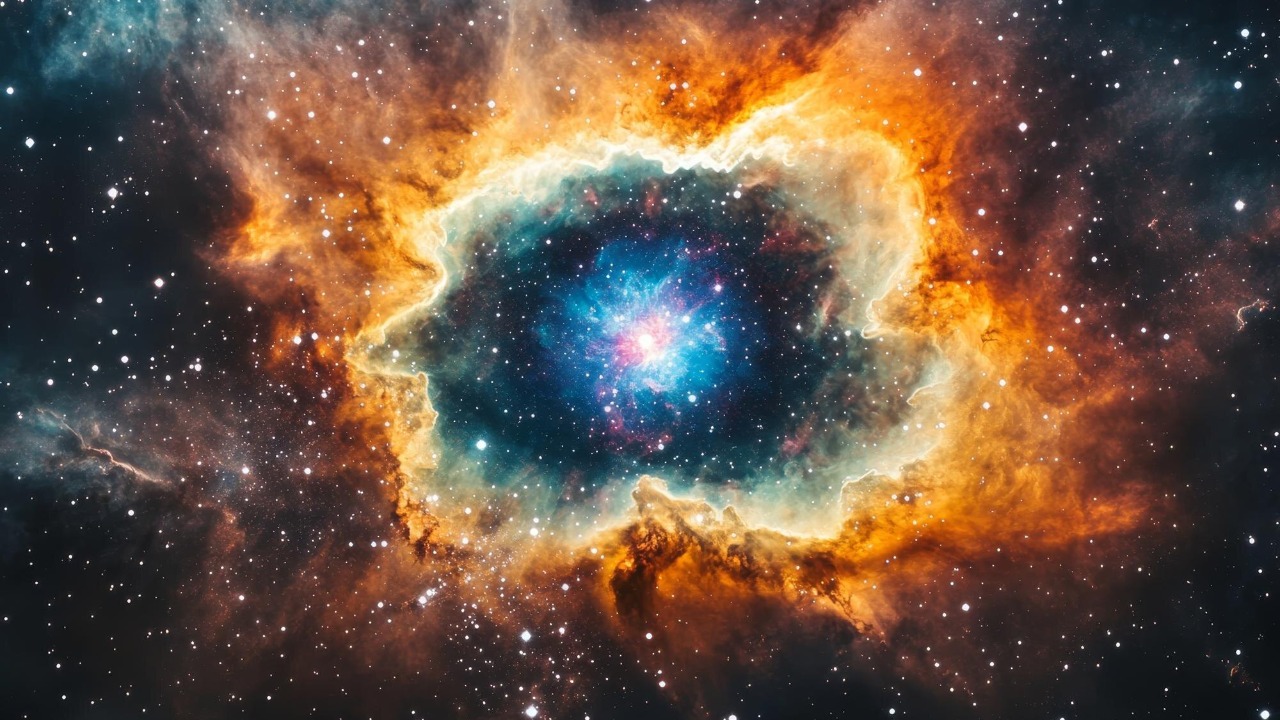

Astrophysicists are starting to treat a strange class of “undead” suns as potential tools rather than mere curiosities, arguing that these so‑called zombie stars might help expose the invisible matter that dominates the universe. Instead of building ever more elaborate detectors on Earth, some researchers want to use the stars themselves as laboratories, watching how they flicker, flare, or refuse to die for clues about dark matter. In a cosmos where four fifths of the mass is missing from our direct view, turning stellar corpses into sensors could be one of the boldest bets in modern physics.
What astronomers really mean by a “zombie star”
When astronomers talk about zombie stars, they are not being cute, they are trying to capture how unsettling these objects are. A normal star burns steadily for billions of years, then fades or explodes, but a zombie star appears to have died and then come back in some altered, hungry form. In some cases the core has collapsed into an ultra dense remnant that should be quiet, yet it keeps feeding on its surroundings and lighting up again, as if stellar death were only a pause.
One popular scenario starts with a pair of suns that form together and evolve at different speeds. As one of them runs out of fuel and shrinks into a white dwarf, it can begin to pull fresh hydrogen off its still living companion, a process that an Aug explainer captured with the phrase, “Imagine two stars forming together” and ending with a cannibal remnant left behind as a “zombie star.” In another version, a massive star collapses into a neutron star that is technically defunct as a normal sun, yet it keeps blasting radiation as it spins, so that even a stellar corpse the size of an average city can outshine entire galaxies.
Neutron stars, the original undead suns
Long before the phrase became fashionable, neutron stars were the archetypal undead objects in the sky. These remnants form when a massive star exhausts its fuel and its core collapses into a ball of neutrons, packing more mass than the Sun into a sphere barely tens of kilometers across. They no longer fuse hydrogen, so by the usual definition they are dead, but their intense magnetic fields and rapid spin let them beam out pulses of radiation that sweep across Earth like a lighthouse.
That eerie combination of death and activity led one NASA effort to describe neutron stars as “undead,” real zombie stars that can still shape their environment even after their original stellar lives have ended. A Nov mission brief on a new hunt for such objects emphasized that these neutron remnants, despite being technically defunct, can be as small as the size of an average city yet remain among the brightest X‑ray sources in the sky, turning them into natural beacons for high energy astrophysics Neutron stars have been classed. If dark matter interacts with ordinary matter at all, these compact, extreme objects are exactly where those interactions are most likely to leave a visible mark.
Black holes that raise the cosmic dead
Zombie stars are not always compact remnants that refuse to fade, sometimes they are ordinary stars that should have been destroyed but somehow keep shining. In one dramatic case, scientists watched as a star wandered too close to a black hole and was torn apart in a tidal disruption event, only to see the system flare again as if the victim had survived the first encounter. The pattern suggested that the black hole and the star were locked in a gruesome dance, with the compact object taking repeated bites instead of a single fatal gulp.
Reporting on that system described how Oct observations revealed a pair of black holes that appeared to take turns slaughtering one unlucky star, a process that lit up the region again and again as fresh stellar material spiraled in and heated up Scientists spot 2 black holes. The James Webb telescope was flagged as a key tool for tracking such bizarre systems, because its infrared vision can follow the cooling debris long after the initial flash. For dark matter hunters, these repeated flares are not just cosmic horror stories, they are controlled experiments in extreme gravity that might reveal subtle extra energy sources or losses if something invisible is at work.
Dark stars and the idea of matter powered by the invisible
Alongside zombie stars, theorists have revived an even stranger concept, the “dark star,” which is not dark in the sense of being invisible but in the sense of being powered by dark matter. In these models, the first stars in the universe formed in regions rich with exotic particles that could annihilate or decay, heating the gas from within. Instead of fusing hydrogen in their cores, these primordial giants would have shone because dark matter itself was dumping energy into them, changing how they grew and how long they lived.
Evidence for such objects is still tentative, but some of the most distant galaxies seen so far contain candidates that do not quite fit standard expectations. Now, researchers argue that four of the brightest early universe objects seen by the James Webb Space Telescope might be better explained if they are powered by dark matter rather than ordinary fusion, suggesting that we may have found the best evidence yet for a bizarre dark star scenario Now, researchers have found. While the case is far from closed, the idea that some stars could be lit by invisible particles rather than nuclear reactions is a powerful hint that stellar astrophysics and dark matter physics are starting to overlap.
Axions, exotic particles, and scars in the sky
To turn zombie or dark stars into detectors, physicists need a concrete candidate for what they are trying to detect. One of the leading possibilities is a hypothetical particle called the axion, originally proposed to solve a puzzle in quantum chromodynamics but now elevated to a prime dark matter contender. Axions would be extremely light and interact very weakly with ordinary matter, yet in the intense magnetic fields and dense plasmas around compact stars they could convert into photons or steal energy in ways that astronomers might spot.
As theoretical work has matured, some researchers have argued that axion powered processes could leave “scars” across the cosmos, subtle distortions in the light from stars that have spent eons immersed in dark matter halos. Malcolm Fairbairn, a physicist at King’s College London, has been quoted stressing that “Axions are one of the prime candidates for dark matter,” and that their interactions could be probed by looking for unusual signals from extreme objects Axions are one of the prime candidates. If neutron stars or white dwarfs show cooling rates, spin changes, or spectral lines that cannot be explained by known physics, axions or related particles would be high on the list of suspects.
How zombie stars could act as dark matter detectors
The core idea behind using zombie stars as detectors is simple: treat each star as a test mass sitting in a sea of dark matter and watch for deviations from expected behavior. A neutron star that cools faster than theory predicts, a white dwarf that refuses to explode when it should, or a black hole accretion disk that glows at the wrong wavelengths could all be signs that invisible particles are carrying energy away or injecting it in unexpected ways. Because these objects are so extreme, even a tiny additional interaction can have an outsized effect on their evolution.
Recent commentary on the subject has framed zombie stars as potential beacons in our search for dark matter, arguing that their strange persistence and violent outbursts might encode information about the invisible sector. One Dec analysis quoted physicist Cumrun Vafa reflecting that puzzles in physics often point toward deeper structures, and suggested that these undead suns might be a “Beacon in Our Search for Dark Matter” if we learn how to read their signals correctly Zombie Stars Might Be. In that view, every anomalous flare or stubbornly bright remnant is not just an oddity to be cataloged but a potential data point in a vast, distributed experiment that spans the galaxy.
NuSTAR, XMM‑Newton, and the telescopes built for the undead
Turning that vision into a working program requires instruments that can see the high energy universe in detail, and that is where modern X‑ray observatories come in. NASA’s Nuclear Spectroscopic Telescope Array, better known as NuSTAR, was designed to focus hard X‑rays with unprecedented sharpness, letting astronomers map the hottest, most energetic regions around compact objects. Operated from a control center at Caltech, the mission has become a workhorse for studying black holes, neutron stars, and supernova remnants, exactly the kinds of systems where zombie behavior and dark matter signatures might overlap, as highlighted on the official NuSTAR mission site.
NuSTAR does not work alone. Follow up studies by the European Space Agency’s XMM‑Newton observatory and the NASA telescope, which is led by Caltech, have been used together to refine measurements of X‑ray spectra, timing, and variability in extreme systems. Technical documentation describes how these joint campaigns help pin down key properties of compact objects, including those used to estimate its age, by combining the broad spectral coverage of XMM with the high energy focus of NuSTAR Follow up studies by the European Space Agency. If dark matter is subtly altering how zombie stars emit X‑rays, these paired observatories are among the best tools available to catch the effect.
From Instagram explainers to precision cosmology
One striking feature of the zombie star story is how quickly it has jumped from specialist jargon into popular culture. Social media clips now walk viewers through the life and death of binary systems, showing how a white dwarf can strip gas from its partner and ignite in a thermonuclear flash, only to leave behind a remnant that keeps feeding. When an Aug reel invites people to “Imagine two stars forming together” and then describes the cannibalistic aftermath, it is translating a complex mass transfer scenario into a narrative that anyone can follow, even if they have never heard of Roche lobes or Chandrasekhar limits Imagine two stars forming together.
That popularization matters because the same systems that make for gripping visuals are also the ones that theorists want to use as dark matter probes. A public that already understands, at least in outline, how a white dwarf can explode or how a neutron star can pulse is better prepared to grasp why small deviations from those patterns might signal new physics. When I look at the way zombie stars are framed in outreach and in technical papers, I see a rare alignment between storytelling and science, where the same vivid metaphors that draw people in also point toward the frontier questions cosmologists are trying to answer.
The stakes: a cosmic census of the invisible
If the zombie star strategy pays off, the reward would be nothing less than a new way to weigh and characterize dark matter across the universe. Instead of relying solely on gravitational effects like galaxy rotation curves or gravitational lensing, astronomers could start to map how dark matter interacts with ordinary matter in different environments, from the dense cores of neutron stars to the diffuse outskirts of dark stars. Each class of object would probe a different combination of density, temperature, and magnetic field, giving physicists a multidimensional view of the invisible sector.
There are risks, of course, starting with the possibility that every apparent anomaly in a zombie star will eventually yield to more mundane explanations involving magnetic fields, rotation, or messy accretion physics. Yet even that outcome would sharpen our models of stellar death and rebirth, improving the baseline against which any future dark matter signal must be measured. As Cumrun Vafa suggested in the Dec reflection on puzzles in physics, the most stubborn discrepancies often point the way to new principles, and zombie stars, with their refusal to behave like tidy textbook examples, are already forcing theorists to stretch. Whether they ultimately reveal axions, some other exotic particle, or simply the limits of our imagination, these undead suns are poised to play a central role in the next chapter of cosmic detective work.
More from MorningOverview