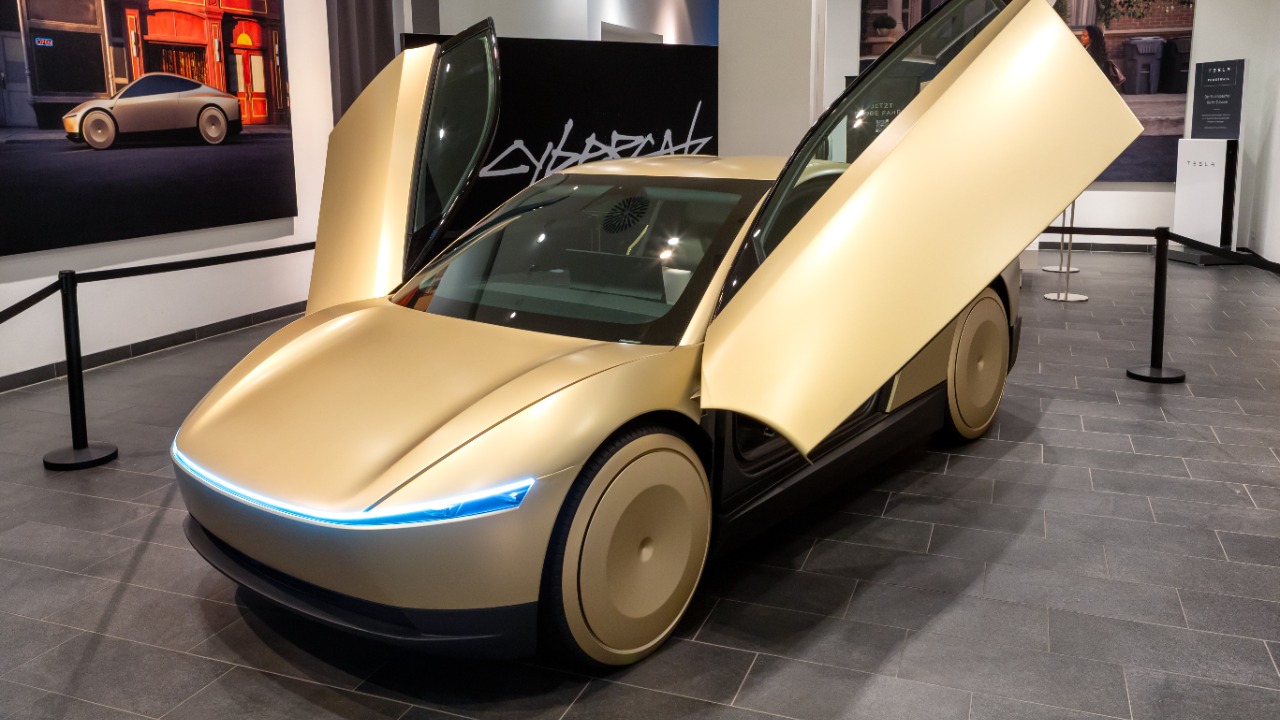

Tesla is leaning hard into its robotaxi story again, splashing the Cybercab across marketing channels and product pages just as Elon Musk approaches a self‑imposed deadline that many investors see as existential. The company is trying to convince Wall Street that autonomy, not car margins, will define its next chapter, even as regulators, rivals and the stock market test that claim in real time.
The stakes are clear: if Tesla can turn its Cybercab vision into a scaled service, the company could shift from a cyclical automaker to a software‑rich mobility platform, with all the valuation upside that implies. If it stumbles, the robotaxi drumbeat risks looking like another over‑promised pivot at a moment when competition in electric vehicles and autonomous driving is only intensifying.
The Cybercab reveal that set expectations sky‑high
The current robotaxi cycle really began when Tesla pulled the wraps off its dedicated self‑driving vehicle, the Cybercab, at a splashy event in Burbank, California. The company staged the unveiling at a Hollywood studio, positioning the car as a kind of sci‑fi prop made real, and promising a future in which riders summon a sleek, two‑seat pod instead of owning a traditional car. That showmanship was meant to signal that Tesla was no longer just iterating on sedans and SUVs, but building a purpose‑built autonomous platform.
Investors, however, reacted with more skepticism than awe. After Tesla unveiled its “Cybercab” in Burbank, California in Oct, the stock closed down nearly 9%, a sharp reminder that markets wanted more than a design exercise and a sizzle reel of simulated rides to justify lofty autonomy narratives, according to trading data tied to the Cybercab reveal. The Tesla Cybercab itself is described as an upcoming two‑passenger battery‑electric self‑driving car under development by Tesla, and The Tesla Cybercab was presented as a clean‑sheet design rather than a retrofit of an existing model, a detail that underscores how much capital and engineering focus the company is pouring into this bet, according to background on the Tesla Cybercab.
Hollywood theatrics and the promise of a driverless future
At the Hollywood launch, Musk framed the Cybercab as the culmination of a vision he first laid out when he began talking about Full Self‑Driving nearly a decade earlier. Tesla used the studio setting in Hollywood to emphasize that this was not just another product refresh but a narrative pivot, with Musk telling fans that the company was finally ready to deliver a car designed to drive without human intervention. The event was calibrated to reassure loyalists who had waited through years of software betas that the hardware side of the robotaxi equation was now locked in.
Yet even as Musk and Tesla unveiled the long‑awaited Cybercab in Hollywood in Oct, investors were already questioning whether the underlying software could match the stagecraft. Reporting from the event noted that Tesla unveiled its long‑awaited robotaxi at a Hollywood studio on a Thursday night and reiterated its ambition for the vehicle to drive without human intervention, but also highlighted that investors do not all share Musk’s confidence and that there are doubts about its reliability, concerns captured in coverage of the Hollywood Cybercab debut and the follow‑up analysis of how investors reacted. That tension between spectacle and skepticism has defined the robotaxi narrative ever since.
“We, Robot” and the pivot from cars to services
By the time Tesla staged its “We, Robot” event, the company was already signaling that autonomy would be central to its identity, not a side project. The gathering, billed as a kind of robotaxi day, was framed as an overview of how Tesla would move beyond selling cars to operating fleets of self‑driving vehicles that could generate recurring revenue. The company told fans that the event would take place on a Thursday in Oct, with remarks beginning at 7 pm Pac, and teased a vehicle with no steering wheel or pedals, a design choice meant to underscore that human drivers were no longer part of the plan.
Coverage of the We, Robot event described how Tesla used the stage to recap both the Cybercab and a larger Robovan concept, positioning them as the hardware backbone of a future ride‑hailing network. An update on the gathering noted that Tesla’s We, Robot event concluded with plenty of new details about The Cybercab and its role in a broader ecosystem of autonomous products, and that Tesla was pitching this lineup as a way to reclaim time for riders who could work or relax instead of driving, according to a detailed recap of the We, Robot event. Another account of the same showcase emphasized that Tesla unveiled its much‑anticipated Cybercab Robotaxi at the “We, Robot” event held at Warner Bros. Discovery studio, and that the company described the Cybercab Robotaxi as a way to “get your life back,” a phrase that captured how Tesla wants to sell autonomy as a lifestyle upgrade rather than just a tech feature, according to reporting on the Cybercab Robotaxi launch.
From concept to streets: Austin as Tesla’s robotaxi lab
The real test of Tesla’s robotaxi ambitions is not on a Hollywood backlot but on public roads, and Austin, Texas has become the company’s chosen proving ground. Tesla launched a limited robotaxi service in Austin, Texas using modified Model Y vehicles equipped with Full Self‑Driving software, effectively turning the city into a live experiment in how riders respond to driverless rides and how the system handles messy urban traffic. That pilot, which uses existing hardware rather than the dedicated Cybercab, is a bridge between Tesla’s current fleet and its future purpose‑built pods.
Reporting on the Austin rollout notes that Tesla’s limited service is already handling paid rides and that the company has floated internal targets of up to 450,000 paid rides per week if the program scales, an ambition that hints at how aggressively it wants to move from selling cars to selling miles, according to analysis of the Austin robotaxi service. A separate look at the same market describes how Tesla’s long‑overdue robotaxi is finally hitting the streets in Jun and outlines several notable specifics about the launch, including operational constraints and regulatory conditions, details that show how carefully the company has to choreograph each step of the rollout in Austin, according to a breakdown of everything we know about Austin.
Musk’s shifting timelines and the “make‑or‑break” moment
For years, Musk has set aggressive timelines for autonomy, and the current deadline he faces is the latest in a long line of promises that have raised expectations and risk in equal measure. Earlier this year, Tesla CEO Elon Musk said on a Tuesda that his company’s robotaxi rides in Austin would tentatively begin on Jun 22, tying a specific date to a program that regulators and investors are watching closely. He also linked the Cybercab to a broader vision of a driverless network, pointing to a Cybercab robotaxi displayed at the AutoMobility LA 2024 auto show on Nov 21, 2024 as a symbol of what Tesla intends to deploy at scale.
In parallel, Musk has been telling markets that a full robotaxi launch is imminent, not a distant dream. One detailed summary of his comments notes that in Jun, under a section labeled Key Takeaways, Tesla shares rose on a Wednesday morning as CEO Elon Musk said the EV maker’s robotaxi program is set to launch sometime this month, a formulation that left little room for slippage without reputational cost, according to an analysis of the robotaxi launch date pledge. When those kinds of statements stack up, each new deadline starts to look like a make‑or‑break moment for Musk’s credibility on autonomy, especially as Tesla’s core EV business matures.
Marketing blitz: websites, ads and the race to control the narrative
As the latest deadline approaches, Tesla is not leaving the messaging to chance. The official Tesla account on X has started a new round of paid advertisements on the Musk‑owned social media platform, pushing robotaxi clips and Cybercab imagery into user feeds in an effort to frame the conversation before regulators or rivals do. That campaign is part of a broader push in Dec in which Tesla and Musk have ramped up robotaxi messaging days before the big deadline, a strategy that suggests the company wants to keep enthusiasm high even as questions linger about safety and timing, according to reporting that Tesla ramps up robotaxi messaging.
The marketing push is also visible on Tesla’s own digital real estate. In Dec, Tesla revamped its robotaxi website, a move that analysts interpreted as a signal of expansion plans and a desire to present a more polished, less “dated” vision of autonomy to potential customers and investors. As part of his tech predictions for 2026, Tesla bull and Wedbush analyst Daniel Ives said he expects Tesla to launch Robotaxis and pointed to the website overhaul as evidence that the company is preparing for a broader rollout, according to a breakdown of how Tesla signals robotaxi expansion with a website revamp. That kind of digital staging matters because it shapes how the market perceives the maturity of Tesla’s robotaxi business, even before the fleet is fully deployed.
Investor hopes, ARK’s math and the valuation overhang
Behind the marketing and deadlines sits a simple financial reality: Tesla needs a new growth engine to justify the kind of valuation multiples it once enjoyed, and many bulls believe robotaxis are that engine. ARK analysts now believe that Tesla’s outlook is even better than before, boosting its price target from $1,400 in 202 to reflect a scenario in which autonomy, insurance and software subscriptions drive a large share of future profits. Their thesis hinges on Tesla successfully deploying a fully‑autonomous vehicle and monetizing an expanding insurance initiative that benefits from the data generated by those cars, according to a detailed note on how Tesla Robotaxi, Autonomy and Insurance drive a new price target from ARK’s Tesla model.
That kind of bullish modeling amplifies the pressure on Musk to deliver something tangible by each self‑imposed deadline. If robotaxi launches slip or remain tightly constrained pilots, the gap between narrative and numbers widens, and the stock can react as it did after the initial Cybercab reveal, when Tesla shares dropped sharply despite the fanfare. At the same time, the presence of high‑profile supporters like ARK gives Musk an incentive to keep talking up autonomy, because every new detail about the Cybercab or the Austin service can be plugged into spreadsheets that assume high utilization rates and software‑like margins. The result is a feedback loop in which messaging, milestones and market expectations are tightly intertwined.
Regulators, sensors and the safety question Tesla cannot dodge
Even if investors are willing to give Musk more time, regulators are already scrutinizing how Tesla’s robotaxis behave on real streets. Federal safety regulators have contacted Tesla over robotaxi incidents, focusing on how the vehicles respond to pedestrians, cyclists and complex intersections. The software that controls these cars relies largely on cameras and machine‑learning sensors but lacks the radar or LiDAR sensors used on other autonomous vehicles, such as Alphabet’s Waymo, a design choice that has long divided experts and is now under renewed examination as Tesla scales up its service, according to a detailed account of how federal safety regulators are probing Tesla’s robotaxi incidents and sensor strategy.
Those investigations matter because they could shape the conditions under which Tesla is allowed to operate large robotaxi fleets in cities like Austin or San Francisco. If regulators decide that camera‑only systems pose unacceptable risks, Tesla might have to retrofit vehicles or accept tighter operational limits than rivals that use more redundant sensor suites. That would not only slow deployment but also undercut one of Tesla’s core arguments, that its approach is both safer and more scalable than competitors. For a company that has built its brand on pushing boundaries, the emerging regulatory framework around robotaxis may prove to be as consequential as any engineering breakthrough.
Competition heats up as rivals target the same streets
While Tesla works through pilots and regulatory questions, competitors are racing to claim their own share of the robotaxi map. In Texas, where Tesla is premiering its autonomous ride‑hailing service in Austin, other players are already planning large fleets that could crowd the same streets and app screens. One detailed report notes that Thus, when the company premiered its ( Tesla ) autonomous ride‑hailing service last month in Austin, the vehicles relied on a different mapping and sensor philosophy than rivals like Waymo, which trains its robotaxis on highly detailed maps, and that Uber is revving up pressure with a plan for a fleet of 20,000 robotaxis, according to an analysis of how Uber and others are pressuring Tesla.
That competitive backdrop raises the bar for Tesla’s own launches. It is not enough to get Cybercabs on the road; the service has to be compelling enough in price, reliability and safety to win riders who may already be familiar with other robotaxi brands. At the same time, cities like San Francisco and Austin are becoming testbeds where regulators can compare different approaches side by side, from Tesla’s camera‑heavy system to Waymo’s LiDAR‑rich vehicles and Uber’s partnerships. In that environment, any misstep by Tesla could quickly become a talking point for rivals and a data point for policymakers deciding how aggressively to green‑light future deployments.
Why this deadline feels different for Musk and Tesla
Deadlines are nothing new for Musk, but the current one around robotaxis lands at a moment when Tesla’s core business is under more pressure and its autonomy story is more central to its valuation than ever. The company has already used events like the We, Robot showcase, held at Warner Bros. Discovery studio and framed in an Overview as Tesla’s “We, Robot” event happening on a Thursday in Oct with remarks at 7 pm Pac, to argue that a steering‑wheel‑free future is close at hand, according to previews that described how Tesla’s robotaxi day would unfold. Now, with pilot services live in Austin and Cybercab imagery saturating social media and Tesla’s own website, the gap between rhetoric and reality is narrower, and misalignment is harder to explain away.
If Tesla can show that its Austin service is scaling smoothly, that regulators are comfortable with its camera‑based sensor suite, and that the Cybercab is on track for real‑world deployment, Musk’s latest deadline could mark the moment when robotaxis shift from perpetual promise to credible business line. If not, the intensified marketing, the Hollywood reveals and the bullish models from firms like ARK will start to look less like a prelude to disruption and more like a high‑stakes gamble to keep the growth story alive. Either way, the company’s decision to crank up robotaxi buzz right before this make‑or‑break date underscores how much of Tesla’s future now rides on whether the Cybercab can safely and profitably drive itself.
More from MorningOverview