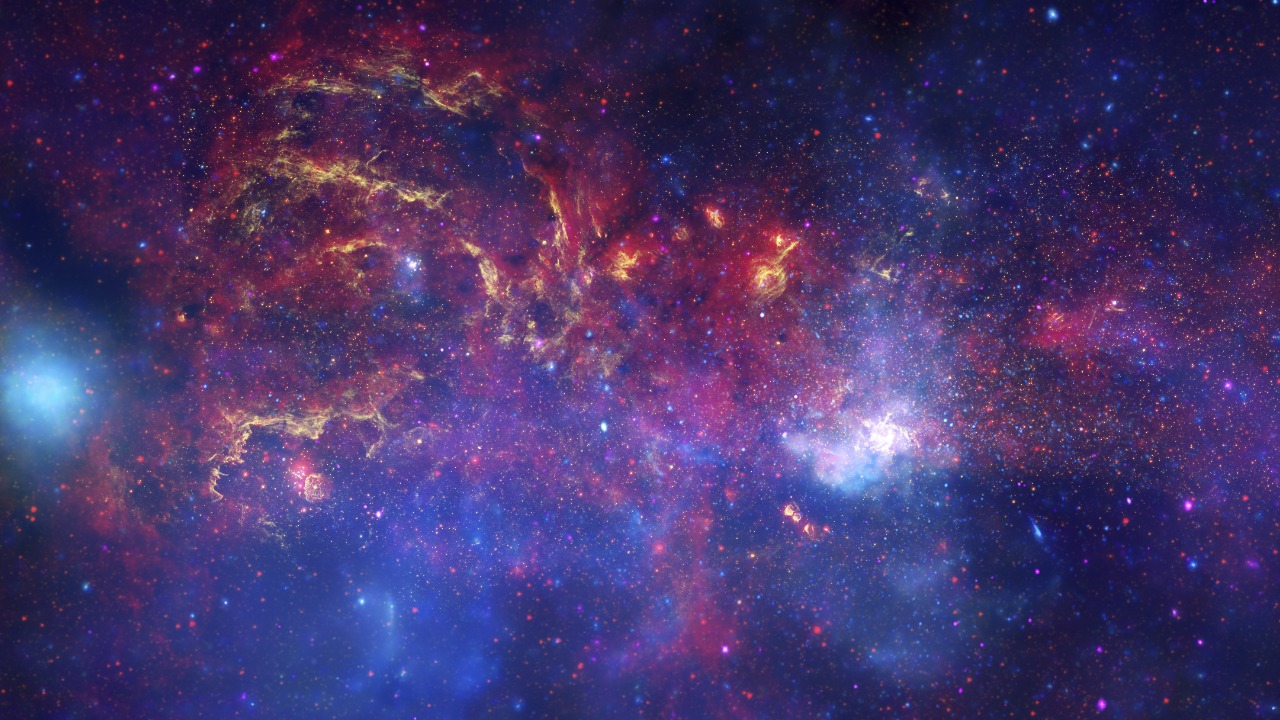

The Milky Way is not the neat, flat pinwheel many of us learned about in school. Fresh data from precision star maps now show our home galaxy as a warped, rippling disc that appears to twist and precess in space in a way that really does resemble a slowing top. The deeper astronomers look, the more they find that this wobble is tied to ancient collisions, invisible dark matter and giant waves of stars still sloshing through the galactic disk.
To understand whether the Milky Way is truly “wobbling through space like a top,” I need to unpack several overlapping motions: the basic spin of the galaxy, the large-scale warp of its disc, the precession of that warp and the newly detected waves rippling through its stars and gas. Together, these layers of movement are turning the Milky Way from a static backdrop into a dynamic, restless system whose history is written in its lopsided shape.
What astronomers mean by a galactic “wobble”
When astronomers talk about the Milky Way wobbling, they are not referring to the galaxy drifting off course in the universe, but to the way its thin stellar disc bends and slowly swivels in three dimensions. Instead of lying flat, the outer regions of the disc are bent upward on one side and downward on the other, creating a warped shape that rotates over time relative to the inner, more symmetric part. That slow rotation of the warp, a kind of precession, is what invites the comparison to a spinning top that starts to tilt and trace a circle as it loses speed.
In this picture, the familiar spiral arms sit inside a much larger, more complex structure that is constantly in motion. The central bulge and inner disc orbit the galactic center, while the warped outer disc appears to twist around that inner region on a different timescale. Astronomers now have enough precise stellar positions and velocities to track this behavior directly, rather than inferring it from gas clouds or indirect tracers, which is why the “wobbling top” metaphor has moved from a poetic image to a testable description of the Milky Way’s structure.
Gaia’s sharp view of a warped Milky Way
The clearest evidence that the Milky Way is not flat comes from the European Space Agency’s Gaia mission, which has mapped the positions and motions of more than a billion stars in three dimensions. Using this vast catalog, researchers reconstructed the shape of the galactic disc and found that its outer regions are distinctly bent, with the warp becoming more pronounced farther from the center. Analyses of these data show that the warp is not static, but instead rotates around the galactic center, which is why scientists describe the warped galactic disc as wobbling like a spinning top.
Visualizations based on Gaia’s star catalog, including work credited to Stefan Payne Wardenaar, turn this abstract geometry into a vivid 3D model of a twisted, slowly precessing disc. In one widely shared animation, the Milky Way’s outer edge rises and falls above the central plane as the whole structure rotates, capturing the essence of the wobble in a way that raw numbers cannot. The underlying measurements, however, are precise astrometric data, not artistic license, and they show that the warp’s motion is a real, measurable feature of the galaxy’s large-scale dynamics.
A galactic collision written into the warp
Once Gaia made the warp and its motion undeniable, the next question was what could have bent an entire galaxy. Astronomers had long suspected that interactions with smaller companions might be responsible, and detailed modeling of the Gaia data now points strongly to a past collision with another system. One analysis argues that the Milky Way’s warped shape is best explained if the disc was disturbed by a significant encounter, a scenario in which Gaia suggests the warp was caused by a galactic collision that left the outer disc permanently tilted.
In this view, the Milky Way’s wobble is a fossil record of a violent episode rather than a gentle, internal quirk. The disc behaves like a struck bell, still ringing long after the impact that set it vibrating. A separate access point to the same work emphasizes that astronomers have pondered for years why our galaxy is warped at all, and Gaia’s measurements finally give them a concrete dynamical explanation rooted in a specific interaction rather than vague tidal forces.
Dark matter’s invisible hand in the Milky Way’s tilt
Even with a collision on the table, the full story of the warp is not settled, and some teams have turned to dark matter to explain why the disc remains so persistently bent. One line of research argues that the Milky Way’s dark matter halo, the vast, invisible envelope of mass that surrounds the visible galaxy, may itself be tilted or lopsided. In that scenario, the gravitational pull of this misaligned halo would keep the disc twisted and could help maintain the wobble over billions of years, an idea explored in detail by Harvard astronomers who modeled the shape of the halo.
Other work frames the warp as the signature of a mysterious external force acting on the galaxy, potentially tied to the distribution of dark matter beyond the Milky Way’s visible edge. One analysis describes a mysterious force that is warping the Milky Way and suggests that the dark matter surrounding the entire galaxy could be the culprit. In both cases, the wobble becomes a tool for probing dark matter’s shape and behavior, turning a geometric oddity into a potential test of one of cosmology’s biggest unknowns.
Is the whole galaxy really moving like a spinning top?
With so many moving parts, it is fair to ask how literal the “spinning top” analogy really is. A careful dynamical study by the Instituto de Astrof, Canarias, known as the IAC, examined whether the Milky Way’s warp behaves like a rigid structure that precesses as a unit, or whether different parts of the disc move more independently. The investigation, led by Žofia Chrobáková, concluded that the warp defines the rotation of the outer disc and that the pattern of motion does resemble a global precession, which is why the team framed their work around the question, does the Milky Way move like a spinning top.
At the same time, the galaxy is not a solid object, and the wobble is not perfectly uniform. Stars at different radii feel different gravitational influences, and the warp’s amplitude and phase change with distance from the center, so the precession is more like a flexible plate twisting than a rigid toy tilting on a table. That nuance matters for models of how the warp formed and how long it can persist, but it does not erase the basic picture: the outer disc is tilted relative to the inner disc and that tilt slowly rotates, which is exactly the kind of motion that the spinning top metaphor is meant to capture for a general audience.
Giant waves rippling through the Milky Way’s disc
On top of the large-scale warp, astronomers are now finding evidence for enormous waves propagating through the Milky Way’s stars and gas. One recent analysis of stellar motions describes a Giant, Unexplained Wave Rippling Through the Milky Way, a structure that suggests the disc is not just bent but also oscillating vertically as stars move above and below the midplane. These waves can extend across large swaths of the galaxy, indicating that some past disturbance set huge regions of the disc in motion.
Another team reports that Astronomers Have Detected a Vast Wave Disturbing the Structure of the Milky Way Galaxy, again pointing to a coherent, large-scale oscillation whose source is still uncertain. These waves may be related to the same collision that produced the warp, or they could be the imprint of repeated encounters with satellite galaxies that periodically tug on the disc. Either way, they add another layer of motion to the picture, turning the Milky Way into a churning, rippling system rather than a smooth, steady spinner.
New Gaia evidence for a colossal galactic ripple
Gaia’s data are central not only to the warp story but also to the discovery of these waves. By tracking the vertical positions and velocities of stars across the disc, researchers have identified a pattern that looks like a colossal ripple moving outward from the galactic center. One analysis of the positions and motions of stars in the Milky Way’s disc concludes that they trace a colossal wave that is likely the result of past and continuing processes, such as interactions with smaller galaxies or the influence of the dark matter halo.
Complementary work emphasizes that Our Milky Way is constantly in motion, not only spinning and tilting but also rippling as this wave travels outward from its center. In that picture, the wobble of the warp and the passage of the wave are intertwined, with the disc flexing and bending in response to both its own internal dynamics and external nudges. The result is a galaxy whose shape is time dependent in a very literal sense, changing as the wavefront moves and as the warp slowly precesses.
Competing ideas: satellites, dark matter and internal instabilities
Behind the evocative language of wobbling tops and colossal waves lies a serious debate about what is actually driving all this motion. One camp focuses on the role of satellite galaxies, particularly Sagittarius, a smaller system that has plunged through the Milky Way’s disc multiple times. Analyses of the disc’s structure argue that They suggest that the Sagittarius galaxy may have created some of the observed structures the last time it passed through the disc, seeding both the warp and the vertical waves as it goes.
Another perspective emphasizes the possibility that the dark matter halo itself is distorted or rotating in a way that torques the disc, an idea that dovetails with the work on a misaligned halo and the mysterious force warping the galaxy. Some researchers also consider internal instabilities, such as the bar at the Milky Way’s center or spiral arm dynamics, as contributors to the disc’s bending and oscillations. A separate study, summarized in a report that notes Their research suggests something is warping the entire galaxy, even raises the possibility that the Milky Way is still in the process of absorbing a smaller system whose gravity continues to disturb the disc. The wobble, in other words, is not a single-issue phenomenon but the outcome of several overlapping influences.
Why the Milky Way’s wobble matters for cosmic history
Understanding how and why the Milky Way wobbles is not just a matter of tidying up a galactic portrait. The warp, the precession and the waves all encode information about the galaxy’s past encounters, its dark matter environment and the way it assembled over time. If the warp was triggered by a specific collision, then its current shape and motion can help reconstruct when that event happened and how massive the intruder was, which in turn refines models of how the Milky Way grew through mergers.
The same is true for the giant waves now being mapped across the disc. Their amplitude, wavelength and speed can reveal whether they were launched by a single dramatic impact or by repeated, smaller tugs, and whether dark matter plays a dominant role in sustaining them. As more Gaia data accumulate and as follow-up surveys add chemical information about the stars involved, the Milky Way’s wobble will become a kind of seismograph for galactic archaeology, letting astronomers read the galaxy’s hidden history from the way it flexes and twists in space.
From poetic metaphor to precise measurement
For decades, describing the Milky Way as wobbling like a top would have been little more than a colorful metaphor. Today, thanks to Gaia and a suite of follow-up analyses, that image has a quantitative backbone. The warp is mapped, its precession rate is being measured and the waves rippling through the disc are being traced in detail, turning a once speculative idea into a set of concrete parameters that can be plugged into simulations and compared with theories of galaxy formation.
At the same time, the metaphor has its limits, and I find it useful mainly as a bridge between everyday intuition and the messy reality of a galaxy made of hundreds of billions of stars. A child’s spinning top is rigid and simple, while the Milky Way is flexible, stratified and constantly perturbed by both visible companions and invisible dark matter. The real story is richer than any single image can capture, but the core insight holds: our galaxy is not a static, flat disc drifting quietly through space, it is a restless, warped and rippling structure whose ongoing wobble is one of the clearest clues to how it came to be.
More from MorningOverview