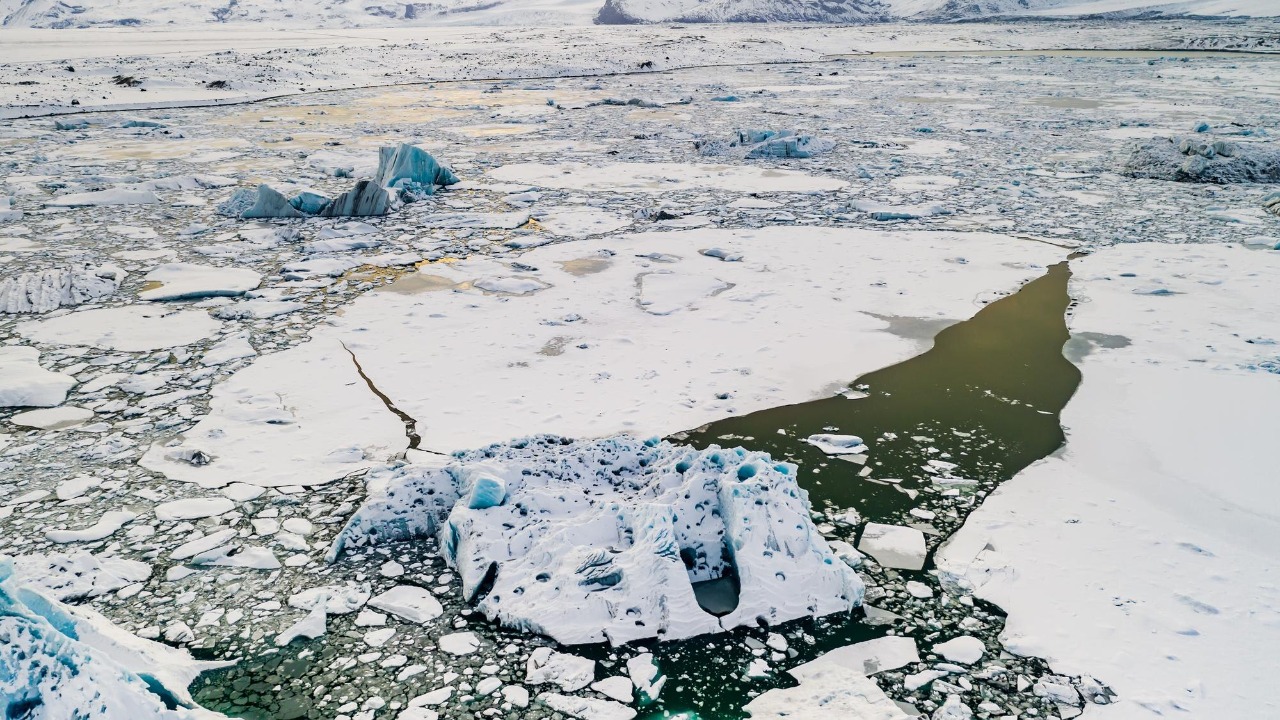

Far below the frozen surfaces of Antarctica and Greenland, scientists are uncovering a restless world of gas, water, rock and even strange signals that is far more dynamic than the blank white maps suggest. What they are finding is both astonishing and unsettling, from buried lakes and hidden rivers to methane seeps and mysterious radio waves that hint at processes we barely understand. I see a pattern emerging in these discoveries: the more we learn about what lies under the ice, the clearer it becomes that the planet’s most remote regions could shape our climate future in ways we are only beginning to grasp.
The new alarm: methane seeping from the seafloor
The most immediate red flag is the discovery of planet-heating methane leaking from cracks in the seafloor around Antarctica, a sign that long-frozen carbon stores are starting to stir. Researchers who set out to study other questions stumbled on plumes of gas rising from the ocean bed, then traced them back to fractures in sediments that had locked away methane for millennia. In their account, the gas is not just trickling out, it is escaping in a way that suggests the system has been disturbed and could be sensitive to further warming, a point underscored when the work was described as scientists discovering something alarming seeping out from beneath the ocean around the icy continent, with the report explicitly noting that planet-heating methane was the culprit.
The concern is not limited to one patch of seabed. Other work has highlighted that Huge amounts of methane lie in reservoirs that have formed over millennia beneath the seafloor around the world, including the Southern Ocean. Methane is a far more potent heat trapper than carbon dioxide over short timescales, so any large-scale destabilization of these stores could amplify warming in a feedback loop that is difficult to stop once it begins. I read the scientists’ language carefully here: they are not saying catastrophe is inevitable, but they are clear that the system is more fragile than many climate models have assumed, and that the cracks now venting gas are a warning sign that the deep ocean is responding to a changing climate.
Antarctica’s buried landscape is anything but flat
From space, Antarctica looks like a smooth white shield, but radar and seismic surveys reveal a continent carved by mountains, valleys and lakes that rival major river basins elsewhere on Earth. Under the ice sheet, there are unseen mountain ranges, deep troughs and subglacial lakes that channel meltwater in complex ways, shaping how ice flows toward the sea. One detailed mapping effort described how this hidden terrain includes valleys, lakes and rivers, and noted that the ice sheet itself rises 13,400 feet above sea level in places, a reminder that the ice is not a thin veneer but a colossal mass draped over a rugged bedrock world.
This topography matters because it controls where meltwater can pool, how quickly glaciers slide and which sectors of the ice sheet are most vulnerable to collapse. Channels can funnel relatively warm ocean water under ice shelves, while deep basins can trap freshwater that lubricates the base of the ice, speeding its flow. I find it striking that the same mapping that reveals this dramatic landscape also shows how little of it we have actually sampled directly, forcing scientists to infer conditions from radar echoes and sparse boreholes. The picture that emerges is of a continent whose stability depends on the interplay between ice, water and rock in places no human has ever seen.
Greenland’s soft underbelly and “large uncertainties”
It is not only Antarctica that is hiding surprises. Under the Greenland Ice Sheet, researchers have identified widespread soft sediments that behave more like mud than solid rock, a finding that could help explain why some glaciers there are thinning and accelerating faster than expected. Using techniques akin to listening for tiny earthquakes to map subsurface conditions, they found that large areas beneath the ice are not rigid, but instead are deformable layers that can be squeezed and sheared as the ice above them moves. In their summary, Scientists warned that these soft sediments are a major contributor to ice loss and sea-level rise, and they emphasized that there are “Large uncertainties in how this under-ice geology will respond as the climate warms further.
Those “large uncertainties” are not academic. If the base of the ice sheet is softer and more slippery than models assume, then projections of future sea-level rise could be underestimating how quickly Greenland’s ice can drain into the ocean. I see a parallel here with the methane reservoirs under the Antarctic seafloor: in both cases, processes hidden from direct view are acting as wild cards in the climate system. The Greenland work suggests that even if surface melt were to stabilize, the internal mechanics of the ice sheet could keep driving loss for decades, because the sediments beneath have already been primed to deform. That makes understanding this buried layer a priority for anyone trying to forecast coastal risk in the coming century.
Methane, doom loops and the Antarctic ocean
The methane seeps around Antarctica are part of a broader pattern of concern about how polar oceans might tip the climate into self-reinforcing change. Analyses of what is hiding under the Antarctic ocean have highlighted that Methane leaks are multiplying beneath Antarctic waters, raising fears of a climate “doom loop” in which warming seas destabilize gas hydrates, which then release methane that drives further warming. In the same under-ice catalog, researchers also described a Giant structure deep beneath the ice, likely a geological feature, that underscores how much of the Antarctic environment remains unmapped and potentially unstable.
What troubles me is how these findings intersect with other signs that the polar regions are entering a new regime. Reporting on the methane seeps around Antarctica noted that the scientists involved had not set out to find them, but instead encountered them while studying other questions, a detail captured in the description that the work was At the frontier of what we know about under-ice oceans. That suggests we may be undercounting similar seeps elsewhere simply because we have not looked closely enough. The possibility of a feedback loop is not a prediction that it will happen at full force, but it is a reminder that the climate system contains buried triggers that could accelerate change if they are “provoked or underestimated,” to borrow the scientists’ own cautionary phrasing.
A hidden world of lakes and rivers under the ice
While gas and sediments raise alarms, the water flowing under Antarctica’s ice sheet is a quieter but equally consequential discovery. Using satellite altimetry and ice-penetrating radar, researchers have identified networks of subglacial lakes that fill and drain over time, sending pulses of water toward the coast. One recent survey reported that Scientists have discovered 85 “active” lakes buried beneath Antarctica’s ice, meaning they periodically gain and lose water rather than remaining static. The same account noted that this tally was compiled by a team working with data current to 26.09, underscoring how rapidly our picture of the subglacial hydrology is evolving.
These lakes are not isolated ponds. They are connected by channels that can route meltwater across hundreds of kilometers, lubricating the base of the ice sheet and influencing how fast glaciers slide. Some of the lakes sit beneath fast-moving ice streams that are already thinning, raising the possibility that changes in their filling and draining cycles could trigger surges in ice flow. I find it telling that scientists now talk about “active” lakes in the same breath as they discuss ice dynamics and sea-level projections, a sign that what once seemed like a curiosity has become central to understanding how quickly Antarctica can respond to a warming world.
Life thrives in the dark: ecosystems revealed by collapsing ice
Not everything hidden under the ice is a threat. When a giant Antarctic iceberg broke away and drifted, it exposed seafloor that had been sealed off from sunlight and open water for thousands of years, giving biologists a rare chance to see how life evolves in isolation. As the berg collapsed and currents began to flow more freely, researchers documented a secret ecosystem of sponges, worms and other creatures that had adapted to a world of near-constant darkness and scarce food. One account described this as a Hidden World Uncovered Beneath Antarctica: Giant Iceberg collapse revealing a secret ecosystem lost for thousands of years, and linked the find to broader questions about how climate change is reshaping Earth’s polar regions.
Elsewhere, when researchers used a remotely operated vehicle to peer under an intact iceberg, they found a startling kaleidoscope of life clinging to the underside of the ice and the seafloor below. The rich ecosystem they observed suggested that any food arriving from the surface would have been carried on currents, slipping in under the ice and then circulating in eddies that trapped nutrients long enough for animals to feed. The team that Scientists peeked underneath an iceberg and documented this thriving community emphasized how little we know about such habitats, and how vulnerable they may be if warming waters and shifting ice cover disrupt the delicate balance that sustains them.
Mysterious radio waves from beneath the ice
Not all of the surprises under Antarctica are visible in images or cores. Over several seasons, a balloon-borne experiment called the Antarctic Impulsive Transient Antenna, or ANITA, has detected strange radio signals that appear to be coming from within or below the ice, rather than from space as expected. These signals, which look like upward-traveling showers of particles, have puzzled physicists because they do not fit neatly into existing models of how high-energy neutrinos should interact with matter. One report framed the puzzle bluntly, noting that Scientists detect mysterious radio waves coming from beneath Antarctica’s ice, and that the ANITA instrument was designed to catch exactly this kind of fleeting signal.
Follow-up analyses have only deepened the mystery. A separate account explained that the study results were published in Physical Review Letters, and that the findings have left scientists perplexed because the radio waves seem to challenge the current understanding of particle physics. Another popular explanation of the phenomenon described Antarctica as a vast expanse of white snow, freezing winds and lifeless landscapes, yet noted that researchers have detected weird, eerie signals seemingly coming from within, a narrative captured in a video titled Researchers Detected Mysterious Signals from Under the ice. I see these reports as a reminder that Antarctica is not just a climate laboratory but also a frontier for fundamental physics, where the ice itself becomes part of the detector for particles that rarely interact with ordinary matter.
Antarctica as a planetary warning system
When I step back from the individual discoveries, a broader picture comes into focus: Antarctica is functioning as an early warning system for planetary change. The methane seeps, the soft sediments under Greenland, the 85 active lakes, the hidden mountains and valleys, the thriving ecosystems under icebergs and the mysterious radio waves all point to a world where the boundaries between solid, liquid and gas are shifting. A synthesis of what is hiding under the ice has emphasized that from above, Antarctica might seem simple, but beneath the surface lie not only geological structures and water networks, but also the remnants of ancient ecosystems and perhaps clues to how life could exist in similar conditions on icy moons.
At the same time, the polar regions are sending a clear message about risk. The work on Greenland’s soft sediments explicitly flagged “large uncertainties” in how fast ice loss and sea-level rise might accelerate, while the methane studies around Antarctica warned that long-stable reservoirs can be disturbed by relatively modest warming. I read these as signals that our models, which often smooth over the messy details of what happens under the ice, may be missing key levers that control the pace of change. The discoveries do not guarantee worst-case outcomes, but they do narrow the margin for complacency, suggesting that what is hidden under the ice is not just a scientific curiosity, but a set of processes that could shape coastlines, ecosystems and even the basic physics we use to describe the universe.
More from MorningOverview