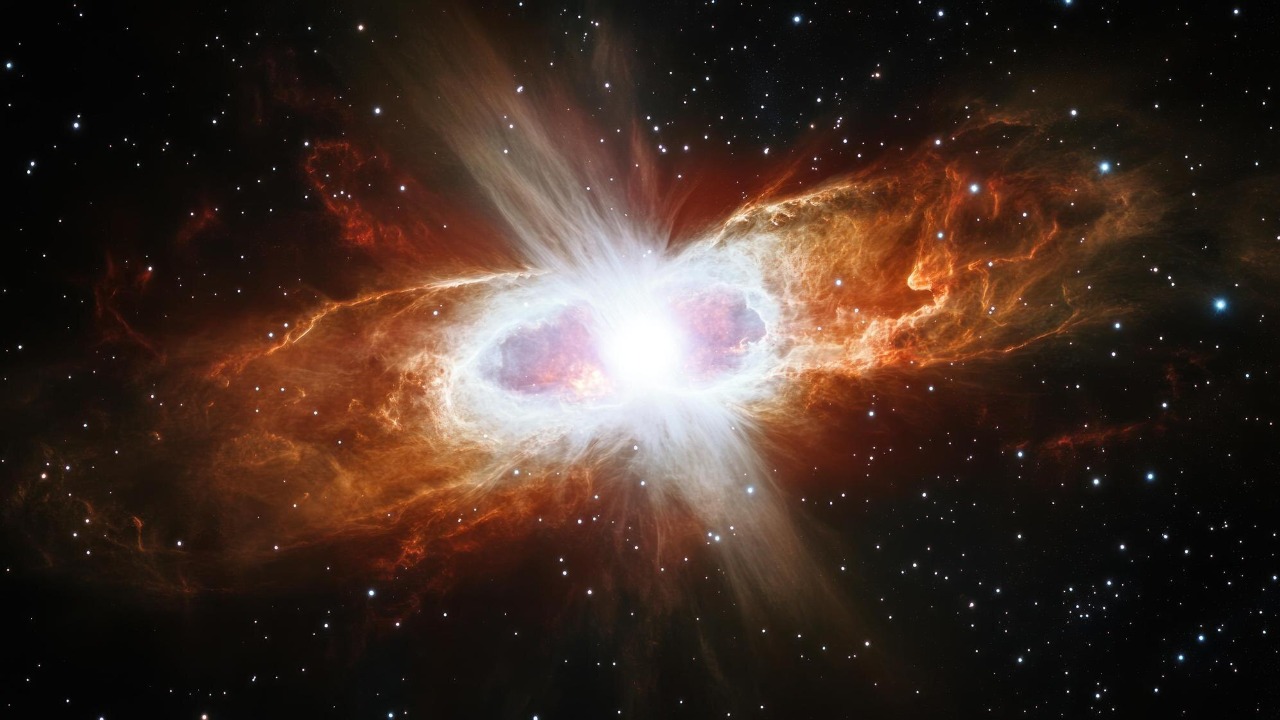

Astronomers have traced the origin of a colossal white dwarf to a catastrophic crash between two dead stars, turning a quiet stellar ember into a cosmic heavyweight. Using the Hubble Space Telescope, researchers have pieced together how this “mega” remnant defies the usual life cycle of a single star and instead carries the scars of a violent merger. The result is a nearby object that looks ordinary at first glance but, under ultraviolet scrutiny, reveals a history written in extreme gravity and explosive chemistry.
I see this discovery as a rare chance to watch stellar evolution break its own rules, offering a laboratory for physics that usually plays out in distant supernovae. By tracking the atmosphere, mass, and motion of this unusual white dwarf, scientists are learning how often stars collide, how close they can come to detonating, and what that means for the future of systems like our own.
The mega white dwarf hiding in plain sight
The star at the center of this story is known as WD 0525+526, a compact stellar corpse that, on paper, should have been unremarkable. White dwarfs are the dense remnants left behind when stars like the Sun exhaust their nuclear fuel, and most of them are roughly similar in mass, about 0.6 times that of our star. WD 0525+526, however, is far heavier than that norm, placing it in the category of an ultra massive white dwarf that is unusually close to the upper limit of what such objects can be before they collapse or explode, a rarity that immediately caught astronomers’ attention once its properties were measured in detail and compared with other rare massive white dwarfs.
What makes WD 0525+526 even more intriguing is that it sits relatively close to us in cosmic terms, Located about 128 light years away in our galactic neighborhood. That proximity means its light is bright enough for detailed dissection, allowing researchers to probe its atmosphere and interior structure with tools that would be impossible for more distant targets. The combination of extreme mass and nearness turned this star into a natural test case for theories that predict some white dwarfs are not the product of a single stellar life, but the aftermath of two smaller remnants spiraling together and merging into one.
Hubble’s ultraviolet vision exposes a violent past
To uncover what made WD 0525+526 so massive, Astronomers turned to Hubble and, in particular, to its ability to see in ultraviolet light where hot, energetic processes leave their fingerprints. Using Hubble’s Cosmic Origins Spectrograph, the team split the star’s light into its component wavelengths and searched for subtle features that would betray unusual elements or temperatures in the thin outer layers. That ultraviolet spectrum is far more sensitive to trace gases than visible light, which is why the Cosmic Origins Spectrograph has become a workhorse for studying faint signatures in stellar atmospheres and interstellar gas, especially in compact objects where every photon counts, as highlighted in the mission’s own Cosmic Origins Spectrograph observations.
Those ultraviolet data revealed something that standard models of white dwarfs struggle to explain. Instead of showing a clean, stratified atmosphere dominated by lighter elements, WD 0525+526 displays small but persistent amounts of carbon rising from deeper layers into its outer envelope. That pattern suggests the star’s interior has been stirred or disturbed, as if a recent upheaval had mixed its contents rather than letting them settle quietly over billions of years. The presence of this carbon, combined with the star’s extreme mass, pointed researchers toward a more dramatic origin story than simple solitary evolution, a conclusion reinforced by the way the ultraviolet signatures deviate from what is expected in a typical white dwarf of similar temperature, as detailed in the analysis of ultraviolet light revealing the aftermath of a rare star collision.
Why two dead stars had to collide
When I weigh the evidence, the merger scenario is the only one that fits all the clues without stretching the physics. A single star would have to be extremely massive to leave behind a white dwarf as heavy as WD 0525+526, yet such progenitors usually end their lives in core collapse supernovae instead of quietly shrinking into dense embers. The fact that this object exists as a white dwarf at all, rather than a neutron star or black hole, suggests it was assembled from smaller pieces that never individually crossed the threshold for catastrophic collapse. That is exactly what happens when two lower mass white dwarfs in a tight binary system lose energy, spiral inward, and eventually smash together, a process that can either trigger a thermonuclear explosion or, if conditions are just right, fuse them into a single ultra massive remnant like the one Hubble has now exposed as a white dwarf merger remnant.
The carbon in the atmosphere strengthens that case because it looks like the chemical echo of a collision that did not quite finish the job. In a full-blown thermonuclear supernova, the merging white dwarfs are completely disrupted and their material is blasted into space, leaving no compact core behind. In WD 0525+526, the presence of carbon suggests nuclear burning ignited during the merger but then stalled, leaving behind a star that is partially processed and still carrying the ashes of that near-miss in its outer layers. That kind of incomplete detonation is exactly what theorists expect when the total mass of the system approaches, but does not exceed, the critical limit for runaway fusion, and it explains why this object can be both extraordinarily dense and yet still intact, a survivor of a process that often ends in total destruction.
A “Zombie Star” that almost blew itself apart
Because of that near-fatal history, some researchers have taken to describing WD 0525+526 as a kind of Zombie Star, a stellar corpse that effectively died twice and yet still lingers in a new form. First, its original progenitors exhausted their fuel and collapsed into white dwarfs, then those remnants collided in a violent event that should have triggered a final thermonuclear death. Instead, the system stopped just short of that threshold, leaving behind a single ultra massive white dwarf that carries the Shocking Backstory of its interrupted explosion in the form of unusual atmospheric chemistry and extreme density. It is a vivid example of how stellar evolution can produce objects that are neither fully alive nor fully dead in the traditional sense, a point underscored in reports that describe how Astronomers Just Found a Zombie Star with a Shocking Backstory lurking in our neighborhood.
What makes this label more than just a catchy metaphor is the physical evidence that the star still bears the sign of its explosive past. The carbon dredged up into the atmosphere is not expected in a quiet, slowly cooling white dwarf, and its presence indicates that the interior was heated and mixed by a powerful event that did not fully unbind the star. That is why the question “What is this?” has become central to the analysis of WD 0525+526, as Astronomers try to reconcile its current stability with the clear traces of past violence. The object stands as a reminder that stellar remnants can be reanimated by later interactions, turning what should have been a simple cooling ember into a complex, multi-stage survivor of cosmic trauma, a narrative captured in the way researchers frame the sign of its explosive past in the star’s atmosphere.
How Hubble’s instruments cracked the case
From my perspective, the real hero of this story is not just the star but the technology that made its diagnosis possible. Hubble has been orbiting Earth for decades, yet its instruments remain uniquely capable of dissecting faint ultraviolet signals that ground-based telescopes cannot see through the atmosphere. The Cosmic Origins Spectrograph, in particular, was designed to capture high quality ultraviolet spectra from compact, hot objects like white dwarfs, and in this case it delivered the precision needed to detect the subtle carbon features that betray WD 0525+526’s merger history. Without that level of sensitivity, the star might have remained just another data point in a catalog, its extraordinary mass noted but its violent origin left unproven, a gap that the dedicated Hubble ultraviolet campaign was specifically designed to close.
The broader Hubble program around this object also shows how coordinated observations can turn a single target into a window on fundamental physics. Astronomers combined ultraviolet spectroscopy with measurements of the star’s temperature, gravity, and motion to build a coherent picture of its structure and past. Visualizations and outreach materials have helped translate that technical work into a more intuitive story, with animations showing how two white dwarfs spiral together and merge into a single ultra massive remnant. Those materials, produced under the banner of Hubble Uncovers Star’s Unusual Atmosphere, emphasize how Astronomers using NASA’s Hubble Space Telescope relied on ultraviolet data that revealed something unusual in the star’s outer layers, a narrative captured in the mission’s own Hubble Uncovers Star Unusual Atmosphere presentation.
Why ultra massive white dwarfs are so rare
Ultra massive white dwarfs like WD 0525+526 are statistical outliers, and that rarity is part of what makes this discovery so valuable. Most stars that end their lives as white dwarfs start with masses similar to or only slightly larger than the Sun, which naturally leads to remnants clustered around a common mass. To reach the extreme values seen in WD 0525+526, a star would either need to be born unusually heavy or, more plausibly, be assembled from the merger of two smaller remnants. Observational surveys have long hinted that such heavy white dwarfs exist but did not always have the detailed atmospheric data needed to distinguish between single-star and merger origins, a gap that the new Hubble work on this white dwarf created in a violent star collision helps to fill.
The fact that WD 0525+526 is both ultra massive and nearby suggests that such merger remnants may be more common than previously thought, even if they remain a small fraction of the overall white dwarf population. Each one represents a system that avoided a full thermonuclear explosion, which has implications for how often certain types of supernovae occur in galaxies like ours. If more of these heavy remnants are hiding in plain sight, then the balance between quiet mergers and explosive outcomes may need to be recalibrated, affecting everything from models of chemical enrichment to the use of supernovae as standard candles in cosmology. That is why researchers are now combing through catalogs of dense white dwarfs, looking for similar atmospheric anomalies that might betray a hidden merger history, a search that builds directly on the identification of this object as a rare star formed as a result of a cosmic collision.
A different kind of stellar life cycle
What strikes me most about WD 0525+526 is how thoroughly it upends the tidy diagrams of stellar evolution that appear in textbooks. Those charts usually show a single star swelling into a red giant, shedding its outer layers, and then settling into a white dwarf that cools forever in isolation. In reality, many stars are born in binary or multiple systems, and their fates are intertwined in ways that can radically alter their endpoints. The mega white dwarf uncovered by Hubble is a textbook example of this more chaotic reality, where the life cycle of a single star is not enough to explain the properties of the final remnant, a point underscored by analyses that describe how this object has a very different history from what we would have guessed from a simple stellar life cycle.
In this sense, WD 0525+526 is not just an oddball but a signpost pointing toward a richer, more interconnected view of how stars live and die. Its existence confirms that some white dwarfs are the products of multi-stage histories involving mass transfer, orbital decay, and eventual collision, processes that can leave behind remnants that are heavier, hotter, or chemically stranger than any single-star path would allow. That realization feeds back into models of binary evolution, gravitational wave sources, and the demographics of compact objects in the Milky Way, reminding us that the universe is less a collection of isolated actors and more a web of interactions where even dead stars can reshape each other’s destinies through close encounters and catastrophic mergers.
From data point to public spectacle
The story of WD 0525+526 has also been shaped by how it has been presented to the public, turning a dense set of spectra and models into a narrative that captures the imagination. Visual explainers and short videos have framed the discovery as a rare ultra massive white dwarf formed from merging stars, highlighting the role of NASA and the Hubble Space Telescope in catching the aftermath of a stellar crash. Those materials often show two compact stars spiraling together, colliding in a burst of light, and then settling into a single, oversized remnant, a sequence that mirrors the scientific reconstruction of the event and helps non-specialists grasp why this object is so unusual, as seen in outreach pieces that describe how NASA and the Hubble Space Telescope revealed a rare ultra massive white dwarf.
At the same time, more detailed written accounts have emphasized the detective work behind the scenes, from the initial identification of WD 0525+526 as an unusually massive white dwarf to the follow-up ultraviolet observations that clinched the merger interpretation. Those reports stress that the star, known as WD 0525+526, is unusually massive and shows small amounts of carbon in its atmosphere, a combination that flagged it as a likely merger remnant and led to its publication as a key case study in Nature Astronomy. By tracing that path from catalog entry to headline-grabbing Zombie Star, they show how careful analysis of nearby objects can yield insights that ripple across astrophysics, a process captured in coverage that explains how Hubble spots unusual signs in a nearby white dwarf.
What this mega white dwarf means for future astronomy
Looking ahead, I see WD 0525+526 as both a benchmark and a warning. As a benchmark, it provides a concrete example against which models of white dwarf mergers can be tested, from the amount of carbon expected in the atmosphere to the final mass and temperature of the remnant. As a warning, it reminds astronomers that some systems may be perched precariously close to the threshold for thermonuclear explosion, and that small changes in mass or composition could tip them into full-blown supernovae. That has implications for how we estimate the rates of such explosions in galaxies and how we interpret the remnants they leave behind, especially in the context of using supernovae as tools to measure cosmic expansion, a theme echoed in discussions of how rare massive white dwarfs can inform our understanding of stellar deaths.
For Hubble and its successors, the discovery underscores the value of ultraviolet astronomy in an era increasingly dominated by infrared observatories. While newer telescopes probe the cool, dusty universe, instruments like the Cosmic Origins Spectrograph continue to reveal the hot, energetic processes that shape compact objects and their environments. Future missions that can match or exceed Hubble’s ultraviolet capabilities will be essential for finding more merger remnants, mapping their distribution, and tying them to gravitational wave signals from inspiraling white dwarf binaries. In that sense, the mega white dwarf born from a violent star crash is not just a curiosity but a harbinger of a richer, multi-messenger view of how even the smallest stars can end their lives in spectacular, and sometimes surprising, fashion, a perspective that aligns with the broader narrative of how Hubble spots a white dwarf created in a violent star collision and turns it into a cornerstone of modern stellar astrophysics.
More from MorningOverview