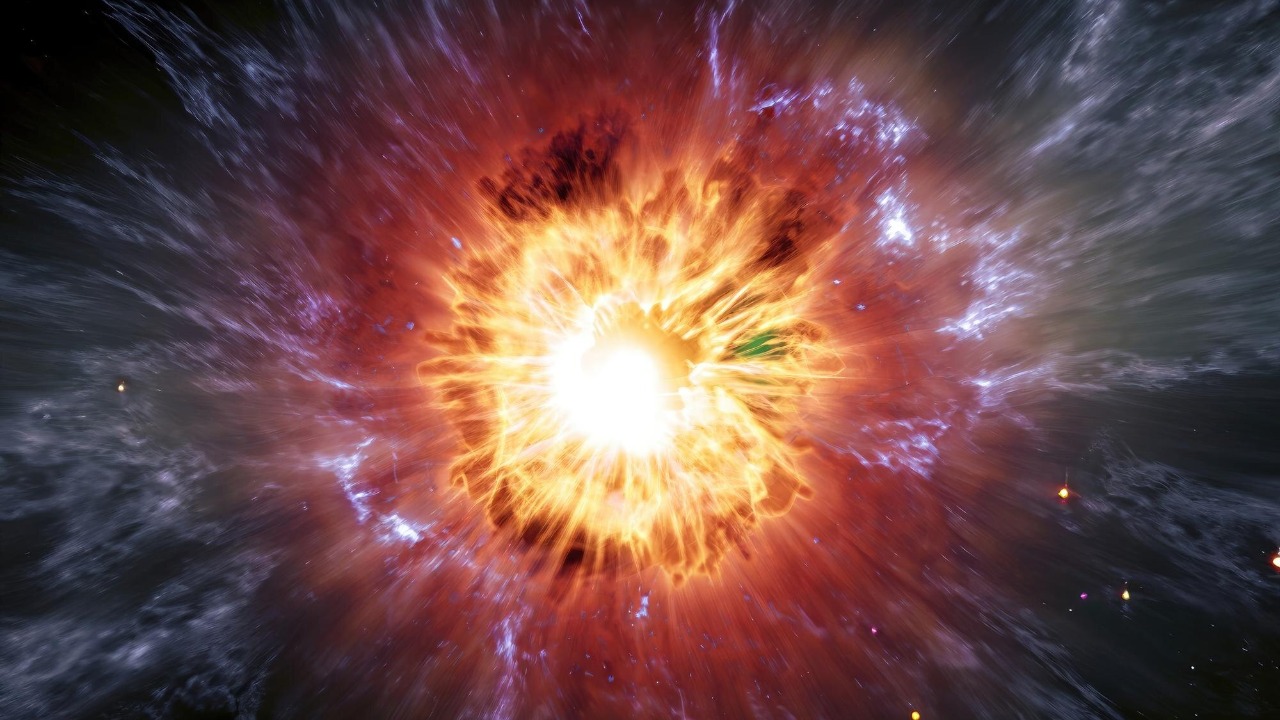

For more than a century, astronomers have known that some “new stars” flaring into view are not births at all but violent outbursts on long‑dead stellar cores. What they lacked was a clear, close look at those eruptions in the first days after they ignite, when the physics is most extreme and the clues to how they work are written into the expanding fireball. That gap has finally started to close, as teams have now captured nova explosions in real time and in unprecedented detail, catching the moment when a quiet white dwarf suddenly turns into one of the brightest objects in its corner of the sky.
Those early snapshots are already rewriting what I thought I knew about how stars die, how they shed material into space, and how some of the universe’s heaviest elements are forged. They are also tying novae to a broader menagerie of stellar cataclysms, from supernovae to the newly proposed “superkilonova,” revealing that the cosmos has more ways to blow up a star than textbooks ever suggested.
What a nova really is, and why catching one early is so hard
A nova is not a star tearing itself apart once and for all, but a recurring surface detonation on a white dwarf that has been quietly stealing gas from a nearby companion. As hydrogen piles up on the dwarf’s surface, pressure and temperature climb until nuclear fusion ignites in a runaway flash, blasting material outward and making the system brighten by factors of thousands. The underlying white dwarf survives, which is why the same system can flare again and again over centuries, each time masquerading as a “new” star to anyone who was not watching closely before.
The catch is that these eruptions rise fast and fade quickly, and they can happen almost anywhere in the sky, so by the time telescopes swing around, the most revealing early stages are usually gone. Historically, observers have been forced to reconstruct the opening act from late‑time light curves and spectra, which is a bit like trying to understand a fireworks show from the smoke patterns left behind. That is what makes the latest observations so striking: for the first time, astronomers have managed to secure detailed images of nova fireballs within days of the eruption, rather than weeks or months later, and to watch how their structure changes in real time.
Two dead stars, two fresh fireballs, and a leap in resolution
The breakthrough came when teams zeroed in on two separate nova eruptions on compact stellar remnants and resolved their expanding shells with a clarity that would have been unthinkable a decade ago. Instead of a fuzzy blob, the explosions around these two dead stars appeared as structured, evolving clouds, with knots, jets, and asymmetries that betrayed the violence of the underlying blast. By following the same objects over multiple days, researchers could see how those features grew, thinned, and cooled, turning a static snapshot into a time‑lapse of stellar demolition.
One report described how two nova eruptions were captured in such unprecedented detail that individual clumps of ejected gas could be tracked as they raced outward. Another analysis emphasized that these were not exotic monsters in distant galaxies but relatively nearby systems, close enough that modern instruments could separate fine structure in the debris. For me, that proximity is part of the story’s power: these are ordinary stellar corpses in our own galactic neighborhood, suddenly laid bare in the act of hurling their outer layers back into space.
Real‑time movies of stars blowing their tops
What truly changes the game is not just resolution but timing. Instead of waiting for chance discoveries long after the peak, coordinated surveys and rapid‑response follow‑up have allowed astronomers to start observing within days of the first outburst. In one campaign, astronomers captured detailed images of two stellar explosions within days after the eruption began, then kept returning as the fireballs expanded and cooled. That cadence turned what used to be a single still frame into a frame‑by‑frame record of a nova’s evolution.
Another team reported that astronomers obtained images of two novae just days after they erupted, capturing the unfolding, life‑changing events as they developed. By combining those early images with spectra and light curves, researchers could watch shock fronts plow through surrounding gas, see how quickly the ejected material thinned, and test long‑standing models of how the blast couples to the binary system. For the first time, the phrase “watching a star explode in real time” is not a metaphor but a literal description of what the data show.
From textbook novae to messy, asymmetric blasts
For years, standard diagrams of novae showed neat, spherical shells expanding uniformly into space, a simplification that made the math easier but never quite matched the messy reality hinted at by late‑time images. The new close‑ups confirm that the explosions are anything but smooth. Instead, the ejected gas appears clumpy and lopsided, with some regions racing ahead while others lag behind, and with hints of jets or bipolar flows that suggest the white dwarf’s magnetic field and the binary’s orbital motion are sculpting the blast.
High‑resolution observations described in one report show that astronomers captured the clearest view yet of how material is thrown off, including regions where almost no gas was released at all. That patchiness matters, because it affects how much mass the white dwarf loses or gains over time, which in turn shapes whether it might eventually cross the threshold into a full‑blown supernova. It also changes how the blast enriches its surroundings with elements like carbon, nitrogen, and oxygen, seeding future generations of stars and planets with the raw material for life.
When a star seems to explode twice
As the nova picture sharpens, astronomers are also confronting stranger explosions that do not fit neatly into existing categories. One of the most intriguing involves a distant object whose light curve appears to show two distinct outbursts, separated by a delay that is hard to explain with a single event. The first flare looks like a classic supernova, the terminal blast of a massive star, while the second resembles the glow of a kilonova, the radioactive afterglow produced when two neutron stars collide and forge heavy elements like gold and platinum.
In one analysis, researchers asked bluntly whether astronomers saw a star explode twice, noting that observers currently spot multiple supernovae every day but have only one confirmed kilonova on record. The idea is that a single massive star could first die in a supernova, leaving behind a tight pair of neutron stars that then spiral together and merge in short order, producing a second, distinct explosion. If that interpretation holds, it would mean that some of the universe’s most dramatic fireworks come in two acts, with the second act powered not by a dying star but by the collision of its ultra‑dense remnants.
The rise of the “superkilonova” and a new class of stellar blasts
That two‑stage scenario has led some researchers to propose a new label for the combined event: a “superkilonova,” a hybrid that carries the hallmarks of both a supernova and a kilonova. In this picture, the initial supernova both creates and tightens the neutron‑star pair, while the subsequent merger unleashes an even more luminous and longer‑lasting glow than a typical kilonova alone. The result would be an explosion that outshines ordinary supernovae in some wavelengths and lingers for weeks or months as freshly minted heavy elements decay.
Reporting on this possibility notes that astronomers may have detected first known “Superkilonova” Explosion, an unprecedented discovery that combines features of both supernovae and kilonovae. A separate study describes a strange afterglow in which a supernova may have birthed two tiny neutron stars that quickly spiraled together, colliding in a kilonova and producing light from the stellar fireworks that did not match any standard template. For me, the appeal of the “superkilonova” idea is not the label itself but what it implies: that stellar death can be a chain reaction, with one catastrophe setting up the conditions for another.
Historic firsts beyond novae: catching a supernova at the starting gun
The nova work is part of a broader shift toward catching stellar explosions at the very moment they ignite, not just after they have already reshaped their surroundings. That shift is visible in reports that scientists have, for the first time, secured a snapshot of a supernova right at the start of its outburst, rather than hours or days later. In one widely discussed case, researchers linked a mysterious object described in ancient texts to a modern remnant, then used contemporary instruments to capture a new explosion’s opening flash, providing a direct bridge between historical records and present‑day physics.
A video report on this achievement describes a historic first‑ever supernova snapshot, in which ancient texts described a strange object in the sky and astronomers have just worked out what it was. For me, that connection between archival human observations and cutting‑edge detectors underscores how long we have been watching the sky, and how much more we can now extract from the same kinds of events. Where earlier generations saw a “guest star” that appeared and faded, we can now dissect the shock breakout, the interaction with circumstellar material, and the birth of a neutron star or black hole at the explosion’s core.
How these explosions reshape galaxies and our models
All of these observations, from ordinary novae to candidate superkilonovae, feed into a larger effort to understand how stellar explosions regulate galaxies. Each nova on a white dwarf injects energy and freshly processed material into its surroundings, stirring nearby gas and sprinkling it with elements that were forged in earlier generations of stars. Over millions of years, repeated outbursts from many such systems can help drive winds out of galactic disks, alter the chemistry of star‑forming clouds, and set the stage for planets with the complex ingredients needed for biology.
At the same time, the most extreme events, like the proposed superkilonova, may be key factories for the heaviest elements in the periodic table. If a single system can both explode as a supernova and then merge as a kilonova, it would concentrate a remarkable amount of nucleosynthesis in one place, potentially explaining some of the odd abundance patterns seen in ancient stars. The fact that we are now catching novae and related explosions in the act, rather than inferring them long after the fact, means that theoretical models can be tested against real, time‑resolved data. For someone like me, who grew up on simplified diagrams of stellar evolution, it is a reminder that the universe is not obligated to follow our tidy categories, and that the most interesting physics often happens in the messy overlap between them.
More from MorningOverview