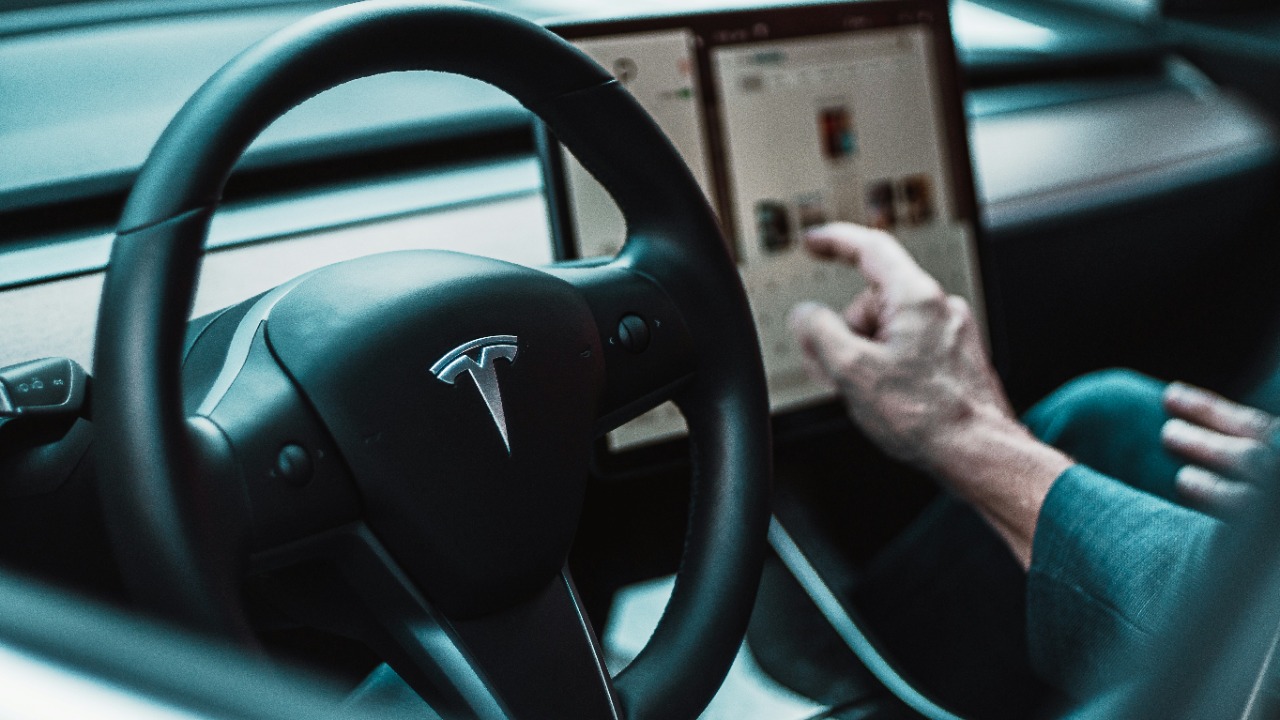

Tesla’s latest Full Self-Driving software is not just edging closer to autonomy, it is starting to convince seasoned AI researchers that it behaves like a person behind the wheel. With FSD v14, NVIDIA robotics chief Jim Fan has argued that Tesla’s system now drives so naturally that he could not tell whether a human or a neural network was in control, a claim that raises the stakes for how we judge machine intelligence on real roads. His praise lands at a moment when Tesla is rapidly rolling out new FSD Supervised builds and reframing the debate over what it means for an AI to “pass” a Turing test in the physical world.
Jim Fan’s bold verdict on Tesla FSD v14
Jim Fan, a senior leader in robotics at NVIDIA, has put his reputation behind a striking assessment of Tesla’s latest driver-assistance stack. After riding with Tesla FSD v14, he described the experience as so smooth and humanlike that he framed it as the first artificial intelligence to pass what he calls a “physical Turing test,” arguing that the system’s behavior on public roads is indistinguishable from that of a competent human driver. In his view, the leap is not just about clever code but about an AI that can navigate messy, real-world traffic with the kind of nuance that used to be reserved for science fiction.
Fan’s endorsement matters because it bridges two worlds that rarely align so cleanly: high performance computing and consumer automotive technology. As the robotics chief at NVIDIA, he works at the heart of the hardware and software stack that powers many modern AI systems, so his declaration that Tesla FSD v14 is the first AI to pass a physical Turing test carries more weight than a casual social media compliment. He is effectively saying that, in the wild, Tesla’s neural networks now behave like a real-world intelligence, a claim that will shape how investors, regulators, and rival engineers judge the company’s progress.
What a “physical Turing test” really means on the road
The original Turing test asked whether a machine could converse so convincingly that a human judge could not tell it apart from a person. Translating that idea to the physical world is far tougher, because driving involves perception, prediction, and split-second control in a chaotic environment. When Jim Fan talks about a physical Turing test, he is arguing that Tesla FSD v14 now operates a vehicle in traffic in a way that, from the passenger seat, feels indistinguishable from a human driver, from lane changes and merges to how it handles awkward four-way stops.
That bar is far higher than simply obeying traffic laws or following a pre-mapped route. It implies an AI that can read subtle cues, anticipate what other drivers and pedestrians will do, and adapt to unstructured situations without obvious robotic hesitation. Fan’s own framing underscores that this is not just corporate hype, describing his declaration that Tesla has passed a physical Turing test as a line where corporate marketing and technological fact begin to blur. If his assessment holds up under broader scrutiny, it would mark a rare moment when an AI system’s behavior in the physical world matches the kind of indistinguishability that has so far been mostly confined to text and images.
How FSD v14 reached this point from the v13 era
To understand why FSD v14 feels so different, it helps to look at where Tesla was with the v13 series. Earlier this year, the company pushed a wide rollout of FSD v13.2.6 to its AI4 fleet of Model S, 3, X, and Y, delivering the update as an OTA Release Notes 2.6 package that focused on scaling the system’s context length by 3x. That change was about giving the neural network more temporal memory, so it could reason over longer stretches of driving history instead of reacting to each frame in isolation. It was a foundational step, but the driving still felt, in many situations, like a cautious robot learning the ropes.
The jump from v13 to v14 is where Tesla’s Full Self-Driving software began to look less like a beta experiment and more like a cohesive driving style. The company’s own documentation and independent analysis describe v14 as a major stride in perception, planning, and control, with Tesla Full Self Driving shifting toward a more end-to-end neural approach that ties camera input directly to steering and acceleration decisions. In practice, that means smoother lane selection, more confident unprotected turns, and fewer abrupt corrections, all of which contribute to the humanlike feel that impressed Fan.
Inside the v14.1 and v14.2 rollout
The refinement of FSD v14 has not been a single switch flip, but a sequence of tightly scoped releases. Version 14.1 arrived alongside a new, more affordable Tesla vehicle, and early users reported that the software handled complex urban scenarios with a level of composure that surprised even long-time beta testers. In a widely shared discussion, one commentator urged investors not to sleep on Tesla Energy or Tesla AI, pointing out that Tesla AI and FSD version 14.1 landed the same day as the new car, a pairing that highlighted how central autonomy has become to Tesla’s broader strategy.
The company then began a limited rollout of FSD v14.2, identified in vehicle software as build 2025.38.9.5, which added a Self-Driving Stats feature so owners could see how often the system was engaged and how many miles it covered. That update, which Tesla started pushing to a subset of cars, was framed in official release notes as a way to give drivers more transparency into how the system behaves over time, with Self Driving Stats turning abstract autonomy claims into concrete usage data. By the time Jim Fan rode in a car running FSD v14, he was seeing the product of this iterative tuning rather than a single monolithic release.
FSD Supervised v14.2.2 and the scale of deployment
Behind the scenes of Fan’s praise is a rapid expansion of Tesla’s FSD Supervised program. The company has been pushing out FSD Supervised 14.2.2 and 14.2.2.1 to a growing share of its fleet, with one tracker noting that build 2025.45.6 had reached 8% of cars and logged 134 installs in a single day. Those figures, listed under FSD Supervised Bug Fixes and All FSD Updates, show how quickly Tesla can propagate a new driving behavior once it is confident in the underlying neural network.
The latest builds are still labeled “Supervised,” a reminder that drivers must keep their hands ready and eyes on the road, but the software’s behavior is edging closer to what many people would intuitively call autonomy. A recent rollout of FSD Supervised v14.2.2 highlighted how Tesla is using over-the-air updates to refine edge cases and improve comfort, with coverage noting that the company is explicitly tying these improvements to the idea of a physical Turing test. One analysis of the update explained that, based on Fan’s comments, Tesla believes it has achieved a form of real world AI today, even if regulators still classify the system as driver assistance rather than full autonomy.
Why Jim Fan’s praise resonates beyond Tesla’s fan base
Endorsements of Tesla’s driving software are nothing new, but Jim Fan’s comments have cut through the usual noise because of who he is and how he framed his experience. As a robotics chief at NVIDIA, he spends his days thinking about how to translate neural network intelligence into physical action, and he has been explicit that moving from digital benchmarks to real-world performance is a vastly different challenge. In one detailed reflection, he noted that, in the physical world, perception errors and control delays can have immediate safety consequences, which is why his assessment that Tesla FSD v14 has crossed a key threshold carries more weight than a typical product review.
Fan’s remarks also landed in the middle of a broader conversation about how to evaluate AI systems that interact with humans in complex environments. One report on his comments emphasized that he sees Tesla FSD v14 as the first AI to pass a physical Turing test, a phrase that has since been picked up and debated across the tech community. Another analysis described how his declaration has stirred up discussion about whether this is primarily a marketing narrative or a genuine technological milestone, noting that his role at NVIDIA gives him a unique vantage point on Tesla FSD and the Physical Turing Test. The fact that his praise is being dissected rather than dismissed suggests that, at minimum, Tesla has forced a serious rethinking of what on-road AI can do.
Humanlike driving, social fluidity, and the limits of rules
Calling FSD v14 “humanlike” is not just about how smoothly it accelerates or how precisely it centers in a lane. It is also about how the system navigates the unwritten rules of the road, the subtle negotiations at four-way stops, merges, and crosswalks that human drivers handle through eye contact, gestures, and intuition. One detailed analysis of Tesla’s progress argued that most AI systems never reach this level of “social fluidity,” noting that Rule-based systems can follow the law but often miss the culture of driving that keeps traffic flowing.
By contrast, FSD v14 appears to be moving toward a style of driving that respects formal rules while also reading the room, so to speak. Reports on the software’s behavior describe it yielding when another driver clearly intends to go first, accepting courteous waves, and handling ambiguous situations without freezing or lurching. That is the kind of behavior that makes passengers forget they are riding with a machine, and it is central to why Jim Fan said he could not tell whether a neural net or a human was driving. If Tesla can consistently deliver that level of social awareness across different cities and cultures, it will have solved a problem that has stumped many autonomy programs.
Global and market implications of a more human FSD
The perception that FSD v14 drives like a person is not just a technical curiosity, it has real commercial and geopolitical implications. In South Korea, for example, Tesla has gained an edge after a cap on United States vehicle imports was removed, opening the door for more Model 3 and Model Y sales equipped with the latest software. Coverage of that shift noted that Tesla Gains Edge South Korea After US Vehicle Import Cap Removed in part because buyers see FSD Supervised v14 as a differentiator, especially in dense urban traffic where humanlike behavior matters most.
At the same time, Tesla’s progress is forcing regulators and competitors to rethink their timelines. If an AI system can convincingly mimic human driving in most conditions, the regulatory question shifts from “Is this safe enough to test?” to “What level of oversight and liability is appropriate when a machine is this capable?” That is a harder conversation, because it touches on insurance, infrastructure, and labor markets for professional drivers. Jim Fan’s framing of FSD v14 as a physical Turing test compresses those debates into a single, provocative question: if you cannot tell the difference from the passenger seat, should the law still treat the system as a mere assistant?
Hype, skepticism, and what comes after v14
For all the excitement around FSD v14, there is still a healthy dose of skepticism about how far Tesla has really gone. Some critics argue that passing a physical Turing test in one city, on one route, with one passenger is not the same as delivering consistent, safe performance across millions of vehicles and billions of miles. Others worry that the language of “real-world AI” and “physical Turing tests” could lull drivers into overtrusting a system that still requires active supervision, especially when the branding emphasizes Full Self Driving even as the interface reminds users to stay alert.
Yet even the skeptics tend to agree that Tesla has crossed an important threshold in how natural its driving feels. The company’s own materials on the jump from v13 to v14 emphasize that Tesla Full Self Driving has taken significant strides in perception and planning, and independent observers have echoed that the driving experience for all users has improved. One detailed breakdown of the upgrade framed it as a Conclusion Tesla Full Self Driving moment, where the system’s behavior finally matches years of ambitious promises. The real test will be what happens with v15 and beyond, as Tesla tries to turn a humanlike driving style into a statistically safer one, and as regulators decide how to classify an AI that, at least to some passengers, already feels indistinguishable from a person at the wheel.
More from MorningOverview