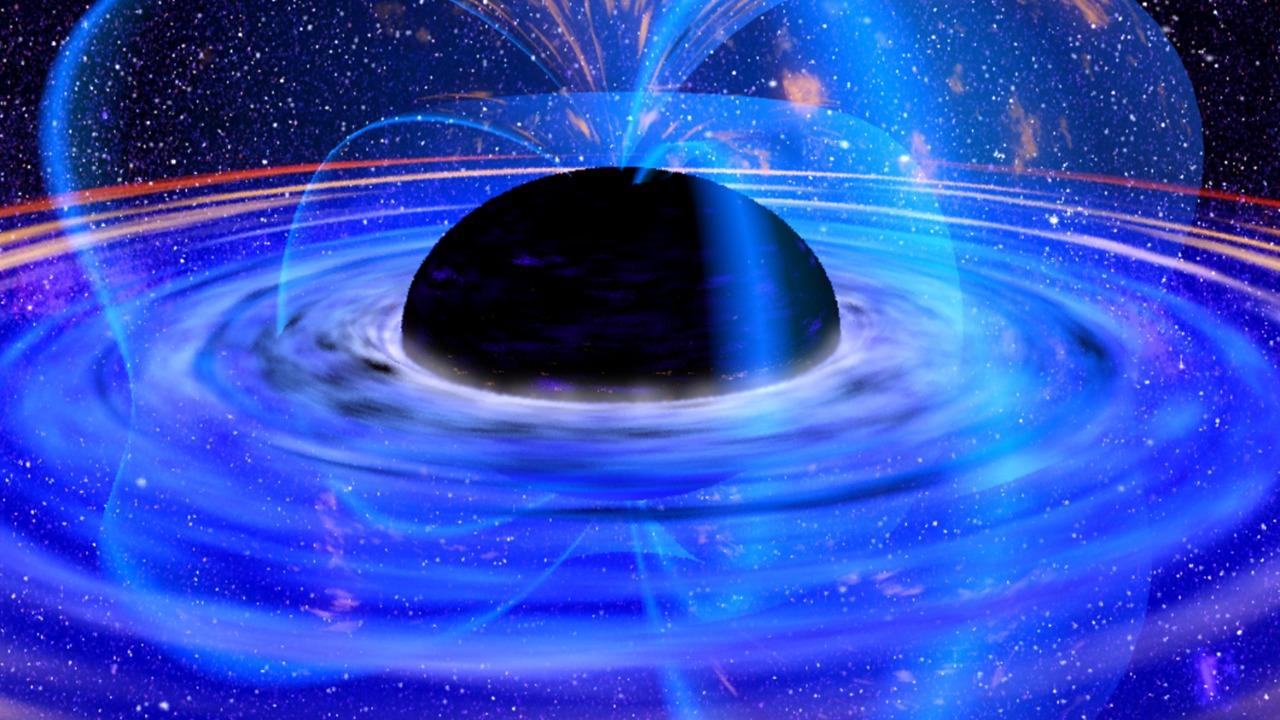

Black hole science in 2025 did not advance in gentle increments. It lurched forward in giant steps, from record shattering collisions to hints of entirely new kinds of objects that blur the line between star and singularity. The year’s most important breakthroughs did more than add exotic entries to astronomy’s record books, they forced researchers to rethink how quickly black holes can grow, how early they appear, and how faithfully they obey the rules of physics.
Ranked from most transformative to merely extraordinary, these are the black hole discoveries that defined 2025, reshaping everything from gravitational wave astronomy to our picture of the infant universe.
1. The heaviest black hole collision ever recorded rewrites merger physics
The most consequential black hole result of the year came from a single, stupendously violent event. Over the summer, detectors picked up a signal dubbed GW231123, a merger so massive that it immediately stood out from the hundreds of previous detections. The colliding objects were black holes far heavier than the typical stellar remnants seen before, and the final merged hole pushed the upper limits of what astronomers thought binary systems could produce, forcing a rethink of how such giants form and pair up in the first place.
Researchers described the instruments that captured GW231123 as “the most sensitive measuring instruments that human beings have ever built,” a reminder of how far gravitational wave technology has come since its debut. The event’s exceptional mass and clarity, reported in detail for GW231123, gave theorists an unprecedented test bed for models of black hole formation in dense star clusters and galactic nuclei. It also set the stage for a broader upgrade in expectations: if such a heavyweight collision can be seen now, even more extreme mergers are likely waiting in the data.
2. LIGO’s most massive binary yet turns a detector into a survey machine
Closely linked to that record collision was another milestone: the confirmation that the Laser Interferometer Gravitational-wave Observatory has become a true black hole census taker. A decade after its first detection, LIGO’s improved sensitivity delivered its most massive binary system to date, again tied to the GW231123 event. The merger’s final black hole was the largest ever spotted through ripples in spacetime, underscoring how upgrades in hardware and analysis have transformed the observatory from a proof of concept into a routine discovery engine.
The signal was strong enough that it was highlighted as a benchmark for the facility’s new era, with the event described as the largest binary black hole merger yet detected with gravitational waves. That result, Announced in connection with the California Institute of Technology, cemented LIGO’s status as a long term survey instrument rather than a one off experiment. A separate retrospective on the observatory’s first ten years framed this discovery as the clearest example of how LIGO has evolved into a black hole hunting machine, capable of catching ever rarer and more massive mergers that were once purely theoretical.
3. Hawking’s area theorem passes its sharpest test yet
If the massive merger set new records for size, its theoretical impact was even deeper. Physicists used the clean gravitational wave signal from colliding black holes to test one of Stephen Hawking’s most famous predictions: that the total surface area of black hole horizons can never decrease. By carefully reconstructing the sizes of the two original horizons and the final merged one, they found that the area after the collision was larger, just as Hawking’s mathematics demanded.
One senior theorist remarked that “If Hawking were alive, he would have reveled in seeing the area of the merged black holes increase,” capturing how emotionally charged it was to see a decades old idea confirmed so precisely. The analysis showed that the horizon area grew exactly as predicted by detailed models, providing the most stringent observational support yet that black holes obey a kind of thermodynamic law. The result, described in depth in a study of how If Hawking was right about area growth, dovetailed with a separate report on the Clearest signal yet from colliding black holes, which emphasized that the confirmation of Hawking’s area theorem now rests on the most precise data set available.
4. A 36 billion solar mass “sleeping giant” reshapes the upper limit
On the cosmic scales of mass, 2025 will be remembered as the year astronomers pushed the known size of black holes to a staggering new extreme. Using gravitational lensing, They, the Researchers, identified an ultramassive object whose gravity bends light from a background galaxy into a distorted arc. By modeling that distortion, the team inferred a black hole so heavy it ranks among the largest ever found, a result that immediately raised questions about how such a monster could have grown.
The same system was analyzed in detail in work on the New research into the Cosmic Horseshoe, which revealed an Ultra Massive Black Hole, or UMBH, with a staggering 36 billion solar masses at its center. A separate report framed the find as one of the biggest black holes ever, explaining that They, the Researchers, used a technique called gravitational lensing to weigh the invisible giant. Another account described how “We detected the effect of the black hole in two ways,” detailing how its gravity alters the path of light as it travels past the object, and confirming that the new black hole is 36 billion times bigger than the Sun through careful modeling of those distortions in We detected the effect of the black hole.
The discovery quickly spilled beyond technical journals into popular coverage, where it was described as a 36 BILLION SOLAR MASS BLACK HOLE DETECTED thanks to gravitational lensing, complete with an illustration of the giant lurking in a distant galaxy cluster. That phrasing, preserved in an BILLION SOLAR MASS BLACK HOLE DETECTED graphic, captured the public imagination precisely because it sounded almost implausible. Another account described the same object as a Sleeping giant, emphasizing that this black hole is considered dormant, not actively feeding on material and therefore difficult to spot with traditional X ray surveys that rely on high energy signals, a point underscored in the description of the Sleeping giant.
5. A quasar’s “tremendous growth” exposes a mystery from 12.8 billion light years away
While the Sleeping giant shows what black holes can become, another 2025 breakthrough highlighted how quickly they can get started. Astronomers using X ray data focused on a quasar located 12.8 billion light years from Earth, catching a supermassive black hole in the act of rapid growth less than a billion years after the Big Bang. The object’s brightness and inferred mass suggest it has been gorging on surrounding gas at an extraordinary rate, challenging simple models of slow, steady accretion.
The observation was presented with a detailed Visual Description of the quasar, which appears as a bright point surrounded by swirling material as the camera moves closer and exits the image, emphasizing just how compact yet powerful the central engine is. The fact that this system sits 12.8 billion light years from Visual Description Earth means we are seeing it as it was when the universe was still in its infancy. A companion “Quick Look” video stressed that this supermassive black hole is seen less than a billion years after the Big Bang, and that NASA’s Chandra X ray Observatory captured the data needed to infer its tremendous growth, making the Big Bang era quasar one of the clearest examples yet of early, overgrown black holes.
6. Oldest and strangest: red dots, black hole stars and the earliest quasars
Beyond individual showpieces, 2025 brought a flurry of results that collectively deepened the puzzle of how early black holes formed. One study focused on mysterious “red dots” in the early universe, compact sources whose colors and brightness did not match ordinary galaxies. Now, in a paper in Astronomy and Astrophysics, researchers proposed that these could be atmospheres of “black hole stars,” exotic objects where a nascent black hole is cocooned inside a massive stellar envelope, offering a new pathway to create heavy seeds very quickly.
The idea that such black hole star atmospheres might explain the red dots was laid out in detail in a report that explicitly linked the phenomenon to the journal Astronomy and Astrophysics, noting that the work appeared in Now Astronomy and Astrophysics. At the same time, observations of the oldest black hole ever observed pushed the timeline for supermassive growth even closer to the cosmic dawn. Maiolino and his team are hoping to use future observations from JWST, the James Webb Space Telescope, to find smaller black holes at similar epochs and determine whether these giants start out large or grow fast, a strategy described in detail in the account of how Maiolino and his team plan to probe the earliest quasars.
7. Cosmic explosions “unlike any we’ve ever seen” reveal black hole tantrums
Not all of 2025’s black hole breakthroughs were about mass and age; some were about sheer spectacle. Astronomers reported a Mysterious cosmic explosion that could not be easily explained, a blast described as unlike any we have ever seen and among the most powerful since the Big Bang. The event’s energy output and unusual light curve suggested a black hole at its most active moment, possibly tearing apart a star or swallowing dense material in a way that defied standard categories of supernovae and gamma ray bursts.
The same theme of extreme behavior surfaced again in a separate report of a record breaking black hole eruption. In that case, a supermassive black hole appears to have generated a flare brighter than 10 trillion Suns after gobbling a star at least 30 times more massive than the Sun, an outburst that pushed tidal disruption events into new territory. The findings, reported in Nov, showed that the black hole’s eruption was unlike any we have ever seen in terms of brightness and duration, and that the devoured star’s mass was carefully estimated to be at least 30 times the mass of the Sun, details that were highlighted in the description of the Mysterious explosion and the follow up account of an eruption Unlike any we have ever seen.
8. Early universe overachievers and the hunt for missing growth channels
As more of these extreme objects turned up, a broader pattern came into focus: the universe seems to have produced oversized black holes far earlier than simple models allow. Surveys of distant quasars and galaxies revealed supermassive black holes from the infancy of the universe that are bigger than they ought to be, given the limited time available for them to “eat” enough material to grow that large. This mismatch between theory and observation has become one of the central puzzles in high energy astrophysics.
One synthesis of recent work put it bluntly, noting that Thus, there are supermassive black holes from the early universe that defy standard growth scenarios, and that astronomers are now exploring alternatives such as direct collapse of massive gas clouds or rapid mergers of smaller seeds. That perspective, laid out in a discussion of how scientists are finding more mysterious black holes and trying to solve the early universe puzzle, underscored that the problem is not a single outlier but a population level trend, as described in the analysis that begins with Thus there are supermassive black holes from the infancy of the universe.
9. Gravitational waves go global, and exotic tests of relativity follow
Behind the headline grabbing events, 2025 also marked a strategic shift in how the world listens for black holes. In one notable move, China unveiled 3 gravitational wave experiments after a major discovery, signaling its intention to become a central player in the hunt for spacetime ripples. The planned facilities, described in a report that opened with “China unveils 3 gravitational wave experiments after discovery,” are designed to complement existing detectors and extend coverage to new frequency bands, a step that could reveal mergers and cosmic events currently out of reach.
The same report tucked this announcement alongside a section labeled You May Also Like You May Also Like More Northern Light, a reminder that gravitational wave science is now mainstream enough to sit next to aurora photography in public interest. On the analysis side, theorists seized on a Record Breaking Gravitational Wave Detection Suggests These Black Holes Merged Before, using the detailed waveform to test Einstein’s relativity and search for hypothetical particles that might subtly alter the signal. That study, which carried a promotional line about a 40% OFF OFFER, Ends Dec 31st, 2025, nonetheless delivered serious physics by examining whether the merging black holes had previous encounters and whether any deviations from general relativity could be seen, as outlined in the work titled Record Breaking Gravitational Wave Detection Suggests These Black Holes Merged Before.
10. A year that made black holes central to the cosmic story
Individually, any one of these results would have made 2025 a strong year for black hole science. Taken together, they amount to a wholesale reframing of how central these objects are to the universe’s history. A year in review from Dec highlighted how Caltech scientists continued to inspect the exotic nature of black holes, objects so dense that not even light can escape, and emphasized that some of the systems under study weigh billions of times the mass of our Sun, a scale that matches the ultramassive discoveries elsewhere in the literature. That same overview noted that these efforts span everything from theoretical modeling to direct observation, reflecting how deeply black holes are woven into modern astrophysics, as described in the summary of how Caltech scientists continued to inspect these exotic objects.
Popular roundups of the year’s space science echoed that sense of a turning point. One podcast on 9 space discoveries of 2025 that shocked astronomers noted that 2025 delivered some of the most astonishing space discoveries ever recorded, including black hole findings that challenged long held scientific beliefs and revealed a billion scale gulf between expectation and reality. Another video on major scientific discoveries about other galaxies revisited a very exciting galaxy first spotted in 2015, then updated the story with new evidence of an active central black hole, showing how archival data and fresh analysis can combine to produce breakthroughs, as highlighted in the discussion of 2025 delivered astonishing discoveries and the separate look at Major Scientific Discoveries About Other Galaxies. Even detailed photo releases, such as the artist’s illustration of the quasar named RACS J0320-35 located about 12.8 billion light years away and seen 920 million years after the big bang, reinforced how often black holes now sit at the center of the most striking cosmic images, as shown in the RACS J0320-35 photo album.
More from MorningOverview