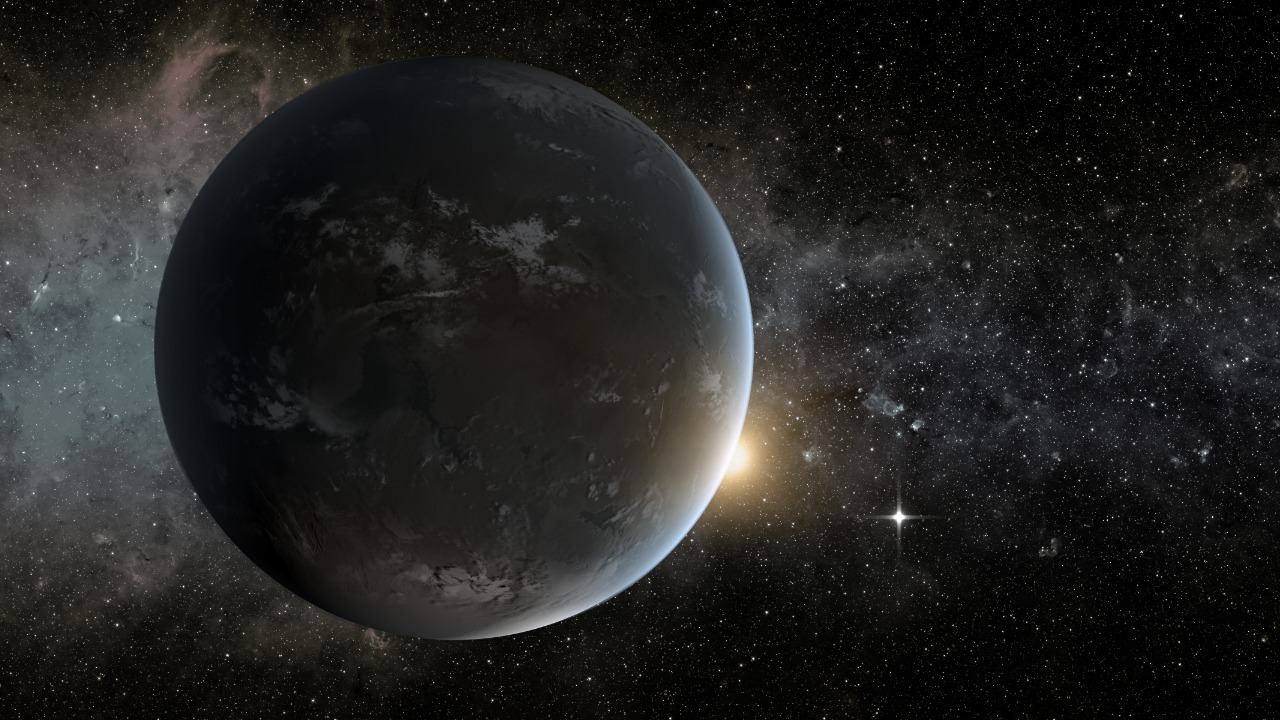

An ancient rocky world so close to its star that its surface is largely molten should have been stripped bare of gas long ago. Instead, new observations reveal that this ultra-hot planet has somehow preserved a thick atmosphere for billions of years, forcing astronomers to rethink how small, scorched planets evolve and what kinds of environments might exist beyond our Solar System.
The discovery turns a supposed rule of thumb on its head: worlds that hug their stars were expected to be airless cinders, not shrouded in dense envelopes of gas. By showing that even a lava-covered planet can cling to an atmosphere against all odds, the finding opens a fresh window on how rock, magma and gas interact on extreme exoplanets and, by extension, on how atmospheres may have behaved in the early history of Earth and its neighbors.
A lava world that should not have an atmosphere
The planet at the center of this puzzle orbits so close to its parent star that its surface is thought to be an ocean of molten rock. It belongs to a rare class of ultra-short-period worlds that complete an orbit in less than a day, with one report describing a similar molten rocky exoplanet circling its star in under 11 hours, a regime where theory long suggested that such planets cannot maintain atmospheres because stellar radiation and winds efficiently blow their gases away. In this environment, any volatile molecules should be blasted into space faster than they can be replenished, leaving behind a bare, incandescent rock.
Instead, multiple teams now see strong signs of a substantial gaseous envelope around this kind of world, including the planet known as TOI-561 b, which is identified as an ultra-hot rocky planet in new Webb observations. One analysis describes an ultra-hot exoplanet just 1.6 m kilometers from its star that has managed to retain a thick atmosphere for billions of years, a configuration that should have been impossible under earlier models of atmospheric escape. The very existence of such a world forces a reassessment of how radiation, gravity and planetary interiors trade energy and material over cosmic time.
Webb’s hidden-atmosphere breakthrough
The turning point came when the James Webb Space Telescope, designed to read the faint fingerprints of molecules in distant starlight, turned its instruments on this molten super-Earth. By watching the planet slip behind and in front of its star and measuring tiny changes in the combined light, researchers inferred that the world is not a naked ball of magma but is instead cloaked in gas that absorbs and re-emits heat. In one study, the new data are described as the Strongest evidence yet for an atmosphere on a rocky planet outside our Solar System, a thick blanket of gases above a molten surface that reflects and redistributes starlight.
Another report characterizes Webb’s latest observations as revealing a hellish world cloaked in an unexpected atmosphere, explicitly identifying TOI–561 b as the target. If TOI-561 b is a bare rock with no atmosphere to carry heat around to the nightside, its dayside temperature should be far higher than what Webb actually measured, which implies that gases are transporting energy and perhaps even raining molten material back into the interior. That mismatch between expected and observed temperatures is what convinced many astronomers that they were seeing a real, persistent atmosphere rather than a transient cloud of vapor.
Why theory said this atmosphere should be gone
Before these observations, the standard picture for ultra-short-period rocky planets was bleak. Bathed in intense stellar radiation, such worlds were expected to lose any primordial hydrogen and helium in their first few hundred million years, then gradually erode heavier molecules as well. One analysis of molten rocky exoplanets with orbits of less than 11 hours argued that planets this close to their stars cannot maintain atmospheres, because the energy input is simply too high for gravity to hold on to the gas, especially for relatively small bodies. In that framework, a lava world hugging its star should resemble Mercury on steroids, with a thin exosphere at best.
That expectation is echoed in commentary that, based on what we know about other systems, astronomers would have predicted that a planet like this is too small and hot to sustain a thick atmosphere. A report on an ultra-hot lava world with a thick atmosphere notes that this finding upends expectations and quotes the view that, Based on prior models, such a planet should have been stripped to its rocky core. The new data therefore do not just fill in a missing detail, they directly contradict a widely used set of assumptions about how atmospheres behave under extreme irradiation.
Clues from temperature patterns and heat transport
The key to diagnosing an atmosphere on a world we cannot see directly lies in its temperature map. If a planet like TOI-561 b had no air, the side facing the star would be blisteringly hot while the nightside would be much cooler, with a sharp contrast between the two. Instead, Webb’s measurements show a more modest difference, which implies that winds or circulation are carrying heat from day to night. One study notes that if TOI-561 b is a bare rock with no atmosphere to carry heat around to the nightside, its dayside temperature should be much higher than observed, and that discrepancy is a strong indicator of a gaseous envelope.
Researchers also see hints that the atmosphere is not just passively moving heat but is actively interacting with the molten surface. One report describes how gases may be evaporating from the magma ocean on the dayside, then condensing and raining back into the interior on the cooler nightside, effectively cycling rock between surface and sky. In a separate analysis, scientists describe Webb’s detection of a hidden atmosphere on a molten super-Earth as revealing a hellish world cloaked in an unexpected atmosphere, with Webb data suggesting that this circulation helps the planet redistribute energy and perhaps stabilize its atmospheric blanket over long timescales.
What the atmosphere might be made of
Knowing that an atmosphere exists is only the first step; the next challenge is to infer what it contains. For a world with a molten surface, the most likely gases are not the nitrogen and oxygen familiar from Earth but vapors of rock-forming elements and compounds. Some analyses suggest that the atmosphere of a lava planet like TOI-561 b could be dominated by species evaporated from silicate magma, such as sodium, silicon monoxide and other metal-rich molecules, mixed with heavier volatiles that have survived the planet’s violent youth. The presence of a thick blanket of gases above a molten surface, described as the Strongest evidence yet for such an atmosphere, points to a complex chemical stew rather than a simple hydrogen shell.
Webb’s infrared instruments are sensitive to specific molecular fingerprints, and early interpretations hint that the gases may be enriched in heavier elements compared with the host star. One report on NASA’s flagship observatory notes that NASA‘s James Webb Space Telescope Has Discovered an Impossible Atmosphere Around a Magma-covered world that standard models said should be incapable of sustaining atmospheres, which implies that heavier, more tightly bound molecules are doing the work of holding the air in place. As spectroscopic analyses improve, astronomers expect to pin down the exact mix of rock vapor and volatile gases that make this atmosphere so resilient.
Lessons from 55 Cancri e and other lava planets
The molten super-Earth TOI-561 b is not the only extreme world challenging assumptions about rocky exoplanets. Another famous lava planet, 55 Cancri e, orbits a Sun-like star in the constellation Cancer and has long intrigued astronomers as a possible world with an ocean of magma. According to one detailed description, 55 Cancri e is about eight times the mass of Earth and close to two times as wide, placing it firmly in the “super-Earth” category. For years, scientists debated whether it had any atmosphere at all or whether its surface was a bare, glowing sea of rock.
Newer observations have tipped the balance toward a substantial gaseous envelope. One study notes that the latest data, published in Nature, focus on the planet 55 Cancri e and find signs of a thick atmosphere around this rocky exoplanet, again in defiance of earlier expectations that such close-in worlds should be airless. Together with TOI-561 b, 55 Cancri e forms a small but growing class of lava planets that appear to have held on to their gases, suggesting that the processes at work are not unique to a single system but may be a common outcome of planet formation and evolution in harsh environments.
How JWST rewrote the rulebook on rocky exoplanet atmospheres
Behind these breakthroughs is a revolution in observational capability. The James Webb Space Telescope was built to study the early universe and the atmospheres of giant exoplanets, but it has turned out to be equally transformative for small, rocky worlds. By capturing exquisitely precise spectra during planetary transits and eclipses, Webb can tease out the signatures of molecules even when the planet itself is too small and faint to see directly. One report describes how Webb’s latest observations reveal a hellish world cloaked in an unexpected atmosphere, with This Blazing Exoplanet Breaks All the Rules about Alien Atmospheres, with JWST providing the sensitivity needed to detect them.
Another analysis emphasizes that researchers suspected the planet might be more than a bare ball of magma because of its unusually low density, and that the team is confident that the observed heat distribution requires an atmosphere to spread the heat around. In that account, scientists explain that they are using Webb’s data to probe the origins of our own air by comparing Earth’s history with what they see on this lava world, with one report noting that But researchers suspected the planet might be more than a bare ball of magma because of its density and are confident that an atmosphere is present to spread the heat around. In effect, Webb has given astronomers their first clear look at the atmospheric physics of rocky exoplanets in regimes that were previously accessible only in computer simulations.
Rethinking planetary evolution and habitability
For me, the most striking implication of this work is what it says about the resilience and diversity of planetary atmospheres. If a world just 1.6 m kilometers from its star can hold on to a thick atmosphere for billions of years, then the boundary between “habitable” and “uninhabitable” may be more nuanced than a simple distance line. No one expects life in a magma ocean, but the same physical processes that stabilize an atmosphere in such an extreme environment, such as rock vapor cycles and interior outgassing, could also help more temperate planets maintain their air over geological timescales. The discovery therefore feeds directly into broader efforts to understand which exoplanets might be able to support liquid water and, eventually, biology.
These results also force a re-evaluation of how rocky planets cool and differentiate. If gases can be continually exchanged between a molten surface and an atmosphere, then the composition of both the crust and the air can evolve in tandem, potentially leading to exotic chemistries that have no analog in our Solar System. One report on an ultra-hot lava world with a thick atmosphere notes that the same minerals that make up Earth’s interior rocks may be vaporized and cycled through the air on these planets, as highlighted in the analysis that begins with Based on what we know about other systems. In that sense, the ancient molten exoplanet that keeps its atmosphere against all odds is not just a curiosity, it is a laboratory for testing ideas about how planets, including our own, became the worlds we see today.
Supporting sources: Scientists Find the Strongest Evidence Yet of an Atmosphere on a Molten Rocky….
More from MorningOverview