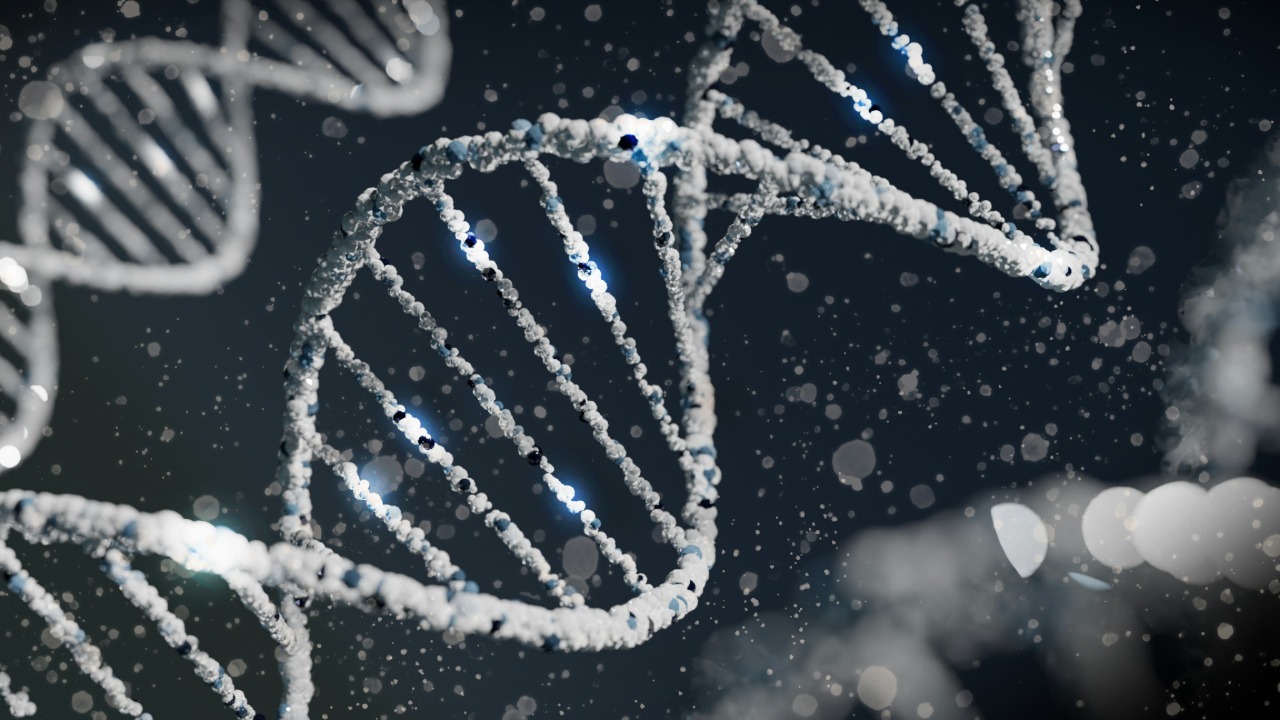

Artificial intelligence has just redrawn the map of our genome’s control room, revealing hundreds of thousands of tiny DNA knots that behave less like static quirks and more like hidden switches. Instead of the familiar tidy double helix, the new work shows a genome crowded with intricate tangles that quietly influence which genes turn on, which stay silent, and when those decisions go wrong in disease. I see this as a shift from reading DNA as a linear code to treating it as a dynamic 3D machine, with AI finally precise enough to track the moving parts.
At the heart of the discovery is a catalog of roughly 360,000 unusual DNA structures that form when the molecule folds into compact quadruple-stranded knots rather than the classic ladder. These structures, long suspected but hard to see, now look like a missing layer of gene regulation that could help explain why the same genetic sequence behaves so differently from one cell type to another. For cancer researchers and drug developers, that is not just a curiosity, it is a new set of levers to pull.
From textbook helix to crowded knotwork
Most of us were taught a simple picture in school: DNA as a neat, uniform double helix that stores instructions while proteins and RNA do the real regulatory work. That image was always an oversimplification, but the new AI driven maps make it look almost misleading, because they show how frequently the molecule abandons that tidy form to twist into compact knots and loops that change how genes behave. I find it helpful to think of the genome less as a straight string of letters and more as a densely packed city skyline, where shape and proximity matter as much as the underlying blueprint.
These knots include so called quadruplex structures, where four strands of DNA stack together instead of two, creating stable, boxy shapes that can stall or attract the molecular machines that read genes. The latest work identifies around 360,000 of these DNA quadruplex patterns across the genome, a scale that turns them from rare curiosities into a pervasive regulatory layer. Scientists now argue that these structures do not act alone but cluster and interact, forming networks that help coordinate when genes switch on and off in normal cells and in cancer.
How AI learned to see DNA’s hidden shapes
For years, the main obstacle to understanding these structures was not lack of interest but lack of visibility, because conventional sequencing flattens DNA into a linear readout that erases its 3D folds. AI changes that by learning to recognize the subtle signatures of knots and quadruplexes in experimental data, then extrapolating where similar shapes are likely to form across the genome. In practice, that means training models on a mix of biochemical assays and high resolution images until they can spot patterns that human analysts would miss or take months to annotate.
One striking example pairs machine learning with high resolution Atomic Force Microscopy so that algorithms can scan physical images of DNA and classify tangled regions in seconds rather than hours. In community discussions of this work, researchers have highlighted how AI can now map tangled DNA knots in seconds, using those microscopy images as ground truth to refine predictions. I see this as a feedback loop: the better the images, the smarter the models become, and the smarter the models, the more efficiently scientists can decide which regions to image next.
Microscopes, nanometers, and the new genome cartography
AI alone cannot rewrite biology, it needs precise measurements to learn from, and that is where advanced microscopy comes in. By combining machine learning with instruments that can resolve structures at the scale of a nanometer, or one billionth of a metre, researchers can finally match computational predictions to physical reality. That level of detail matters because quadruplexes and related knots are tiny even by molecular standards, and their regulatory impact often depends on exactly how they sit relative to nearby genes and proteins.
Teams working with high resolution imaging at the University of Sheffield have shown how AI can sift through vast microscopy datasets to pick out tangled DNA structures with nanometer precision. Instead of manually tracing each knot, models learn to recognize characteristic shapes and textures, then flag likely quadruplexes and other non canonical forms for closer study. In my view, this is what turns DNA structure mapping from a boutique experiment into a scalable survey of the entire genome.
Quadruplexes as quiet gene switches
Once you can see where these knots form, the next question is what they do, and the emerging answer is that many behave like subtle switches that tune gene activity up or down. When a quadruplex forms near a gene’s promoter, it can block the transcription machinery from binding, effectively dimming that gene, while in other contexts it can create a landing pad for regulatory proteins that enhance expression. The AI generated atlas of quadruplex locations shows that these structures are enriched near key regulatory regions, which supports the idea that they are not random accidents but part of the genome’s control logic.
What makes them “quiet” is that they do not change the underlying DNA sequence, so traditional genetic tests that look for mutations would miss their influence entirely. Instead, they add an extra layer of control on top of epigenetic marks like methylation, shaping when and where genes respond to signals. I see this as a partial answer to a long standing puzzle in biology, namely why cells with identical DNA can behave so differently in development, immunity, or cancer, and why some disease associated regions in the genome look normal at the sequence level but abnormal in their structural behavior.
Cancer, stalled replication, and therapeutic targets
The stakes become clearest in cancer, where uncontrolled growth often traces back to misregulated genes and broken checkpoints in DNA replication. Quadruplexes can stall the replication machinery when they form in the wrong place or at the wrong time, creating stress that leads to mutations or chromosome breaks, which in turn fuel tumor evolution. AI based maps that pinpoint where these structures cluster in cancer relevant regions give researchers a way to connect specific knots to specific vulnerabilities in tumor cells.
Drug developers are already exploring small molecules that bind selectively to quadruplexes, stabilizing them in some contexts to shut down oncogenes or destabilizing them in others to relieve harmful replication blocks. With a catalog of around 360,000 candidate sites, the challenge shifts from finding any quadruplex to choosing which ones matter most for a given cancer type or patient. I think AI will be central here as well, ranking targets based on how strongly their structural state correlates with gene expression changes, cell survival, or response to existing therapies.
Beyond cancer: neurological and immune implications
Although cancer dominates the early discussion, the same structural logic likely extends into neurological and immune disorders where gene regulation is exquisitely sensitive. Neurons, for example, rely on finely tuned expression of synaptic genes, and even modest shifts in timing or dosage can contribute to conditions like epilepsy or neurodegeneration. If quadruplexes and related knots form preferentially in long genes or repetitive regions that are common in the brain, they could help explain why some loci are particularly fragile or variable across individuals.
In the immune system, rapid bursts of gene activation are essential for responding to infection, and structural features that can be flipped quickly between open and closed states would be valuable control points. AI driven structural maps could reveal whether certain cytokine genes or antibody loci are bracketed by dynamic knots that act as brakes or accelerators. I see a future where clinicians interpret not just which genes are mutated or methylated in a patient’s cells, but also which structural hotspots are unusually stable or unstable, adding a new dimension to precision medicine.
Why speed matters: from months of analysis to seconds
One of the most transformative aspects of using AI in this space is not just accuracy but speed, because structural genomics has historically been painfully slow. Manually analyzing high resolution images or complex biochemical readouts for a single region could take days, and scaling that to the whole genome was effectively impossible. With trained models, the same classification and mapping can happen in seconds, turning what used to be a bottleneck into a routine step in experimental workflows.
In practical terms, that speed lets scientists iterate: they can test how a drug, a mutation, or a change in cellular conditions reshapes the knot landscape, then feed those results back into the model to refine predictions. When I look at the reports of AI systems that map tangled DNA knots in seconds using Atomic Force Microscopy data, I see a template for similar accelerations in other structural assays. The faster we can close the loop between hypothesis, experiment, and structural readout, the more quickly we can move from descriptive maps to actionable interventions.
Rethinking what “genetic information” means
All of this forces a broader conceptual shift in how I think about genetic information itself. For decades, the focus has been on sequence, the order of bases that encode proteins and regulatory motifs, with structure treated as a secondary consequence. The new AI enabled maps argue that structure is not just a byproduct but a parallel code, one that uses folding patterns, knots, and local stiffness to encode when and where the linear code is read.
That perspective has practical consequences for everything from basic research to consumer genomics. A standard whole genome sequence might tell you whether you carry a particular mutation, but it says nothing about whether your DNA is prone to forming quadruplexes at critical sites or whether those structures are unusually stable in your cells. As structural data becomes more accessible, I expect to see new diagnostic categories that treat “structural variants” in folding behavior as seriously as sequence variants, especially in diseases where conventional genetics has struggled to explain risk.
AI as collaborator, not oracle, in molecular biology
It is tempting to treat these AI systems as black box oracles that simply reveal hidden truths about DNA, but the reality is more collaborative and more fragile. Models are only as good as the data they are trained on, and biases in which regions are imaged, which cell types are studied, or which experimental conditions are used can all skew the resulting maps. I see a responsibility on the part of researchers to treat AI predictions as hypotheses that need experimental validation, not as final answers, especially when they inform drug development or clinical decisions.
At the same time, the partnership between AI and experimental tools like nanometer scale microscopy is already expanding what is thinkable in genome biology. By offloading pattern recognition and large scale mapping to algorithms, scientists can focus on designing sharper experiments and asking more ambitious questions about how structure and function intertwine. If the first wave of work has uncovered around 360,000 DNA knots that quietly steer gene activity, the next wave will likely probe how those structures change over time, differ between individuals, and respond to therapies, turning a static atlas into a dynamic movie of the living genome.
More from MorningOverview