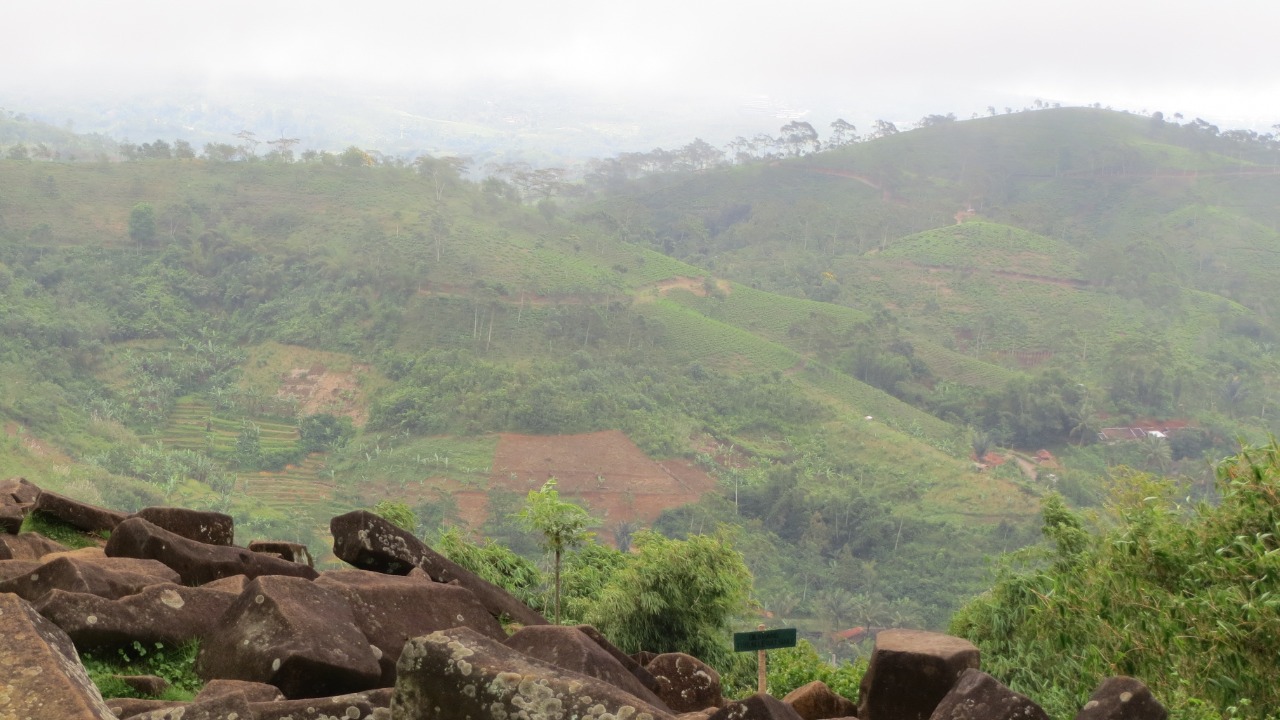

Claims that a “world’s oldest pyramid” has been found in Indonesia have raced around social media, promising a 25,000-year monument that would rewrite everything we think we know about civilization. The story is gripping, but the core claim that this site is a manmade pyramid from the Ice Age does not survive contact with the evidence. When I trace the research, the counterarguments, and the geology, the picture that emerges is far more grounded: an intriguing ancient hilltop sanctuary, not a lost super-civilization.
The site at the center of the storm, Gunung Padang in West Java, Indonesia, is real, important and genuinely mysterious in places, but the “oldest pyramid” label rests on contested interpretations rather than hard proof of construction at 25,000 years ago. Archaeologists and geologists who have looked closely at the data say the deep layers are natural rock, with human activity confined to much later periods, long after agriculture began. The result is a cautionary tale about how extraordinary claims can outpace the science that is supposed to support them.
How a quiet Indonesian hill became a viral ‘Ice Age pyramid’
Gunung Padang sits on a ridge in West Java, Indonesia, a terraced hill crowned with megalithic stones that have drawn local reverence for generations. Long before it became a click-friendly “mystery,” the site was known to Indonesian researchers as a ceremonial complex, with stone arrangements and stairways that suggest ritual use rather than a hidden city. The terraces and upright blocks are striking, but at first glance they look more like a stepped sanctuary built on a natural hill than a geometric pyramid in the Egyptian sense.
The leap from regional heritage site to global sensation came when a group of researchers argued that the hill concealed a colossal manmade structure tens of meters deep. Their work, framed around a “25,000-Year-Old Pyramid” that “Is Older” than anything in Egypt and that “Scientists Say It Was Not Built” in the way mainstream archaeology assumes, implied that an advanced culture was shaping stone here during the last Ice Age. That framing, amplified online, turned Gunung Padang into a magnet for speculation about lost civilizations and ancient engineers.
The bold paper that claimed a 25,000-year monument
The scientific spark for the current controversy was a paper in the journal Archeological Prospection that asked, in effect, “Could Gunung Padang Be the World’s Oldest Pyramid?” The authors argued that geophysical surveys and core samples revealed multiple construction phases, with the deepest layers allegedly dating back around 25,000 years. They described a sequence in which natural rock was supposedly reshaped and then covered by later stonework, building up a hidden, tiered monument beneath the visible terraces.
In that paper, the team suggested that the subsurface features, including what they interpreted as walls and chambers, pointed to deliberate engineering rather than random geology. They linked these interpretations to radiocarbon dates from organic material in the cores, using those numbers to push the origin of the structure deep into the late Pleistocene. The claim that this could be the “World, Oldest Pyramid” was presented as a serious possibility, and the association with Archeological Prospection gave the argument a veneer of peer-reviewed legitimacy that helped it spread far beyond academic circles.
What the ‘25,000-Year-Old Pyramid’ story actually says
Once the paper was public, popular coverage leaned heavily into the most dramatic angle, describing a “25,000-Year-Old Pyramid” that “Is Older” than the monuments of Egypt and hinting that “Scientists Say It Was Not Built” by any civilization we currently recognize. Some accounts framed the site as evidence that humans, or perhaps some other intelligence, were shaping massive stone structures long before the Neolithic revolution. The language blurred the line between cautious hypothesis and established fact, turning a speculative reading of data into a headline-ready revelation.
When I look closely at those reports, however, the scientific core is more modest and much more uncertain. The radiocarbon dates come from organic material in soil and cracks, not from carved blocks or mortar that can be tied directly to construction. The suggestion that the deepest layers represent deliberate building is an interpretation layered on top of those dates, not a direct measurement. Even sympathetic summaries of the “25,000-Year-Old” claim acknowledge that archaeologists “may” be dealing with something unusual rather than a proven Ice Age pyramid, and that the phrase “Scientists Say It Was Not Built” reflects a contested reading of the evidence rather than a consensus.
Geology versus masonry: why many experts see a natural hill
As the “oldest pyramid” narrative spread, geologists and archaeologists who specialize in ancient stonework began to push back. Their central point is straightforward: the deep interior of Gunung Padang looks like weathered volcanic rock, not like blocks that have been quarried, shaped and stacked. The columnar formations that some interpret as walls or chambers can form naturally when lava cools and fractures, producing regular, pillar-like structures that can easily be mistaken for masonry by a non-specialist eye.
One UK archaeologist, Flint Dibble from Cardiff University, has been particularly blunt, arguing that the supposed builders who “must have possessed remarkable masonry capabilities” are a mirage because the underlying formation does not show the tool marks, joints or construction patterns that a true pyramid would require. In his view, the regular shapes are a geological pattern, and the burden of proof lies with those who insist “that it’s man-made” despite the lack of clear architectural features. That critique is echoed by other specialists who note that extraordinary claims about Ice Age engineering demand equally extraordinary evidence, which has not yet materialized.
What the dating really shows about Gunung Padang
The age question sits at the heart of the debate, and here the details matter. Radiocarbon dating can tell us when organic material, such as charcoal or plant remains, stopped exchanging carbon with the atmosphere, but it cannot by itself prove when stones were cut or stacked. At Gunung Padang, the oldest dates come from material buried within or beneath natural rock layers, which could have been deposited long before any human touched the hill. Using those numbers to date a supposed construction phase assumes that the rock around them was being shaped by people at the same time, an assumption that critics say is not justified.
Other research on the site paints a more conventional timeline. One analysis cited in discussions of the “25,000-year-old pyramid” notes that the visible terraces and stone arrangements were completed between roughly 2000 and 1100 BC, a range that fits comfortably within the Bronze Age. In that reading, the hill itself is a much older volcanic feature, while the human activity is confined to the surface and near-surface layers, where people rearranged existing stones into platforms, stairways and ritual spaces. The deeper radiocarbon dates then record the natural history of the hill, not a hidden Ice Age construction project.
How Indonesian and international teams describe the site
Indonesian researchers who have worked at Gunung Padang for years tend to describe it as a megalithic complex built on a pre-existing hill, with multiple phases of use and modification. They point to the arrangement of upright stones, the orientation of terraces and the presence of steps as evidence of deliberate design in the upper layers. At the same time, they acknowledge that the core of the hill is volcanic, and that the line between natural formation and human enhancement can be blurry when people are working with columnar basalt that already looks like stacked blocks.
International teams that have visited or reviewed the data often reach similar conclusions, even when they disagree on details. A report that framed the site as a “25,000 years old pyramid” noted that recent research proposes the megalithic site of Gunung Padang in West Java, Indonesia, “may not be a natural formation” in its uppermost layers, but also emphasized that the more “advanced construction started after agriculture.” That phrasing implicitly places the major building phases within the Holocene, after farming had taken root, rather than in a deep Pleistocene past. In other words, the hill is ancient, but the recognizable architecture appears to be relatively young by geological standards.
The online echo chamber and ‘High Strangeness’ framing
Once the “world’s oldest pyramid” label hit social platforms, the story took on a life of its own. In communities that focus on anomalies and fringe history, Gunung Padang was quickly folded into a familiar narrative about suppressed discoveries and hidden chapters of human civilization. Threads circulated claims that mainstream archaeologists were ignoring evidence of a 25,000-year-old monument because it did not fit established timelines, even as many of those same archaeologists were still trying to get access to the raw data.
In one widely shared discussion, users highlighted a summary that flatly stated there was “No evidence of being man-made” for the supposed 25,000-year-old pyramid, underscoring the gap between the viral headline and the actual findings. That conversation, hosted in a forum explicitly labeled “HighStrangeness,” shows how the site has become a Rorschach test: for some, it is proof of a lost epoch of builders; for others, it is a case study in how ambiguous data can be spun into sensational claims. The fact that the same set of cores and scans can support such divergent stories is a reminder of how interpretation, not just evidence, drives public perception.
Alternative history enthusiasts versus archaeological method
Gunung Padang has also become a touchstone in alternative history circles that argue for advanced civilizations long before the known rise of cities. In those spaces, the question “Could Gunung Padang Be the World’s Oldest Pyramid?” is often treated less as a cautious hypothesis and more as a rallying cry. The paper in Archeological Prospection is cited as proof that “mainstream” science is finally catching up with ideas long championed by fringe authors, even though the paper itself is far more tentative and has been sharply criticized by other specialists.
From an archaeological standpoint, the contrast is stark. Standard method demands clear stratigraphy, repeatable dating, and unambiguous signs of human modification, such as tool marks, quarry faces or construction joints. The alternative history reading is more willing to treat suggestive patterns as decisive and to fill gaps in the record with assumptions about lost knowledge. A discussion in an “AlternativeHistory” forum that leans on the Archeological Prospection paper illustrates this divide, presenting the claim that the site could date back “25,000 years” as a near-fact, even as professional archaeologists stress that such a date for construction is “Unverified based on available sources.”
Why the ‘not man made’ verdict matters for real science
When I strip away the hype, the most robust conclusion from current research is that the deep interior of Gunung Padang is not a human-built pyramid, and that the evidence for construction at 25,000 years ago is lacking. Some summaries of the latest analyses put it bluntly, describing the “25,000 years old pyramid” as “not man made” in its deepest layers, while still recognizing that people later modified the surface. That distinction matters, because it preserves the genuine archaeological value of the site without inflating it into something it is not.
Accepting that the hill is largely natural does not make Gunung Padang boring. On the contrary, it highlights how ancient communities in West Java, Indonesia, selected and reshaped a striking volcanic feature into a place of ceremony and meaning. It also reinforces a broader lesson: extraordinary claims about Ice Age pyramids or “25,000-Year-Old” monuments that “Is Older” than Egypt need to be tested, not simply repeated. When scientists say a structure “Was Not Built” in the way a viral headline suggests, they are not trying to kill wonder. They are trying to anchor our curiosity in evidence, so that the real achievements of past societies are not lost in the noise.
How to think about Gunung Padang after the debunking
For anyone fascinated by ancient architecture, the debunking of the “world’s oldest pyramid” label can feel deflating at first. Yet I find that the real story is more interesting than the myth. Gunung Padang shows how people have long engaged with dramatic landscapes, turning natural hills into sacred spaces through terraces, alignments and ritual pathways. It also shows how modern tools like ground-penetrating radar and core drilling can generate complex data that demand careful interpretation, not instant conclusions.
The site is also a case study in media literacy. A single provocative paper, amplified by headlines and social media, can create the impression of a revolution in our understanding of the past, even when the underlying evidence is thin and contested. By following the debate from the original Archeological Prospection claims through the geological critiques, the “No evidence of being man-made” assessments, and the more measured descriptions of Gunung Padang as a megalithic hilltop sanctuary, I come away with a clearer sense of both the power and the limits of scientific storytelling. The hill in West Java remains what it has long been: a remarkable intersection of geology, history and belief, but not a 25,000-year-old manmade pyramid.
Why the ‘oldest pyramid’ myth keeps coming back
Even after detailed critiques, the idea of a hidden Ice Age pyramid at Gunung Padang is unlikely to disappear. Stories about “world’s oldest” structures tap into a deep desire to believe that our ancestors were far more advanced than textbooks admit, and that there are still world-changing secrets buried just beneath the surface. The combination of a visually striking site, a bold numerical claim like “25,000 years,” and the suggestion that “Scientists Say It Was Not Built” by any known culture is almost perfectly engineered for virality.
As long as that appetite exists, similar claims will surface, whether about Indonesian hills, Bosnian valleys or underwater rock formations. The challenge, for me and for anyone who cares about the past, is to meet those claims with curiosity and rigor at the same time. Visiting the official listing for Gunung Padang, which presents the site as a cultural and geological landmark rather than a sci-fi relic, helps ground the conversation in what is actually there. From that vantage point, the real achievement is not a mythical 25,000-year-old pyramid, but the ongoing effort to understand how people, rocks and stories have shaped one another on this hill for thousands of years.
More from MorningOverview