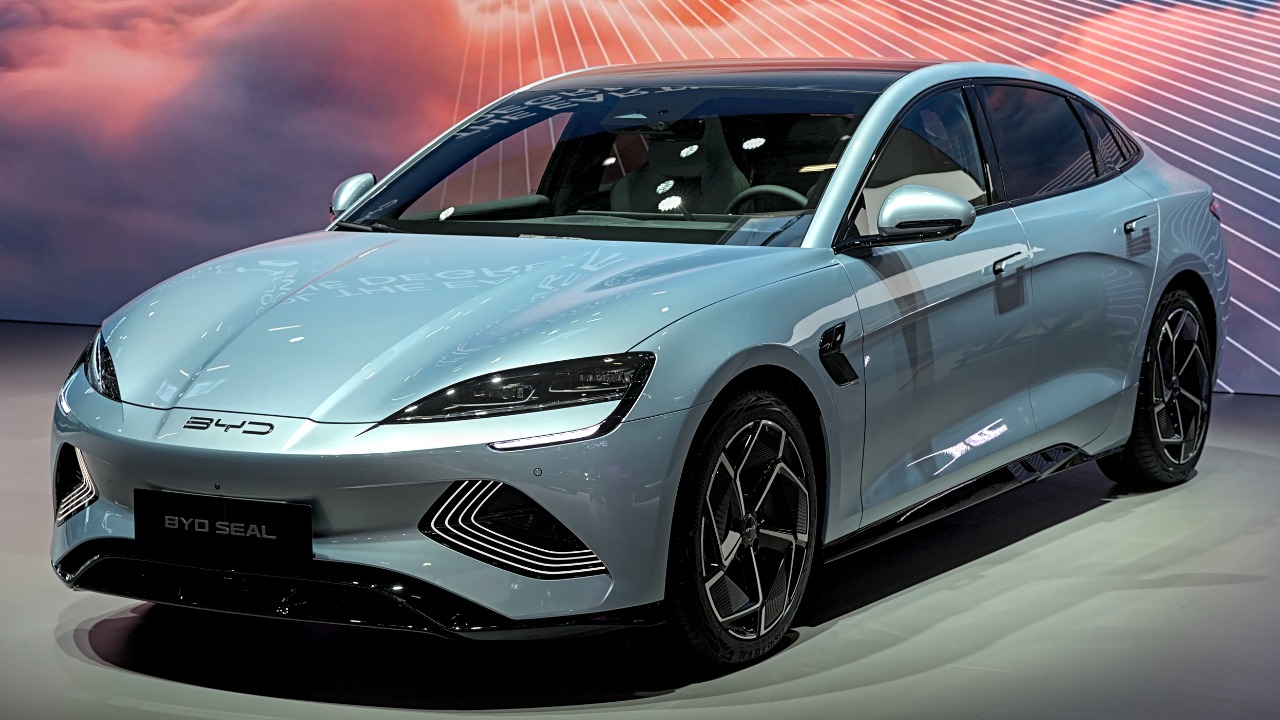

Tesla long framed ultra-fast charging and mass-market dominance in China as problems that could not be solved at the same time. BYD has just shown that both can be tackled head on, pairing aggressive pricing with technology that pushes electric vehicles into territory that once sounded impossible. The result is a reshaped Chinese market where Tesla is no longer the default benchmark but one of several players chasing a new leader.
From “impossible” to inevitable in China’s EV market
The core of Tesla’s skepticism was simple: you could build premium performance or affordable scale, but not both without sacrificing margins or technology leadership. In China, that logic is now colliding with a rival that has embraced vertical integration, local supply chains, and a willingness to compete on price in a way Tesla has resisted. BYD has turned what looked like structural constraints into a competitive weapon, especially in the mid range where most Chinese buyers actually shop.
Earlier this year, BYD’s momentum became impossible to ignore as it overtook Tesla in key measures of market performance. In China’s crowded electric vehicle arena, the company has rolled out a lower priced sedan to challenge the long dominant Model 3, undercutting Tesla in the segment that once defined its brand in Chin. That shift signals more than a pricing skirmish, it marks a structural change in who sets the pace in the world’s largest EV market.
BYD’s revenue surge and the $100 billion line Tesla could not hold
For years, Tesla argued that its software, brand, and manufacturing efficiency would keep it ahead financially even as rivals caught up on hardware. BYD has now punctured that assumption by scaling revenue to a level that Tesla itself had not yet reached, proving that a Chinese automaker can match global demand with robust economics. The financial gap is not just symbolic, it gives BYD the cash flow to fund the next wave of battery plants, platforms, and charging networks that will define the next decade.
According to detailed financial disclosures, The Chinese EV manufacturer vaulted past the psychological $100 billion revenue mark in 2024, while Tesla reported $97.7 billion over the same period. That milestone, highlighted in coverage that urged readers to Follow Thibault Spirlet for more analysis, underscores how far BYD has come from its origins as a battery supplier. The Chinese EV group also delivered 1.79 million vehicles in 2024, a scale that gives it leverage over suppliers and a platform to keep pressing its advantage.
Sales momentum: BYD’s 29% surge and Tesla’s China problem
Revenue is only part of the story, the speed of BYD’s growth is what now alarms Tesla’s investors and executives. While Tesla has warned of margin pressure and softer demand in China, BYD has been accelerating, not retrenching, in its home market. That divergence suggests Tesla’s playbook, built around a narrower product line and premium positioning, is less suited to a market where value and variety are winning the day.
Mar reports show that Tesla’s China rival BYD’s sales surged 29% last year, topping $100 billion in revenue as The Chinese automaker pushed deeper into both domestic and export markets. That same analysis noted how Mar, Tesla, China, and BYD are now locked in a contest where growth rates matter as much as absolute size, and on that front BYD is clearly ahead heading into 2025. For Tesla, which once treated China as its growth engine, the idea that a local rival could outpace it so decisively would have sounded impossible only a few years ago.
Outpacing Tesla with more than $100 billion in annual sales
What makes BYD’s rise particularly striking is that it is not a niche success confined to one price band or technology. The company has built a portfolio that spans budget city cars, family crossovers, and premium sedans, all feeding into a revenue base that now exceeds Tesla’s. That breadth has allowed BYD to capture demand that Tesla’s more focused lineup leaves on the table, especially in emerging markets that prize affordability and practicality over brand cachet.
Mar commentary on the Chinese EV sector notes that Chinese EV giant BYD outpaces Tesla with annual sales of more than $100 billion, underscoring how far the company has come in China and abroad. That same reporting emphasizes how the Chinese EV leader is using its scale to invest in charging technology that can refill a battery in roughly the time it takes to fill a gasoline car, a direct challenge to Tesla’s long standing claim that its Supercharger network is the gold standard.
Ultra-fast charging: BYD’s megawatt leap that Tesla dismissed
For Tesla, one of the most persistent talking points has been that ultra-fast charging at scale would be too hard on batteries, too expensive for networks, or simply unnecessary if drivers charged at home. BYD has chosen a different path, betting that public charging that feels as quick as a fuel stop will be essential to win over apartment dwellers and long distance drivers in dense cities. That bet is now materializing in hardware that pushes charging speeds into the megawatt range, a level Tesla once treated as a theoretical future rather than a near term product.
In China, BYD has already demonstrated what it calls megawatt class charging, with independent testers trying a five minute “megawatt” EV charging session that showed how quickly a compatible car could add meaningful range using 5 minute charging infrastructure. The experience, captured in a detailed video review, highlighted how such speeds could transform road trip planning for drivers who do not have a plug at home or who depend on public networks. For Tesla, which built its network around lower peak rates and longer dwell times, this is a direct challenge to its assumption that faster was either impossible or unnecessary.
Hybrid endurance: BYD’s long-range play against Tesla’s pure EV focus
Tesla has long dismissed plug in hybrids as a distraction, arguing that pure battery electric vehicles are the only future worth investing in. BYD has taken the opposite view, treating hybrids as a bridge technology that can win over skeptical drivers while its battery and charging ecosystem matures. That strategy is now yielding products with headline grabbing range figures that make even Tesla’s most efficient models look constrained.
One recent showcase imagined a driver going from New York to Miami without stopping for fuel or charging, covering over 2100 km or about 1,35 mi on a single tank and battery charge in a BYD hybrid, a feat highlighted in a detailed explainer on why BYD’s hybrid breakthrough could kill Tesla and why the figure of 35 m matters in that context. The video argues that such endurance, combined with low running costs, directly undercuts Tesla’s narrative that range anxiety can only be solved with ever larger batteries. By offering both hybrids and pure EVs, BYD is effectively telling consumers they do not have to choose between convenience today and a fully electric future tomorrow.
The slow-burn strategy Musk missed
Behind BYD’s sudden seeming dominance lies a methodical strategy that unfolded over more than a decade. While Tesla raced to build a global brand and premium image, BYD quietly invested in battery chemistry, supply chains, and manufacturing depth that would only later become visible in its products. That slow burn approach meant accepting lower margins and less glamour early on in exchange for control over the components that now define EV competitiveness.
Management expert Howard Yu has described how BYD’s slow burn playbook for domination offers lessons for every business, noting in a widely read analysis that BYD built capabilities step by step, from battery cells to full vehicles, before unleashing a flood of models across segments, a perspective he laid out in detail in BYD strategy. That piece, which drew 52 comments and sparked debate about whether Elon Musk underestimated his Chinese rival, argues that Tesla’s focus on software and autonomy left room for a competitor that treated hardware and manufacturing as the true battleground.
Winning every price segment while Tesla stays premium
Another pillar of BYD’s success is its willingness to compete in every price band, from entry level city cars to high end sedans and SUVs. Tesla, by contrast, has concentrated on the upper and mid tiers, leaving the lowest cost segments to others while it pursues software margins and autonomy. In a market like China, where price sensitivity is high and government incentives are shifting, that difference in strategy has profound consequences.
Analysts looking at global EV sales have pointed out that BYD’s secret is a lineup that caters to all price segments, while Tesla has focused on high end EVs, a contrast that has allowed BYD to flood the market and start eating into Tesla’s market share, as one detailed breakdown of how BYD surpassed Tesla put it. That same analysis, published in Dec, argues that While Tesla continues to refine a relatively small set of models, BYD is experimenting across body styles, price points, and powertrains, learning faster and locking in customers before Tesla even enters those niches.
Super e-Platform and the 1000 kW charging frontier
Perhaps the clearest example of BYD turning “impossible” into operational reality is its new Super e-Platform and associated charging technology. Tesla has long touted its Supercharger network as the industry benchmark, but it has not yet fielded a 1000 kW system for mass market vehicles. BYD, by contrast, is already demonstrating hardware that pushes into that realm, signaling its intent to redefine what fast charging means in everyday use.
In Dec, China’s BYD officially launched its groundbreaking Super e-Platform and just demonstrated a 1000 kW ultra fast charger, pushing EV charging into territory that once sounded impossible, a milestone highlighted in a widely shared China BYD demo. The short clip, tagged with asia, asiainnovation, cntech, and evbattery, shows how BYD is not just matching Tesla’s infrastructure but leaping ahead in raw capability. For drivers in China, where urban density and limited home parking make public charging essential, that kind of performance could be the difference between choosing BYD and sticking with Tesla.
More from MorningOverview