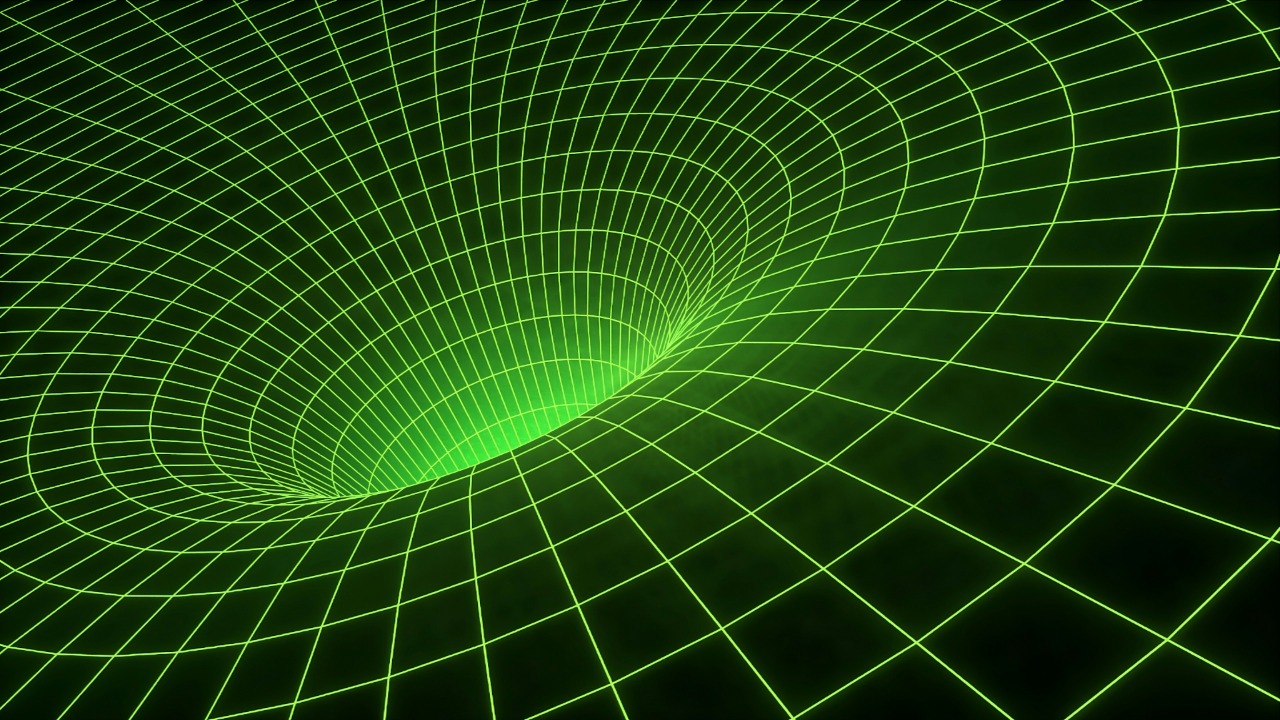

Gravity used to be the most down-to-earth of ideas, the thing that kept apples falling and planets in line. Now a growing group of physicists is treating it as a possible glitch report from the fabric of reality itself, arguing that the way gravity behaves could be a clue that the Universe is running on something like code. At the same time, other researchers are firing back with rigorous mathematical arguments that our world cannot be a simulation in any straightforward sense.
That tension, between gravity as a hint of hidden computation and gravity as a perfectly ordinary feature of a non‑simulated cosmos, is driving one of the strangest debates in modern physics. I want to trace how the latest theories try to turn a familiar force into evidence of a cosmic processor, and how equally serious work insists that even the most powerful simulator would hit hard logical limits long before it recreated a universe like ours.
From Newton’s apple to a possible cosmic computer
For centuries gravity has been the archetype of a physical law, first as the invisible pull that Isaac Newton used to explain falling apples and orbiting moons, then as the curvature of spacetime in Albert Einstein’s general relativity. In both pictures, gravity is fundamental, something you accept as part of the rulebook rather than a side effect of deeper information processing. The equations are continuous, smooth and indifferent to whether anyone is watching, which is why they have long been taken as the opposite of anything like a digital simulation.
The new wave of ideas does not dispute Newton or Einstein on the level of prediction, but it does question what those equations really mean. Instead of treating gravity as a basic interaction, some theorists now frame it as an emergent phenomenon that appears when information is stored, moved or compressed in particular ways. In that view, the familiar pull between masses might be less like a fundamental force and more like the visible interface of a hidden computational process, the way a smartphone’s icons sit on top of code you never see.
The simulation hypothesis grows up
The broader backdrop is the “simulation hypothesis”, the claim that what we call reality could be a high‑fidelity virtual environment. Philosophers have argued about that possibility for years, but physicists have only recently tried to turn it into something testable. In a detailed Introduction to the topic, one team lays out how the “simulation hypothesis” can be treated as a scientific claim, then uses astrophysical data and explicit Simulation models to ask what kind of universe a simulator could realistically run.
Those researchers lean on large‑scale cosmological simulations, the same tools used to study galaxy formation, to argue that any simulated cosmos would face trade‑offs between resolution, size and computational cost. If our Universe were running on finite hardware, they suggest, we might expect to see telltale limits in the distribution of galaxies or in the behavior of high‑energy particles. That work does not prove or disprove anything on its own, but it marks a shift from late‑night dorm speculation to concrete constraints that any serious version of the hypothesis has to respect.
Vopson’s radical claim: gravity as an information throttle
Into that landscape steps physicist Melvin Vopson, whose latest work pushes the idea that gravity is not fundamental at all. In his study, he proposes that the Universe behaves like a giant cosmic PC that is constantly trying to run itself more efficiently. According to that picture, gravity is the mechanism the system uses to reduce the processing load, pulling matter together so that information is stored and updated in a more compact, less resource‑hungry way. The Videos that introduced this idea to a wider audience framed it as a bold attempt to reinterpret one of physics’ bedrock forces as a side effect of data compression.
Vopson has been developing a broader “information physics” program for years, and in this latest iteration he treats every physical system as a bundle of bits that must be tracked by whatever substrate underlies reality. If that substrate has finite capacity, then the total information entropy of the cosmos cannot grow without bound. In a separate report, he argues that gravity must be the mechanism that stops the information entropy of the cosmos from ballooning out of control, a claim he connects directly to the idea that we might be living in a simulation that is constantly managing its own memory footprint. That argument is laid out in more detail in a piece asking whether Vopson’s proposal could be tested in the lab.
Gravity as a computational process, not a force
Vopson is not alone in treating gravity as a kind of algorithm. Another recent paper argues that gravity is the result of a computational process within what it explicitly calls a “computational universe”. The authors state that their results introduce “distinct conceptual and methodological differences” compared with standard approaches, and they suggest that gravity serves as a computational tool that organizes matter and energy in ways that are optimal for information processing. In this view, the familiar attraction between masses is simply how a deeper layer of calculation manifests at large scales.
That work, which frames the cosmos as a system that updates its own state step by discrete step, leans on techniques from computer science as much as from physics. Instead of continuous fields, it imagines a lattice of information units whose interactions give rise to what we perceive as spacetime and curvature. The authors present their model as a serious alternative to traditional theories, arguing that the Universe might be better understood as a vast program than as a smooth geometric object, and they spell out those claims in a detailed computational universe analysis.
Turning a wild idea into an experiment
For all its philosophical weight, the simulation question only becomes physics when it touches data, and that is where Vopson’s latest proposal tries to go further. In the report that asks “Are we living in a simulation? This experiment could tell us”, he outlines a concrete way to probe whether gravity really behaves like an information throttle. The basic idea is to look for subtle deviations in how gravitational fields respond when the information content of a system changes, even if its mass and energy stay the same, something that would not happen if gravity were purely geometric in the Einstein sense.
Vopson suggests that if gravity is tied directly to information entropy, then carefully designed setups that alter the number of bits needed to describe a system should produce measurable shifts in gravitational behavior. That is a tall order experimentally, but it is at least a roadmap for turning a speculative claim into a falsifiable one. The article that lays out this plan emphasizes that Vopson says gravity must be the mechanism that reins in cosmic information growth, and that if his experiment finds no such effect, the simulation‑friendly version of his theory would take a serious hit.
The scientist who says he has found a “clue”
The idea that gravity might hint at a simulated universe has also spilled into more popular discussions, sometimes in ways that blur the line between careful theory and eye‑catching claim. One widely shared story profiles a Scientist who argues that certain patterns in physical law could be interpreted as a possible clue that we are living in a “simulated universe”. In that piece, the Scientist is quoted explaining how specific regularities might reflect design choices by a programmer rather than inevitable consequences of deeper mathematics, and the article frames his argument as a provocative but testable hypothesis rather than a mere thought experiment.
According to that report, the Scientist’s theory is presented as part of a broader conversation about whether apparently arbitrary constants or symmetries might be signatures of underlying code. The piece notes that he added in the paper that such clues would not amount to definitive proof, but they could shift the balance of plausibility toward a simulation scenario if they accumulated across different domains of physics. Those claims are laid out in more detail in a feature that asks, with deliberate bluntness, Is this proof we are living in a simulated universe.
Mathematicians push back: maybe the Universe cannot be simulated
While gravity‑as‑computation theories are grabbing headlines, another camp is quietly arguing that the entire simulation project may be impossible in principle. A team at UBC Okanagan has used Gödel’s incompleteness theorems to argue that a universe with the richness of ours cannot be fully captured by any finite computational system. Their work, described as New research, claims to mathematically demonstrate that the Universe cannot be simulated in the strong sense that many versions of the hypothesis assume, because there will always be true physical statements that no algorithm can derive.
The same report explains that the team’s argument hinges on translating physical laws into formal systems, then showing that any such system inherits the undecidability and incompleteness that Kurt Gödel identified in arithmetic. If that translation is valid, then no simulator, no matter how powerful, could predict every outcome or compress every detail of reality into a consistent set of rules. The researchers present this as a direct challenge to the idea that we are living in a fully controlled virtual environment, and they outline their reasoning in a detailed Using Gödel‑based analysis.
Another “New Study” narrows the simulation options
The UBC Okanagan work is not the only attempt to put hard limits on the simulation idea. A separate report, headlined New Study Rules Out Popular Version Of The Simulation Hypothesis, describes research that takes aim at one of the most widely discussed forms of the theory. The authors use explicit Simulation methods to show that a certain class of simulated universes would produce observational signatures that we simply do not see, effectively ruling out that family of models. While the article that presents these findings is wrapped in promotional language, including a “40% OFF OFFER, Ends Dec 31st, 2025!” banner, the underlying claim is that at least some versions of the hypothesis are now in direct conflict with data.
In that work, the researchers focus on how a simulated cosmos would handle quantum fluctuations and large‑scale structure, arguing that finite computational grids and update rules would leave fingerprints in the cosmic microwave background or in the distribution of matter. Since observations do not show those fingerprints, they conclude that the “popular version” they analyze cannot describe our world. The study does not kill the simulation idea outright, but it does shrink the space of viable models, and it underscores how quickly speculative concepts can run into trouble once they are forced to match specific measurements.
Astrophysical constraints and the limits of cosmic hardware
Even before these latest gravity‑focused theories, astrophysicists were already probing how a simulated universe would have to behave. The detailed Astrophysical constraints paper treats the simulation hypothesis as a working model and asks what kind of “hardware” would be needed to reproduce the observed cosmos. By comparing the computational cost of existing cosmological simulations with the complexity of the real Universe, the authors argue that any simulator would need resources far beyond anything we can currently imagine, and that those resources would still impose limits that might show up as anomalies in high‑precision data.
They point in particular to the way large‑scale simulations handle dark matter and dark energy, two components that dominate the mass‑energy budget of the Universe but are still poorly understood. If those ingredients are already hard to model with our best supercomputers, the argument goes, then a simulator trying to fake them at full fidelity would face even steeper challenges. That does not rule out a simulation outright, but it reframes the question: instead of asking whether our Universe could in principle be simulated, the focus shifts to whether any plausible simulator could hide its shortcuts from careful observers armed with telescopes and particle detectors.
Where gravity‑as‑code stands now
Put together, these strands of research leave gravity in an oddly liminal place. On one side are theorists like Vopson and the authors of the computational universe paper, who see in gravity’s behavior a hint that reality is built from information and that the Universe might be optimizing its own processing load. On the other side are mathematicians and astrophysicists who argue that logical limits, observational constraints and the sheer complexity of the cosmos make a full‑blown simulation either impossible or at least very different from the tidy virtual worlds imagined in science fiction. Both camps are using gravity as a key test case, but they are reading its equations in radically different ways.
For now, the balance between those views will be decided not by clever analogies but by experiments like the ones Vopson proposes and by further work on the mathematical structure of physical law. If gravity ever does reveal itself as a kind of code, it will be because precise measurements show behavior that cannot be reconciled with Newton and Einstein alone, and because models that treat the Universe as a computational system make better predictions than their traditional rivals. Until then, the idea that gravity is evidence we are in a simulation remains a provocative possibility rather than a settled fact, a reminder that even the most familiar forces can still surprise us when we look at them through a new lens.
More from MorningOverview