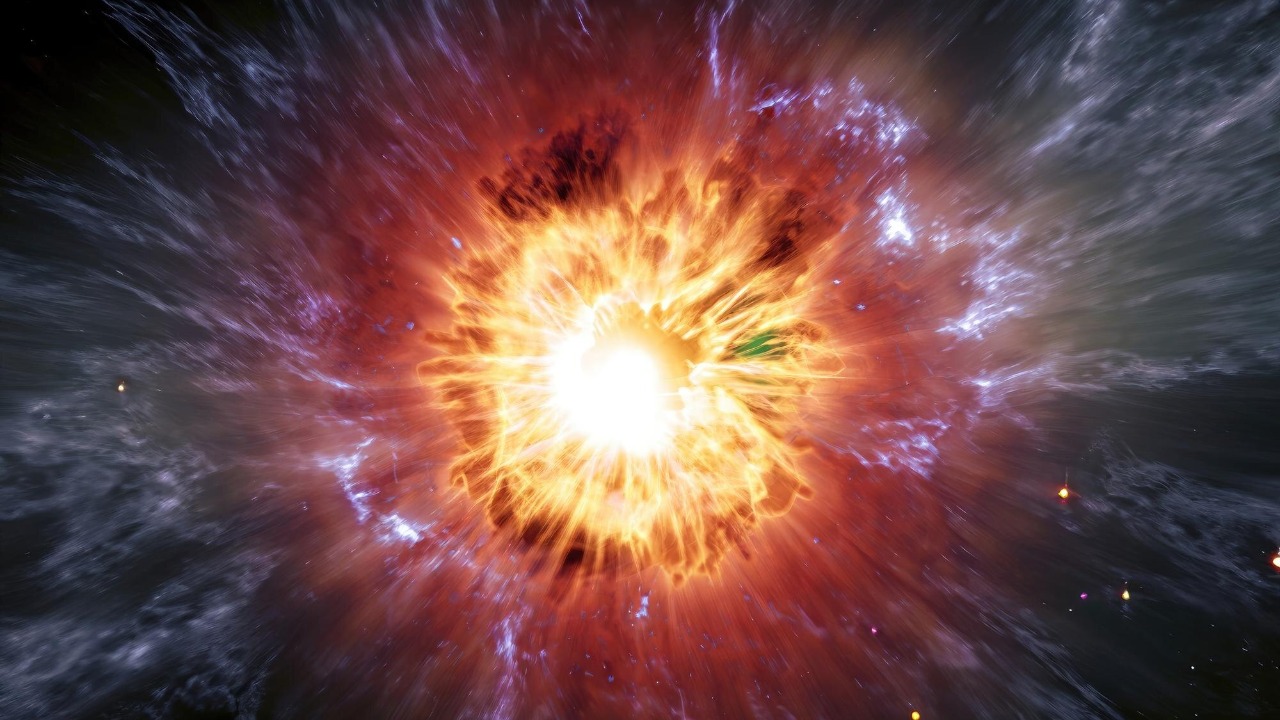

A strange double flash in a distant galaxy may be the first glimpse of a “superkilonova,” a cosmic one‑two punch that fuses two of the most violent stellar deaths known. Astronomers watched a massive star collapse in a supernova, then appear to detonate again as its newborn neutron stars spiraled together and merged, releasing a second, richer burst of light and gravitational waves. If confirmed, the event would open a new chapter in how I understand the life cycles of stars and the origins of the universe’s heaviest elements.
The candidate blast, tagged with a gravitational‑wave signal and followed across the spectrum, does not fit neatly into any category currently on the books. Instead, it looks like a hybrid, combining the shock of a stripped‑envelope supernova with the radioactive glow of a kilonova, but on a scale that justifies the “super” label. For astronomers, it is both a tantalizing first and a stress test for some of the field’s most cherished models of how dead stars behave.
How a routine gravitational-wave alert turned into a cosmic oddity
The story began as a standard alert from the global network of gravitational‑wave detectors, which routinely flags ripples in spacetime from colliding compact objects. Earlier this year, the instruments known as LIGO and Virgo picked up a signal that analysts labeled with a new event code, a pattern that initially looked like a merger of dense remnants but did not immediately stand out from the growing catalog of such detections. Only when telescopes swung toward the patch of sky indicated by the waveform did observers realize that the light show unfolding there was anything but routine, with a bright optical transient that evolved in a way no one expected.
According to detailed reconstructions, the discovery began when the LIGO and Virgo detectors registered a gravitational‑wave signal whose properties hinted at a pair of neutron stars, one of which was unusually small compared with typical examples. That mass asymmetry already suggested something exotic about the progenitor system, and it prompted rapid follow‑up by optical and infrared observatories. What they found was a transient that brightened and faded in two distinct stages, a double‑peaked light curve that immediately raised the possibility that the gravitational waves and the strange glow were two acts in the same astrophysical drama.
What exactly is a “superkilonova” supposed to be?
To understand why this event is so intriguing, I need to unpack the jargon. A supernova is the explosive death of a massive star, while a kilonova is the radioactive afterglow that follows the merger of two neutron stars, powered by freshly forged heavy elements. A “superkilonova” is a theoretical mash‑up of these ideas, in which a massive star’s core collapse not only triggers a supernova but also leaves behind a tight pair of neutron stars that quickly spiral together, collide, and ignite a second, even more luminous outburst.
Researchers have long suspected that such a sequence could occur, but until now it had been hypothesized and never seen in the wild. In the new case, Dec Astronomers describe a blast that appears to combine the hallmarks of a Type IIb stripped‑envelope supernova with the telltale radioactive glow of a kilonova, but at a brightness and energy scale that justify calling it a superkilonova. In that picture, the first explosion blows off the star’s outer layers, then the compact core fragments into two neutron stars that merge quickly enough to produce a second, distinct flash, giving observers a rare chance to watch both processes in a single system.
A star that seemed to explode twice
What sets this candidate apart from ordinary stellar deaths is the unmistakable sense that the same object went off not once but twice. The initial outburst looked like a relatively normal core‑collapse supernova, with a shockwave racing through the star’s remaining envelope and a bright optical peak as the debris expanded. Then, instead of fading smoothly, the light curve showed a renewed surge, accompanied by a shift in color and spectral features that pointed to a different power source taking over.
Observers tracking the transient report that the event was first detected by gravitational‑wave instruments in the United States and Italy, then followed as its optical emission evolved from redder hues to bluer tones during the second brightening. That color evolution is consistent with a fresh injection of energy from radioactive heavy elements synthesized in a neutron‑star merger, rather than the cooling of ordinary supernova ejecta. The double structure in both time and spectrum is what led several teams to argue that the system produced a supernova and a kilonova in rapid succession, effectively exploding twice.
Peering into the blast from Maunakea to space-based eyes
Once the odd behavior became clear, astronomers mobilized some of the most powerful telescopes on and above Earth to dissect the event. Ground‑based facilities on Maunakea in Hawaiʻi, including large optical and infrared instruments, captured high‑resolution spectra that traced how the chemical fingerprints in the ejecta changed between the first and second peaks. Those data, combined with space‑based imaging, allowed teams to estimate the ejecta mass, expansion velocities, and the likely composition of the material flung into space.
A team working from Maunakea argues that the observations match the long‑predicted but never observed scenario of a Potential first‑of‑a‑kind superkilonova, in which gravitational waves and light are produced in tandem. Their analysis points to an initial supernova that stripped the star of most of its hydrogen envelope, followed by a compact merger whose radioactive debris powered the second, hotter flare. By comparing the spectra to models of both Type IIb supernovae and kilonovae, they conclude that no single known class can explain the full dataset, reinforcing the case for a new hybrid category.
From Washington and Louisiana to global follow-up
The gravitational‑wave side of the story is just as important as the fireworks in light. The initial spacetime ripples were picked up by sensors in Washington and Louisiana, the twin LIGO facilities that form the backbone of the global network. Their timing and amplitude measurements allowed researchers to triangulate the source’s location on the sky and estimate the masses of the merging objects, which appeared consistent with a pair of neutron stars rather than black holes.
Reporting on the event notes that the candidate superkilonova was identified after sensors in Washington and Louisiana registered the gravitational‑wave signal, with visualizations later produced by Caltech, Miller and Hurt at IPAC, Expl showing an artistic representation of the double explosion. Those early alerts triggered a worldwide campaign of follow‑up observations, from small robotic telescopes that scanned the localization region to large observatories that zoomed in once the optical counterpart was found. The coordination between gravitational‑wave and electromagnetic teams is what made it possible to catch both the initial supernova‑like flash and the later kilonova‑like surge in such detail.
Why astronomers are excited but cautious
For all the enthusiasm around the term “superkilonova,” the scientists involved are careful not to oversell what they have. The data are rich but still open to interpretation, and alternative explanations, such as an unusual supernova interacting with dense circumstellar material, have not been fully ruled out. Theoretical models of how a collapsing core could fragment into two neutron stars that merge quickly enough to produce a second explosion are still being refined, and some parameters remain uncertain.
One lead researcher is quoted as saying, “We do not know with certainty that we found a superkilonova, but the event nevertheless is eye opening,” a sentiment reflected in the technical paper described in Dec coverage of the work from an astronomy center at Caltech. That cautious framing underscores how science progresses: by proposing a bold interpretation, testing it against every available observation, and inviting the community to probe for weaknesses. Whether or not the label sticks, the event has already forced theorists to revisit assumptions about how massive stars die and how quickly their remnants can collide.
What makes this blast different from ordinary supernovae and kilonovae
Even if I set aside the catchy new name, the physics of the event looks different from the standard playbook for stellar explosions. Ordinary core‑collapse supernovae release enormous energy in a single, relatively smooth outburst, with light curves that rise and fall over weeks as the expanding debris cools and radioactive nickel decays. Kilonovae, by contrast, tend to be shorter‑lived and redder, their glow dominated by the decay of heavy r‑process elements like gold and platinum synthesized in the neutron‑rich merger ejecta.
Analyses of the candidate superkilonova emphasize that Few spectacles in space can match the combined power of a supernova followed by a kilonova, and that the observed light curve shows features of both. The first peak resembles a stripped‑envelope supernova, while the second is shorter, hotter, and consistent with a follow‑up kilonova triggered by twin dead stars merging. That hybrid behavior, along with the gravitational‑wave detection, is what sets this blast apart from the many supernovae and the handful of kilonovae astronomers have cataloged so far.
The strange afterglow and what it reveals about heavy elements
One of the most intriguing aspects of the event is its lingering afterglow, which did not fade as quickly or as simply as models predicted. Instead, the emission showed a complex evolution in color and brightness, hinting at multiple energy sources and layers of ejecta interacting over time. That complexity offers a rare window into how heavy elements are forged and mixed into the surrounding space, a process that ultimately seeds future generations of stars and planets.
Detailed reports describe how, When big stars die, they explode as supernovae that scatter essential elements like carbon and iron, But in this case the strange afterglow hints at a second explosion that may have produced even heavier nuclei. Comments from David Reitze, executive director of LIGO, underscore how the combination of gravitational‑wave and electromagnetic data lets researchers trace the full chain of element production, from the initial core collapse to the neutron‑star merger. If the interpretation holds, this single event could account for a significant amount of r‑process material, making it a key data point in the long‑running debate over where the universe’s gold and similar elements come from.
Modeling a double cosmic explosion in unprecedented detail
To make sense of the observations, theorists have been racing to build models that can reproduce both the gravitational‑wave signal and the two‑stage light curve. The emerging picture is of a double cosmic explosion in which the collapsing core of a massive star fragments into two neutron stars that remain bound in a tight orbit. As they spiral together, they plow through the supernova ejecta, their merger ejecting additional material and shocking the surrounding debris, which then lights up as the second, brighter flare.
One analysis describes how a Double Cosmic Explosion Gives Birth to an Unprecedented Superkilonova, with the first blast clearing a path for the second to make a powerful kilonova. In that scenario, when massive stars die, they do not always follow a simple script, and the interplay between the initial supernova and the later merger can shape the geometry and brightness of the resulting transient in a complex manner. By adjusting parameters like the delay time between explosions and the mass of the ejecta, modelers can match the observed timing and luminosity, lending support to the superkilonova interpretation.
Why this potential first matters for future astronomy
Beyond the thrill of a possible first, the candidate superkilonova has practical implications for how observatories plan their searches and allocate precious telescope time. If massive stars can sometimes produce rapid‑fire sequences of explosions, then survey strategies may need to account for transients that change character over days rather than weeks. Gravitational‑wave facilities, too, might refine their alert criteria to flag events whose mass ratios or other parameters hint at such exotic outcomes, prompting more aggressive follow‑up.
Coverage of the event stresses that Potential “Superkilonova” scenarios have been discussed for years, with theorists outlining how a massive double cosmic explosion could occur if ejected debris later interfered with a compact merger. Now that observers may have finally caught such an event in action, the race is on to find more examples and to see how common or rare this pathway really is. Each new detection would help pin down the role of superkilonovae in enriching galaxies with heavy elements and in shaping the population of neutron stars and black holes.
Astronomers weigh the evidence for a first-known superkilonova
As data continue to pour in, the community is converging on a cautious but optimistic view that this blast may indeed represent the first known example of the long‑theorized phenomenon. The combination of a gravitational‑wave signal from a neutron‑star merger, a double‑peaked optical light curve, and spectral signatures that evolve from supernova‑like to kilonova‑like is difficult to explain with any single conventional model. That convergence of clues is what gives the superkilonova hypothesis its appeal, even as researchers acknowledge the need for more events to solidify the case.
Summaries of the work note that Astronomers May Have Detected First Known Superkilonova Explosion, describing an unprecedented discovery in which Astronomers see features of both supernovae and kilonovae in a single event. For now, the candidate stands as a benchmark for what a superkilonova might look like, a bizarre star blast that challenges existing categories and invites a new generation of models and observations. Whether future data confirm or complicate this picture, the episode has already expanded the imagination of what dying stars can do, and how dramatically they can reshape the cosmos around them.
More from MorningOverview