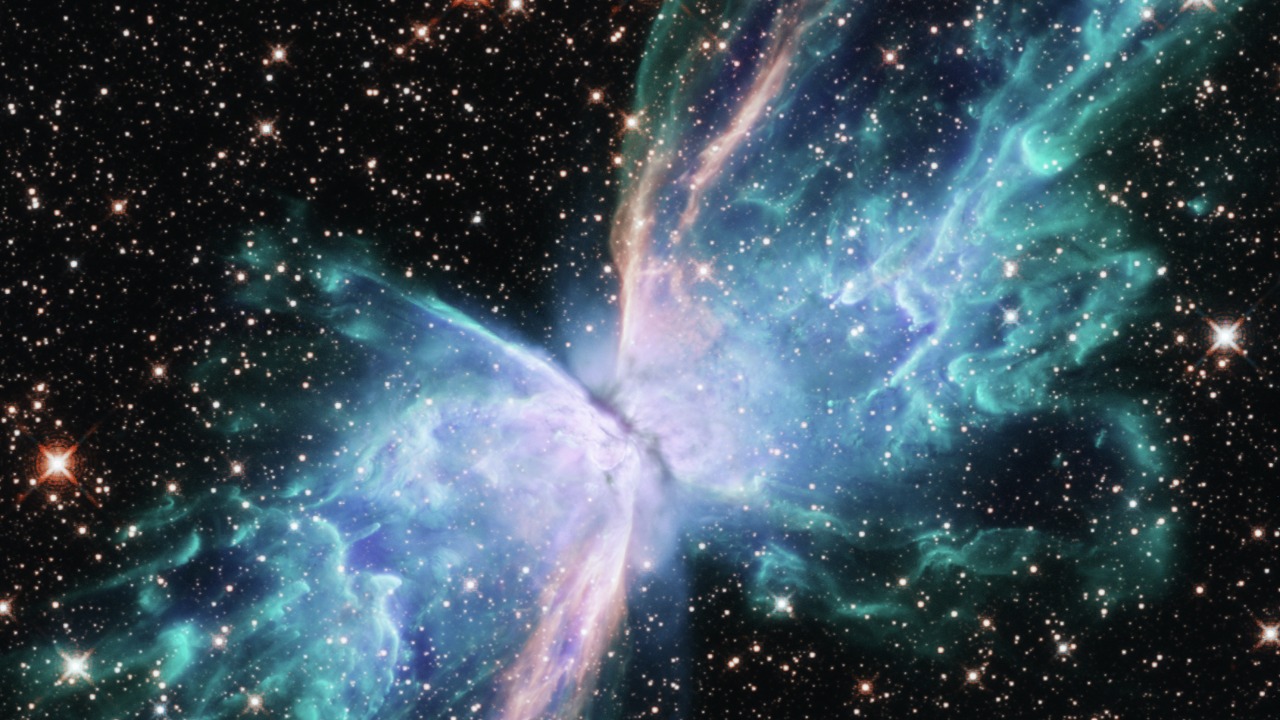

A strange, layered structure in deep space has captured astronomers’ attention, looking uncannily like a cosmic sandwich floating in the dark. The object, a vast disk of gas and dust, appears as a stacked, bun-like silhouette that hints at violent processes shaping new worlds. I see it as the latest reminder that even in the most technical corners of astrophysics, our first instinct is still to describe the universe in the language of food and myth.
Researchers using Hubble have zeroed in on this massive, sandwich shaped blob and found that its scale and complexity push the limits of what we thought young planetary systems could look like. Nicknamed Dracula’s Chivito, the structure stretches roughly 1,000 light years across and sits far from our own solar system, yet it offers a close-up look at how stars and planets may be assembled inside chaotic disks of dust and gas.
How Hubble turned a fuzzy smudge into a cosmic sandwich
When I look at the history of space imaging, the leap from faint smudges to detailed portraits of stellar nurseries is one of the quiet revolutions of modern astronomy. The latest deep exposure from Hubble transforms what might have been a nondescript patch of sky into a sharply defined, layered disk that immediately invites comparison to a stacked sandwich. Instead of a simple ring, the image reveals a thick, dark band of dust flanked by glowing layers of gas, a geometry that makes the structure look like a bun, filling, and bun again.
That visual clarity matters because it lets astronomers trace how light from embedded stars filters through the dust, which in turn exposes the disk’s thickness, warps, and clumps. In this case, the sandwich-like profile is not a gimmick but a clue that the disk is puffed up and uneven, likely stirred by gravity and turbulence. By resolving those layers in such detail, Hubble gives researchers a rare chance to test models of how massive disks fragment and evolve, rather than forcing them to infer everything from unresolved blobs.
Why “Dracula’s Chivito” is more than a playful nickname
Nicknames in astronomy often sound whimsical, but they usually encode something about how an object behaves or looks. In this case, the disk has been Nicknamed Dracula’s Chivito, a mashup that evokes both a nocturnal predator and a famously overstuffed sandwich. I read that as a nod to the object’s dark, brooding silhouette and its layered, overbuilt structure, which looks far more complex than the thin, flat disks that often appear in textbook diagrams of planet formation.
The “Chivito” part of the name also hints at excess, and that fits the science. The disk’s sheer size, on the order of 1,000 light years across, suggests a reservoir of material large enough to feed multiple generations of stars and planets rather than a single, tidy system. By giving it a vivid, slightly absurd label, astronomers make it easier for the public to remember, but they also signal that this is not a run-of-the-mill protoplanetary disk. It is a sprawling, overstuffed environment where gravity, radiation, and turbulence are all competing to shape the final menu of worlds.
A chaotic birthplace for planets on an unprecedented scale
What makes Dracula’s Chivito scientifically compelling is not just its shape but its role as a chaotic nursery for new worlds. The disk’s scale and structure line up with a broader pattern that Hubble has been revealing, where vast, clumpy disks appear capable of forming multiple gas giants at once. Instead of a neat, orderly progression from dust to pebbles to planets, these environments look more like stormy construction sites, with dense knots of material collapsing in parallel.
In that context, the sandwich-like layering is a sign of vertical complexity, not just a visual quirk. The thick central band likely marks a region where dust has settled and grown, while the glowing upper and lower layers trace gas that is being heated and stirred by young stars. I see this as evidence that planet formation is happening in three dimensions, with material moving up and down through the disk as well as around the star. That vertical motion can feed instabilities, trigger fragmentation, and ultimately set the architecture of any planetary system that emerges from the chaos.
From interstellar hamburgers to Dracula’s sandwich
Dracula’s Chivito is not the first time Hubble has turned a food metaphor into a teaching tool. Earlier in its career, the Hubble Space Telescope captured a striking image of what astronomers dubbed an “interstellar hamburger,” a pair of glowing buns of gas separated by a dark patty of dust in the middle. That object, like Dracula’s Chivito, was a young star wrapped in a thick disk, seen edge on so that the dust blocked starlight in a way that mimicked a layered sandwich.
By comparing these two food-themed objects, I can see how much the field has advanced. The earlier hamburger image was already impressive, but the new sandwich shaped blob shows finer structure, more complex layering, and a much larger environment. Both rely on the same basic geometry, with a central band of dust slicing through a glowing nebula, yet the newer observations push the technique to larger scales and more chaotic conditions. The continuity between them underscores how a single telescope, used creatively over decades, can build a visual vocabulary for understanding star and planet formation.
A strange object and the search for a new kind of baby star
Dracula’s Chivito also sits in a growing family of odd, layered objects that challenge simple categories. Earlier work on a Strange Object Described as Dracula’s Sandwich Could Represent a New Kind of Baby Star highlighted how some disks and envelopes do not fit neatly into standard stages of stellar evolution. That strange object, described as a Sandwich Could Represent a New Kind of Baby Star, suggested that there may be transitional phases where a forming star is still deeply embedded yet already reshaping its surroundings in unexpected ways.
When I place Dracula’s Chivito alongside that Strange Object, I see a pattern of layered, asymmetric structures that hint at a more diverse set of birth environments than classic models allow. Instead of a single, smooth disk, we are finding warped, puffed up, and sometimes partially hollowed sandwiches of gas and dust. These shapes may mark stages where outflows, magnetic fields, or multiple forming stars carve cavities and ridges into the material. Each new example adds another data point, pushing theorists to refine their timelines for how a baby star emerges from its cocoon and how quickly planets can start to assemble around it.
What amateur astronomers can and cannot see of this cosmic sandwich
For backyard observers, the idea of spotting Dracula’s Chivito directly is out of reach, but the broader class of star forming regions it represents is not. Guides aimed at enthusiasts, such as a June observing list that highlights Big Blue Targets for June like Messier 5 or M5 (also designated NGC 59), show how globular clusters and nebulae can be explored with modest telescopes. While those targets are not sandwich shaped disks, they occupy the same broader ecosystem of stellar evolution, from dense clusters of old stars to glowing clouds where new ones are born.
I find that connection important because it grounds the exotic imagery from Hubble in the practical experience of people at the eyepiece. When an amateur slews a telescope toward a Messier object or an NGC entry, they are looking at the large scale environments that feed or follow the kind of disk seen in Dracula’s Chivito. The fine sandwich structure is invisible without space based optics and careful processing, but the larger context of star formation, cluster evolution, and galactic structure is accessible. That shared sky helps bridge the gap between professional surveys and personal observing, turning distant, food themed disks into part of a continuum that stretches from a suburban backyard to the far reaches of the galaxy.
How NASA and Hubble keep finding food in the cosmos
The recurring food metaphors in space imagery are not accidental. Agencies like Science Space NASA and teams working with Hubble understand that the human brain latches onto familiar shapes. When a disk looks like a hamburger or a chivito, the comparison becomes a hook that draws people into a story about dust, gas, and gravity that might otherwise feel abstract. I see this as a deliberate communication strategy that respects the science while acknowledging that metaphors are powerful entry points.
At the same time, the reliance on food imagery reflects something deeper about how we process the cosmos. We are pattern seeking creatures, and when confronted with a complex, layered structure, we reach for analogies from everyday life. By leaning into that instinct, NASA and its partners turn technical data into cultural touchstones. Dracula’s Chivito joins a long line of nebulae, galaxies, and disks that carry nicknames rooted in animals, objects, and meals, each one a reminder that the universe is easier to grasp when we can compare it to something we might hold in our hands.
Why the sandwich shaped blob matters for the future of planet hunting
Looking ahead, I think Dracula’s Chivito will matter less as a one off curiosity and more as a template for what astronomers should expect to find with future observatories. The detailed layering and chaotic structure captured by Hubble point toward a universe where giant, unstable disks are common birthplaces for planetary systems. That has direct implications for how we interpret exoplanet demographics, especially the prevalence of massive gas giants on wide or eccentric orbits that may trace back to early dynamical upheaval in such disks.
As new instruments come online, from next generation space telescopes to extremely large ground based observatories, I expect more of these sandwich like structures to emerge from the noise. Each one will offer a snapshot of a different stage in the life of a disk, from initial collapse to fragmentation and eventual clearing. Dracula’s Chivito stands out today because it is visually striking and unusually large, but its real legacy may be as the first in a series of case studies that force us to rewrite the recipe for how stars and planets are assembled in the messy kitchens of interstellar space.
More from MorningOverview