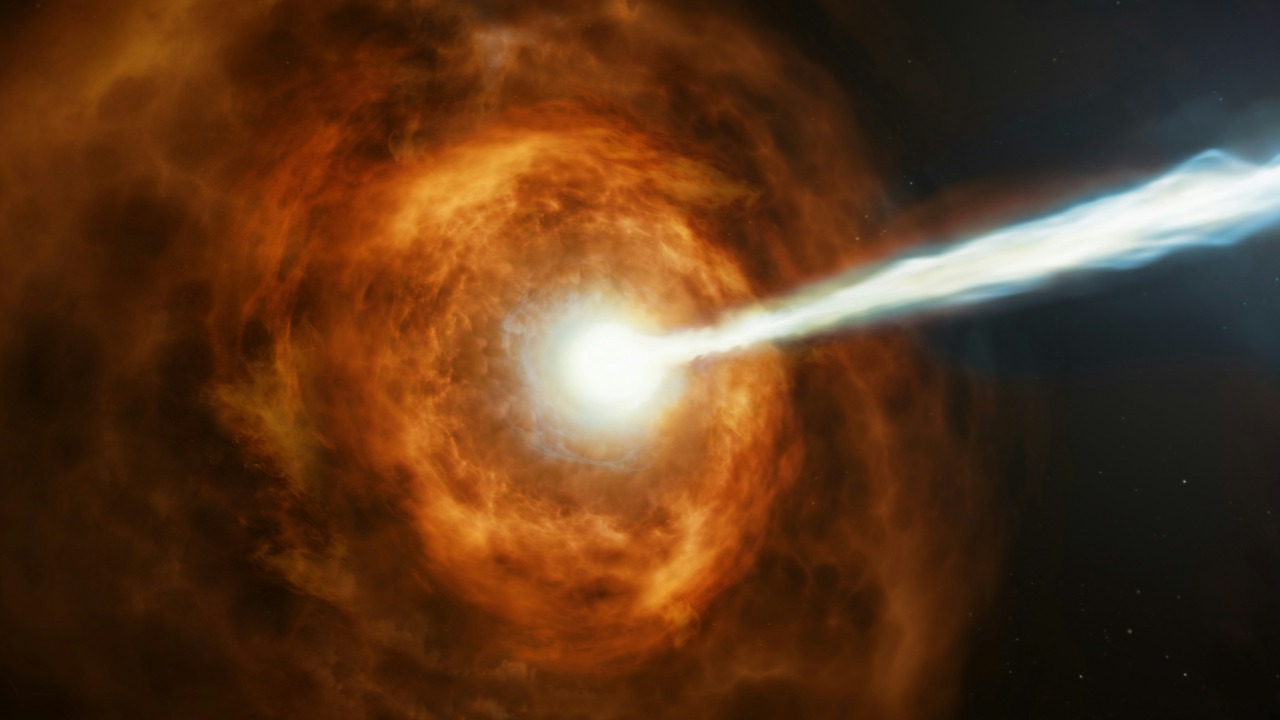

A doomed star spiraling into a supermassive black hole has given physicists one of their clearest looks yet at how gravity warps reality itself. As the star was shredded, its glowing debris did not simply fall straight in, it traced a slow, graceful wobble that revealed spacetime twisting around the black hole’s spinning mass. For researchers testing Albert Einstein’s most extreme predictions, this death plunge has become a rare natural experiment in the wild.
A violent stellar death that became a physics experiment
When a star strays too close to a supermassive black hole, tidal forces tear it apart in what astronomers call a tidal disruption event. In this case, the star’s orbit carried it into a region where gravity is so intense that its own structure could not survive, and the result was a stream of stellar material whipping around the black hole and lighting up as it fell inward. Instead of a single flash, the disruption unfolded over weeks and months, giving scientists time to watch the changing pattern of light and decode the underlying motion.
What turned this particular event into a landmark was the way the debris disk appeared to precess, or slowly change its orientation, as it circled the black hole. The pattern matched what general relativity predicts when a spinning black hole drags the surrounding spacetime into a swirl, a phenomenon that theorists describe as frame dragging. Visualizations of the system, including an artist’s impression from ICRAR, show the warped geometry that the star’s remains had to navigate as they plunged inward.
How a twisting spacetime leaves fingerprints in light
At the heart of this story is the idea that gravity is not just a force pulling on objects, it is a curvature of spacetime that dictates how objects move and how clocks tick. Near a black hole, that curvature becomes so extreme that even light paths bend sharply, and time itself runs at a different rate compared with distant regions. When the black hole spins, it does more than curve spacetime, it drags it around with its rotation, so that anything nearby is forced to swirl in the same direction, like leaves caught in a whirlpool.
For astronomers, the only way to infer this invisible twisting is to track how matter and radiation behave close to the event horizon. In the recent observations, the wobbling of the inner disk and the changing brightness of the X-ray and optical emission lined up with the expectations for a rotating spacetime, a pattern that researchers interpret as direct evidence of frame dragging. The detailed modeling of this behavior, described as a star’s death plunge reveals spacetime twisting around a black hole, turns a catastrophic event into a precision probe of gravity.
Lense–Thirring precession, from abstract math to real motion
More than a century ago, Josef Lense and Hans Thirring calculated that a rotating mass should cause nearby orbits to precess, a subtle effect that came to be known as Lense–Thirring precession. For decades, this remained a largely theoretical curiosity, because the effect is tiny around ordinary objects like Earth and only becomes dramatic near extremely compact, fast spinning bodies. Black holes, with their enormous mass packed into a tiny volume, are the ultimate arena where this precession should be unmistakable.
In the new observations, astronomers watched the inner flow of gas around the black hole slowly change its orientation in a way that matches the predicted Lense–Thirring pattern. The phenomenon, described in one report as Lense–Thirring precession or frame dragging, arises because the black hole’s spin is so rapid that spacetime itself is forced to rotate at nearly the speed of light close to the event horizon. I see this as a striking example of how an idea that once lived only in equations now shows up as a measurable wobble in the light curve of a distant galaxy.
Einstein’s general relativity under extreme pressure
Einstein’s general theory of relativity has passed every test scientists have thrown at it, from the precession of Mercury’s orbit to the detection of gravitational waves from colliding black holes. Yet the theory is most vulnerable where gravity is strongest, because any deviation from its predictions is likely to appear first in those extreme environments. Supermassive black holes feeding on nearby stars provide exactly that kind of stress test, with spacetime stretched and twisted to its limits.
In this case, the way the star’s debris orbited, brightened, and dimmed as it was devoured matched the relativistic models with remarkable precision. Researchers have described the system as a feasting black hole that appears to be dragging the very fabric of spacetime, in line with Einstein’s expectations. For now, the data strengthen the case that general relativity still holds even in the most violent corners of the universe, although they also sharpen the challenge for any alternative theory that hopes to replace it.
A spacetime whirlpool, just as Einstein first predicted
One of the most evocative ways to picture frame dragging is as a whirlpool in spacetime, with the black hole at the center acting like a cosmic drain. In the recent observations, the inner regions of the accretion flow behaved exactly like material caught in such a whirl, with orbits tilted and twisted by the rotating geometry. The result is not a flat, uniform disk but a warped, precessing structure that can send pulses of radiation toward Earth as it turns.
Physicists have long argued that if we could watch such a spacetime whirlpool in action, it would be a direct confirmation of Einstein’s description of rotating black holes. That is why some researchers have called the new data a real gift, because they show a spacetime whirlpool around a spinning black hole behaving as first predicted by Einstein. For me, that bridge between abstract theory and vivid, almost cinematic dynamics is what makes this event so compelling.
The “wobbling” star and NASA’s precise eye
Before the star was fully torn apart, its motion already hinted that something unusual was happening near the black hole. Astronomers tracked a subtle wobble in the star’s orbit, a deviation from a simple ellipse that signaled the influence of a rotating spacetime. This wobbling pattern, repeating in a regular rhythm, became one of the key signatures that the black hole’s spin was tugging on the orbit in a way that Newtonian gravity alone could not explain.
Capturing such delicate motion required high cadence, high sensitivity observations that could follow the system over many cycles. Instruments associated with Credit NASA recorded the star’s changing position and brightness in unison, repeating every 20 days, which allowed researchers to map the precession pattern with confidence. I see this as a reminder that even the most exotic tests of relativity still depend on the patient accumulation of data, orbit after orbit, photon after photon.
Spacetime vortices seen in action for the first time
Physicists sometimes describe frame dragging as a vortex in spacetime, a region where the geometry itself is twisted into a spiral. Until now, that language was mostly metaphorical, because the effect had only been inferred indirectly or measured in very weak form around Earth. The new tidal disruption event changes that, offering a view of spacetime vortices operating at full strength as the black hole devours a star.
In a detailed analysis, researchers reported spacetime vortices discovered in action for the first time, confirming a century old prediction that such structures should form around a spinning black hole. The way the infalling gas traced out these vortices, with its emission modulated by the twisting geometry, provides a kind of flow map of the warped spacetime. For theorists, that map is a treasure trove, because it lets them compare detailed simulations with reality point by point.
Astronomers watch a black hole twist space and time
What makes this event stand out from previous black hole observations is the clarity with which the twisting of spacetime shows up in the data. Instead of relying solely on indirect clues like broadened spectral lines or time delays, astronomers could watch the geometry evolve as the star was shredded and consumed. The changing orientation of the inner disk, the periodic brightening as beams of radiation swept past Earth, and the long term drift of the system’s axis all point to a rotating spacetime sculpting the motion.
One summary described how astronomers have witnessed a black hole twisting space time while devouring a star, a rare alignment of circumstances that turned a destructive event into a clean test of theory. I find it striking that the same physics that governs the fall of an apple on Earth also dictates the fate of a star in such an extreme environment, with the only difference being the intensity of the curvature. In watching that curvature at work, we are not just learning about black holes, we are also refining our understanding of gravity itself.
More from MorningOverview