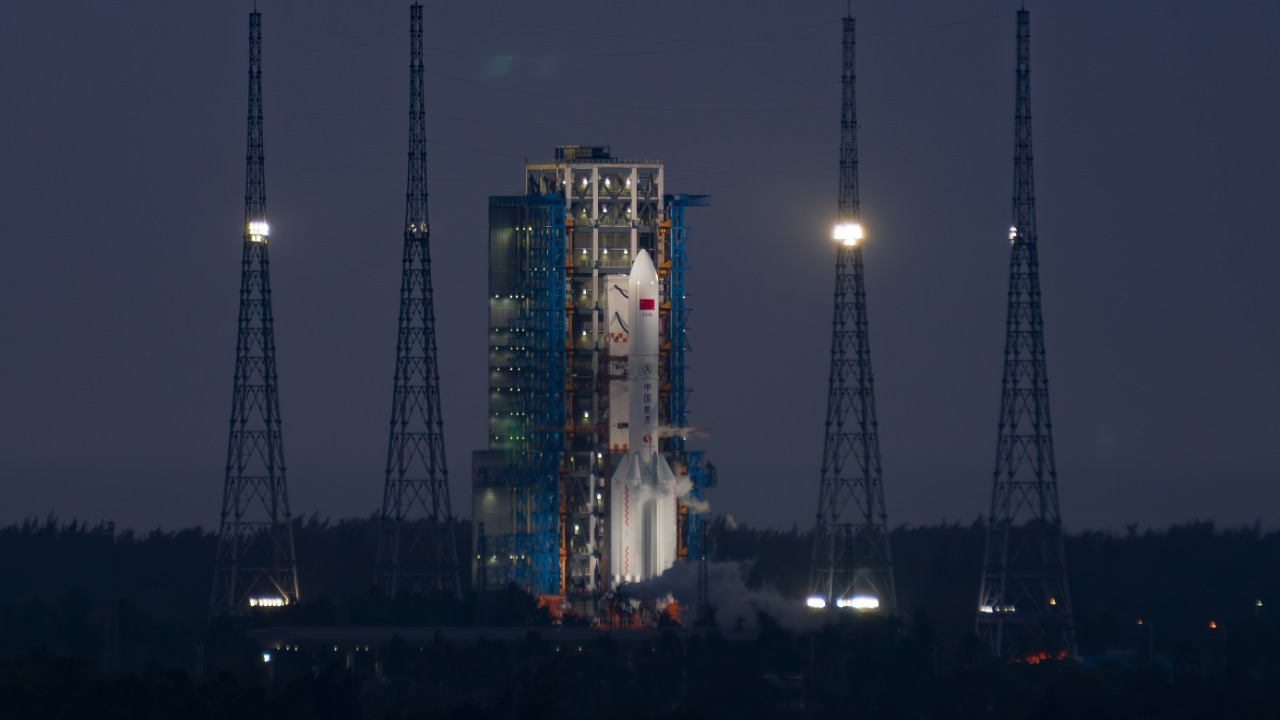

China has added a new milestone to its space program by sending a high-speed test satellite into orbit on a heavy-lift Long March-5 rocket, underscoring its ambition to dominate next-generation communications and orbital infrastructure. The mission, built around a powerful new spacecraft and an upgraded launcher, is designed to probe technologies that could reshape how data moves between Earth and space.
Rather than a one-off spectacle, the launch fits into a broader pattern of rapid-fire missions, expanding commercial partnerships, and record-setting cadence that is redefining China’s role in orbit. I see this flight as a snapshot of a country methodically building the hardware, industrial base, and diplomatic leverage it needs to compete in a crowded, high-stakes space economy.
Long March-5 and the new high-speed test satellite
The centerpiece of the story is the pairing of a heavy Long March-5 rocket with a high-speed test satellite built to trial advanced communications and data-transfer systems. The launcher, already central to China’s deep-space and large-payload ambitions, is being used here as a testbed for a powerful new spacecraft that officials describe as part of a push to expand space capabilities and explore high-throughput links. In practical terms, that means experimenting with faster, more resilient connections that could support everything from broadband services to secure government networks, with the satellite framed as a “powerful” platform in its own right according to detailed coverage of the high-speed test satellite.
What stands out to me is how the mission blends continuity and experimentation. The Long March-5 has already flown major payloads, but here it is matched with a satellite explicitly described as a test platform, signaling that the rocket family is now mature enough to support iterative technology demonstrations rather than only flagship missions. That shift matters, because it suggests China is moving from proving it can reach orbit with heavy payloads to refining what those payloads can actually do once they are there, a transition that often marks the difference between symbolic prestige and sustained strategic advantage.
A modified Long March-5 with an extended fairing
The rocket that carried this satellite was not a standard configuration, and that detail is more than cosmetic. Reporting on a recent Long March 5 flight notes that the vehicle used on a Saturday launch featured an extended fairing that was 18.5 meters tall, a change from the conventional setup that allows bulkier or more complex payloads to fit under the nose cone. By stretching the fairing, engineers effectively gave themselves more room to package large antennas, experimental modules, or multi-satellite stacks, a capability highlighted in technical descriptions of the Long March 5 configuration.
I read that hardware tweak as a quiet but important signal of where China wants to go next in orbit. An extended fairing is not just about one satellite, it is about designing a launcher that can accommodate the next generation of oversized communications platforms, modular space stations, or clustered tech demos. It also hints at a more flexible manufacturing pipeline, where the same core rocket can be tailored for different mission profiles, which is exactly the kind of adaptability that commercial and government customers look for when they plan multi-year constellations or complex test campaigns.
From TJSW-23 to the latest testbed
The new high-speed satellite does not exist in isolation, it follows a line of experimental spacecraft that have quietly expanded China’s technical playbook. Earlier this year, the Long March-5 Y10 launch vehicle, referred to in Chinese as 长征五号遥十, carried a payload designated TJSW-23, another mission framed as a technology or communications test. Video and mission notes on the Long March-5 TJSW-23 flight show how the same heavy-lift platform is being used repeatedly to loft experimental satellites, each one adding a layer of data about performance, reliability, and on-orbit behavior.
When I connect the dots between TJSW-23 and the new high-speed test satellite, a pattern emerges of incremental, tightly scoped missions that build toward more ambitious systems. Rather than betting everything on a single, monolithic communications constellation, China is using the Long March-5 as a workhorse for iterative learning, with each TJSW or similar payload acting as a stepping stone. That approach mirrors how other space powers have matured their own secure communications and early-warning architectures, and it suggests that the latest satellite is both a continuation and an escalation of a long-running test campaign.
Wenchang, Hainan and the rise of coastal launch hubs
The geography of this launch is as strategic as the hardware. The mission lifted off from the Wenchang Space Launch Site on the island of Hainan, a coastal complex that has become central to China’s heavy-lift operations. Official accounts describe how China sent a new communication technology test satellite from WENCHANG in Hainan on a Saturday, underscoring that this site is now the default home for large rockets and experimental payloads that benefit from low-latitude efficiency and sea-based safety corridors, as detailed in reports on the WENCHANG, Hainan launch.
Launching from Wenchang also reflects a broader shift toward coastal hubs that can support higher cadence and heavier traffic. The Wenchang Space Launch Site in southern China’s Hainan province is repeatedly cited as the origin point for new communication technology test satellites, including the one that rode a Long March 5 with an 18.5 meter fairing, according to detailed mission coverage of the Wenchang Space Launch Site. From my perspective, that concentration of heavy-lift activity on a modern coastal range gives China a structural advantage as it scales up both state and commercial launches, reducing overflight risks and opening the door to more frequent, larger missions.
Record-breaking Long March cadence
The high-speed satellite launch also lands in the middle of a remarkable surge in activity for the Long March family. Earlier in December, China managed to send three Long March rockets into space in less than 19 hours, a feat that pushed its total number of launches this year to 83 and extended an existing national record. Coverage of that sprint highlights how China continues to make big advances in what is often called the final frontier, using the Long March series as the backbone of a launch schedule that rivals any other spacefaring nation.
From my vantage point, that cadence is not just a bragging point, it is a prerequisite for the kind of high-speed communications ecosystem the new satellite is meant to test. High-throughput networks, resilient constellations, and rapid tech refresh cycles all depend on the ability to put hardware into orbit quickly and reliably. When a country can fly three Long March rockets in less than a day, then follow up with a heavy Long March-5 carrying a sophisticated testbed, it signals that the industrial and logistical machinery behind the scenes is robust enough to support sustained experimentation, not just occasional headline-grabbing missions.
Commercial satellites and the Spacesail–Airbus factor
Behind the state-led launches, a commercial ecosystem is taking shape that could amplify the impact of missions like the high-speed test satellite. Recent reporting describes how China’s commercial satellites are accelerating global connectivity, with a Spacesail–Airbus partnership aiming to build a robust, diversified ecosystem that blends domestic manufacturing with international expertise. In that context, the same Long March 5 rocket that deployed a tech demo satellite is part of a broader push to create launch and payload options for commercial players, as highlighted in analysis of how Spacesail and Airbus are working together.
I see the high-speed test satellite as a bridge between state experimentation and commercial opportunity. If the mission validates new high-speed links or advanced modulation schemes, those capabilities can feed directly into commercial constellations that promise global connectivity, including services that might be marketed by Chinese firms in partnership with established aerospace names. One executive, Tim Sommer, vice president of Airbus, is cited in related coverage discussing how such collaborations can support a more diversified space economy, a point that surfaces in reporting on Tim Sommer and Airbus as they engage with China’s commercial satellite sector. For investors and policymakers, that blend of domestic rockets, foreign partners, and experimental payloads is a sign that China is not just building hardware, it is building markets.
Strategic implications for China’s space ambitions
When I step back from the technical details, the strategic stakes of this launch come into sharper focus. The high-speed test satellite, lofted by a Long March-5 from Wenchang, fits neatly into a national strategy that treats space as a domain for economic growth, military resilience, and diplomatic influence. The country’s broader profile as a rising space power is evident in the sheer volume of missions, the diversity of payloads, and the way its name now anchors global conversations about orbital infrastructure, a trend that is easy to see in any overview of China’s space program.
High-speed communications satellites are particularly sensitive because they sit at the intersection of civilian and military needs. A platform capable of moving large volumes of data quickly and securely can support streaming video and cloud services, but it can also underpin encrypted command links, real-time reconnaissance feeds, and resilient backup channels if terrestrial networks are disrupted. By using a heavy launcher like Long March-5 to test such capabilities, China is signaling that it intends to field not just many satellites, but sophisticated ones that can anchor high-value services and strategic functions in orbit.
What comes next for Long March-5 and high-speed space tech
Looking ahead, I expect the Long March-5 to remain the workhorse for China’s most demanding communications and tech demo missions, especially those that require large, power-hungry payloads or complex antenna arrays. The combination of an extended 18.5 meter fairing, a proven heavy-lift core, and a launch site like Wenchang gives mission planners the flexibility to design ever more ambitious high-speed test satellites, building on the template set by the current flight and earlier experiments like TJSW-23. Each new mission will likely refine specific elements, from on-board processing to inter-satellite links, gradually turning experimental features into operational standards.
For the rest of the world, the key question is how quickly those standards will translate into services that compete with or complement existing global networks. If China can pair its record-breaking Long March cadence with commercially attractive offerings, supported by partnerships such as the Spacesail–Airbus collaboration and a steady stream of tech demos, it will be well positioned to shape the norms and infrastructure of high-speed space communications. The latest launch, framed as a powerful new step in a push to expand space capabilities, is less an endpoint than a marker on a trajectory that is clearly pointed toward a more crowded, more contested, and far more connected orbit.
More from MorningOverview