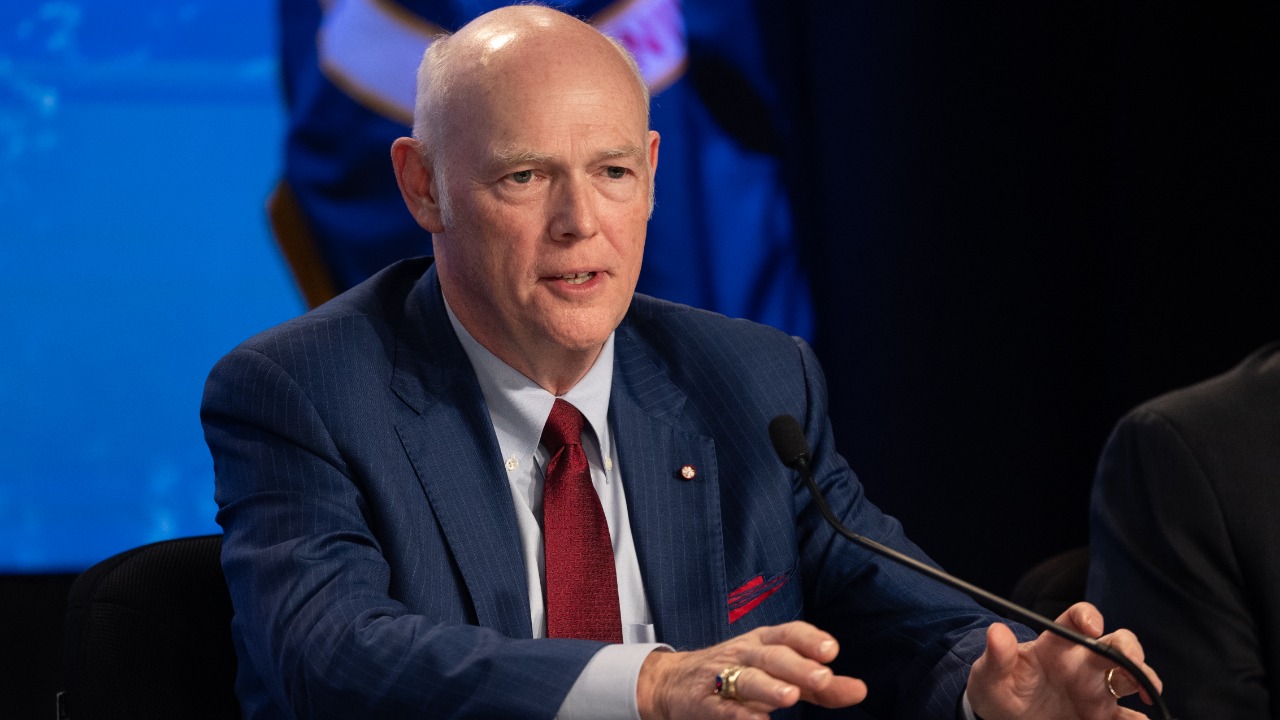

Tory Bruno’s abrupt exit from United Launch Alliance has jolted a launch industry that had come to see him as a fixture. After more than a decade as the public face and strategic architect of ULA, his resignation lands at a moment when the company is juggling Vulcan delays, a crowded manifest and unresolved questions about its long term ownership. The surprise is not that leadership would eventually change, but that it happened now, in the middle of a pivotal transition.
His departure instantly reshapes the competitive landscape around national security launches and commercial mega constellations, where ULA has been trying to hold ground against SpaceX and newer entrants. I see this as a stress test of ULA’s underlying business model, its relationship with the Pentagon and NASA, and the patience of its owners, Boeing and Lockheed Martin, who have been weighing what to do with the joint venture.
The shock exit and what we actually know
The basic fact is stark: United Launch Alliance chief Tory Bruno has resigned, ending a tenure that defined the company’s shift from the Atlas and Delta era toward Vulcan. Reporting describes how ULA had forecast nine launches for the year when Bruno spoke with reporters in August, a target that was already a sharp reduction from earlier ambitions, which underscores how much execution risk was still on his plate when he chose to leave. The language around his move, framed as a decision to pursue other opportunities, does not change the reality that the chief executive of a key national security launch provider is stepping away in the middle of a complex fleet transition, a point made clear in coverage of the United Launch Alliance chief Tory Bruno resigns story.
What stands out to me is how little advance signaling there was from ULA’s owners or customers that a change at the top was imminent. The company has been under pressure, but it was still winning new business and publicly projecting confidence in Vulcan’s ability to clear its backlog. That makes the timing of Bruno’s resignation feel less like a carefully staged succession and more like a decision that crystallized quickly once it became clear that the current trajectory, including the reduced launch forecast, was not sustainable without a reset.
John Elbon steps in and the board asserts control
Into that vacuum steps John Elbon, who has been named Interim CEO in a move that signals the board’s desire for continuity without committing to a long term successor. Robert Lightfoot, identified as the ULA Lockheed Martin Board Chair, announced that, effective immediately, Elbon would take the reins, a formulation that emphasizes both urgency and the board’s direct hand in the transition. I read that as a clear message that the owners, through figures like Robert Lightfoot at ULA, are no longer content to let strategic questions drift while Vulcan and the manifest hang in the balance.
Elbon’s “Interim CEO” label matters because it buys Boeing and Lockheed Martin time to reassess what they want ULA to be. An interim leader can focus on operational stability, keeping launches on track and customers reassured, while the board evaluates whether the next permanent chief should be a continuity figure from within the traditional aerospace ecosystem or someone brought in to push a more radical restructuring. By making the change effective immediately, the board has also avoided a drawn out lame duck period for Bruno, which can be destabilizing in a company that depends on tight coordination with the U.S. Space Force and other government customers.
How Bruno’s tenure reshaped ULA
To understand why his departure matters, I have to look at what Tory Bruno actually did as President and CEO of ULA. He took over a joint venture that had been created between Lockheed Martin and Boeing to consolidate their launch operations and, over time, he pushed it to shed some of the complacency that came with being the default provider for national security missions. Under his leadership, ULA began the long process of retiring the Atlas and Delta families and investing in Vulcan, while also trying to streamline operations and pricing to stay competitive with SpaceX. That arc is captured in reporting that notes how Tory Bruno, President and CEO of ULA, was steering a company born from that Lockheed Martin and Boeing partnership.
Bruno also became one of the most visible executives in the launch sector, using social media and public outreach to humanize a company that had long been seen as a quiet, government focused contractor. That visibility helped ULA defend its role in national security launches when SpaceX challenged its monopoly and pushed for open competition. Yet the same visibility now amplifies the sense of disruption, because the person who embodied ULA’s attempt to reinvent itself is no longer there to explain delays, reassure customers or sell the long term vision. His exit closes a chapter in which ULA tried to evolve within the constraints of its ownership structure and legacy hardware, with mixed results.
Vulcan delays, backlogs and the operational squeeze
The most immediate operational backdrop to Bruno’s resignation is the performance of ULA’s Vulcan rocket. Vulcan has been delayed, and those delays have translated into a backlog of more than 20 national security missions that still need rides to orbit. Even so, ULA has continued to win new contracts, which means the pressure is not just to catch up but to accelerate beyond the original plan. One report notes that while ULA’s Vulcan delays have created that backlog, the company is still adding work to its queue, a dynamic that captures both the trust it still enjoys and the risk of overpromising, as seen in coverage of how ULA’s Vulcan delays have stacked up.
From my perspective, that backlog is not just a scheduling problem, it is a strategic vulnerability. National security customers expect reliability and predictability, and a queue of more than 20 missions waiting on a new rocket strains that expectation. It also gives competitors an opening to argue that they can provide more responsive launch services. Bruno’s reduced forecast of nine launches for the year, compared with earlier, more ambitious targets, was an implicit acknowledgment that ULA could not simply will Vulcan into a higher tempo. His departure now raises the question of whether a new leader will double down on Vulcan as designed, or push for changes in how ULA allocates resources and manages risk around that vehicle.
Competing with SpaceX and serving demanding customers
ULA’s challenges do not exist in a vacuum. The company is a direct rival to SpaceX in the launch market, and its Vulcan rocket has been positioned as a workhorse for both government and commercial customers. Vulcan has already found customers in Amazon, for its Leo internet satellites, and in space startup ABL, which underscores how ULA is trying to tap into the same mega constellation and small satellite markets that have fueled SpaceX’s growth. Reporting on the resignation of the CEO of SpaceX rival ULA highlights that Vulcan’s customer list includes Amazon and other Vulcan users, which raises the stakes for getting the rocket’s cadence right.
In that context, Bruno’s exit looks like more than a personnel change, it is a pivot point in a race where SpaceX has already normalized rapid reuse and high launch rates. ULA has been trying to differentiate itself on reliability and mission assurance, especially for national security payloads, but commercial customers like Amazon also care about schedule and cost. If Vulcan cannot deliver both, those customers have alternatives. I see the leadership transition as a test of whether ULA can adapt its culture and operations quickly enough to remain a credible competitor in a market that is no longer defined solely by government procurement cycles.
Ownership tensions and the unsold joint venture
Behind the scenes, ULA’s ownership structure has been a persistent source of uncertainty. The company is a joint venture of Boeing and Lockheed Martin, and by late 2023 both owners had been exploring a sale of their stakes. Reporting notes that by that point, despite those efforts, the company had not been sold, leaving ULA in a kind of strategic limbo where its long term direction was unclear. That context is crucial when reading that, on December 22, 2025, Tory Bruno resigned as president and CEO of United Launch Alliance in what has been described as an unexpected departure, a fact captured in the summary that The ULA owners had not sold the company even as he stepped down.
From my vantage point, that unresolved ownership question hangs over every decision ULA makes, including leadership changes. If Boeing and Lockheed Martin still hope to sell ULA, installing an interim CEO could be part of a strategy to stabilize operations and clean up the balance sheet before a transaction. If a sale is off the table for now, then the board may be preparing to invest more deeply in Vulcan and other capabilities, which would require a leader aligned with that renewed commitment. Either way, Bruno’s exit removes a known quantity at a time when the joint venture’s future path is still being debated in boardrooms that sit outside ULA’s own headquarters.
Why Bruno’s resignation reverberates across the space sector
United Launch Alliance is not just another commercial launch provider, it is a central player in the U.S. national security space architecture. That is why the fact that United Launch Alliance (ULA) President and CEO Tory Bruno has resigned after more than a decade of leading the Boeing and Lockheed Martin backed company matters far beyond its own payroll. The description of him as “President and CEO Tory Bruno” of ULA, tied explicitly to Boeing, underscores how deeply integrated he was into the broader aerospace ecosystem, as reflected in reporting that United Launch Alliance (ULA) President and CEO Tory Bruno has resigned.
His departure will be closely watched by the U.S. Space Force, NASA and commercial partners who rely on ULA to deliver critical payloads. These stakeholders care less about the internal politics of Boeing and Lockheed Martin and more about whether the rockets will fly on time and on budget. A leadership change of this magnitude can either reassure them, if it is paired with a credible plan to improve performance, or deepen their concerns if it appears reactive and unmoored from a broader strategy. I see the reaction from these customers over the coming months as a key indicator of whether ULA’s brand of high assurance launch services still commands the same loyalty it did when Bruno was firmly in charge.
What “pursuing other opportunities” really signals
Officially, the owners of the United Launch Alliance rocket company have said that CEO Tory Bruno has left the company to pursue other opportunities, a familiar corporate phrase that often masks a more complex mix of push and pull factors. The wording makes clear that the decision is being framed as his choice, but the fact that the announcement came alongside the immediate appointment of an interim successor suggests that the owners were prepared for this outcome. The report that the owners of United Launch Alliance CEO Tory Bruno have moved quickly to install John Elbon reinforces that impression.
In my view, “pursuing other opportunities” in this context likely reflects a convergence of Bruno’s own assessment of ULA’s trajectory and the board’s appetite for change. After more than a decade in the role, he had shepherded the company through the end of the Atlas and Delta era and into the early Vulcan phase. If the next phase requires a different risk profile, a different approach to pricing or a more aggressive stance toward reuse and innovation, it is plausible that both he and the owners concluded that a new leader would be better suited to that task. The phrasing allows everyone to save face while acknowledging that the status quo was no longer tenable.
How ULA’s identity is being rewritten in real time
Stepping back, I see Bruno’s resignation as part of a broader rewriting of ULA’s identity. The company was created to be a stable, conservative provider of launch services for the U.S. government, insulated from the boom and bust cycles of purely commercial space ventures. Over time, as SpaceX and others changed the economics and cadence of launch, ULA tried to straddle two worlds, maintaining its high assurance culture while dabbling in more commercial opportunities like Amazon’s Leo satellites. The fact that ULA’s Vulcan rocket has attracted customers such as Amazon and space startup ABL, even as it struggles with delays and a heavy national security backlog, shows how far the company has moved from its original, narrower remit.
Leadership changes crystallize those tensions. With Bruno out and John Elbon in as Interim CEO, the question is whether ULA doubles down on being the gold standard for government missions, even if that means ceding some commercial ground, or whether it leans harder into competing head to head with SpaceX on price and cadence. The unresolved ownership situation, the unsold joint venture status and the operational realities of Vulcan all feed into that choice. For now, what is clear is that the surprise departure of Tory Bruno has forced ULA, its owners and its customers to confront those questions more directly than at any point since the company was formed.
More from MorningOverview