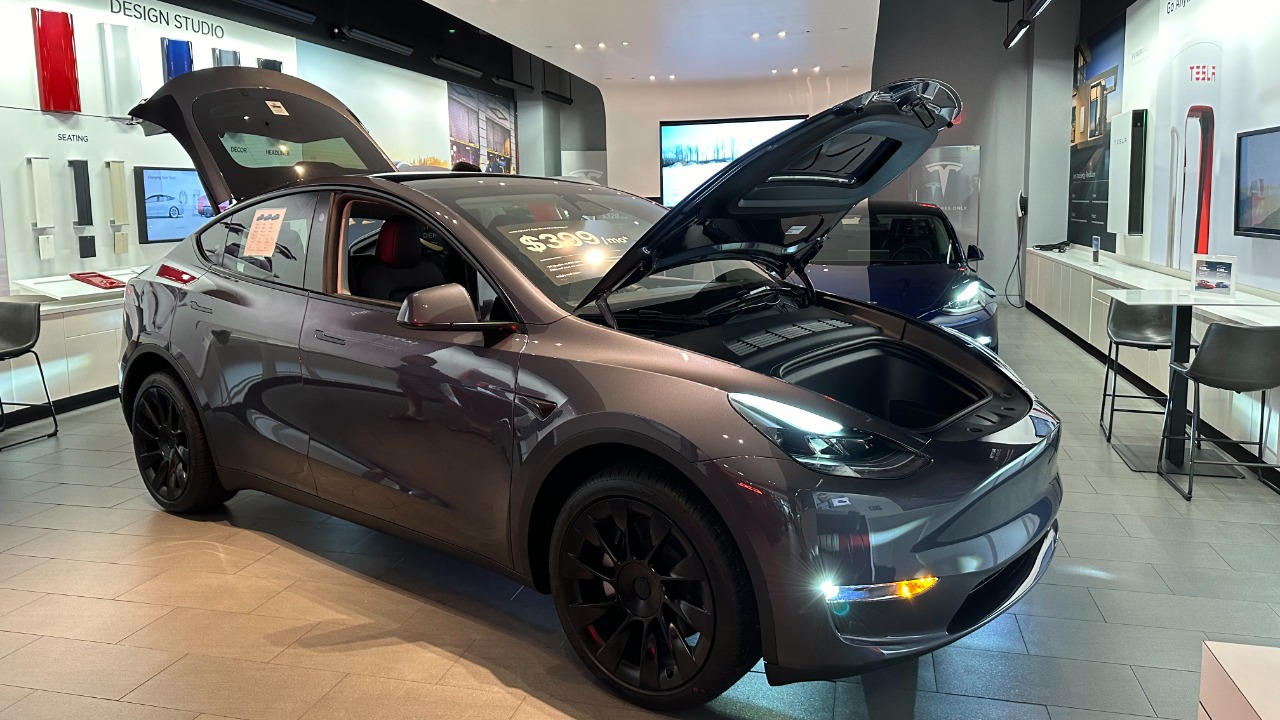

Tesla’s California ride-hailing experiment has quietly turned into a sizable operation, with the company’s registered fleet in the state now clearing the 1,500-car mark. That scale puts Tesla in the same numerical conversation as the most established robotaxi players, even as its service still relies on human drivers and a driver-assistance system that regulators do not classify as fully autonomous.
The rapid buildout raises a sharper question about what exactly Tesla is building in California: a conventional rideshare network that happens to use its own cars, or the scaffolding for a future driverless service that could compete head-on with the industry’s pure-play autonomy leaders. The answer will shape not only Tesla’s business, but also how regulators, rivals, and riders think about the next phase of urban mobility.
From pilot to 1,500-plus: how Tesla’s fleet ballooned
The most striking part of Tesla’s California story is the speed of its fleet expansion. In just a few months, Tesla has registered more than 1,000 new vehicles for its so‑called robotaxi program in the state, a surge that pushed the total number of cars in its ride-hailing pool past the 1,500 threshold. That registration data reflects a deliberate push to seed California’s roads with Tesla-owned vehicles that can be dispatched for rides, rather than relying solely on privately owned cars using the company’s software.
Regulatory filings indicate that Tesla has been approved to operate a fleet of up to 1,655 Robotaxis in California, a ceiling that effectively defines the near-term growth runway for its service in the state. The fact that Tesla has already registered more than 1,500 cars against that cap suggests the company is not treating this as a tentative pilot, but as a scaled commercial operation. It also signals to regulators and competitors that Tesla intends to be a fixture in California’s ride-hailing ecosystem, not a niche experiment.
What “robotaxi” means in Tesla’s California rollout
On paper, Tesla describes this California fleet as a robotaxi initiative, but in practice the service still depends on human drivers sitting behind the wheel. Reporting on the program notes that Tesla has registered over 1,000 vehicles for the service while also recruiting drivers to operate them, a model that looks more like a vertically integrated rideshare platform than a fully driverless robotaxi network. The company’s branding leans heavily on autonomy, but the operational reality is closer to a traditional ride-hailing fleet that happens to be owned and dispatched by the automaker itself.
This distinction matters because California regulators draw a clear line between driver-assistance systems and true autonomous vehicles. Tesla markets its software as Full Self-Driving, but the state treats it as an advanced driver-assistance feature that still requires human supervision, which is why the current fleet must have drivers behind the wheel. The company’s decision to label these cars as Robotaxis in filings and marketing, even while they operate with human drivers, underscores how much of Tesla’s California push is about positioning for a future driverless era rather than reflecting the capabilities of the service today.
Waymo’s benchmark and the race for California streets
Tesla’s scale only makes sense when set against the incumbent that has defined the robotaxi category in California. Earlier this year, data from the California Public Utilities Commission showed that Waymo had 1,429 vehicles operating in California, a driverless fleet that already covers roughly 170 square miles of the Bay Area. That footprint, built over years of testing and regulatory engagement, has made Waymo the reference point for what a mature autonomous ride-hailing service looks like in the state. Tesla’s decision to push its own fleet past 1,500 cars is best understood as an attempt to match that presence in raw numbers, even if the underlying technology and regulatory status are very different.
Waymo’s service, accessible through its dedicated app and detailed on its public-facing site at waymo.com, operates without human drivers in the front seat, a milestone Tesla has not yet reached in California. However, the California Public Utilities Commission (CPUC) data that put Waymo at 1,429 vehicles also highlighted how quickly the competitive landscape is shifting, with multiple companies vying for permits and territory. By racing to fill its own allocation of up to 1,655 Robotaxis, Tesla is effectively staking out its share of California’s streets before regulators and rivals can lock in a new status quo.
Regulators, safety, and the semantics of autonomy
California’s regulators sit at the center of this contest, and their decisions will determine how far and how fast Tesla can push its robotaxi ambitions. The CPUC’s role in certifying that Waymo could operate 1,429 driverless vehicles in the state illustrates how carefully it calibrates fleet sizes and service areas. In Tesla’s case, the approval to run up to 1,655 Robotaxis in California shows that regulators are willing to let the company scale, but only within a framework that still assumes human oversight behind the wheel. That balance reflects both the promise of electric, software-driven mobility and the lingering concerns about safety and accountability when algorithms take on more of the driving task.
The semantics of autonomy are not just a branding issue, they shape how incidents are investigated and who bears responsibility when something goes wrong. When a driverless vehicle from a company like Waymo is involved in a collision, regulators and the public look directly at the autonomous system. When a Tesla operating under Full Self-Driving in California crashes, the presence of a human driver complicates the picture, even if the software was in control at the time. The state’s insistence on treating Tesla’s system as driver assistance, despite the company’s robotaxi rhetoric, is a reminder that the legal definition of autonomy is still catching up to the marketing language that surrounds it.
Cybercab and the long game behind today’s fleet
To understand why Tesla is pouring so many cars into California’s ride-hailing pool, it helps to look at the company’s product roadmap. Tesla is preparing a dedicated robotaxi vehicle called Cybercab, with plans to gear up for production in 2026. Separate reporting has described how Tesla is set to unveil its Cybercab in a move that Musk hopes will steer the company into a new era, signaling that Tesla sees purpose-built robotaxis as a core pillar of its future business rather than a side project. The current California fleet, made up of existing Tesla models, looks increasingly like a bridge to that dedicated platform.
The CEO has also laid out a geographic strategy that puts California at the center of Tesla’s ride-hailing ambitions. In a recent discussion of the company’s plans, he said that The CEO wants to launch rideshare services in California and Texas this year using a “fully autonomous” version of Tes software, even though the dedicated Cybercab will not enter production until at least 2026. That timeline makes the current 1,500-plus fleet in California look like a testbed for the software, logistics, and customer experience that will eventually underpin a driverless Cybercab network. In other words, the cars on the road today are as much about training Tesla’s systems and operations as they are about generating near-term ride revenue.
Rivals retreat and regroup as Tesla leans in
Tesla’s aggressive buildout in California is happening against a backdrop of consolidation and retrenchment in the broader robotaxi sector. General Motors has pulled back from its self-driving taxi business, a retreat that has reshaped expectations about how quickly fully autonomous ride-hailing can scale. Reporting on that decision noted that the target market for robotaxis still includes companies like Waymo, which already operates driverless ride-hailing vehicles in some cities, and suggested that robotaxis could be picking up passengers at scale by 2026 or so. GM’s decision to step back underscores how capital intensive and politically fraught this space has become, even for legacy automakers with deep pockets.
In that context, Tesla’s willingness to register more than 1,000 new vehicles in California in a matter of months looks like a calculated bet that scale and data will eventually outweigh the near-term risks. While some rivals are trimming fleets or slowing deployments, Tesla is racing toward its approved ceiling of 1,655 Robotaxis in the state, effectively using California as the proving ground for its broader autonomy strategy. The contrast with GM’s pullback highlights how divergent the industry’s approaches have become, with some players prioritizing caution and others prioritizing momentum.
What riders and cities stand to gain or lose
For riders, the immediate impact of Tesla’s 1,500-plus fleet is more choice and, potentially, lower prices in the ride-hailing market. A vertically integrated service, where Tesla owns the cars and controls the software, could allow the company to undercut traditional platforms on cost while offering a more consistent in-car experience. The rapid registration of more than 1,000 vehicles suggests Tesla is serious about reaching a scale where those advantages become tangible for everyday users, especially in dense urban corridors where ride demand is highest.
For cities, the calculus is more complicated. On one hand, a large fleet of electric Robotaxis could help reduce tailpipe emissions and support climate goals, particularly if it displaces older, more polluting vehicles. On the other hand, the arrival of up to 1,655 Tesla-operated cars on California streets raises familiar concerns about congestion, curb management, and the impact on public transit ridership. City officials will have to decide whether to treat Tesla’s service like any other ride-hailing platform or to craft new rules that reflect its hybrid status as both an automaker and a mobility provider.
The next twelve months: from 1,500 cars to true autonomy?
The near-term question is how quickly Tesla can convert its California footprint from a driver-operated fleet into something closer to the driverless vision it has been selling to investors and fans. With Tesla gearing up for the production of its dedicated robotaxi product, Cybercab, in 2026, the next year looks like a transitional period in which the company will try to prove that its software can handle more of the driving task under real-world conditions. The existing fleet, already past 1,500 cars and heading toward the approved limit, gives Tesla a large sample of vehicles on which to iterate its systems and gather data.
At the same time, the company’s own timeline acknowledges that fully driverless service is not imminent. The plan to unveil Cybercab and to launch rideshare services in California and Texas using a “fully autonomous” version of Tes software, even as the dedicated vehicle will not enter production until at least 2026, shows that Tesla is trying to thread a needle between ambition and regulatory reality. Whether the company can move from a 1,500-car, driver-operated fleet to a truly driverless network on that schedule will depend not just on its engineering progress, but also on how California’s regulators, and its competitors like Waymo, respond to the next phase of the robotaxi race.
More from MorningOverview