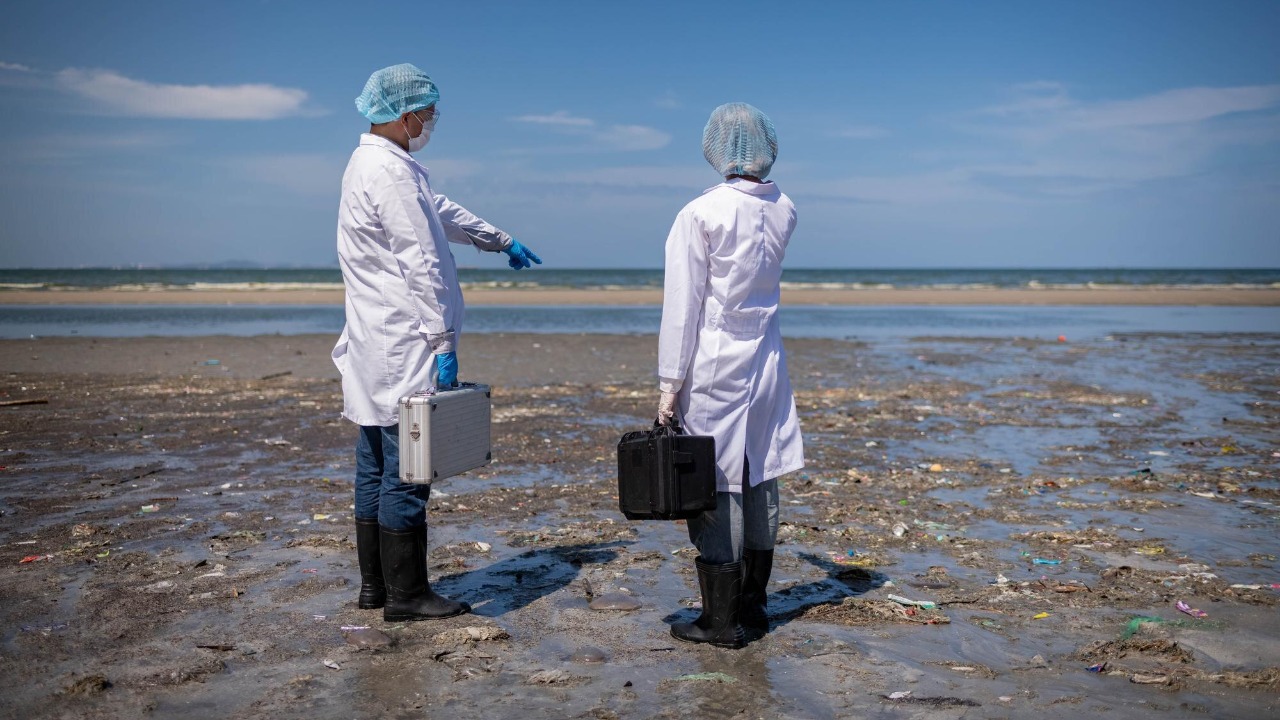

Along the edges of the United States, scientists are picking up signals that the ocean is changing faster than coastal communities are prepared for. From eroding salt marshes and sinking cities to a potentially destabilized Gulf Stream, the latest findings suggest that a new kind of coastal threat is emerging and, in several cases, intensifying. I see a pattern in these warnings: what once looked like slow, distant risks is now showing up as a series of concrete, local shocks along the US coast.
Those shocks are not isolated. They are linked by the physics of a warming planet, rising seas, and shifting currents that are reshaping shorelines from Georgia’s marshes to the Pacific Northwest and the Outer Banks. The science is increasingly clear that without rapid changes in how the country manages emissions, development, and coastal defenses, the damage that is starting to appear at the water’s edge could accelerate within a single generation.
Salt marshes off Georgia reveal a fragile first line of defense
Along The Georgia coast, researchers have been documenting a quiet but consequential transformation in the salt marshes that buffer communities from storms. These wetlands act as natural breakwaters, absorbing wave energy and trapping sediment, yet field teams now report widening creeks, collapsing banks, and vegetation that is struggling to keep pace with the water. In one recent study, Scientists described a “looming threat” off the US coast and warned that “it might be intensifying even more,” a sign that the processes undermining these marshes are not static but accelerating as sea levels rise and storms push farther inland.
Part of what makes this discovery so troubling is that it undercuts the assumption that marshes will simply migrate landward as seas climb. Work led by KATHARINE OTZEN BUGBEE, detailed in a thesis prepared by KATHARINE OTZEN BUGBEE (Under the Direction of Jon Calabria) ABSTRACT The Georgia, finds that shoreline hardening and altered sediment flows are degrading these habitats and limiting their ability to adapt. Marshes protect habitats along the coast and shield inland neighborhoods from erosion, so their decline is not just an ecological loss, it is a direct hit to the resilience of nearby towns that have long relied on them as a free, self-maintaining flood barrier.
A new study off the US coast hints the damage is getting worse
The latest alarm about a “new US coast find” comes from Scientists who, after surveying stretches of salt marsh and nearshore waters, concluded that the threat they were tracking “might be intensifying even more.” Their work off the Georgia shoreline linked much of the observed erosion and flooding to human-driven climate change, with higher seas and heavier downpours eating away at the marsh platform and drowning low-lying vegetation. When I read that the researchers expect these trends to worsen in the next few years, it is hard not to see this as an early warning for other estuaries that share similar geomorphology and development pressure.
The same research group has emphasized that what is unfolding in Georgia is a test case for delicate ecosystems in other states, a point underscored in a companion explainer that invites readers to Learn how marsh loss can cascade into fisheries declines and more severe storm damage. In their more technical write-up, the same Scientists describe how the researchers linked much of the marsh degradation to climate-driven sea level rise and changing rainfall patterns, warning that without intervention, the erosion and flooding they are documenting now could accelerate markedly in the next few years Scientists Ther. That combination of near-term timing and clear attribution is what makes this discovery feel less like a distant climate scenario and more like a live coastal emergency.
Century‑old corals show the Pacific Northwest is changing too
On the opposite side of the country, another line of evidence is emerging from the skeletons of deep‑water corals off the West Coast. By analyzing chemical signatures laid down over decades, scientists have reconstructed how the acidity of the California Current System has shifted as the ocean has absorbed more carbon dioxide. One key finding is that the water that upwelled along the Pacific Northwest in the summer of 2025 last saw the surface around 30 to 50 years ago, which means it carries the imprint of atmospheric conditions from sometime around the 1980s, when global emissions were already climbing rapidly.
Those coral records suggest that parts of the Pacific Northwest are acidifying faster than expected, a trend that threatens shell‑forming organisms and the fisheries that depend on them. The work, led by researchers including Barto, shows that the chemistry of the upwelled water is now corrosive enough in some seasons to stress oysters and other calcifying species, raising the risk of local die‑offs if conditions worsen. The study’s authors argue that while the California Current System has always delivered nutrient‑rich deep water to the surface, the fact that this water now reflects atmospheric carbon levels from the late twentieth century means today’s emissions will keep reshaping coastal chemistry for decades to come 50 West Coast Barto. That lag makes it harder for communities to reverse course quickly, even if they cut pollution now.
Offshore, a looming threat to fisheries and coastal economies
Beyond the marshes and reefs, Researchers are flagging a different kind of hazard lingering off the US coast, one that could hit both marine ecosystems and the people who depend on them for work. In a recent investigation, they described a “looming threat” offshore and warned that “Everything was very bad” when they examined the conditions facing key species. While the details vary by region, the common thread is that warming, acidifying, and increasingly low‑oxygen waters are squeezing the habitat of commercially important fish and shellfish, undermining the reliability of catches that coastal communities have long taken for granted.
The same report stresses that this is not just a biodiversity story but an economic one, since many coastal residents rely on these species for food and income. The Researchers who issued the urgent warning framed it as a call for both stronger climate action and more adaptive fisheries management, arguing that without changes, the offshore threat could translate into job losses and food insecurity in port towns that are already vulnerable to storms and flooding Researchers Everything. I read that as a reminder that the health of the water just beyond the horizon is tightly bound up with the stability of life on shore.
The Gulf Stream and AMOC: a planetary system with local stakes
Layered on top of these coastal changes is a more global concern that could reshape sea levels and storm patterns along the entire Atlantic seaboard. Several teams of Scientists have warned that the Gulf Stream, part of the larger Atlantic meridional overturning circulation (AMOC), could be weakening more quickly than climate models once projected. One high‑profile analysis suggested that the Gulf Stream could collapse as early as 2025 if greenhouse gas emissions continue unabated, a scenario that would represent a profound tipping point in the climate system and trigger abrupt shifts in temperature and rainfall across the North Atlantic region.
Other experts are more cautious, arguing that while a near‑term collapse is unlikely, the trend toward a weaker overturning circulation is robust and already detectable. Reporting on these debates has highlighted how a slowdown in the AMOC would likely accelerate sea level rise around North America and reduce primary production in the North Atlanti, with knock‑on effects for fisheries and weather extremes Weakening of the AMOC North America and North Atlanti. One study that drew wide attention framed the risk starkly, warning that without rapid cuts in carbon emissions, the system could cross a threshold this century Gulf Stream could collapse. I see these findings less as a prediction of a specific year and more as a warning that the background conditions shaping US coasts are shifting in ways that are hard to reverse.
Scientists split on how close the Gulf Stream is to a tipping point
Part of the public confusion around the Gulf Stream comes from the range of views among specialists about how close the system is to a critical threshold. Some Climate scientists claim the Gulf Stream could be near collapse and even predict a new ice age for parts of the Northern Hemisphere if the flow of warm water from the tropics were to shut down. Their warnings, amplified in popular coverage, paint a picture of dramatic cooling in Europe, shifting storm tracks, and rapid sea level changes along the US East Coast that would compound the flooding already driven by thermal expansion and melting ice.
Other researchers push back, noting that while there is strong evidence of weakening, the uncertainties in both observations and models make it difficult to pin down the timing of any abrupt transition. A widely shared video discussion featuring Scientists debating whether the Gulf Stream could collapse as early as 2025 underscores this divide, with some participants emphasizing the need for precaution and others stressing the limits of current data Scientists Gulf Stream. Coverage by Ben Cost, which notes that Climate experts are warning the Gulf Stream is “on the verge of collapse,” captures the more alarmed end of the spectrum and highlights how a disruption in the flow of warm water from the tropics to the Northern Hemisphere would reverberate through weather and sea level patterns Climate Gulf Stream Ben Cost Published Nov. For US coastal planners, the takeaway is that even a gradual weakening, short of collapse, could still raise local sea levels and alter storm behavior in ways that matter for infrastructure decisions being made now.
American coastal cities are sinking as seas keep rising
While these large‑scale ocean shifts play out, a more immediate and measurable problem is unfolding beneath American cities built on soft sediments and reclaimed land. Using satellite data, Scientists have documented that several American coastal cities are subsiding at rates that, when combined with global sea level rise, are “More than enough to put human life at risk” in low‑lying neighborhoods. In parts of California, for example, the ground is sinking even as higher tides and stronger storms push water farther inland, creating a double exposure that erodes the safety margin engineers assumed when they designed roads, airports, and wastewater systems.
One recent analysis warned that as these cities continue to sink, rising seas will add further risk, particularly in areas where levees and seawalls were built to past standards that did not account for ongoing subsidence. The same pattern is visible in other regions, from the Gulf Coast to the mid‑Atlantic, where dense development and groundwater extraction are causing the land to settle even as climate change lifts the ocean surface Scientists American More. A separate report framed the issue bluntly, noting that Scientists sound alarm as American coastal cities continue to sink, with the added stress of higher tides and storm surges threatening homes, businesses, and critical infrastructure along the California coast Scientists American More. I see this as one of the clearest examples of how climate hazards and local land use decisions can combine to magnify risk.
Sea‑level rise is flooding wetlands for longer, eroding their resilience
Behind the headlines about sinking cities and eroding marshes lies a more subtle but powerful driver: the way long‑term sea level rise is changing the rhythm of tides in coastal wetlands. Decades of sediment core and elevation data show that as the baseline water level creeps up, marshes are flooded more frequently and for longer periods, which can initially boost sediment deposition but eventually drowns vegetation that cannot tolerate prolonged submergence. That shift in flooding duration is one reason scientists are seeing more open water ponds and collapsing creek banks in places that once supported continuous marsh grass.
High‑resolution records of coastal wetland response to sea‑level variability indicate that this process is not linear. In some cases, a modest additional rise can push a marsh past a threshold where plant productivity drops and erosion outpaces sediment gain, leading to rapid habitat loss over just a few decades The long‑term rise in sea level. In Georgia and other low‑gradient coasts, that dynamic is colliding with human alterations like ditches and bulkheads, which can trap water on the marsh surface and further stress plant roots. From my perspective, this is one of the clearest examples of how a global signal, measured in millimeters per year, translates into very local tipping points for ecosystems that have limited room to move.
Crab burrows, soil oxygen, and the hidden mechanics of marsh collapse
Zooming in even further, some of the most intriguing work on marsh vulnerability focuses on what is happening beneath the surface. Biologists have long known that burrowing crabs and other organisms can change how water moves through marsh soils, but recent studies suggest these small engineers may play an outsized role in how wetlands respond to rising seas and nutrient pollution. As burrows proliferate, they can create preferential pathways for tidal water to infiltrate the sediment, altering pore water flows and the balance of oxygen and sulfide around plant roots.
One experimental study found that Such changes in pore water dynamics can deplete oxygen in marsh soils, which in turn impairs plant root respiration and weakens the vegetation that holds the sediment together Such. When combined with higher flooding and stronger waves, that weakened root network can accelerate bank erosion and creek widening, exactly the patterns now being documented in parts of The Georgia coast. I see this as a reminder that the stability of a marsh is not just about sea level and storms, but also about the intricate interactions between animals, plants, and geochemistry that can tip a system from resilience to rapid loss.
Homes falling into the Atlantic show what failure looks like
If all of this still sounds abstract, the images from the Outer Banks of North Carolina offer a stark, tangible illustration of what happens when coastal risk is underestimated. In the Outer Banks, a string of barrier islands that has long been a magnet for vacation homes, several beachfront houses have literally collapsed into the Atlantic as erosion chewed away the dunes beneath their pilings. Video from recent storms shows entire structures tilting and then sliding into the surf, scattering debris along miles of shoreline and forcing emergency cleanups to protect wildlife and swimmers from nails, insulation, and broken lumber.
Officials there have pointed out that these dramatic failures are not isolated accidents but the predictable outcome of building too close to an eroding shore in an era of rising seas. A recent report on the incidents noted that MORE: Coastal US ( U.S. ) cities are sinking as sea levels continue to rise, new research shows, drawing a direct line between what is happening on that narrow strip of sand and the broader pattern of vulnerability along the nation’s coasts MORE Coastal US In the Outer Banks. For me, those fallen homes are less a curiosity than a preview of the choices other communities will face as the line between land and sea keeps shifting.
What coastal communities can still do with the warning
Across these stories, a common thread is that the warnings are arriving early enough for action to matter, but late enough that the costs of delay are already visible. Scientists who track global sea level and storm trends have issued an urgent warning about the looming threat to coastal communities around the world, arguing that the latest United Nations projections should be treated as a floor, not a ceiling, for planning purposes Scientists. In the United States, that means rethinking where and how to build, investing in living shorelines that can grow with rising water, and, in some cases, planning for managed retreat from the most exposed areas rather than doubling down on hard defenses that may fail.
At the same time, the offshore and large‑scale signals, from acidifying waters tracked by Barto’s coral records to the debated weakening of the Gulf Stream, reinforce the need for rapid cuts in greenhouse gas emissions to limit further destabilization. I come away from this body of research with a clear impression: the “new” coastal threats scientists are flagging are not isolated anomalies, they are early chapters in a longer story of how a warming planet reshapes its shorelines. The question now is whether policymakers, developers, and residents treat these findings as a final warning or as the starting point for a different relationship with the sea that has always defined, and now increasingly threatens, the American coast.
More from MorningOverview