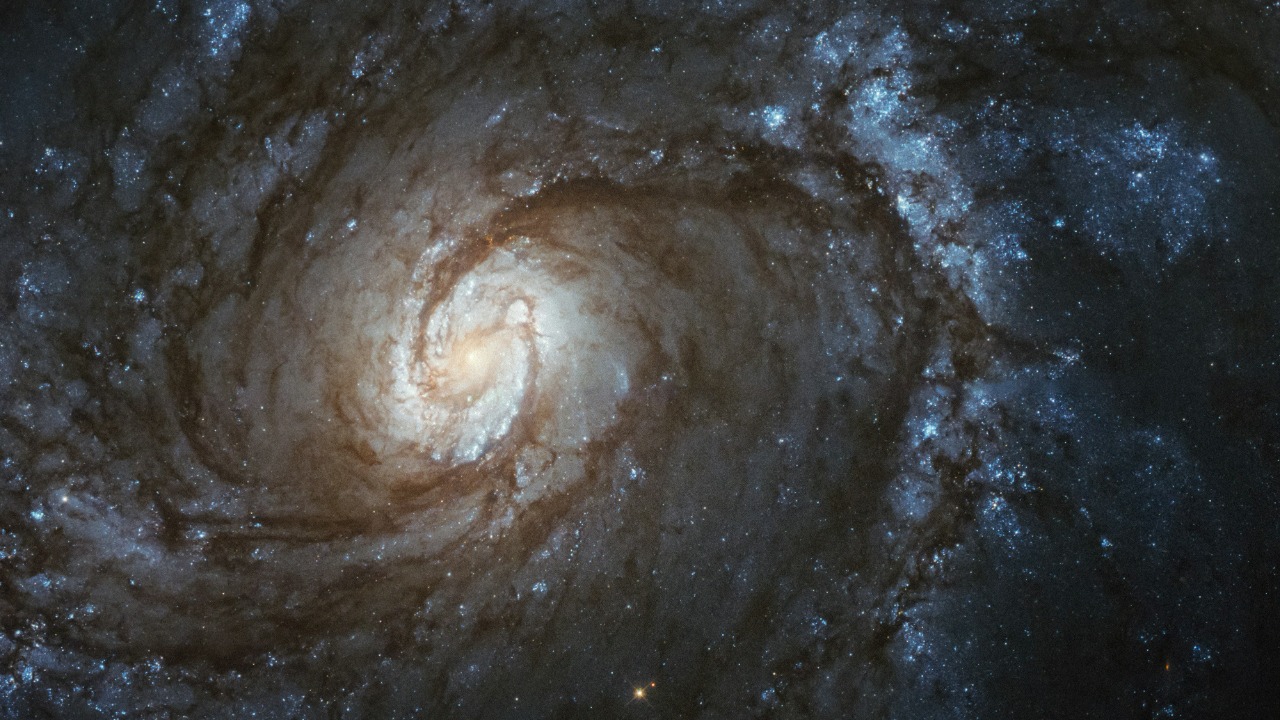

Most of the matter and energy in the cosmos does not shine, yet its presence is written into the way galaxies twist, stretch, and smear across the sky. By treating those warped galaxies as data rather than defects, astrophysicists are turning the night into a vast measuring instrument for dark matter and dark energy. The result is a new generation of maps that chart the invisible scaffolding of the Universe with a precision that would have sounded like science fiction a decade ago.
Instead of looking for dark matter directly, researchers are watching how it tugs on light, using subtle distortions in galaxy shapes to reconstruct where unseen mass lies and how it has grown over time. Those same distortions also carry clues about the mysterious force that is speeding up cosmic expansion, giving scientists a way to test whether our best theory of gravity still holds on the largest scales we can observe.
The strange physics behind warped galaxies
When light from a distant galaxy passes near a massive object, gravity bends its path, slightly altering the galaxy’s apparent shape by the time it reaches our telescopes. In the most dramatic cases, this gravitational lensing produces bright arcs and multiple images, but for most galaxies the effect is far subtler, amounting to tiny changes in ellipticity that only emerge statistically across millions of objects. Those tiny distortions are exactly what teams now measure to map how dark matter and dark energy affect the visible universe, as described in recent work that uses small shape changes to trace the unseen structures that surround galaxies and clusters.
Because dark matter, as far as current evidence shows, interacts only through gravity, its fingerprints appear most clearly in how it deflects light rather than in any glow of its own. By studying these weak distortions in the shapes of distant galaxies, astrophysicists have been able to reconstruct where dark matter is densest and how it is distributed across enormous volumes of space, turning warped galaxies into a practical tool for charting the invisible universe and its evolution over billions of years, a strategy highlighted in new analyses of tiny distortions.
Gravitational lensing as a cosmic weighing scale
At the heart of this approach is gravitational lensing, the bending of light by massive objects that effectively turns galaxies and clusters into natural telescopes. In its weak form, lensing does not produce spectacular arcs but instead introduces a coherent, small shear in the shapes of background galaxies that can be teased out statistically. Because this bending depends directly on the total mass along the line of sight, including both ordinary and dark matter, it provides a way to weigh structures that would otherwise be invisible, allowing scientists to probe the amount of mass and its distribution in systems like galaxies and galaxy clusters using Gravitational lensing.
Weak lensing measurements are especially powerful because they do not care what form the mass takes, only how much gravity it exerts, which makes them ideal for tracking dark matter that does not emit or absorb light. By mapping how the average distortion pattern changes with distance and direction on the sky, researchers can reconstruct three dimensional mass distributions and follow how structures have grown over cosmic time, turning the sky into a laboratory for testing models of dark matter and the physics of cosmic acceleration.
From The University of Chicago Via new maps of the invisible universe
Recent work From The University of Chicago Via large imaging surveys has pushed this technique to new scales, combining measurements of galaxy shapes with redshift information to build detailed maps of dark matter and dark energy. In one such effort, scientists described how they could trace the invisible web of mass that threads through space and compare it with the distribution of galaxies, revealing new clues about how dark matter clumps and how dark energy influences the growth of structure. These studies, gathered under the banner Scientists Map the Invisible Universe, Revealing New Clues About Dar, show that the unseen components of the cosmos can be charted with a fidelity that rivals traditional maps of stars and gas, as summarized in a report on Scientists Map the Invisible Universe, Revealing New Clues About Dar.
These maps do more than just visualize the unseen, they provide quantitative tests of cosmological models by comparing the observed clumpiness of matter with predictions from simulations that assume specific amounts of dark matter and dark energy. When the observed pattern of lensing matches the expected distribution, it strengthens the case that our current picture of the Universe is broadly correct, while any mismatch could signal new physics or unaccounted for systematics in the data. The Chicago led analyses are part of a broader push to use warped galaxies as a precision tool, turning what once looked like noise in galaxy images into a rich source of information about the dark sector.
How tiny shape distortions become precision cosmology
Extracting cosmological information from warped galaxies is technically demanding, because the lensing signal is small compared with the intrinsic variety of galaxy shapes and the blurring introduced by telescopes and the atmosphere. Researchers must model and subtract these effects with exquisite care, then average over vast numbers of galaxies to reveal the underlying shear pattern caused by intervening mass. One recent analysis emphasized that it was not clear that such tiny distortions could be measured reliably at the required precision, yet careful calibration and sophisticated algorithms have now made it possible to turn those subtle signals into robust maps of dark matter and dark energy, as highlighted in a study that quotes a PhD student in Physics reflecting on the challenge of measuring such small effects in Dec.
Once the shear field is measured, it can be translated into a map of projected mass using the equations of general relativity, then compared with the distribution of galaxies and clusters to test how well light traces mass. By slicing the data in redshift, scientists can also watch how the amplitude of lensing grows with distance, which encodes information about the expansion history of the Universe and the influence of dark energy. This is where warped galaxies become a tool for precision cosmology, allowing teams to measure parameters like the matter density and the strength of clustering with percent level accuracy, and to check whether gravity behaves as expected on scales far beyond the reach of laboratory experiments.
Why dark matter and dark energy dominate the cosmic story
All of this effort rests on a stark fact, Most of the Universe is made of components that do not emit light, yet their gravitational pull guides the formation of everything we can see. Dark matter acts as a kind of invisible scaffolding, drawing in gas that later forms stars and galaxies, while dark energy appears to drive the accelerating expansion that stretches space itself. Observations of galaxy rotation curves, cluster dynamics, and the cosmic microwave background all point to this unseen majority, but it is through gravitational lensing that its influence on the paths of photons becomes directly measurable, as described in work that uses the way light is lensed by a foreground cluster to illustrate how Most of the mass is dark.
Because dark matter appears to interact only through gravity, lensing is uniquely suited to track it, while dark energy reveals itself through its effect on the overall expansion and the rate at which structures grow. By combining lensing maps with other probes, scientists can test whether a single model of dark energy can explain both the accelerated expansion and the observed pattern of clumping, or whether more exotic ideas, such as modifications to gravity, are needed. In that sense, warped galaxies are not just a curiosity of optics, they are a key diagnostic for understanding why the Universe looks the way it does and how its invisible components shape the visible universe around us.
Testing Einstein with 160 collaborators and cosmic growth
Weak lensing surveys are also becoming a frontline test of general relativity on cosmological scales, by comparing how structures grow with predictions from Einstein’s equations. In one major project, more than 160 collaborators combined lensing measurements with other data to build a new map of the Universe’s cosmic growth and assess whether gravity behaves as expected. Their analysis emphasized that, as far as we know, dark matter only interacts with gravity, so tracking its distribution through lensing is effectively a direct test of Einstein’s theory, and they reported that the observed pattern of growth remains broadly consistent with those predictions, reinforcing confidence in the standard model of cosmology as summarized in a study involving 160 scientists.
These tests are subtle, because small deviations from Einstein’s theory could mimic the effects of different dark energy models or changes in the amount of matter, so researchers must disentangle multiple parameters at once. By comparing lensing based mass maps with galaxy clustering and other observables, they can check whether gravity pulls on light and matter in the same way and whether the strength of gravity has evolved over time. So far, the warped galaxy data have largely supported the idea that general relativity still works on the largest scales we can probe, but the increasing precision of surveys means that even tiny discrepancies could soon become detectable, potentially pointing toward new physics.
Zooming in on the invisible skeleton of the Universe
While some teams focus on the largest scales, others are using lensing to zoom in on the fine grained structure of dark matter, revealing what one group called the invisible skeleton of the Universe. By carefully analyzing how individual galaxies and clusters distort the images of more distant objects, they can infer the presence of smaller clumps of dark matter that do not host visible galaxies, testing predictions about how cold or warm the dark matter particles might be. One study stressed that, in particular, we have come to realize that without dark matter, our universe would look nothing like the way it does, because the invisible skeleton sets the stage for the visible universe around us, a point underscored in research that explicitly describes this invisible skeleton.
These zoomed in lensing studies complement the wide field surveys by probing different scales of the cosmic web, from the largest filaments down to the substructure within individual halos. If dark matter were made of particles that move faster or interact more strongly than in the standard cold dark matter picture, the amount of small scale clumping would change, and lensing offers a way to detect that. By comparing the inferred distribution of subhalos with simulations, scientists can therefore use warped galaxies not only to map where dark matter is, but also to constrain what it is, narrowing the range of viable particle physics models.
From early dark matter maps to Euclid’s ambitious survey
The idea of mapping dark matter with lensing is not new, but recent surveys have dramatically expanded its reach, creating the largest ever maps of the Universe’s dark matter and showing how visible galaxies trace the densest regions of the unseen web. In one such effort, researchers emphasized that Visible galaxies form in the densest regions of dark matter, a point made by co author Professor Ofer Lahav of UCL, Physics and As, who highlighted how comparing galaxy positions with lensing based mass maps reveals where light and mass coincide and where they diverge. These early wide field maps demonstrated that lensing could be used at scale, paving the way for even more ambitious projects that aim to cover much larger fractions of the sky, as described in reports on Visible galaxies and their relation to dark matter.
Building on that foundation, new missions are being designed to push lensing measurements to unprecedented precision and depth. One key project is Euclid, a space based observatory that will survey a huge swath of the sky with stable, sharp imaging that avoids the blurring effects of Earth’s atmosphere. By measuring over 1 billion galaxies, Euclid will create the next generation of dark matter maps covering almost half of the night sky, while also probing the dark energy that is driving the Universe’s accelerating expansion through its combination of lensing and galaxy clustering, as outlined in plans that describe how Euclid will extend earlier ground based efforts.
ESA’s Euclid and the art of weak gravitational lensing
ESA’s Euclid mission is explicitly designed to explore the dark Universe by turning weak gravitational lensing into a high precision cosmological probe. From its vantage point in space, Euclid can capture extremely sharp images of distant galaxies, allowing scientists to measure their shapes with the accuracy needed to detect the tiny distortions caused by intervening dark matter. By mapping how those distortions vary across the sky and with distance, the mission will build a three dimensional picture of the dark matter distribution and how it has evolved, a strategy described in detail in mission briefings that explain how ESA designed Euclid to read those distortions.
To achieve its goals, Euclid relies on weak gravitational lensing and galaxy clustering as its primary investigative tools, using the former to map mass and the latter to trace how galaxies populate that mass. The mission’s planners emphasize that by combining these two observables, Uklid will precisely map the geometry of the cosmos and the growth of structure, providing tight constraints on dark energy models and potential deviations from general relativity. Educational material associated with the project explains how weak lensing works and why it is so sensitive to dark matter, illustrating how Sep presentations on Uklid’s methods focus on turning tiny shape changes into a full three dimensional map of the dark sector.
Revealing the Hidden Universe Through Lensing with early Euclid data
Even in its early operations, Euclid has begun to demonstrate the power of this approach, offering a first glimpse of the dark Universe it is designed to chart. Using an initial sweep of the sky, the mission has already cataloged 26 million galaxies, only 0.4% into its planned survey, and has started to identify strong lensing features such as arcs and multiple imaged lenses that can be used to probe dense concentrations of dark matter. These early results, framed under the theme Revealing the Hidden Universe Through Lensing, highlight how light traveling towards us from distant galaxies is bent and distorted by intervening mass, turning the sky into a rich field of natural experiments in gravity, as described in reports that emphasize how Revealing the Hidden Universe Through Lensing depends on Light bending.
As Euclid’s survey progresses, the number of galaxies with measured shapes will grow by orders of magnitude, turning those early maps into a detailed atlas of dark matter and dark energy across a huge fraction of the sky. The mission’s combination of depth and area will allow scientists to study rare structures, such as massive clusters and long filaments, while also measuring the average properties of the cosmic web with unprecedented precision. In doing so, Euclid will not only refine our picture of the invisible Universe but also provide a critical benchmark for theories of dark matter, dark energy, and gravity itself, all by reading the subtle warps imprinted on galaxies by the unseen mass that surrounds them.
More from MorningOverview