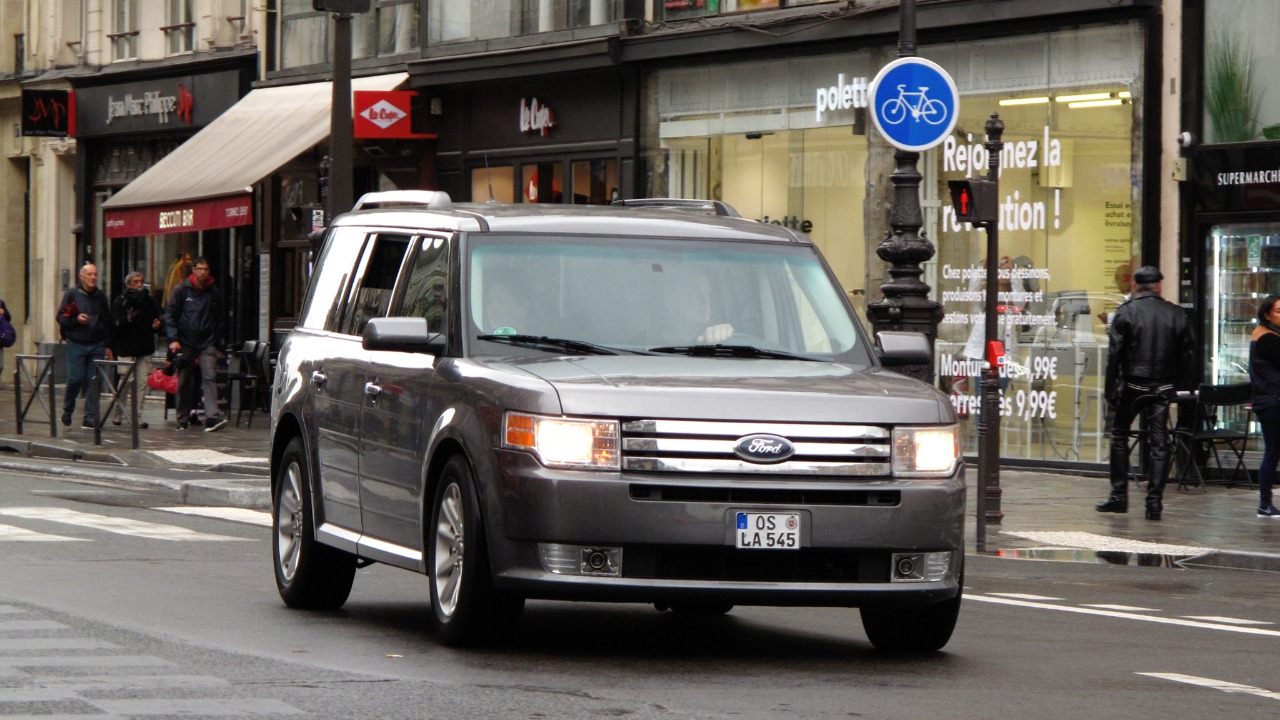

The Ford Flex arrived as a boxy, contrarian family hauler and left as a cult favorite that never quite found a big enough audience. Its cancellation was not a single snap decision but the end point of years of lukewarm sales, shifting corporate priorities, and a brutal market tilt toward more conventional crossovers and trucks. To understand why Ford killed the Flex, I have to trace how a quirky idea collided with hard economics, labor politics, and a changing definition of what an American family vehicle should look like.
The Flex’s oddball promise in a crossover world
From the start, the Ford Flex was designed to stand apart from the sea of rounded crossovers, with a long, low roofline and unapologetically square profile that made it look more like a modern wagon than a typical SUV. That was the point: it tried to blend minivan practicality with a cooler, more architectural shape, betting that families would trade the sliding doors of a people mover for a three-row box that still felt distinctive in the school pickup lane. In an era when most brands chased the same soft-edged silhouette, the Flex was a deliberate outlier.
That contrarian stance earned the car a small but passionate following, yet it also limited its mainstream appeal. The Flex shared underpinnings with other Ford crossovers, but its styling and proportions made it harder to pigeonhole, which is a problem in a market that likes simple labels like “compact SUV” or “full-size SUV.” As rivals leaned into more traditional three-row shapes, the Flex’s wagon-like stance and horizontal lines made it look almost retro, and while some buyers loved that, many more simply walked past it to something that looked more like the SUVs they already knew.
Early warning signs from Canadian labor talks
Long before the final Flex rolled off the line, the model’s fate was already being discussed in union halls. Officials at Unifor, the Canadian auto workers union, signaled in late 2016 that Ford would discontinue the Flex around 2020, tying the model’s future to broader negotiations over product allocation at the Oakville Assembly Plant in Ontario. Those talks were not just about one quirky crossover, they were about securing jobs and investment for Canadian workers as Ford reshaped its North American lineup. When a union publicly acknowledges that a vehicle is on borrowed time, it usually reflects internal planning that has already moved on.
The Canadian context mattered because the Flex was built in Oakville alongside other crossovers, which gave Ford options about what to prioritize on the same lines. As the company weighed which products to back, the Flex’s modest volumes made it vulnerable compared with more conventional models that could be built in the same facility. The fact that the warning came from Canadian labor leaders underscored how decisions in Dearborn ripple through communities far from corporate headquarters, and how a single model’s survival can hinge on whether it fits into a larger industrial strategy that satisfies both management and organized labor.
Ford’s pivot to trucks and mainstream SUVs
By the time Ford formally confirmed the Flex’s demise, the company had already made clear that its future in North America would revolve around trucks and SUVs. Executives framed the decision to end production of the Flex as part of a broader shift in which Ford Motor would lean harder into high-volume pickups, larger utilities, and more profitable crossovers. In that strategy, a niche, polarizing three-row like the Flex was always going to be a tough fit, especially when the same plant capacity could be used for vehicles with broader appeal and stronger margins.
At the same time, Ford was preparing to revive nameplates and expand segments that promised more obvious returns. The company highlighted that The Ford Bronco was expected to be re-released, and that several crossovers or small utility vehicles were in the pipeline, signaling a clear preference for models with strong brand recognition or on-trend positioning. In that context, the Flex’s ambiguous identity and aging design made it a low priority. The company was not just cutting a slow seller, it was clearing space in its portfolio and factories for vehicles that better matched its new, truck-heavy playbook.
Sales reality and a polarizing design
For all its clever packaging, the Flex never translated its distinctiveness into the kind of sales that could protect it when the product planners sharpened their pencils. The model’s boxy shape, ribbed side panels, and contrasting roof options made it instantly recognizable, but they also divided opinion in a way that more conservative crossovers avoided. Even fans acknowledged that the Flex was an acquired taste, and in a showroom full of smoother, more conventional SUVs, that meant many shoppers never got past the first impression.
Commentary from enthusiasts captured this tension vividly, with one widely shared piece describing the Flex as “funky and different” while still conceding that its styling was “Bad Shakespeare” from Ford. That kind of love-it-or-hate-it reaction is great for building a cult following but risky for a mass-market family vehicle that needs broad acceptance to justify its existence. As competitors rolled out more traditional three-row SUVs with bolder grilles and higher ride heights, the Flex’s low, wagon-like stance made it look out of step with what many buyers thought an SUV should be, and the sales charts reflected that disconnect.
Plant economics and the human cost
When Ford finally announced that it would end production of the Flex, the decision was framed in starkly economic terms that also carried a human toll. The company confirmed that it would discontinue the Flex crossover and lay off 450 workers at the Oakville Assembly Plant, tying the job cuts directly to the end of the model’s run. That figure, 450, became a shorthand for the human impact of a corporate strategy that prioritized higher-margin vehicles over a quirky outlier.
The Oakville facility itself remained central to Ford’s crossover plans, building other models such as the Edge and serving as a key node in the company’s North American footprint. Later reporting on quality issues referenced Ford ( Ford Motor Company ) Edge vehicles built at Oakville Assembly Plant from Nov. 13, 2019, to May 26, 2020, underscoring that the plant continued to produce other crossovers even after the Flex was gone. For workers, that meant the end of the Flex did not close the factory, but it did reshape the workforce and shift the mix of vehicles rolling down the line, with some employees paying the price for a model that could not justify its place in the portfolio.
How rivals and Ford’s own lineup boxed the Flex in
Even if the Flex had a loyal fan base, it had to compete in a crowded field of three-row family vehicles that offered more conventional styling and, in some cases, fresher technology. Shoppers comparing the Flex to other large SUVs, including imports like the Volkswagen Atlas, often found that the Ford’s aging interior and polarizing exterior made it a tougher sell, especially when the price gap was not dramatic. Reporting on the end of the model noted that the 2019 Flex ran about the same price as several rival SUVs, including the Volkswagen Atlas, which highlighted how little room there was to compensate for its quirks with a bargain sticker.
The Flex also faced internal competition from Ford’s own lineup, which included more traditional crossovers and SUVs that overlapped its size and price. As the company expanded its range of small utilities and prepared to bring back rugged nameplates, the Flex’s role became harder to define. It was not as off-road oriented as some future models, not as upscale as the brand’s premium offerings, and not as fresh as newer crossovers. In a world where every slot in the showroom has to earn its keep, the Flex ended up squeezed between better-selling siblings and aggressive rivals that offered a clearer story to buyers.
The official end and how Ford framed it
When Ford publicly confirmed that the Flex was finished, the company presented the move as a rational response to consumer demand rather than an emotional farewell to a design experiment. Corporate statements emphasized that the decision to end the Flex was part of a broader effort to align production with what buyers were actually choosing, and that resources would be redirected to vehicles with stronger growth prospects. That framing echoed what Ford had been signaling for years: the company was willing to walk away from sedans and niche crossovers if they did not fit its new, utility-heavy strategy.
Enthusiast coverage and video explainers filled in the emotional side of the story, noting that it was official that the boxy crossover SUV known as the Ford Flex was dead and that Ford officially announced production would end within a defined window. Those reactions captured a sense of loss among drivers who appreciated the Flex’s low-slung stance and spacious cabin, but they also acknowledged that the model had been living on borrowed time. By the time the last units were built, the narrative had shifted from surprise to postmortem, with most observers accepting that a polarizing design and modest sales could not survive in a market that rewards safe bets and clear segment labels.
What the Flex’s demise says about risk and identity
Looking back, the Flex’s cancellation reads less like a failure of engineering and more like a lesson in how far a mainstream brand can push design before the market pushes back. Ford tried to create a family vehicle that rejected the anonymous blob shape of many crossovers, and in doing so it produced something that still turns heads years after production stopped. Yet the same qualities that made the Flex memorable also made it vulnerable when executives and unions sat down to decide which products would carry the company into its truck-centric future.
In that sense, the Flex’s story is a reminder that automotive risk-taking often survives only if it is attached to a nameplate or segment with enough momentum to carry it. Ford was willing to gamble on reviving icons like the Bronco and to double down on pickups, but it was not prepared to keep funding a quirky three-row that never broke out of its niche. The Flex may have been “funky and different,” as one critic put it, yet in a corporate spreadsheet it was simply a low-volume crossover built at a plant that could be used for more profitable models. That is ultimately why Ford killed the Flex: not because it lacked character, but because character alone was not enough to justify its place in a lineup being ruthlessly reshaped around what sells best.
More from MorningOverview