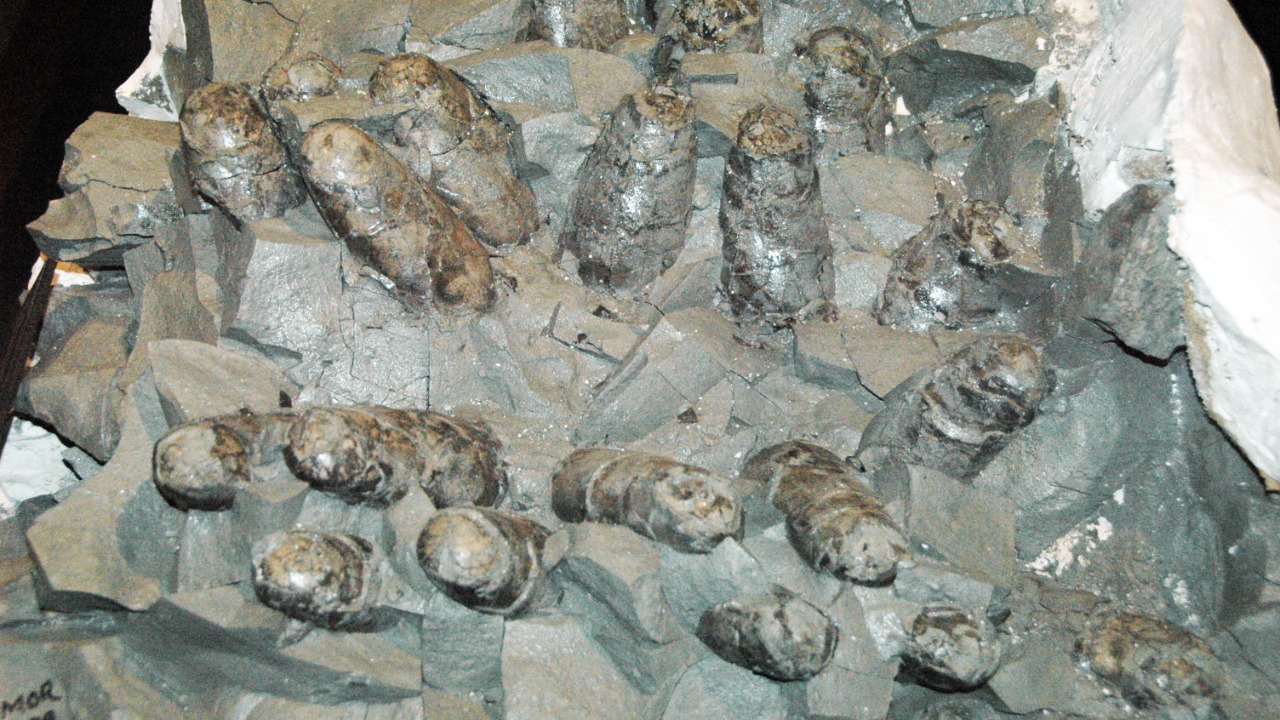

For more than a century, dinosaur eggs have offered haunting snapshots of ancient life, from curled embryos to trampled nests. Now scientists say those fragile shells do something even more surprising: they keep time. Locked inside the calcite are radioactive isotopes that behave like a built‑in clock, letting researchers pinpoint when the eggs were laid, buried and fossilized with a precision that once seemed impossible.
By reading that atomic clock, paleontologists are starting to fix dinosaur events to specific moments in Earth’s history instead of broad, fuzzy intervals. The technique is already rewriting the age of spectacular egg clutches in China and promises to transform how I understand dinosaur evolution, extinction and even climate change during the Cretaceous.
How a dinosaur eggshell becomes a clock
The key to this new timing method lies in the chemistry of eggshell calcite. As a dinosaur mother formed her egg, trace amounts of uranium slipped into the growing shell, while lead was largely excluded. Those uranium atoms then began to decay at a known rate into lead, turning the shell into a natural stopwatch that starts the moment the egg hardens and continues ticking for tens of millions of years. Researchers describe these isotopes as functioning like a natural clock that can reveal when the eggs were buried, solving age problems that used to be insurmountable once the surrounding rock record was disturbed, as outlined in work on how these isotopes function.
Because the decay rate of uranium to lead is fixed, scientists can measure the ratio of parent to daughter isotopes in the eggshell and calculate how long the process has been running. This is the same basic principle behind uranium–lead dating in zircon crystals, but applied to a biological material that forms directly around dinosaur embryos. The result is a timestamp embedded in the shell itself, independent of volcanic ash layers or other geological markers that are often missing from fossil sites.
The cutting-edge tech that made it possible
Turning eggshells into precise timekeepers required more than clever theory, it demanded instrumentation that could tease out tiny amounts of uranium and lead without destroying the fossil. A team of specialists has now adapted high‑resolution laser ablation and mass spectrometry to sample microscopic spots on the shell, then read the isotopic ratios with extraordinary accuracy. With this approach, known as eggshell U–Pb dating, researchers can directly date fossilized dinosaur eggshells and run rigorous tests of cause and effect between dinosaur events and environmental change, as shown in work on new cutting-edge tech.
Because the laser only vaporizes tiny volumes of calcite, the method preserves the overall integrity of rare specimens while still generating enough data points to check for contamination or alteration. That combination of delicacy and precision is what turns the eggshell from a pretty fossil into a robust geochronological tool, capable of anchoring dinosaur life histories to the broader timeline of Earth’s shifting climates and ecosystems.
Researchers finally read the “hidden clock”
Once the tools were ready, the next step was to prove that the eggshell clock actually keeps reliable time. Researchers have now shown that fossilized dinosaur eggshells contain a natural clock that can reveal when dinosaurs lived and when their nests were entombed, not just in theory but in practice. By comparing the isotopic ages from eggshells with independent age constraints from surrounding rocks, they demonstrated that the shell’s internal timing matches the broader geological story, confirming that the researchers were indeed reading a real signal rather than noise.
The same work emphasizes that the radioactive elements inside the shell decay at known rates, effectively acting as a built‑in chronometer that reveals when the eggs were buried. The team tested their approach on multiple eggs from different layers and sites, showing that the ages were consistent within each nest and coherent across the broader stratigraphy. That consistency, backed by support from major funders such as the National Science Foundation, underpins the claim that these radioactive elements decay in a way that can be trusted as a geological clock.
“An atomic clock for fossils” and the first directly dated eggs
The breakthrough moment came when scientists were able, for the first time, to directly date dinosaur eggs that had lain buried in rock for tens of millions of years. Using the eggshell U–Pb method, they pinned down the ages of clutches that previously could only be bracketed loosely by the ages of nearby sediments. One study described this as creating an atomic clock for fossils, because it resolves long‑standing uncertainties about their age and lets paleontologists test evolutionary and ecological hypotheses with far sharper timelines, as detailed in work explaining how for the first time scientists directly dated these eggs.
What makes these early case studies especially compelling is the quality of the fossils themselves. Remarkably, most of the eggs in one key site remain in their original positions and show very little distortion, suggesting they were buried quickly and preserved with minimal disturbance. Scientists believe this exceptional preservation makes the eggs ideal candidates for precise isotopic work and strengthens the argument that eggshell calcite can serve as a reliable atomic clock for fossils, a point underscored in reporting that notes how remarkably, scientists found the eggs largely undisturbed.
The 85-Million-Year and 86 m egg clutches from China
The most headline‑grabbing test of the eggshell clock so far comes from central China, where a clutch of 28 dinosaur eggs sat in the Qinglongshan fossil reserve with only a rough age estimate. Using the atomic clock method, scientists in China determined that these are 85-Million-Year fossils, a level of precision that instantly sharpened debates about how these animals fit into the broader Late Cretaceous story and how they responded to climate shifts, as highlighted in coverage titled Atomic Clock Dating Method Reveals 85-Million-Year Old Dinosaur Eggs and links to Late Cretaceous climate changes.
Further analysis of the same Qinglongshan material showed that the clutch of 28 eggs is about 86 m years old, making them the first fossils to be reliably dated from that reserve, which includes three sites critical for understanding dinosaur diversity in China. By tying the eggs to a specific moment roughly 86 m years ago, researchers can now compare them directly with global records of sea level, temperature and extinction, a leap made possible by the atomic clock method that revealed the eggs to be around 86 m years old.
Another report on the same discovery emphasizes that the clutch of 28 dinosaur eggs from Qinglongshan in China is about 86 million years old according to atomic clock dating, and that the results were published in the journal Frontiers in Earth Science. By locking in that age, the study turns the Qinglongshan fossil reserve into a benchmark site for correlating Asian dinosaur faunas with those from other continents, a role made explicit in coverage noting that a clutch of 28 eggs from Qinglongshan in China is about 86 million years old.
Lasers, “Now” moments, and building egg chronologies
Behind those Chinese age estimates is a technical workflow that sounds more like semiconductor manufacturing than traditional paleontology. Researchers used a new method to date dinosaur eggs by firing lasers at eggshell fragments, vaporizing microscopic spots and feeding the resulting plume into a mass spectrometer that measures uranium and lead isotopes. Now, for the first time in paleontology, this laser‑based approach lets scientists build detailed egg chronologies at sites that lack volcanic ash layers, as described in reporting that explains how now lasers are used to date 85-million-year-old dino eggs and understand Cretaceous climate.
Traditionally, dating dinosaur eggs involved correlating them with nearby rock layers or volcanic deposits, a process that often left large uncertainties and made it hard to compare sites across regions. By contrast, the laser‑driven eggshell method can be applied directly to the fossils themselves, turning each nest into a timestamped data point. That shift opens the door to reconstructing how egg‑laying behavior, nesting sites and species distributions changed through time, rather than treating every Cretaceous egg as part of a single, undifferentiated era.
Eggshell calcite as a versatile timekeeper
One of the most striking aspects of this work is how broadly useful eggshell calcite appears to be. Dr Tucker, a geologist who has helped pioneer the approach, describes eggshell calcite as remarkably versatile because it can be used to date fossil sites that lack the volcanic minerals normally required for high‑precision geochronology. In effect, eggshells become portable clocks that can be read even in sedimentary basins where traditional methods fail, giving researchers a new way to tell time in the fossil record, as emphasized in analysis of how eggshell calcite is remarkably versatile according to Dr Tucker.
Because eggshells are found at many dinosaur sites worldwide, this versatility could rapidly expand the number of localities with precise ages. Instead of relying on a handful of well‑dated quarries, paleontologists could anchor dozens of nesting grounds to specific intervals, then trace how dinosaur communities shifted in lockstep with regional or global environmental changes. That kind of dense temporal framework is essential for testing whether particular climate swings or volcanic pulses actually coincided with evolutionary bursts or declines, rather than simply occurring in the same broad epoch.
Turning Eggshells Into Natural Clocks for climate and extinction
The scientific payoff from this eggshell timing revolution goes far beyond satisfying curiosity about when a particular nest was laid. By turning eggshells into natural clocks, researchers can build high‑resolution timelines that link dinosaur reproductive behavior to climate trends, sea‑level changes and ecosystem disruptions. Dr. Ryan Tucker, a geologist at Stellenbosch University, and an international team have shown that when eggshells preserve their original uranium–lead system, the ages they yield should be trustworthy, giving paleontologists a powerful new way to test hypotheses about extinction and survival, as detailed in work on Turning Eggshells Into Natural Clocks led by Ryan Tucker of Stellenbosch University.
With precise ages in hand, scientists can now ask whether certain dinosaur groups disappeared just before, during or after specific environmental shocks, rather than treating those events as roughly contemporaneous. The 85-Million-Year and 86 m egg clutches from Qinglongshan, for example, can be slotted directly into records of Late Cretaceous climate change, helping to reveal whether local nesting patterns tracked global temperature swings or regional habitat shifts. As more eggshell clocks are read from other continents, I expect the dinosaur timeline to sharpen from a blurred panorama into a frame‑by‑frame record of how these animals lived, adapted and, ultimately, vanished.
More from MorningOverview